These things you keep You’d better throw them away You wanna turn your back On your soulless days Once you were tethered And now you are free Once you were tethered Well now you are free That was the river This is the sea!
–This Is the Sea, The Waterboys, 1985
Don’t have much to say this morning but thought I would share a song that I came across this morning. It’s from the ageless Tom Jones and his version of a song from a Scottish band that I have featured here in the past, The Waterboys. This is a song from what is called their BigMusic period in the early 1980’s, which is when I first began listening to their music. An interesting and influential group though not many folks here are aware of them now.
This song, This Is the Sea, is masterfully performed by Tom Jones here in a performance from 2021 when he was a mere 81 years of age. I am always fascinated by how he maintains that powerful voice, as well as how he manages to say relevant with his choice of material and his always interesting interpretations of these songs. This is different than the the Waterboys’ original but holds true to the integrity of the song while still making it his own.
As an artist who has went from being a younger artist to a now aging one, I find inspiration in his work from recent years even though I work in a much different medium. It reminds me that I always want to be pushing forward, to not be stagnant and relying on and restricted by those things I have done in the past. You got to push past the boundaries you put up for yourself. Set new challenges.
Because as the song says: that was the river, this is the sea.
God is not in the vastness of greatness. He is hid in the vastness of smallness. He is not in the general. He is in the particular. When we understand the particular, then we will know all.
–Pearl S. Buck, God’s Men (1951)
…hid in the vastness of smallness…
Though I do not adhere to any single belief system or single deity, I love the excerpt above from Pearl Buck. We often look to the greatest, the loudest, the brightest– the furthest reach of everything– as proof of the miracle of the world in which we exist. The grandeur of the tallest mountains and the deepest seas.
But so often just the smallest of those things we look past while searching for some reason for our existence hold the very proof we seek. Sometimes small things hold the majesty and power of tall mountains, deep oceans and the sun high in our sky.
If only we pause to look close enough…
Well, that’s my statement for this year’s Little Gemsshow at the West End Gallery which opens tonight. There’s ample proof of the vastness to be found in smallness in this year’s show from so many of the gallery’s artists. I’ve participated in every Little Gems show since 1995– my first public display of my work– and this might well be the best of those 29 shows. It’s a beautiful exhibit of the power to be found in small works.
Hope you can get to see it.
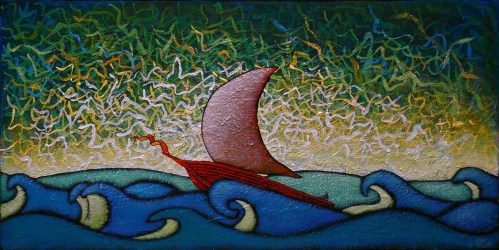
FYI- The group at the top, all included in this show, are true Little Gems, each measuring just under 2″ by 2.”
I thought I would include a word about the death of Burt Bacharach, who passed away at the age of 94. What a career and what a unique talent! I was both stunned and surprised going through the list of songs he wrote. Most were easily recognizable as the hits he had during the 60’s and 70’s but some were news to me. For example, I was surprised he wrote The Man Who Shot Liberty Valance. Or The Story ofMy Life for Marty Robbins, Magic Moments for Perry Como and several others. I’ve sang along to all these songs and more not knowing they were Burt Bacharach songs.
Of course, he is best known for his work with Dionne Warwick. Theirs was one of those rare perfect unions of composer and artist. I played this video here of the two of them back in 2016. It shows Bacharach working with Warwick on a new song before the recording session and displays how beautifully the two worked together. It’s fascinating to see how he communicates his vision for the song to Warwick and how she easily she comprehends and responds to his cues. It goes a long way towards explaining why she was such a perfect vessel for his music. The clip ends with the full recording of the song. The song is Loneliness Remembers What Happiness Forgets.
The knack of our species lies in our capacity to transmit our accumulated knowledge down the generations. The slowest among us can, in a few hours, pick up ideas that it took a few rare geniuses a lifetime to acquire.
Yet what is distinctive is just how selective we are about the topics we deem it possible to educate ourselves in. Our energies are overwhelmingly directed toward material, scientific, and technical subjects and away from psychological and emotional ones. Much anxiety surrounds the question of how good the next generation will be at math; very little around their abilities at marriage or kindness. We devote inordinate hours to learning about tectonic plates and cloud formations, and relatively few fathoming shame and rage.
The assumption is that emotional insight might be either unnecessary or in essence unteachable, lying beyond reason or method, an unreproducible phenomenon best abandoned to individual instinct and intuition. We are left to find our own path around our unfeasibly complicated minds — a move as striking (and as wise) as suggesting that each generation should rediscover the laws of physics by themselves.
~Alain de Botton, The School of Life: An Emotional Education
Alain de Botton is right. We have accumulated the knowledge of the ages and made it virtually accessible to almost anyone anytime anywhere. Yet, though we stand at the current and ever heightening apex of knowledge, our emotional and behavioral development has not accompanied us on the climb.
The world has become increasingly complicated and interconnected and we are left to fend for ourselves with little more than our brains and minds. And while that brain might be suitably equipped for the job, we have no idea how to control it. It’s like we have instant access to a very powerful computer yet barely know how to turn it on or off let alone perform up to its capabilities. There’s no owner’s manual or website for customer service.
Some of us fumble around in the dark trying to find out how to make better use of these brains and minds on our own. Some band together and use theirs sparingly, often following the thoughts and guidance of religious and ideological leaders. Some give up altogether and run on autopilot, simply echoing the words and behavior of the mobs.
We try to use it as best we can– with mixed results, which often leaves disappointed, disenchanted, and disturbed.
This brings me to the character depicted in the current Ring of Fire series that is part of the Little Gems show that opens tomorrow at the West End Gallery. They feel as though they are among those who feel lost in this world, who don’t quite understand how the state of things came to this point and are struggling to make their way through it. Faced with a complicated world with complicated dangers, they can only respond in a primal manner.
Trapped in their own rings of fire…
That’s the last thing I am going to say about this series, at least for some time to come. I am having second thoughts on showing this series at all and have few expectations for it. But despite these misgivings, this work serves a great purpose for me in fumbling my own way through my own ring of fire.
I am playing a song from Johnny Cash today that is notRing of Fire, which you might have anticipated. This is from his later work, near the end of life. This song might also apply to these characters who feel lost and alone, with no other person to turn to. Here’s Nobody.
When I get older losing my hair Many years from now Will you still be sending me a Valentine Birthday greetings bottle of wine
If I’d been out till quarter to three Would you lock the door Will you still need me, will you still feed me When I’m sixty-four
–Paul McCartney, When I’m 64
This is another of the new small pieces included in the Little Gems show, now hanging at the West End Gallery. This little 2″ by 4″ painting is titled Hearts Eternal and is what I call one of my Baucis & Philemon paintings based on the couple from a Greek myth that I have detailed here many times before.
Being that it’s a favorite theme to revisit and that we’re less than a week from Valentine’s Day, this little piece seemed a natural fit for the Gems show. Of course, the dominant feature of this painting is the magenta-red mound from which the intertwined trees arise. I leave it to the viewer to interpret this but for me, it’s as though they are atop a red beating heart.
Along with that magenta-red heartmound, there’s lot that I like in this small piece. It packs a wallop for the little space it occupies. It’s one of those pieces that would make a great large work if I could scale everything up in size without losing any of the effect of the smaller piece.
That’s a lot more difficult than you might imagine. Things that work small don’t always translate well as they grow in size. But sometimes they do, and that potential is one of the added benefits I get from doing this small work. These pieces always spark a lot of the work that comes in the months that follow.
Here’s a song that sort of fits the painting and the fact that Valentine’s Day is nearing. This is When I’m 64 from the Beatles. It was written by Paul McCartney when he was a mere 14 years old, one of the first songs he wrote. As someone who has been married forever and who has lost my fair share of hair, this song has taken on added significance for me as the years stack up.
And Warmth Arrives— At Little Gems, West End Gallery
There is no distress so complete but that even in the most critical moments the inexplicable sunrise of hope is seen in its depths.
–Victor Hugo, The Man Who Laughs, 1869
I’ve been featuring new small paintings that are included in this year’s edition of the Little Gems exhibit that is now hanging at the West EndGallery. The opening is this Friday, February 10 with an opening reception that runs from 5-7:30 PM.
The piece above is 6″ by 6″ on paper and is titled And Warmth Arrives. It’s part of a group of pieces I’ve been working on lately that are done in shades of gray and black with a small amount of color in the tree and sun. This contrast between the grays and the areas of color make the colors seem more intense and adds an animating quality to the piece. It also brings a sense of warmth and other positive things– hope, contentment, joy, etc.– to the more somber tone emanating from the black and grays.
This juxtaposition of dark and light feelings is nothing new in my work. Even my most color drenched paintings feature an underlying darkness that brings a contrasting tone to the optimism that might otherwise be indicated by the bright colors. This adds a realistic edge that keeps the work from seeming too naive or blind to the darker, grittier aspects of the world we inhabit.
Pragmatically hopeful. Maybe that is how this work should be described.
No matter how we describe it, I think we all look for signs of hope, especially in the darkest of instances. And that brings me to a song for today. It’s an older video of Willie Nelson doing his rendition of The World is Waiting For the Sunrise. The song was written at the end of World War I when the world was definitely in need of some pragmatic hope. It became a hit record in the 1920’s and later gained renewed fame as a 1952 hit for Les Paul and Mary Ford. It has been recorded 100’s of times over the past century but I like this swingy version from Willie who plays here with the late Paul Buskirk, who was a Texas music legend who made key contributions to Willie’s success.
Like the sunrise, this song is a good thing to wake up to.
For art to be free and universal you must create like a god, command like a king and work like a slave.
–Constantin Brâncuși
I was looking for something to pair with this little painting and came across the quote above from the great Romanian sculptor Constantin Brâncuși. His words really hit the bell for me, both summing up what I feel about creating art and what I see in this very small painting.
I have long felt that the artist had to create their own inner world and universe. It might be based on the outer world in which they reside but it is a separate world. It has its own atmosphere, its own feel, its own sense of place and time.
This would be the create like a god part of Brâncuși’s words.
In that newly created world, the artist is the law. The artist determines what is right and wrong. If the artist says the trees shall be red, the fields purple or orange, and the sky green, that is how it shall be done. As Pharoah might have said: So it is written, so it shall be done.
This would be the command like a king part.
To make this world, with its own rules and sense of right and wrong, a reality requires hard work. It demands sweat and dedication, not half-hearted efforts, to maintain the vitality and viability of this newly formed world, those things it requires in order for others to accept and embrace this new world. Tens of thousands of hours of dedicated work and sacrifice go into it.
That, of course, is the work like a slave part.
I see all three parts in this new little piece that is part of the Little Gems show, opening Friday at the West End Gallery. It represents the world that has been formed in my work over the past 25+ years, with its own rules of how things are and can be along with its own symbol language. The fields in the foreground, for example, are always a symbol of hard work for me. Or I guess I should say that it’s a symbol for that which is created from hard work.
The slave part with its hard work and sacrifice might sound pretty unappealing and has been a deal breaker for many talented people. But I have found that once you have embraced the roles of God and King/Queen in your work, the Slave role becomes much easier to accept.
I call this little painting Merit Badge. When it was completed, I looked at it and thought that it summed up my world well. I also thought it would make a great merit badge if my work were some odd Scout category. Like, if you saw this patch on their sash you would know that they earned their God/King/Slave badge.
To go along with these words and image, I am including a favorite song of mine that I last played about 5 years back. This version is from a band called The Big Beats with vocalist Arlin Harmon. I don’t have a lot of info on either though from what I can glean Harmon was a highly esteemed singer out in the Northwest. It’s a solid rocking performance with a different flavor.
And in my world where I am God/King/Slave, that’s called good stuff.
Well, my poor man, seems we’ve made some progress in my field. Millennia have passed since you first called me archaeology.
I no longer require your stone gods, your ruins with legible inscriptions.
Show me your whatever and I’ll tell you who you were. Something’s bottom, something’s top. A scrap of engine. A picture tube’s neck. An inch of cable. Fingers turned to dust. Or even less than that, or even less.
Using a method that you couldn’t have known then, I can stir up memory in countless elements. Traces of blood are forever. Lies shine. Secret codes resound. Doubts and intentions come to light.
If I want to (and you can’t be too sure that I will), I’ll peer down the throat of your silence, I’ll read your views from the sockets of your eyes, I’ll remind you in infinite detail of what you expected from life besides death.
Show me your nothing that you’ve left behind and I’ll build from it a forest and a highway, an airport, baseness, tenderness, a missing home.
Show me your little poem and I’ll tell you why it wasn’t written any earlier or later than it was.
Oh no, you’ve got me wrong. Keep your funny piece of paper with its scribbles. All I need for my ends is your layer of dirt and the long gone smell of burning.
—Archaeology, Wisława Szymborska, 1986
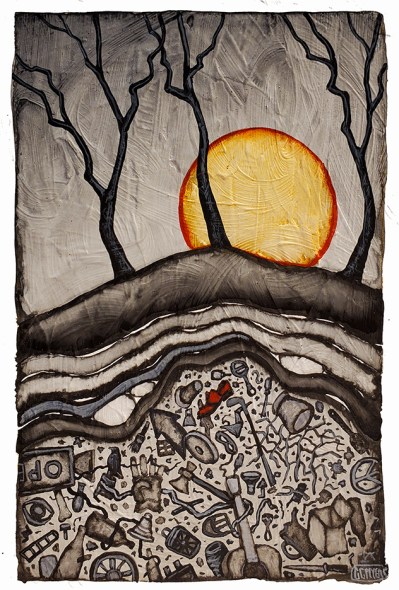
The new painting at the top, Archaeology: The Red Shoe, is included in the Little Gemsshow that opens this coming Friday, February10, at the West End Gallery. The Archaeology series began in 2008 and was a reaction to me feeling blocked in advance of my annual shows. I had three or four solos shows that year. The Red Tree had been my signature element for almost a decade at that point and I had lost a bit of confidence in it, felt that it may have run its course and that I could say little more with it. I was wrong about that, of course, but this concern pushed me to this series with their artifact fields beneath the trees and landscapes above.
It has been one of my more successful series and has had lasting appeal. I still hear from people around the world on this particular series even though I’ve only painted a few, maybe four, of these Archaeology pieces in the past six or seven years or maybe even longer.
I don’t exactly know why I don’t do more of them. Maybe I am fearful they say more about me than I want to share though I doubt that’s the case after 25 years of exposing myself via my work and nearly 15 years of this blog. I imagine that I have given enough data so that anyone who is paying attention — online archaeologists, if you will–would know much about me. Maybe too much.
No, I think it’s because they are draining to paint. They take full concentration as I am constantly weighing and balancing the composition. I like doing them but always feel a bit exhausted after working on them. And I like examining after they are done to see how things come together, to see if they tell a story or if there is any common ground between the objects.
They have a cryptic quality that appeals to that repressed archaeologist part of me, the one who wants to figure out how things might have come to be how and where they ended up.
The part that wonder what we leave behind will say to those in the future.
As the late Polish poet and Nobel Prize winner Wisława Szymborska said in her poem above:
Show me your whatever and I’ll tell you who you were.
I wonder who she would say I was from viewing this painting?
For this Sunday Morning Music, here’s a song that borders just a bit on the idea of archaeology but it makes up for it in the fun factor. The song is The Mesopotamians from They Might Be Giants. No, it’s not about the people of ancient Iraq. It’s about a band called The Mesopotamians who hope that one day, perhaps long after they are gone, their work will be newly discovered by some musical archaeologist from the future.
Come on sorrow Take your own advice This thundering and lightning gets you rain I’m on a top secret mission A Cousteau expedition To find a diamond at the bottom of the drain A diamond at the bottom of the drain A diamond at the bottom of the drain
—Magpie to the Morning, Neko Case
-5° when I went out the door this morning but the wind had stilled so it didn’t feel too bad. I guess you could call it brisk.
Could be better. Could be worse. Nothing to do but keep on keeping on.
I want to get to other things this morning so here’s a lovely song, Magpie to the Morning, from a favorite of mine, Neko Case, to accompany the little 2″ square painting, Sunrise Strum, that is part of the upcoming Little Gemsshow at the West End Gallery.
Stay warm. Or cool. Or dry, safe, loose, or whatever the heck the best condition is for you wherever you might be.
Here, we’re going with Stay Warm. It sounds more civil than the preferred Stay Away.
Now listen to the song then get out of here, okay? I got stuff to do…
From pure sensation to the intuition of beauty, from pleasure and pain to love and the mystical ecstasy and death — all the things that are fundamental, all the things that, to the human spirit, are most profoundly significant, can only be experienced, not expressed. The rest is always and everywhere silence.
After silence that which comes nearest to expressing the inexpressible is music.
–Aldous Huxley, “The Rest Is Silence” –Music at Night and Other Essays, 1931
The excerpt above is the first paragraph from an essay, The Rest Is Silence, from Aldous Huxley that speaks of the significance of silence in music. He says that our greatest emotions, sensations, and feelings are truly inexpressible with words, that silence has a much greater capacity for expression than our feeble verbal abilities and that music is the closest form with the capacity for describing the inexpressible.
Can’t say that I disagree.
Silence has been one of the things I have been looking for in my work since the very beginning back in the early 90’s when I first took up the brush. I had tried writing for years but it always came down to me scribbling about silence and I quickly saw that my words were insufficient to describe or get to that silence. Without reading Huxley, I knew that music would be the best route to finding that silence but never felt that I had the ability, knowledge, or confidence to create the kind of music that encompassed the silence I was seeking.
I knew that visual art was my only way to get to that silence. It had few rules–which was important because I have always been averse to following rules and wanted to set my own rules, if there were to be any at all. Plus, it was in itself a silent medium, one that relied on the eyes rather than the ears required for music.
But it could take its cues from music, employing parts of it like rhythm and melody. I often refer to rhythm when describing my work and I see melody and musical phrasing in the linework of many of my pieces.
And it could make use of silence in much the same way that it is used in music.
Silence is space.
This space contained in silence allows the true emotion that surrounds it to fill the void. Pure and uncontaminated by word or sound.
Trying to reveal and employ that silence is a never-ending task. Just when I think I understand the silence and that its essence can be captured in a visual form, I realize how much more there is to know of silence.
But I keep trying and sometimes it feels near to my efforts.
It may be wordless and soundless and even formless, but it will make its presence known when it arrives.
That’s the hope in this new small piece, Silent Dusk, that is at the West End Gallery for the annual Little Gems show. It opens next Friday, February 10. Jesse and Linda are in the process of hanging the show so if you want a sneak peek, the show will be available for previews before then.
Here’s a favorite piece from composer Philip Glass who celebrated birthday 86 this past week. His work often makes use of space and silence, allowing for expression of those things that seem beyond articulation. This piece, Metamorphosis II, was used in the score for the film The Hours. This performance of the Glass piece is from Dutch harpist Lavinia Meijer. Seeing her hands move over the strings gives this piece a visual aspect where the silences in it can almost be seen.
And this do I call immaculate perception of all things: to want nothing else from them, but to be allowed to lie before them as a mirror with a hundred facets.
–Friedrich Nietzsche, Thus Spake Zarathustra
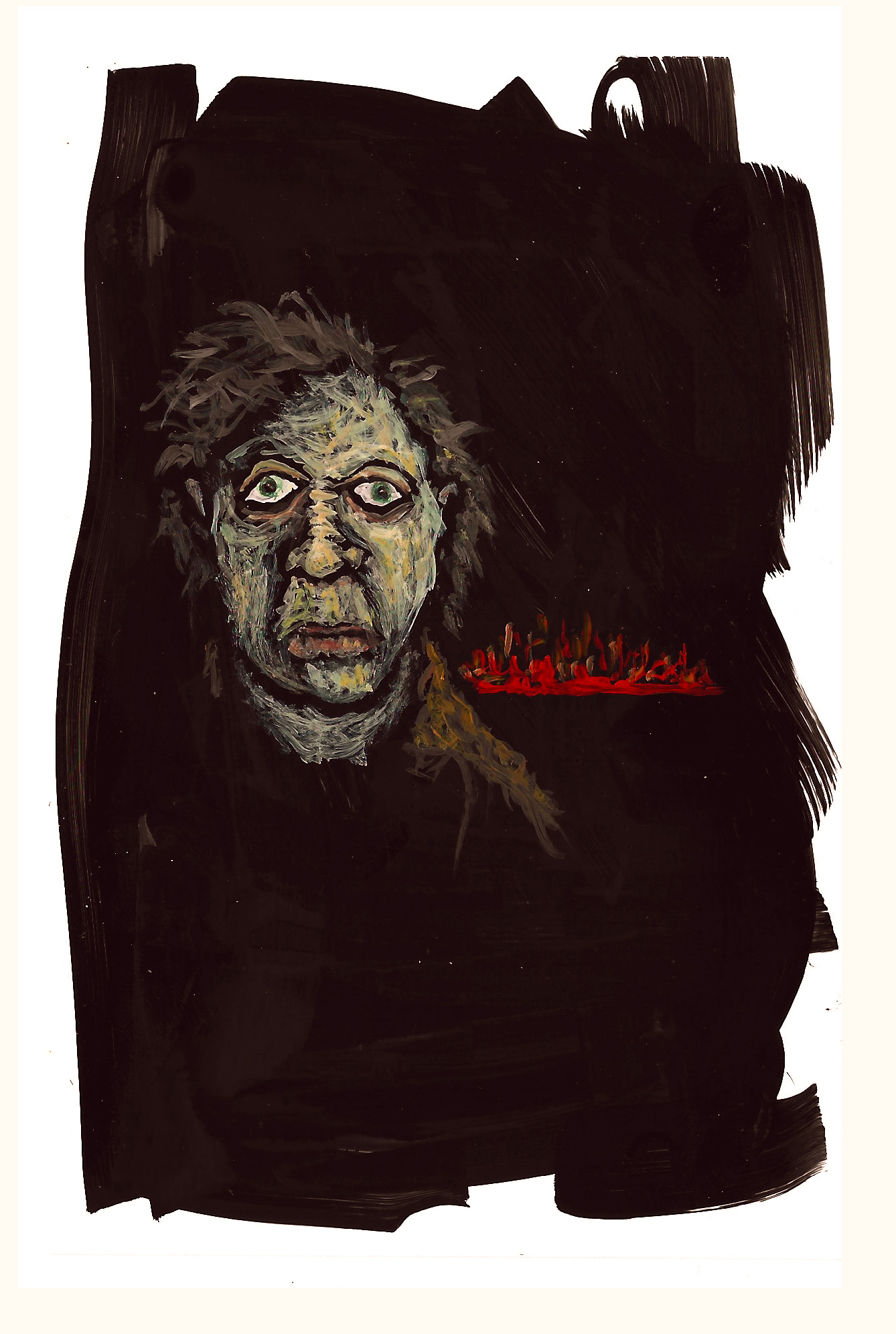
The annual Little Gems show at the West End Gallery opens next Friday, February 10. In my contribution to this year’s show, I have included a group of 6 small face pieces from what I call the Ring of Fire series. I wrote about that series a bit in the past couple of weeks, describing how they came about from an abundance of photo paper I didn’t want to throw away and a desire to shake some things free in my mind.
Ring of Fire 5
They are all painted quickly with little if any forethought. Watercolors are used and the brushes used are very small, nothing larger than a size 0 liner, so that the strokes are little slashes and rubs of color again the blackish background. It is meant to be done with an immediacy that brings whatever life is present to bear as soon as possible. A line of red and yellow fire is in the background of each and the faces have a reaction to being in proximity to that fire. The result are faces in various states of distress, some in anguish or terror.
For me, they represent a release of some sort. They provide a form of release in psychological terms which might be as important for me as anything they provide artistically. They allow me to reveal those parts of my psyche that often left unexpressed or dealt with in other ways.
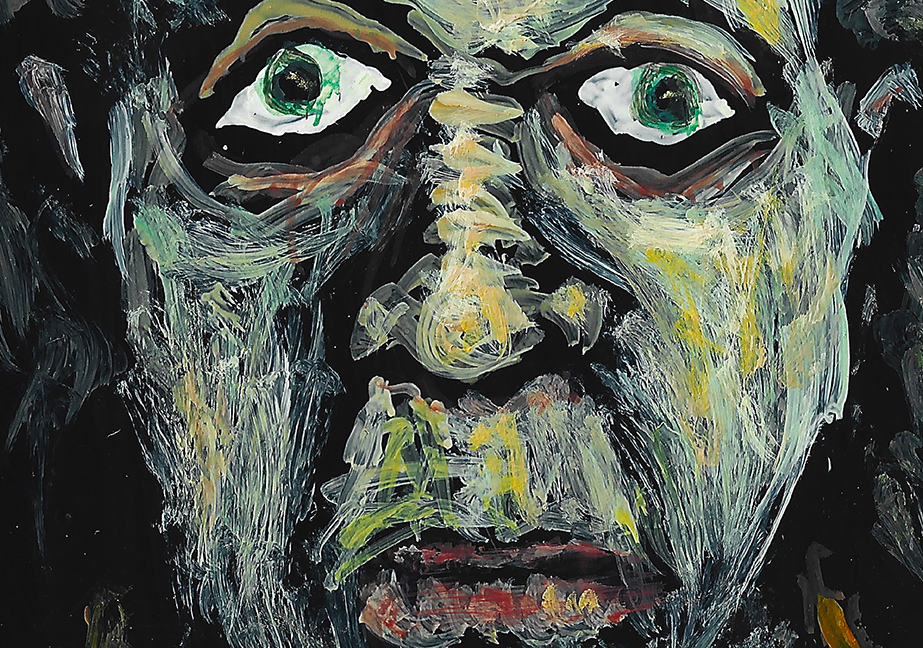
From the perspective of the creative process, the brushwork is rough and barely controlled which is what I react to in each of these pieces. I love seeing the imperfection of the unblended strokes and swipes that build up and animate the faces, as you can better see in the detail shown at the top. This rough rendering might be the main takeaway for me, artistically.
I don’t know how these will be received but I have some idea based on other series that showed other aspects of my work in the past. For example, in 2006 I did a series called Outlaws that were pieces done with dark sepia backgrounds with figures that were often holding handguns. I chose the handgun for that series because there was no gray area in how one perceived a gun in a picture. One has an immediate visceral response.
Some folks loved the work and some didn’t. Actually, some folks hated it.
And I understand that. I had a woman come up to me at the opening for my 2006 solo show that contained the Outlaws series at the Principle Gallery in Alexandria, VA. She was visibly distressed and spoke quickly, almost breathlessly. The work upset her greatly and she begged me to promise that this wasn’t the direction my work was heading in the future, that it wouldn’t replace the Red Tree landscapes she loved.
I assured her that the Red Tree would not go away and explained that, like all humans, I have multiple facets and shades in my personality. A variety of light and dark colors like the spectrum of color that comes from a single prism. I told her that this was merely another facet in the prism of who I was as a human. Perhaps not as visible as the Red Tree but still there.
Still me and part of the whole. Maybe it was the tails side of the coin on which the Red Tree was the heads side. Or maybe it was the yin to the Red Tree’s yang.
She seemed relieved but I understood her concern. We want things that we love to stay the same We don’t want them to not change or to suddenly challenge our perspective on them.
I know that by showing this other part of the prism, the work of the Outlaws and this Ring of Fire series, I am endangering how my other work is perceived. But I also trust that the people who really know and understand my Red Tree and other work have an understanding of the wholeness of each human, of the multiple shades of color n each our prisms.
After all, there is a bit of this work, this darker aspect, in even the brightest and most optimistic of my other work. If anything, this work acts as a complement to the Red Tree.
That’s my take on the Ring of Fire series. You will have your own reaction, good or bad. As it should be, it is yours to have.
Here’s an old video of the Outlaws series. It features a guitar composition, Variation on a Theme (Tales from the Farside), from the great Bill Frisell.




 Redtree Times