Feeds:
Posts
Comments
James McNeill Whistler Nocturne in Grey and Gold

James McNeill Whistler- Nocturne in Grey and Gold: Chelsea Snow, 1876


Why should not I call my works ‘symphonies’, ‘arrangements’, ‘harmonies’, and ‘nocturnes’?… The vast majority of English folk cannot and will not consider a picture as a picture, apart from any story which it may be supposed to tell. My picture of ‘Harmony in Grey and Gold’ is an illustration of my meaning – as snow scene with a single black figure and lighted tavern. I care nothing for the past, present, or future of the black figure, placed there because the black was wanted at that spot. All that I know is that my combination of grey and gold is the basis of the picture. Now this is precisely what my friends cannot grasp.

–James McNeill Whistler, In a letter to ‘The World’, London 22 May, 1878


The painting at the top from James McNeill Whistler (1834-1903) is called Nocturne in Grey and Gold: Chelsea Snow. He originally called it Harmony in Grey and Gold and has also used the titles Nocturne: Grey and Gold Snow and Chelsea Nocturne.

But the fact that the title jumped around a little bit is not the point here. It’s his description of how he viewed his work during the process of creation as compared to how others viewed it after it was complete that interests me.

He often described and titled his work in musical terms such compositions, harmony, nocturne, symphony, and so on. His work was very much more about capturing rhythms, mood, and harmonies than on narrative or subject matter.  He describes just that in the excerpt from his letter to a London newspaper shown above. He doesn’t care that the dark figure in the snow approaching the light of the Chelsea pub creates a narrative.

His interest in that figure is in how it creates a balance and harmony within the composition. The storyline means nothing until the harmony and balance is created.  The narrative is formed afterwards and is as much the creation of the viewer as it is of the artist.

This is a way of working and creating that I can understand. Generally, the driving concern of my painting is to find rhythm, harmony, and balance on the surface. Or mood. Sometimes in doing this, elements are added to the painting that give rise to a storyline. But that doesn’t matter at that point in the process because the primary purpose for that element at that time is as a way of creating balance or harmony in the composition.

Like adding a note or phrase that seems to be missing in a line of music.

I’ve always admired Whistler’s Nocturnes and Harmonies, especially those that had no apparent narrative. They are all harmony and balance, pure mood and feeling. No story needed. It’s good to spend some time looking at these now. They remind me of the aspects of painting that sometimes get less attention than they deserve or need. There’s always something to be taken away from such work.


James McNeill Whistler nocturne-grey-and-silver-1875

James McNeill Whistler- Nocturne in Grey and Silver,1875

James McNeill Whistler Nocturne-in-Black-and-Gold-848x530

James McNeill Whistler- Nocturne in Black and Gold, 1877
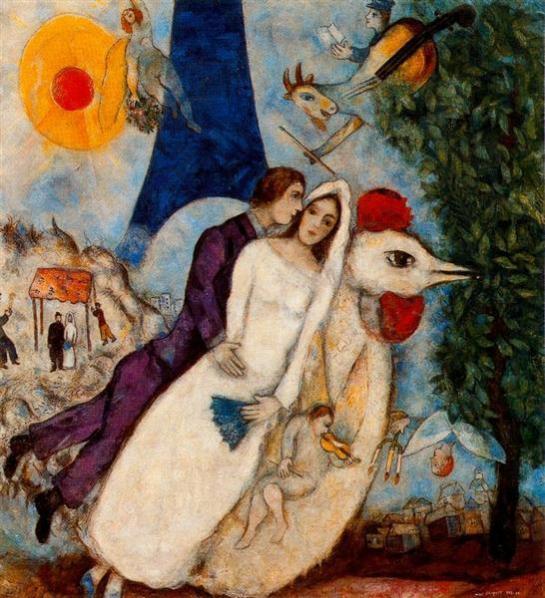
Marc Chagall the-betrothed-and-eiffel-tower-1913.jpg!Large

Marc Chagall– The Betrothed and Eiffel Tower, 1913


If I create from the heart, nearly everything works; if from the head, almost nothing.

–Marc Chagall


Monday. Let’s just look at a couple of Chagall paintings, okay? Can’t go wrong that way.

Plus, his advice above is some that I have found to be true and try to emulate in my own work. I have found that concepts that form intuitively in the moment almost always prove to be more natural and lasting than those that are thought out in the mind. Work formed in and directed by the unconscious part of our brain usually possesses an organic reality that can’t be matched by the workings of our conscious brain.

I have talked about this in past gallery talks. Instinct over intellect– the fact that we our conscious mind can’t match the power of our intuitions and instincts because we are simply not as smart as we believe ourselves to be.

The work of the heart always outshines that of the head.

If you need further proof, just look at these Chagalls.


Marc Chagall Hour Between Wolf and Dog (Between Light and Darkness)Marc Chagall Song of SongsMarc ChagallMarc Chagall The Warmarc_chagall-wedding-imageMarc Chagall_The Fiddler

Friend of the Devil


GC Myers- Seasons of Hell ?

             Seasons of Hell (?)

I ran down to the levee
But the Devil caught me there
He took my twenty dollar bill
And he vanished in the air

Set out runnin’ but I take my time
A friend of the Devil is a friend of mine
If I get home before daylight
I just might get some sleep tonight

Friend of the Devil, Grateful Dead


As I have mentioned earlier, I’ve been cleaning up my studio. Throwing out junk that piled up over the past couple of decades. Some of it is stuff whose format and use is now outdated. Some is just stuff who I thought might someday prove useful. Twenty years has proven that it is has not been useful at all except to clutter up the place.

I ended up with a huge pile of 4″ x 6″ sheets of photo paper. I used to buy packs of HP printer ink that would include these large packs of this photo paper and while I seldom used it, I could never bring myself to just throw it out. But now I was facing a pile of hundreds, if not thousands, of sheets of this paper with no intent of printing photos on them.

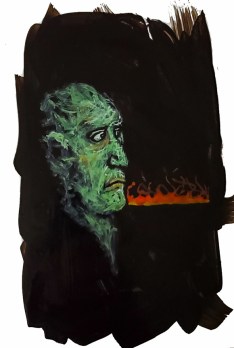
Yet I didn’t want to just throw them out. I began to wonder if I could employ them somehow in my work. Maybe use them to create a series of small pieces like the ones I have periodically done for myself over the years. These are usually done quickly and with short slashy marks, starting with one quick slash then inevitably turning into the same faces that populated my Multitudes series of a few years ago. Faces that have been with me my whole life.

Occasionally, there have been bits of profanity scrawled on these pieces. It’s a kind of release, a scream into the void.

Maybe I could do something similar with these sheets of photo paper, if only for myself?

Season of Hell no. 1 sm

        Seasons of Hell  (?) No.1

I started by putting a quick layer of black watercolor paint down. Then, after they black has dried, a quick mark. It was the beginning of a nose. Slash followed slash and a nose, brow and face began to emerge.

In the moment, I decided that there would be at least the whites of the eyes in these figures. The faces of the Multitudes series had black voids for eyes, which gave them a more masklike appearance. That’s how I have come to see them– as being masks rather than faces. Having the whites of the eyes allows the face to show more thought and emotion.

I wanted these to be done with quickness and not a lot of thought. I wanted them to feel instinctive rather than studied. Coarse, not fine.

To that end, I decided in the moment to have a simple line of fire in the background for this piece and all the ones to follow. Simple yet compelling, an element that the figures could react to. It gave this first piece a sense of doom, like a character trapped in Hell, or at least his own form of Hell.

It worked for me. I immediately attached the title of the Arthur Rimbaud book of poetry, A Season in Hell, to the series. While I like much of it, I am an overly enthusiastic fan of Rimbaud’s work and didn’t see or desire these pieces tied to his work. But that title speaks volumes on its own. Rimbaud, who died in 1891 at the age of 37, wrote this book when he was 19 and never wrote any more literature after the age of 20. A Season in Hell has been very influential with artists and poets over the past century.

I ended up compromising and referring to these pieces as the Seasons of Hell. There are 15 of them right now and I am sure there will be many more before I move past this. I don’t know what will become of them. This post may be the only time I show any of them. They might be just for me or for someone in the future after I am dead and gone. Maybe someone will be cleaning out the detritus of my studio and come across a box with 100’s of these faces staring out at them. Maybe they will mean something to that person or maybe they will just get a glimpse before chucking them into the dumpster.

Who knows?

I like creating them and for now, that is enough. I get the feel I am liberating both them and myself in the process. The benefit is that this sense of liberation transfers to my other work. We’ll see where that goes as well.

For this Sunday Morning Music, here’s the Grateful Dead with their classic Friend of the Devil. The guys in these new pieces are undoubtedly familiar with the song. And the Devil.


This Magic Moment

GC Myers- Absorbed  2022

Absorbed– Now at Principle Gallery


And really the purpose of art – for me, fiction – is to alert, to indicate to stop, to say: Make certain that when you rush through you will not miss the moment which you might have had, or might still have.

–Jerzy Kosiński, Conversations with Jerzy Kosiński, 1993


Awareness of possibility.

Maybe that’s the purpose of art, much as late author Jerzy Kosiński points out above. Sounds right to me. It does seem like the potential for meaningful moments is always in the present– if we are alert to the possibility.

In our day-to-day struggles, our senses often become dulled and our eyes soon pass over the moments without actually seeing what they contain. Beauty. Poetry. Music. Drama. The gamut of emotions.

Art of all sorts is an attempt at giving us back that vison of the possibility. The possibility of meaningful moments. Magic moments.

Okay, this was all a guise to get to play This Magic Moment from the late and great Ben E King from his time with The Drifters. But even so, the sentiment holds real truth. Stay alert– there is magic in every moment.


I Talk to the Trees

blossoms-in-the-night-paul-klee

Paul Klee, Blossoms in the Night


I was asked yesterday if I talked to my paintings.

Interesting question.

I talk to myself. I talk to animals. I talk to the trees and plants in the surrounding forest. I talk to my car. I talk to my studio, which actually has a name. I talk to ghosts, present or not. Whether any of these things or creatures listen is another matter.

But talk to my paintings?

It immediately brought to mind a section of a famous lecture that I had been reading recently and had really resonated with me. It was On Modern Art, delivered in the 1920’s by Swiss artist and a personal favorite of mine Paul Klee:

small-picture-of-fir-trees1922-paul-klee

Paul Klee, Small Picture of Fir Tree, 1922

May I use a simile, the simile of the tree? The artist has studied this world of variety and has, we may suppose, unobtrusively found his way in it. His sense of direction has brought order into the passing stream of image and experience. This sense of direction in nature and life, this branching and spreading array, I shall compare with the root of the tree.

From the root the sap flows to the artist, flows through him, flows to his eye. Thus he stands as the trunk of the tree. Battered and stirred by the strength of the flow, he guides the vision on into his work. As, in full view of the world, the crown of the tree unfolds and spreads in time and space, so with his work.

Nobody would affirm that the tree grows its crown in the image of its root. Between above and below can be no mirrored reflection. It is obvious that different functions expanding in different elements must produce divergences. But it is just the artist who at times is denied those departures from nature which his art demands. He has even been charged with incompetence and deliberate distortion.

And yet, standing at his appointed place, the trunk of the tree, he does nothing other than gather and pass on what comes to him from the depths. He neither serves nor rules–he transmits. His position is humble. And the beauty at the crown is not his own. He is merely a channel.

This very much sums up how I’ve always felt about art, especially my place as an artist– a mere channel or transmitter.  And when I look at my paintings, the crown of my tree, it is not in the form of a conversation so much as listening to what the paintings have to tell me. I paint because I question and, at best, the paintings provide some answers and insight that I might not find or see otherwise.

So, do I talk to my paintings? Not so much. But do they talk to me? Yes. And I do my best to listen…


This post originally ran in 2010 but I like Klee’s thoughts and run it back out every four or five years. I’m adding some music this time around. The song is I Talk to the Trees from the musical Paint Your Wagon. My choices came down to the movie version from Clint Eastwood or an instrumental version from Chet Baker and Bill Evans. Not a hard decision to make. Here’s Chet and Bill.


Beck’s Bolero

GC Myers- Struggle and Will

Struggle and Will– At the West End Gallery


I don’t care about the rules. In fact, if I don’t break the rules at least 10 times in every song then I’m not doing my job properly. Emotion is much more important than making mistakes, so be prepared to look like a chump. If you become too guarded and too processed, the music loses its spontaneity and gut feeling.

–Jeff Beck


Jeff Beck died yesterday at the age of 78 after contracting bacterial meningitis. Been a fan of his music almost all my life. He was always at the leading edge of rock music, creating new fields with his forays into jazz fusion. One comment about his career was that it was self-definable, a unique one that played to its own tune, unconcerned with how other viewed it. I liked that description.

I was equally impressed whenever I read excerpts from interviews with Beck. Said a lot of things that I could relate to as a person and an artist. Like the statement above about having little concern for the rules of his art. Substitute the word painting in for music and it matches the attitude I carried with me from my earliest attempts at painting.

Then there’s:

I cherish my privacy, and woe betide anyone who tries to interfere with that.

Or:

If you were to plot my success or failure, it goes, it very seldom stays on a high plateau.

Or:

I like an element of chaos in music. That feeling is the best thing ever, as long as you don’t have too much of it.

That really hits close to the bone.

The world lost an original.

Here’s one of his better-known compositions, Beck’s Bolero. It’s a take on the famed Ravel piece and really pushed the boundaries of the rock genre when it was recorded in 1966.


Beckmann/ Questing

Max Beckmann Still Life with Three Skulls 1945

Max Beckmann- Still Life with Three Skulls, 1945


All important things in art since Ur of the Chaldea’s, since Tel Halaf and Crete, have always originated from the deepest feeling about the mystery of Being. Self-realization is the urge of all objective spirits. It is this Ego for which I am searching in my life and in my art. Art is creative for the sake of realization, not for amusement, for transfiguration, not for the sake of play. It is the quest of our Ego that drives us along the eternal and never-ending journey we must all make.

–Max Beckmann, On My Painting, 1938


beckmann- beginning

Max Beckmann- Beginning


Everything intellectual and transcendent is joined together in painting by the uninterrupted labour of the eyes. Each shade of a flower, a face, a tree, a fruit, a sea, a mountain, is noted eagerly by the intensity of the senses to which is added, in a way of which we are not conscious, the work of the mind, and in the end the strength or weakness of the soul… It is the strength of soul which forces the mind to constant exercise to widen its conception of space. Something of this is perhaps contained in my pictures.

–Max Beckmann, On My Painting, 1938


Beckmann_Synagogue1

Max Beckmann- Synagogue


Learn by heart the forms to be found in nature, so that you can use them like the notes in a musical composition. That is what these forms are for. Nature is a marvelous chaos, and it is our job and our duty to bring order into that chaos and – to perfect it.

–Max Beckmann, Three Letters to a Woman-Painter, 1948


Beckmann Departure 1935

Max Beckmann- Departure, 1935


A human face, a hand, a woman’s breast or a manly body, an expression of conflicting joy and pain, the infinite ocean, savage crags, the melancholy speech of black trees against the snow, the fierce power of spring blossoms and the heavy lethargy of a hot summer noon when our old friend Pan is asleep and the ghost of noon are murmuring – all this is enough to make us forget the sorrows of the world, or to give them form. In any case the determination to give form to things brings with it part of the solution for which you are seeking. The path is hard and the goal can never be reached – but it is a path.

–Max Beckmann, Three Letters to a Woman-Painter, 1948


Beckmann Blnd Mans Bluff

Max Beckmann- Blind Man’s Bluff, 1945


What I want to show in my work is the idea which hides itself behind so-called reality. I am seeking for the bridge which leans from the visible to the invisible through reality. It may sound paradoxical, but it is in fact reality which forms the mystery of our existence.

–Max Beckmann, The Actors, 1942


Max Beckmann, The Actors, 1941-42. Oil on canvas

Max Beckmann, The Actors, 1942


Wasn’t going to write anything, just let Beckmann’s words and images stand by themselves. But I came across a video with the proper Germanic feel for Beckmann’s images and thought it was worth inclusion. It’s a version of Mack the Knife (Mackie Messer) from Swedish jazz musician/multi-instrumentalist/dancer Gunhild Carling. Exuberant.


Doubling Back

GC Myers- The Sky Is Always the Sky 1995 sm

The Sky Is Always the Sky, 1995


Growth is a spiral process, doubling back on itself, reassessing and regrouping.

–Julia Margaret Cameron (1815-1879)


I have been working in the studio the past week or so, trying to reorganize and clean my workspace. I have a relatively large space here but somehow it has filled and become craped over the 15 years I have been in here. A lot of stuff that I thought might be usable has found its way to the trash and a few things that have been either forgotten or thought lost have emerged from the piles.

It feels good to get things back in order and to rid myself of things that cluttered my life without much purpose.

While reorganizing things, I inevitably end up going through old work here in the studio. I do this most years around this time. I feel like it’s a valuable part of my process, this doubling back. It helps me measure what I perceive is growth in my work. Well, at least what I hope is growth in my work.

The work has changed in many ways and stayed the same in others. The years have changed me as a person in many ways and that is reflected in the newer work. Parts of my skillset– and personality– have grown, some have declined, some have been lost altogether.

Looking back at the earlier work allows me to see where these gains and losses have taken place. In some cases, there are things I want to recapture. I should say try to recapture. Some things are, as I said, lost forever. Technique and materials evolve. The way I perceive things has changed. Eyesight fades a bit, my hand is a bit less steady, and some things are born of emotional moments that can’t be recreated organically.

Things change and there is work that I can’t fully recreate. That makes me a bit sorrowful. It’s like looking at a photo of yourself when you were younger, with more and darker hair and skin that didn’t have quite so many wrinkles or sags. You see yourself as the same but know that that time is past. You can try to go back but the miles are on the odometer and the engine. It will never be quite the same.

I use the word sorrowful, but I am not truly saddened by it. I am actually glad in seeing these pieces from that time, remembering the spirit in which they were created. That spirit is the thing that can be revisited, rediscovered.

It is energy-giving. And that’s a big deal this stage of the game.

Take the piece at the top. It’s called The Sky Is Always the Sky from the middle of 1995. I stumbled across it the other day and it thrilled me, much as it did when I first painted almost 28 years ago. I see things in it that I would struggle in recreating. The colors, the sedimentation of the pigments, and even the organic feel of the linework would be much different.

For some reason, I don’t think this piece ever showed in a gallery. Maybe I knew that its purpose would be in reminding me of that time and emotional feeling some years later. If so, its purpose has been fulfilled.

All I could ask of it.

FYI: The quote at the top, which rings especially true for me, is from Julia Cameron, the great 19th century British photographer. I wrote about some of her photos several times here years ago. Her photos have a freshness and composition that seem distinct and apart from the wok of her contemporaries. They sometimes seem out of their time for me.

Here’s a song about looking back. It’s Reflections on My Life from The Marmalade.


Vita et Lux

GC Myers- Vita et Lux sm

Vita et Lux– At Principle Gallery

As far as we can discern, the sole purpose of human existence is to kindle a light of meaning in the darkness of mere being.

–Carl Jung, Memories, Dreams, Reflections (1963)


Could it be that mere being, with all the darkness it entails, is the meaning and purpose of life? Maybe we have no purpose other than to experience being alive, to be little sparks of light that creates an arc that runs from our birth to our death, cutting through the darkness.

Maybe that arc itself is the light of meaning?

I don’t know if that is the case or if I can believe that. It’s a little too hedonistic to my way of thinking, too limited to self-indulgence and lacking concern for the welfare of others.

But it’s only 6 AM on a Monday morning. Maybe in the light of day I will see things differently.

Or maybe not. Who knows?

Since light seems to be the subject of the day, here’s a song dealing with that subject. Kind of. This is Springsteen and his Blinded By the Light performed in the mid-2000’s with the band from his Seeger Sessions album. That album performed many Pete Seeger folk songs with a hybrid folk-Big Band sound. I wasn’t particularly fond of that album at the time but over the years it has grown on me and I think this folk-Big Band sound works really well with this tune. You be the judge.


George Gray/ Longing

GC Myers- Riding Rhythm sm

Riding Rhythm– At the West End Gallery


I have studied many times
The marble which was chiseled for me–
A boat with a furled sail at rest in a harbor.
In truth it pictures not my destination
But my life.
For love was offered me and I shrank from its disillusionment;
Sorrow knocked at my door, but I was afraid;
Ambition called to me, but I dreaded the chances.
Yet all the while I hungered for meaning in my life.
And now I know that we must lift the sail
And catch the winds of destiny
Wherever they drive the boat.
To put meaning in one’s life may end in madness,
But life without meaning is the torture
Of restlessness and vague desire–
It is a boat longing for the sea and yet afraid.

–Edgar Lee Masters, George Gray, Spoon River Anthology, 1915


Ah, those last four lines…

I’m not going to say any more this morning. It’s Sunday and we all deserve a break. If there is a common thread here, it’s for you to find if you so choose.

For this Sunday’s song, here’s a longtime favorite from the late Leonard Cohen, Night Comes On.