Feeds:
Posts
Comments

Time Is…

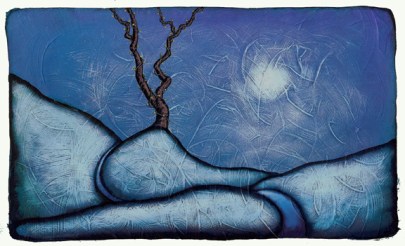
GC Myers- Tempus Pacis

Tempus Pacis– Currently at the Principle Gallery 


IN HER GARDEN OF YADDO
          Hours fly,
          Flowers die
          New days,
          New ways,
          Pass by.
          Love stays.
______________
    Time is
Too Slow for those who Wait,
Too Swift for those who Fear,
Too Long for those who Grieve,
Too Short for those who Rejoice;
    But for those who Love,
          Time is not.

Henry Van Dyke, For Katrina’s Sundial


You don’t hear much about Henry van Dyke (1852-1933) these days though he lived a life filled with achievement. He was a Princeton English professor, an influential Presbyterian clergyman, US Ambassador to Luxembourg and the Netherlands during WW I, and a widely read bestselling author and poet. Not to mention that he was good friend to many of the luminaries of that era including Helen Keller and Mark Twain, whose funeral he officiated in 1910. A big life.

Much of his literary output has not fared well in modern times. It’s considered a little old fashioned and sometimes a bit too religious– he was a clergyman so this is to be expected– for modern readers. I’ve got a few of his old books and they’re okay. Perhaps a bit dated and overtly sentimental, sometimes maudlin. There’s not a lot that fills the modern reader with excited inspiration and self-revelation, like the evergreen verses of Walt Whitman. But it’s well-composed and well-thought and there are gems among them.

For instance, the verse at the top was composed to be used an inscription on a sundial on the estate of a wealthy friend, thus the title For Katrina’s Sundial. The second verse part of it has become well known on its own as a poem called Time Is. It has been read at the funeral of Princess Diana and used on a London memorial to British victims of the 9/11 attacks, as well as inspiring a 1969 song from the rock group It’s a Beautiful Day.

Van Dyke also wrote the lyrics that were set to Beethoven’s Ode to Joy which became the hymn, Joyful Joyful We Adore You.

Now you know a little more about Henry van Dyke. Here’s the song using his poem from It’s a Beautiful Day, the San Francisco based band best known for the song White Bird which I have shared here in the past. This is a good old hippie era jam with passages that slightly recall Time Has Come Today from the Chambers Brothers.

Whatever time is, it’s time for me to go…


Still Waiting

GC Myers- Imitatio

Imitatio– At the West End Gallery


We never live; we are always in the expectation of living.

― Voltaire


After you find out all the things that can go wrong, your life becomes less about living and more about waiting.

― Chuck Palahniuk, Choke


I am using two quotes to kick off today’s post. They are from two very different sources, one the intellectual leading light of the Enlightenment of the 17th century and the other the hard-edged contemporary author of Fight Club.

But both say pretty much the same thing, albeit in different terms: Life is often mainly a matter of waiting.

Waiting for things to begin. Or end.

Waiting for signs or a proper time. Or conditions to change.

Waiting for the Muse to visit.

Waiting for the sun to shine or the dark clouds to recede.

Waiting for justice.

Or the next shoe to drop.

Waiting for things to get better. Or worse.

Waiting for hopes or horrors.

That’s certainly how the last couple of years have felt, like I have been treading water in a deep pool. Not going forward in any way but paddling like hell to just stay afloat, waiting for something to which I can’t even name.

Not even sure I will recognize whatever it is if when and if it appears.

The scary thing about this time is that feels like the normal state of being now even though deep down, something tells me this should not be so.

So, I wait in my corner trying to appear as patient as possible to see if this will soon change. All the while, my brain is furiously treading water, nervous and impatient.

To accompany this little foray, I am going way back with the Rolling Stones. Here’s one of my favorite Stones songs, I Am Waiting, from 1966.

Now, time for me to get back to my chair in the corner. Gonna get some good waitin’ in today. Close the door on your way out, okay?


This post ran about a year ago at this same time of the year. I feel this same sense of waiting every year around now, like I am waiting to get past the requirements and anxieties of the holidays, get past the marker in time that is the new year, get past the creative blocks that seems to build around this time every year. Waiting for the Muse to either inspire or belittle my efforts. Who knows when she will show up? I sometimes feel like the refugees described by the narrator at the beginning of Casablanca:

Here, the fortunate ones through money, or influence, or luck, might obtain exit visas and scurry to Lisbon; and from Lisbon, to the New World. But the others wait in Casablanca… and wait… and wait… and wait.

So, I wait. And wait. And…


Where Is My Mind?

GC Myers- Pursuing the Light

Pursuing the Light– Now at the West End Gallery


I only believe in temporary denial. You know, the kind that gets you home to get your act together and try again. That’s a good denial. The kind that helps you finish the audition or the dinner or the job interview or the credit application–the whole time keeping it together, cool and confidant–then you go home and rewrite your whole autobiography and game plan and prepare to take over the world. That’s good denial. But I don’t believe in denial beyond the period you need to cool down and pep up: I believe in revision. Garson [Kanin] and I both refused to face the facts. People didn’t like a writer or a film, and we both realized they were wrong. We were right, and we trusted that in time other people would join us. And they did! Trust your instincts and trust your taste. It will work out. It has to, if you have talent, and you can’t be in denial about that, and you can only revise your talent so much. Listen and see if people believe in you and want you to succeed. Then go out and earn the faith they had in you. Deny and revise. It’s a good motto.

–Ruth Gordon/Interview with James Grissom/1984


It’s that time of the year as we approach the final squares on the calendar page. It’s a period of time to sum up, to reflect on our triumphs and defeats, both big and small. For me, it’s a time of reflection, one that focuses on the work I have done over the past year, one that normally entails facing the doubts that seem always around me. I’ve written about this subject of self-doubt ad nauseum in the past so I am not going to go too long about it today.

One of the hardest parts of this job is when the work that feel you most passionate about, the work that you feel represents a step forward in your creative progression, doesn’t garner the response you feel it deserves.

Intellectually, it is easy to rationalize this since one realizes that art is subject to personal tastes and desires, that it cannot reach every person in the same way.

But emotionally, it feeds directly into a vein of uncertainty and self-doubt about your own tastes and talents. Mainlining, immediately in the bloodstream and throughout every system. The intellectualized rationalizations don’t stand a chance. It’s like trying to wish away a virus.

I have said in the past that getting past this becomes easier when you can fall back on the experience of having endured prior episodes of this self-doubt. And I believe that is mainly true. However, there is something to be said for the naive confidence of the less experienced, those who have not yet become gun-shy from the inevitable failures and disappointments to come. That innocent naivete carries with it a certain fearlessness and bravado that is important in the creation of art. It is exuberant, hiding nothing and naked to the world for all to see.

Nothing to lose.

That feeling is hard to find again as you progress in your career. You begin to shade things, to be less transparent in an attempt to protect and maintain what your earlier exuberance produced.

This creeping self-doubt is a quandary, a puzzle to be solved. If it, indeed, can be solved. Maybe it requires getting to a point where you feel you have nothing less to lose once more. A point where all is transparent again.

This probably doesn’t make a lot of sense to most folks. I understand that since this is more like a diary entry than a blog post. Just thinking out loud this morning. I came across the excerpt from a Ruth Gordon interview above and it really hit a nerve for me since I am currently in that No-Man’s-Land where self-doubt resides. It reminded me that sometimes it is simply patience that gets you past the self-doubt that has you denying your own abilities and value. If you have enough belief in your abilities and tastes to honestly produce and show work that is a true expression of yourself, that talent and work will someday be vindicated.

Changing yourself or your work for anyone is never a lasting answer.

Okay, I lied. I went on way too long for what I thought I wanted to say. Not even sure I said whatever that was.

Here’s a song to put a bow on this odd little package. It’s a song from the Pixies called Where Is My Mind? performed in an altered manner by the Postmodern  Jukebox featuring vocals from Allison Young.

For some reason, it makes sense here this morning.


Merry Christmas…

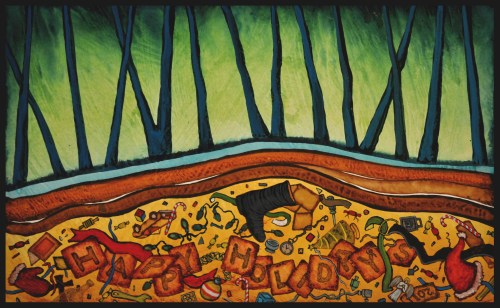
gc-myers-christmas-2007-small

2007


There is nothing sadder in this world than to awake Christmas morning and not be a child…. Time, self-pity, apathy, bitterness, and exhaustion can take the Christmas out of the child, but you cannot take the child out of Christmas.

–Erma Bombeck, I Lost Everything in the Post-Natal Depression


Merry Christmas…


2011 Christmas Card Framed

2011


Everything perishes except the world itself and its keepers…But while life lasts everything on earth has its use. The wise seek ways to be helpful to the world, for the helpful ones are sure to live again.

― L. Frank Baum, The Life and Adventures of Santa Claus


I was going to start today’s blog with an old Phyllis Diller joke– betcha didn’t see that one coming!— about her husband, Fang:

Fang is the cheapest man alive. On Christmas Eve, he puts the kids to bed, fires one shot, and tells them Santa has committed suicide.

I decided against using it as the opening because I didn’t think it would be appropriate. As you can see, that didn’t stop me from still using it. It made me laugh and made me a little nostalgic for all those variety show Christmas specials that were ubiquitous on TV in the 1960’s.

Of course, we all know Santa would never do such a thing. He’s a man on a mission, a man with a purpose, which is, as good ol’ L. Frank Baum further points out in his chronicle of Santa Claus:

Every man has his mission, which is to leave the world better, in some way, than he found it.

And for Santa, his way of making the world a better place is to try to protect the innocence of children before the world overtakes them. As Baum once again states:

Childhood is the time of man’s greatest content. ‘Tis during these years of innocent pleasure that the little ones are most free from care. […] Their joy is in being alive, and they do not stop to think. In after-years the doom of mankind overtakes them, and they find they must struggle and worry, work and fret, to gain the wealth that is so dear to the hearts of men.

But this year is going to be a tough slog for Santa tonight. It’s early Christmas Eve morning and it’s a windy 0° outside. Mind numbingly cold. It’s part of the job, I suppose. And most likely the reason he earned that Saint title. Because, again, as Baum added:

It is possible for any man, by good deeds, to enshrine himself as a Saint in the hearts of the people.

Let’s try to keep that Santa spirit alive and burning through the coldness that exists both in the weather outside and in the hearts of those who have lost the innocence of childhood. Have a good Christmas Eve.

To warm you up a bit, here’s a good early performance of Bruce’s version of Santa Claus Is Coming to Town, from Houston in 1978.


2008 Christmas Card Image

2008


There’s a room out there somewhere with a woman in a chair
With memories of childhood still lingering there
How pretty the paper, the lights and the snow
How precious those memories of long long ago

We held hands and stared at the lights on the tree
As if Christmas was invented for you and for me
When the angel on the treetop requested a song
We sang, “Silent night all day long”

–John Prine, Silent Night All Day Long


Santa Claus 1994

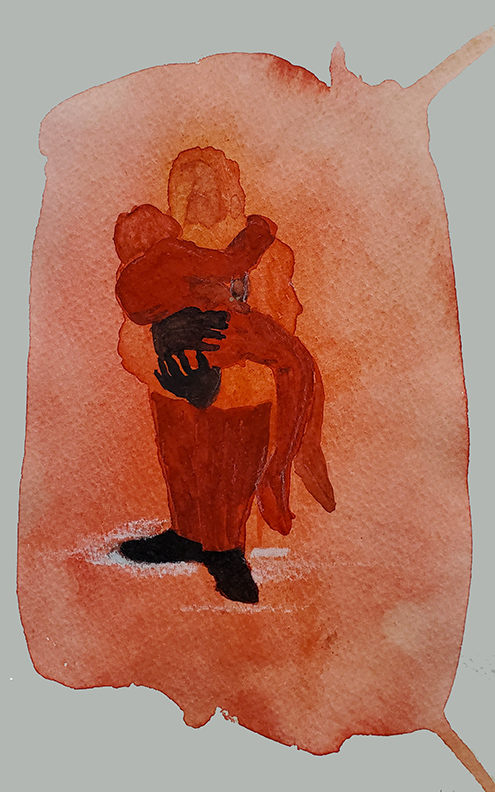
Santa, Early Work July 1994

And, afterward, when a child was naughty or disobedient, its mother would say:
“You must pray to the good Santa Claus for forgiveness. He does not like naughty children, and, unless you repent, he will bring you no more pretty toys.”
But Santa Claus himself would not have approved this speech. He brought toys to the children because they were little and helpless, and because he loved them. He knew that the best of children were sometimes naughty, and that the naughty ones were often good. It is the way with children, the world over, and he would not have changed their natures had he possessed the power to do so.

L. Frank Baum, The Life and Adventures of Santa Claus (1902)


Came across this old piece from the time when I was just starting to paint in earnest. I hadn’t yet found the technique and style that typified my later work but I was starting to zero on it at this point in 1994.

I don’t know how this piece came about. It certainly didn’t start out with Santa as its subject, especially in July when it was done. It most likely began as a pool of paint from which I began moving the pigment around until something caught my eye, until some form or pattern emerged. Kind of like reading tea leaves.

It’s not a great piece by any stretch of the imagination. But it always makes me smile probably because I have always imagined Santa huffing along as he toted this chubby kid in his arms while whispering to him to cut out the sweets because Santa was getting too old to for this crap.

Of course, we all know that Santa would never say such a thing. He remains for many much like L. Frank Baum portrayed him in his book on Santa cited above, as a tolerant and benevolent caretaker of children the world over.

If only…

Anyway, that leads me to a song from Mabel Scott. I play her rocking version of Baseball Boogie here quite often at the beginning of the season and it never gets old. This tune has all that same boogie woogie energy which Santa needs– the dude’s got a lot of work ahead of him. From 1948, this is Boogie Woogie Santa Claus.


Beginnings & Endings

GC Myers- Terminus sm

Terminus— Now at the West End Gallery


There is surely no greater wisdom than well to time the beginnings and endings of things.

–Francis Bacon, Of Delays, 1625


I tromped up through the woods yesterday. The snow wasn’t deep and it was cold enough to freeze up some of the boggier parts of the hillside so that I could wander through. It was something I hadn’t done for some time. Too long. Even though it’s only less than a quarter mile up in the woods, it seems like a world removed from the home and studio down below, which themselves often feel far removed from the world at the end of our long driveway.

It’s quieter than down below, the trees and the terrain muffling sound. The crunch of the snow underfoot is clean and clear. It’s a good sound.

With the snow on the ground and the leaves now gone, I could see deeper into the woods. I was able to better see the individual trunks and crowns of the trees. Some were like anonymous people in a crowd scene in a film, not really standing. While I could still appreciate their individual beauty, they didn’t stop my eye.

It was the bigger trees that jumped out at me, the beech and maples and the now dying ash trees that have been ravaged by the borer beetles. It made me think how loggers must look through the woods, their eyes measuring and taking in the shape of each tree until one large tree sets off their inner alarms. It made me wonder how my great-grandfather, who first set out into the Adirondack forests in 1872 with his own crew of loggers at the age of 17, would look through these woods. Would he simply see the trees as a form of income or would he look upon them as companions? After all, this was man who spent much of about 60 or so years in the deep woods in all sorts of weather conditions before the use of machinery.

It’s one of those times when you wish you had a way to spend a few minutes speaking with an ancestor.

As is always the case in nature, the forest reminds you of the beginnings and endings. The floor of the forest is littered with dead trees that have tumbled over in wetter and windier times or, in the case of the mighty ashes that have died from the damage of the beetles, rot then fall in large chunks until all that is left is the lower trunk of the tree. The remnant ash trunks are sometime twenty plus feet tall.

I am always a bit sad when seeing these dead trees who by virtue of location and environment didn’t last as long as they might have in other places. But even so, among their bony remains on the forest floor new saplings and young trees abound, all straining upward trying to lush their faces to the light.

It’s a reminder of the inborn desire to struggle and survive that is present in all species. We all desire to exist, to feel our faces in the sunlight of this world. But, as the forest points out, we all have beginnings and endings.

And that’s as it should be. How would we be able to appreciate this world, to see it as the gift it is, if we knew our time here was without end?

I don’t know the purpose of this essay. I simply started and this is what it ended up as. A beginning and an ending…

Here’s a song that is about beginnings. Not a holiday song. You most likely will get your fill of those everywhere else. Not to say I won’t play one or two in coming days but today let’s go with From the Beginning from Emerson, Lake & Palmer.


River/ Cool Rising

GC Myers- Cool Rising sm

Cool Rising- At West End Gallery, Corning


A moral character is attached to autumnal scenes; the leaves falling like our years, the flowers fading like our hours, the clouds fleeting like our illusions, the light diminishing like our intelligence, the sun growing colder like our affections, the rivers becoming frozen like our lives—all bear secret relations to our destinies.

–François-René de Chateaubriand, Memoirs of Chateaubriand, 1848


Just wanted to hear River from Joni Mitchell this morning. It’s a song that just gnaws to be heard sometimes. It’s not really a holiday song though its first verse begins in this season:

It’s coming on Christmas
They’re cutting down trees
They’re putting up reindeer
And singing songs of joy and peace
Oh, I wish I had a river
I could skate away on

The video below is a Joni Mitichell endorsed animation of the song, which I wasn’t aware of it when it came out late last year. It certainy captures the mood and tone of the song. Lovely.


First Light

GC Myers- First Light sm

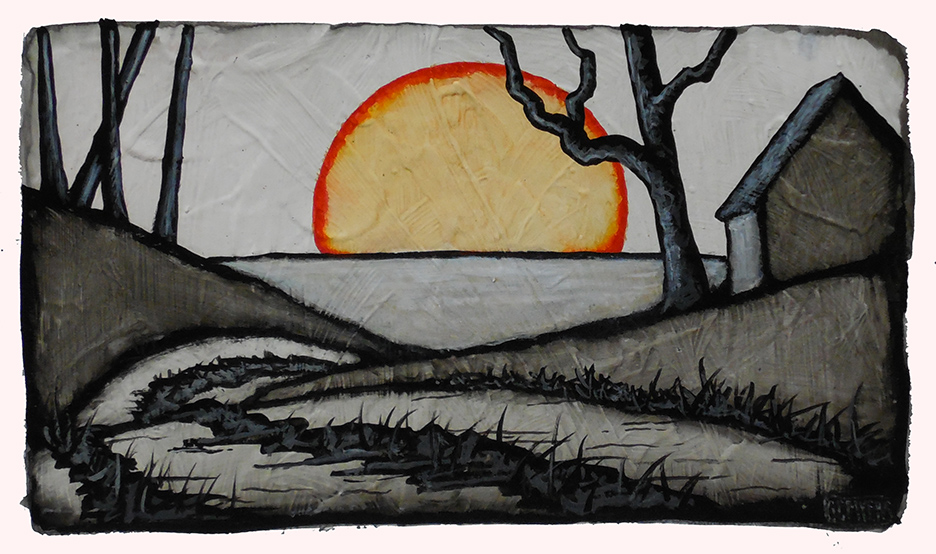
First Light— Now at the Principle Gallery, Alexandria, VA


Some day I shall sing to thee in the sunrise of some other world, “I have seen thee before in the light of the earth, in the love of man.”

-Rabindranath Tagore, Stray Birds,  291


Trying to stay quiet this morning so I don’t have a lot a lot to say here at the moment. Just wanted to share another new small painting, First Light, that is at the Principle Gallery for their Small Works show. Working in tones of gray is something I often turn to in order to cleanse the palate, though I guess I could use the word palette since we’re talking about removing color. I always enjoy doing this work as it makes me focus more on tone than color. This often helps me in the aftermath.

These recent small graytones– sounds like an old a cappella group–include small burst of color, mainly red-tinged suns that really stand out from the grays and blacks. That contrast makes these pieces pop for me. I sometimes think that my attraction to this use of grays and color goes back to the scene in The Wizard of Oz when Dorothy opens the door after the tornado had passed and there is that first burst of color and light of Munchkinland contrasted against the sepia toned Kansas life in which she existed. That scene still thrills me.

The lines at the top were from a short book published n 1913 from the great Nobel Prize winning poet Rabindranath Tagore called Stray Birds. It is comprised of 326 short one- or two-line poems. Really more like aphorisms and random observations than poems, though they are expressed with poetry and grace. Very engaging and thought provoking.

Here’s a song about the first light of sunrise. It’s a version of the Beatles’ Here Comes the Sun performed by the late Richie Havens. Havens gave a well-known performance of the song at Woodstock that you most likely know. This is a later version that takes the song even further from the original while still maintaining the beauty and meaning of its form. Good stuff.