Feeds:
Posts
Comments

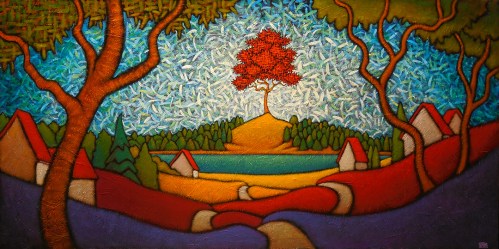
The Noble Spirit

GC Myers- The Noble Spirit sm

The Noble Spirit— Coming to Kada Gallery, November 4


In our daily intercourse with men, our nobler faculties are dormant and suffered to rust. None will pay us the compliment to expect nobleness from us. Though we have gold to give, they demand only copper.

–Henry David Thoreau, A Week on the Concord and Merrimack Rivers


While looking for a few words concerning the noble spirit to kick off this post about the painting at the top, I came across the excerpt above from Thoreau, which set my mind racing.

Would a greater number of us act in a more noble manner if others expected us to do so? Do lowered expectations of others result in their actions– or ours, for that matter– being something less than noble?

Or is it that years of being disappointed by the bad behavior of others has made us cynical, automatically lowering our expectations?

I don’t know. In my experience, I have been sometimes surprised when someone acts with a civil and caring manner or goes out of their way to help me or others.

It bothers me that I am surprised. I want to think the best of people and to find that I now expect so little from them is discouraging.

But, at the same time, a small noble act from another heartens me and gives me hope.

I don’t know where this came from, but I read or heard somewhere that people want to be asked to help, that one of the best ways to befriend someone is to ask them to do a favor for you. The fact that there is something that they can do for another sparks the noble response, giving them a sense of purpose and worth.

It turns out that the favor you are asking is for them as much as it is for you.

So, maybe people will share the gold within themselves if we give them the chance.

Maybe not. I don’t know. I might be way off here. It is stiil very early and I still have night fog in my brain. Come to think of it, I may have read that part about asking a favor of others in my dog-eared copy of The Manipulator’s Handbook.

Even so, it can’t hurt to be less stingy with our inner gold and to ask the same of others.

Amen. Fin. The End.

Now, get off my lawn.

Sharing Heart


GC Myers- Sharing Heart sm

Sharing Heart– Coming to Kada Gallery November 4, 2022

That pleasure which is at once the most pure, the most elevating and the most intense, is derived, I maintain, from the contemplation of the beautiful.

–Edgar Allan Poe, The Poetic Principle, 1848


Running a little late this morning but wanted to share this new painting that is part of my upcoming solo show, Places of Peace, which opens November 4 at the Kada Gallery in Erie.

It’s a 12″ by 24″ canvas called Sharing Heart. It fits in the category of my other Baucis & Philemon paintings with its intertwined trees denoting an eternal bond. But more than that, I see this piece as being about the generosity of spirit, that which makes one wish to share all that they are and have with others. To pull others up, to assist and elevate them.

It can come in the form of love, support, beauty or so many other things. In reality, that’s not far removed from the love that is the basis for the Baucis & Philemon pieces.

We want what is best for those we love.

It’s certainly a concept to be embraced and embellished.

There’s obviously more to be said on this subject but as I said, I am running late and time is short this morning. Let me add one bit of music to this mix. It’s Lift Me Up from Bruce Springsteen. It was written in the late 90’s for a film, Limbo, from filmmaker John Sayles.  The song is a quiet, almost pleading, song that features Bruce singing throughout in a falsetto that takes on a lovely and mesmerizing quality as the melody engulfs it.

Seems to fit this painting.


A Place of Peace

GC Myers- A Place For Peace

A Place For Peace— Coming to Kada Gallery, Erie


I feel the suffering of millions. And yet, when I look up at the sky, I somehow feel that every-thing will change for the better, that this cruelty too shall end, that peace and tranquility will return once more.

Anne Frank, The Diary of a Young Girl


Reading the words above from Anne Frank’s diary, I am both gladdened and saddened. Gladdened by her youthful optimism, which is hopeful and infectious, inspiring belief that a better world is imminent. I have felt that same sense of hope when looking up at the sky.

I am then saddened by the reality that she, like so many millions, was deprived of the chance to achieve the happiness she sought.

I might be phrasing that wrong. Maybe happiness should not be equated with peace and tranquility. I suppose you can have an inner peace without feeling a sense of happiness. Maybe it is just as the author Gustave Flaubert wrote to fellow author Ivan Turgenev:

I don’t believe that happiness is possible, but I think tranquility is.

But maybe not. I think happiness is possible. But it’s a fleeting moment or two, a temporary joy in the result of circumstance.

Tranquility is something more than that. It is an inner quiet based on an understanding of one’s purpose and meaning in life. Maybe Anne Frank, even in the cruelty of the days that followed the time when she wrote the words at the top, was able to find a sense of peace and tranquility.

I certainly hope so.

I have read accounts of others in similar situations who did just that, who found an inner peace within that allowed to live and survive within the bounds of the moment.

Maybe that is all we can hope for in this world, that beyond fleeting moments of joy there is a place of peace within.

I don’t know. It’s still not 7 AM and I am just thinking this morning. Well, trying to think. It sometimes feels like a futile gesture but for some unknown reason I keep trying.

And that gives me hope.

For this Sunday’s musical selection, let’s go with George Harrison and his Give Me Love (Give Me Peace on Earth). Seems about right this morning…


The Man with the Hoe

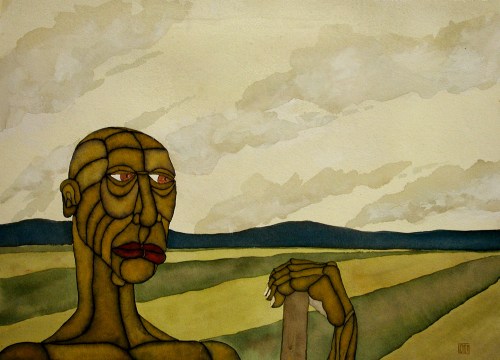
GC Myers- 1995- Exiles-Let Us Now Praise Famous Men

Exiles: Let Us Now Praise Famous Men, 1995


Bowed by the weight of centuries he leans
Upon his hoe and gazes on the ground,
The emptiness of ages in his face,
And on his back the burden of the world.
Who made him dead to rapture and despair,
A thing that grieves not and that never hopes.
Stolid and stunned, a brother to the ox?
Who loosened and let down this brutal jaw?
Whose was the hand that slanted back this brow?
Whose breath blew out the light within this brain?

–Edwin Markham, The Man with the Hoe 


This is one of those posts that just came out of the blue. I was looking for something to begin a post about two vintage paintings from around 1995 that will be included in the Kada Gallery show when I came across the beginning lines above from Edwin Markham poem, The Man with the Hoe.

Reading the rest of the poem, I was reminded of the painting at the top, another vintage piece titled Let Us Now Praise Famous Men. Markham’s poem and its message decrying the greed of those who exploit and dehumanize the workers very much was in line with what I see in this piece.

Overused, overlooked and underappreciated.

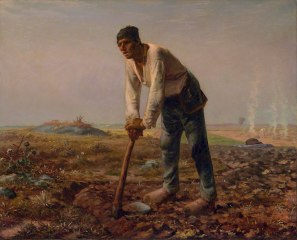
Millet,_Jean-François_-_Man_with_a_HoeMarkham based the poem on a painting of the same title from Jean-François Millet, that portrayed an exhausted laborer in the field leaning on his hoe, his mouth agape as he looks blankly past the endless fields that surround him. I was struck by the similarity of feel in the Millet piece and my own. Both jibed well with Markham’s words.

The poem was first recited by Markham at a New Year’s party at the end of 1898.  The editor of the San Francisco Examiner was at the same party and published the poem in the paper soon after. It then became a huge success across the nation. At the time, as movements and calls for social reforms were gaining momentum in this country, the poem, with its warning that the mindless beasts would someday rise up against those who had cultivated and exploited them for so long, was called “the battle cry of the next thousand years.”

Perhaps they were right. The prevalent greed that marked the Gilded Age is little different than that exhibited by the super-rich few that control most everything in this world now. We may not physically be standing in fields but many of us remain that man with the hoe.

Here’s a fine reading of the Edwin Markham poem.


GC Myers- A Matter of Perspective sm

A Matter of Perspective— Coming to Kada Gallery November 4


Thus, the task is, not so much to see what no one has seen yet; but to think what nobody has thought yet, about what everybody sees.


Every man takes the limits of his own field of vision for the limits of the world.

–Arthur Schopenhauer, Parerga und Paralipomena, 1851


This new piece that is headed to Kada Gallery for my November Places of Peace show is one of those thinking pieces. Everything about it sets my mind to work.

My primary observations are that we live so often within the limits of our own field of vision. By that I mean that we often only see what serves us, that which we expect to see. As a result, we fail to see all that surrounds us.

This cause us to lose a sense of perspective of both our smallness and largeness in this world which makes us live in the realm of one or the other of the two.

And we need to live with both our smallness and largeness.

I’m reading this and it sounds kind of crazy but hear me out.

In short, I am saying that we need to know both our insignificance as well as the importance of our singularity.

In the grand scheme of things, from the longer view we are but a speck, mere clods of mud and blood and bone.

Ah, but look closer and see what magnificent clods we are!

It’s a matter of perspective, right?

Here’s a song from the Beatles whose first line jumped to my mind as I wrote this. This is We Can Work It Out. Oh, and the title of the 12″ by 36″ painting at the top is, of course, A Matter of Perspective.


Flame of Life

GC Myers- Flame of Life sm

Flame of Life— Soon at the Kada Gallery, Erie


To be nobody-but-yourself -in a world which is doing its best, night and day, to make you everybody else -means to fight the hardest battle which any human being can fight; and never stop fighting.

–e e cummings, A Poet’s Advice To Students


I chose the lines above because I thought it meshed well with the feeling that I was getting from the painting above. It’s titled Flame of Life and is a new smaller piece headed to the Kada Gallery for my upcoming solo show there. The lines are from a post from a number of years ago featuring advice from the poet ee cummings to aspiring young poets is one of the most popular posts from this blog.

Its popularity is understandable. The advice is just what any person needs if they want to pursue a life in the arts. I say arts because even though this is targeted at its surface for poets, its wisdom is easily transferred to all other forms of creativity. You can substitute artist, painter, musician or any other term used for a creative person for the word poet in the essay below and the advice is as sound and fitting.

The painting above definitely echoes the nobody-but-yourself feel that cummings invoked in the excerpt just below it. In art– and life, in general– staying true to who you are might well be the most difficult battle of one’s life.

Here’s the full essay including my original intro:


Whenever I am asked to speak with students, I usually tell them to try to find their own voice, to try to find that thing that expresses who they really are. I add that this is not something that comes easily, that it takes real effort and sacrifice. The great poet e e cummings (you most likely know him for his unusual punctuation) offered up a beautiful piece of similar advice for aspiring poets that I think can be applied to most any creative discipline.

Or to anyone who simply desires to feel deeply in this world.

Take a moment to read this short bit of advice and see what you think– or feel.


A Poet’s Advice To Students

(e e cummings)

A poet is somebody who feels, and who expresses his feeling through words.

This may sound easy. It isn’t.

A lot of people think or believe or know they feel-but that’s thinking or believing or knowing; not feeling. And poetry is feeling-not knowing or believing or thinking.

Almost anybody can learn to think or believe or know, but not a single human being can be taught to feel. Why? Because whenever you think or you believe or you know, you’re a lot of other people: but the moment you feel, you’re nobody-but-yourself.

To be nobody-but-yourself -in a world which is doing its best, night and day, to make you everybody else -means to fight the hardest battle which any human being can fight; and never stop fighting.

As for expressing nobody-but-yourself in words, that means working just a little harder than anybody who isn’t a poet can possibly imagine. Why? Because nothing is quite as easy as using words like somebody else. We all of us do exactly this nearly all of the time-and whenever we do it, we’re not poets.

If, at the end of your first ten or fifteen years of fighting and working and feeling, you find you’ve written one line of one poem, you’ll be very lucky indeed.

And so my advice to all young people who wish to become poets is: do something easy, like learning how to blow up the world-unless you’re not only willing, but glad, to feel and work and fight till you die.

Does this sound dismal? It isn’t.

It’s the most wonderful life on earth.

Or so I feel.

GC Myers- Still, The Earth Moves

Still, The Earth Moves— Coming to the Kada Gallery, November 4


Most sweet it is with unuplifted eyes
To pace the ground, if path be there or none,
While a fair region round the traveller lies
Which he forbears again to look upon;
Pleased rather with some soft ideal scene,
The work of Fancy, or some happy tone
Of meditation, slipping in between
The beauty coming and the beauty gone.
If Thought and Love desert us, from that day
Let us break off all commerce with the Muse:
With Thought and Love companions of our way,
Whate’er the senses take or may refuse,
The Mind’s internal heaven shall shed her dews
Of inspiration on the humblest lay.

-William Wordsworth, Most Sweet It Is, 1835


I wasn’t planning on using another poem today from one of the big-name poets of the past since I had employed a short verse from Longfellow yesterday. But while searching for something to accompany the new painting above, I came across the line:

Of meditation, slipping in between
The beauty coming and the beauty gone.

Those two lines seemed to align well with what I was seeing in this piece. But finding and reading the rest of the verse, I found that the whole of it also echoed my thoughts on the painting. I read it to mean that clearing one’s mind of thought and all that we know sometimes leads to inspirations and revelations that spring from within– The Mind’s internal heaven, as Wordsworth phrased it.

The title of this painting, Still, The Earth Moves is from my own slightly longer phrase:

Yet while I am still, the earth moves. 

Looking at this piece made me think of hopefully possessing the ability to quiet my thoughts, to shed away all worries and concerns, to the point I might reach a sense of stillness where I could almost feel the earth as it moved, with me on it, under the sky above.

That sort of deep meditative stillness has always fascinated me though it often seems to evade me or, in those few moments when it does come to me, be quickly fleeting. I suppose that finding bits of it in my painting will have to serve as some sort of surrogate.

In the end, that is not a small thing.

Here’s the great Carole King and I Feel the Earth Move from her classic 1971 album, Tapestry. I think a lot of people have forgotten what a huge album it was at the time. Actually, at any time. It has sold over 30 million copies, making it a 14X Platinum record and one of the bestselling records of all time. This song was a big reason. It might also have fed my own fascination with a stillness that allows one to feel the earth move.


Endless Possibility

GC Myers-  Endless Possibility

Endless Possibility— Coming to the Kada Gallery, Erie


Possibilities

Where are the Poets, unto whom belong
The Olympian heights; whose singing shafts were sent
Straight to the mark, and not from bows half bent,
But with the utmost tension of the thong?
Where are the stately argosies of song,
Whose rushing keels made music as they went
Sailing in search of some new continent,
With all sail set, and steady winds and strong?
Perhaps there lives some dreamy boy, untaught
In schools, some graduate of the field or street,
Who shall become a master of the art,
An admiral sailing the high seas of thought,
Fearless and first, and steering with his fleet
For lands not yet laid down in any chart.

— Henry Wadsworth Longfellow, 1882


This small painting, at 8″ by 16″ on canvas, is another new piece headed to the Kada Gallery in Erie for my upcoming show, Places of Peace, opening November 4.

It’s titled Endless Possibilities. As a non-sailor, I can only imagine the feeling of being carried by the whims of the wind over the surface of the sea. The image of endless horizon all around and the possibilities offered in any and every direction is fascinating to ponder. As is the idea of sailing toward an unseen– and perhaps unknown– destination dependent upon your own wits and experience.

I guess that is how discoveries and breakthroughs take place in anything. We head toward the unknown because that is where real possibilities exist– if only we have the courage and wits to make it there.

Here’s a song about possibilities. It’s The Band and their classic version of the Bob Dylan song, When I Paint My Masterpiece.

Someday everything’s gonna be differentWhen I paint that masterpiece


Places of Peace

And Peace Arrives (Et Pax Advenit) sm

And Peace Arrives — Coming to the Kada Gallery, November 4


Man is the only animal who does not feel at home in nature, who can feel evicted from paradise, the only animal for whom his own existence is a problem that he has to solve and from which he cannot escape.

–Erich Fromm, Man for Himself (1947)


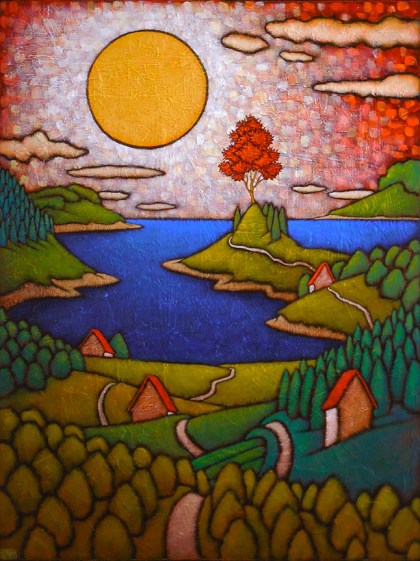
I am coming into the final two weeks of preparation for my next exhibit. The solo show opens Friday, November 4, at the Kada Gallery in Erie, PA. I have been represented by Kada since 1996 and this will be my tenth solo show there, the last having taken place in 2017.

I am calling this show Places of Peace.

It’s a simple and straightforward title because, for the most part, that is the thing I am seeking in my work.

A place of peace, of quiet and harmony.

Much of my life has involved searching for something I couldn’t envision or describe. I was looking for something that would relieve an anxiety that seemed to come from both inside and outside myself.

I soon realized that they were not to be found in the outer world until they had first been found in the inner.

What I was seeking were Places of Peace— places anchored more in feeling and imagination than reality. Places that allowed me to find an inner balance and harmony while living in an outer world that I often did not understand.

I ultimately found these places in my painting.

These places of peace have provided much needed refuge for me over the past 25+ years and in that time, recurring symbols and icons– the Red Tree, the Red Roofed Houses, the Red Chair, the inward leading path, and the ever-present Sun/Moons— have formed the language with which I describe these places to others. Over the years, that language has evolved and grown, adding nuance with the use of deeper and more layered colors and textures.

This symbol language is all there, making up the better part of this show. That makes this a show that very much speaks to and for me. The paintings from this show, such as the one at the top, And Peace Arrives, have provided me with places in which I find that balance and harmony that I sought for so long.

My hope is that it does the same for others.

Here’s song from the immortal Sam Cooke that has the right vibe. Definitely a place of peace in its own right. Because That Where It’s At


Soulful Shades


GC Myers- Time & Patience

Time & Patience–At the West End Gallery

Into my heart an air that kills
From yon far country blows:
What are those blue remembered hills,
What spires, what farms are those?

That is the land of lost content,
I see it shining plain,
The happy highways where I went
And cannot come again.

–A. E. Housman,  A Shropshire Lad, No. 40 (1896)


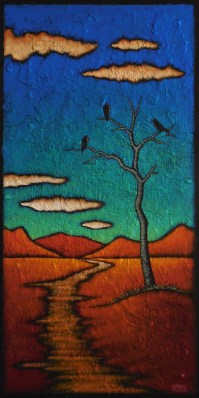
Sunday morning, focusing on the color blue for no reason. It’s a color that is always near in my thinking and my work. From the shades of Housman’s blue remembered hills to that of the blue in the sky of the painting shown here and the soulful shade in the song below, it always finds a way to come to mind for me.

For this Sunday Morning Music selection in blue, I am going back to one of my favorites, Neko Case, whose music has appeared here a number of times.  This song is Soulful Shade of Blue, taken from a live set in 2004 that became the album The Tigers Have Spoken, one that instantly made me a fan when I was introduced to it.  This song is a cover of a great old Buffy Saint-Marie tune which probably doesn’t mean much to you if you’re not of a certain age. She wrote and performed (she still does) some wonderful lasting songs. Click on her name for a quick education on her career.

Here’s Soulful Shade of Blue.