Feeds:
Posts
Comments

Sixty

GC Myers- Big Time

Big Time– Now at the West End Gallery


Baseball is a spirited race of man against man, reflex against reflex. A game of inches. Every skill is measured. Every heroic, every failing is seen and cheered, or booed. And then becomes a statistic.

–Ernie Harwell, late Detroit Tigers Play-By-Play Announcer


Aaron Judge is on a mission this year.

The physically imposing Judge hit his 60th home run of the season last night in his 143rd game of the year while also moving into position to win the Triple Crown. as he became the Batting Average leader with last night’s game.

The Triple Crown is accomplished when a player leads their league in the three major hitting statistics– home runs, batting average and runs batted in, RBIs. It’s a rarity in baseball, occurring only once in the last 55 years. That was in 2012 by the great Miguel Cabrera.

But if Judge’s season might be even more remarkable in that he is doing it while also chasing the legendary home run record. When (not if) he passes the American League record of 61 set by Roger Maris in 1961, many believe he will hold the real home run record. Several other players– Barry Bonds, Mark McGwire, and Sammy Sosa– have higher single season totals but all were tainted by their use of performance enhancing drugs (steroids) and the fact that played in what is is termed a Live Ball Era.

The Live Ball basically means that the balls used at that time were “juiced” much like the players. Inside, they were more tightly wound and would travel much further than the typical ball. You could see evidence of this and the steroid use in the numbers of players who suddenly went from being good, average hitting players into long ball hitters that racked up huge home run numbers.

As a result, the home run totals of that era are discounted. Barry Bonds’ record 73 home runs is marked with an asterisk in the record books. That same year, 2001, Sammy Sosa hit 64.

Since that last Live Ball Era, there has been a concerted effort to limit performance enhancing drug use and the baseball have had much of the juice taken from them. In the 20 years since that time, nobody has come close to those numbers.

Until Judge.

Of course, he has the size and physique that the steroid users of the past were trying to achieve, though his is natural. And being so large and strong often comes with its own problems in a game whose needed skills don’t always match up well with brute force and size. A big guy has to work harder to keep the mechanics of his swing efficient which is one of the main requirements to be an elite hitter.

Judge’s season is one for the ages. As a longtime watcher of baseball, I can attest that he is locked in as any player I have ever seen and his discipline at the plate and in staying within himself is remarkable. By that, I mean that he only takes what he is given in every at bat, not trying to hit every pitch out of the park and taking his walks when given. Not every at bat offers a pitch that can be hit for a home run and Judge will take the single or double when that is all there is to take. 

And the topper is that he is humble about his feats. When he crushes a homer (and he does crush them) he simply puts his head down and trots around the bases. No preening or posing or bat flips.

His swing did all his talking.

While there is a lot more I could say, I have probably gone on too long and in more depth than needed here. In short, watching Judge this year has been a great pleasure and a wonderful diversion from the darker aspects of our society.

Maybe that’s the purpose of baseball. I don’t know. I do know that I am happier writing this than decrying injustice and inequity.

Here’s song that echoes the title of the painting at the top. Here’s Peter Gabriel and his Big Time.

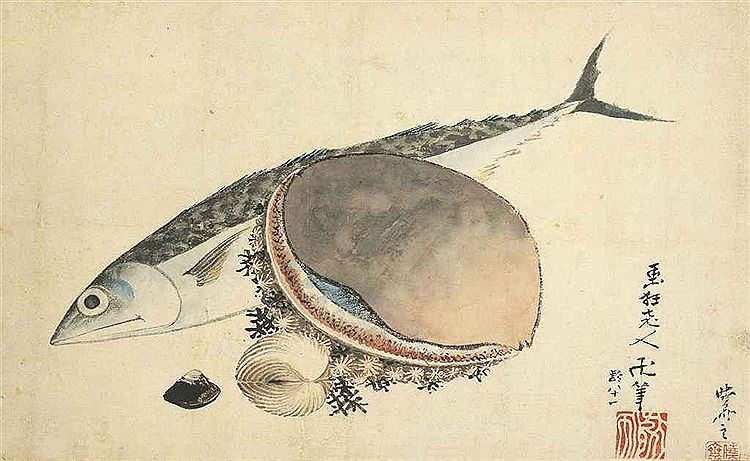

The Living Dot/ Hokusai

Hokusai Two Fish


At seventy-three I learned a little about the real structure of animals, plants, birds, fishes and insects. Consequently when I am eighty I’ll have made more progress. At ninety I’ll have penetrated the mystery of things. At a hundred I shall have reached something marvelous, but when I am a hundred and ten everything I do, the smallest dot, will be alive.

Katsushika Hokusai


I really like the bit of wisdom above from the great Hokusai, both for his optimism on aging as well as the idea that as he continues to progress his work will reach a point where everything he paints– even something as simple as a dot– has a life force within it.

Attaining that life force, where the painting transcends what you put into it, in any one piece is a rare and difficult thing for any artist to achieve. But that idea that you might one day reach a point where your work has moved from a product of thought and craft to a transcendent expression of the spirit is something that seems beyond our reach or even our aim.

But perhaps we should keep it as an aim in our mind, along with the idea that we will continue to progress as we age, even if it is stored in rarely visited corner. If we hold on to it perhaps we will subconsciously find our way to that goal. And when we are a hundred and ten, the dots we paint will have that same life force as those created by Hokusai.

It’s something to hope for…

I’ve included a few of Hokusai’s paintings beyond his famed wave and landscapes. I love his fish pieces and the raven is wonderful. Enjoy!


I am busy on a new piece this morning and am running the post above from several years ago. I am a big fan of the work of the Japanese artist/printmakers such as Hokusai and Hiroshige. But as large a fan as I am of the work, I love the words at the top from Hokusai. It reminds me of the potential for continued progress as an artist even as I move into those years where most folks are retired or at least contemplating the idea.

The idea that art and creation have no endpoints within a person.

I sometimes need that reminder.


koi-carp-and-turtles-katsushika-hokusai

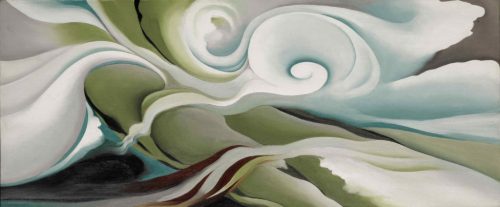
OKeeffe-Nature-Forms-Gaspé 1932

Georgia O’Keeffe- Nature Forms, 1932


I found things I could say with color and shapes that I couldn’t say in any other way… things I had no words for.

–Georgia O’Keeffe


Very short on time this morning but wanted to share a favorite O’Keeffe painting along with her description of her use of colors and shapes as her means of communicating. Let’s top it off with an old song from 1966 by the Yardbirds that is somewhat in the same vein in that it mentions the shapes of things. I know it’s a stretch but it’s a great song with some wonderful guitar work from Jeff Beck and a fine way to kick off the week. Here’s Shapes of Things.


Ten Times More

dropkick-murphys-this-machine-still-kills-fascists-


When the crooks they work, we gotta work
Not once, not twice, but ten times more
Where the robbers they walk, we gotta walk
Not once, not twice, but ten times more

–Woody Guthrie, Ten Times More


I was going to play something sort of cool and breezy for this week’s Sunday Morning Music as a counterpoint to my last couple of diatribes here. But I recently became aware of a new album from the Boston-based Celtic punk band, the Dropkick Murphys. The album is called This Machine Still Kills Fascists and is their take on a group of unrecorded songs written by Woody Guthrie.

This is not a new idea. One of my favorite albums is Mermaid Avenue from a collaboration of Wilco and Billy Bragg in which they did very much the same thing. In both cases, the Guthrie family approached these artists and invited them to take on the project of bringing these lyrics to life.

In the case of the Dropkick Murphys, this began about 20 years ago when Nora Guthrie, Woody’s daughter, made them the offer, saying that she thought her father would have felt like a kindred spirit with the band and what they were doing.

They took it on then and the result was their version of Woody’s Shipping Up to Boston. It is, by far, their most well-known song. It was used effectively in a pivotal scene in Martin Scorsese‘s film of Boston gangsters, The Departed. It is also considered the unofficial Tanthem of Boston. To be honest, though I was a fan of the song, I didn’t know it was a Woody Guthrie song and only recently became aware that they had recorded that small group of his songs that were included in their 2005 album, The Warrior’s Code.

This new album is a more direct collaboration with Guthrie’s music, comprised only of his songs and borrowing its title from the message famously scrawled on Woody’s guitar, This Machine Kills Fascists. They also went out to Tulsa, Oklahoma, which is Woody’s hometown and home to the Woody Guthrie Center, to record the album at Leon Russell’s The Church Studio. Leon Russell was also a Tulsa native.

The result is stirring group of Guthrie’s pro-union/labor, anti-fascist songs infused with the Celtic fighting spirit of the Dropkick Murphys. The song below is titled Ten Times More which has Woody saying that in order to beat back those who would oppress you, you have to meet their effort with not equal effort but ten times more effort.

In short, you can’t take half measures with would-be fascists– you have to overwhelm them with your resistance.

I also have included Shipping Up to Boston, for those who may not have heard it before.


Starlight Tour

GC Myers- Starlight Tour

Starlight Tour, GC Myers


For there is nothing heavier than compassion. Not even one’s own pain weighs so heavy as the pain one feels with someone, for someone, a pain intensified by the imagination and prolonged by a hundred echoes.

–Milan Kundera, The Unbearable Lightness of Being,  1984


In the aftermath of yesterday’s post on cruelty, I began to have concerns about how that staged political grandstanding could well be an omen of other more sinister events to come if we turn a blind eye to them and they are not confronted.

One of the things that came to mind were the freezing deaths that took place on the outskirts of Saskatoon, Saskatchewan from the 1970’s up through the early 2000’s.

During that time, the police force of Saskatoon was known on a number of occasions to pick up indigenous Canadians from the First Nations tribes for minor offenses such as drunkenness or unruly behavior. Instead of merely arresting them or citing them, they would drive them out past the outskirts of the town and dump them, often without shoes or jackets and always in the sub-freezing temperatures of the harsh Canadian winter.

The detainees would freeze to death before they could make their way back into town or to help.

Well, almost always. One such victim made it two miles in -18° F temperatures before coming to a power station where he was helped by a night watchman there. He was able to shine a light on the practice and the two officers involved were charged with unlawful confinement and sentenced to eight months in prison.

For many years, the Saskatoon Police maintained that these were isolated and unrelated incidents. But in 2003, they admitted that their officers may have been participating in this ongoing dumping of members of the First Nations going back to 1976.

The indigenous people of that area called this practice as being taken for a Starlight Tour

I mention it because it is a mere extension of the same mindset that sees nothing wrong, and even revels, in the recent actions of the governors of Texas and Florida. It is a mindset devoid of compassion and humanity, reducing these people to objects and props. Moving from these stunts to even more inhumane and cruel acts is a short trip on a very slippery slope.

I know most of you don’t want to hear or think about this. I understand that. But this naked cruelty stays on my minda and at a certain point, we have to pay attention and make our compassion known if we want to avoid the potential further inhumanity and cruelty that is being set before us.

I can’t do much, but I can try to do what little I can.

Here’s a song from the Wailin’ Jennys from Winnipeg that is titled Starlight and is based on the horror of the Starlight Tours mentioned above.


Circus of Cruelty


Remember, democracy never lasts long. It soon wastes, exhausts, and murders itself. There never was a democracy yet that did not commit suicide. It is in vain to say that democracy is less vain, less proud, less selfish, less ambitious, or less avaricious than aristocracy or monarchy. It is not true, in fact, and nowhere appears in history. Those passions are the same in all men, under all forms of simple government, and when unchecked, produce the same effects of fraud, violence, and cruelty.

–John Adams, XVIII, p. 484 – Letters to John Taylor (1814)


A couple of passages to start today’s post but let’s focus on the last few words above from Founding Father and 2nd American President John Adams in describing the effects from unchecked greed, selfishness, vanity, and ambition on a democracy:

…when unchecked, produce the same effects of fraud, violence, and cruelty.

Wow. Could there be a better illustration of the situation which we have been witnessing for the past several years?

We have stood by while truckloads of fraud, violence, and cruelty have passed by us like floats in a nightmarish parade. And nobody with any authority to step in to put a stop to it was willing to speak up.

For me, the recent political stunts pulled by the Governors of Texas and Florida, where they ship unwitting migrants, who are coerced with empty promises of jobs and housing, to far flung destinations, has broken the proverbial camel’s back for me. The pure cruelty of using these beleaguered people as pawns in a blackhearted political stunt just sickens and infuriates me.

But cruelty is the one of the overriding values of the current iteration of the now MAGA Republican party. They don’t want to build bridges or find compromise. They no longer produce public policy or potential solutions to the problems that plague their constituents.

Hell, they don’t even pretend to want to govern anymore.

They just want to grandstand and rile people up, anything that keeps the money and control in their hands.

As a result, the MAGA-GOP sees the People only as sources of money and their angry mob power, in much the same way a vampire sees its victims, who serve them even as they are being drained. But to keep the People willing and ready to be drained they have to something with which to lure them in, to keep them close at hand.

And that lure has become cruelty.

Punish the poor for their poverty. Punish the desperate for their desperation. Punish the Others for their differences.

And make a show of it.

It’s like the Bread & Circuses of the Roman Empire as it was heading towards its fall. It was a term coined by the poet Juvenal when describing how the values of Rome had degraded:

… Already long ago, from when we sold our vote to no man, the People have abdicated our duties; for the People who once upon a time handed out military command, high civil office, legions — everything, now restrains itself and anxiously hopes for just two things: bread and circuses.

The term basically refers to the means employed by those wishing to hang on to power. They generate public approval, not by excellence in public service or public policy, but by diversion, distraction, or by satisfying the baser qualities of the People.

The Romans of that time believed that their reign was secure so long as they provided just enough sustenance to keep the People satisfied and a Circus or spectacle to keep them distracted.

Bread and Circuses.

Some things never change, as Adams noted above.

Cruelty– the discarding of all humanity as seen in the stunts of the governors of Florida and Texas– plays the part of both Bread and Circus here. Cruelty is sport and a spectacle for them now, one that also satisfies the hunger of its base audience for the suffering and pain of others.

It’s the false full belly feeling of the weak believing they are somehow made stronger by this.

And while cruelty has become sport for the MAGA-GOP, it also their industry. As they wallow with delight at the sport they find in their malignant cruelty, they use it as well to fundraise, draining every penny from the howling masses they can gather with their grubby little fingers.

Meanwhile, the People are left with crusts of bread and a circus.

As Cicero wrote at the top, they have sold their rights for full bellies and the excitement of the games.

I would rather go hungry than abdicate my duty.

Elections are approaching quickly. Every race at every level is vitally important this year.

Each and every vote is crucial.

Please vote for humanity, not for cruelty.

If we fail to keep the MAGA-GOP from taking power this year, an even bigger and crueler Circus featuring even more fraud, violence, and cruelty will soon be coming to every city, county, town and village in this country.

Sleepwalking

GC Myers-Sleepwalk 2002

Sleepwalk, 2002


My days, my years, my life has seen up and downs, lights and darknesses. If I wrote only and continually of the ‘light’ and never mentioned the other, then as an artist, I would be a liar.

–Charles Bukowski


This is a painting, Sleepwalk, from back in 2002. It is part of what I call my Dark Work which was when I first began working on a black painted surface. The idea was to make the blackness part of the painting, to give the painting the darkness against which I could set the contrast of the light.

Like the poet Charles Bukowski says above, I felt that in order to be honest as an artist I had to incorporate my own darkness in my work. Utilizing the darkness kept the perceived optimism of the work from wandering into the territory of cockeyed Pollyanna-ism. It provided contrast in the form of a sense of reality, a basis for validating the optimism of the light and the color.

Light needs dark, plain and simple.

The Dark Work was very important for me and I continue to paint using the same process and techniques I developed in that time. This particular piece has lived with me for many years now and I love pulling it out to study it from time to time. There always seems to be something new to focus on. A brushstroke. A section of the texture. The transition of one color into another.

It provides lessons that memory has long forgotten as I continue my own sleepwalk through this life.


I was looking at Sleepwalk here in the studio the other day and remembered this post from 3 or 4 years back. I thought I’d add a Brian Setzer version of the Golden Oldie Sleepwalk, which was originally performed by Santo and Johnny. Good stuff…


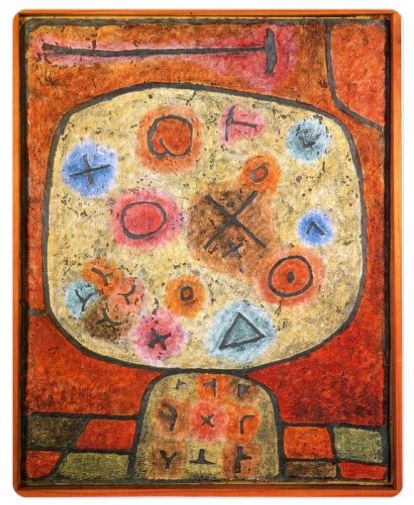
Flowers in Stone/Klee

Paul Klee Flowers in Stone. wo title

Paul Klee- Flowers in Stone (1939)


Formerly we used to represent things visible on earth, things we either liked to look at or would have liked to see. Today we reveal the reality that is behind visible things, thus expressing the belief that the visible world is merely an isolated case in relation to the universe and that there are many more other, latent realities. Things appear to assume a broader and more diversified meaning, often seemingly contradicting the rational experience of yesterday. There is a striving to emphasize the essential character of the accidental.

Paul Klee, Section V – Creative Credo (1920)


During a short break yesterday, I was scanning through social media and the image above popped up on my feed. I have expressed my admiration for the artist Paul Klee many times in the past and have looked at a lot of his work, but this piece was new to me.

And it stopped me in my tracks.

I don’t know how to fully explain it but something that I was seeing in this work hit as close to whatever it is that I desire (and need) to see in art. It set off all sorts of inner alarms that had me scrambling to discern what it was in this piece that brought on such a reaction.

I couldn’t tell if it was its subject or the colors, forms, linework, or textures that comprised it. The title is Flowers in Stone but I wasn’t seeing it as a floral piece in any way. I actually wasn’t seeing it as any physical object at first.

It just had a nonspecific symbolic impact that didn’t need to be identified or named.

The feeling I felt was at first pure elation, as though I was looking at something that somehow answered longstanding questions. Like a bright beam of light suddenly cast in abject darkness. An epiphany of some sort.

But I didn’t know if the answers and questions I was seeing were the same as those posed in this painting. Maybe it was this accidental discovery in that which doesn’t directly correspond to the meaning intended by the artist that makes art so subjective, so personally relatable.

After all, you might well look at this and not be moved at all, not see anything that stirs anything within you. And you wouldn’t be wrong. Your honest response is yours alone and only you can say what moves you.

That is the gift and beauty of art.

But for me, seeing this picture wiped me out for about an hour yesterday afternoon. The elation turned to a deep feeling of sorrow and diminishment. I felt as though I was looking at a perfect expression of something that was beyond myself and my capabilities, something which was still eluding me in my own work.

I felt as though the artistic horizon I mentioned in yesterday’s blog was suddenly pushed further away from me. I suddenly was unsure if I was up to the task, of if I was even deserving to be attempting to reach for it.

I sat there deeply moved, both fulfilled and crushed. How do you start at that point? Why go on with this futile act?

The answer, of course, comes in picking up the brush, making a mark and going to work. Something in that simple act usually puts me back on the path towards that horizon once more.

Sometimes producing a single stroke of paint is a fully encapsulated work of art in itself, obscuring all the doubts and providing answers to questions not yet asked, having much the same effect that Klee’s painting had on me.

I ended up having a very good afternoon in the studio. Surprisingly, after feeling deflated and pushed back from that horizon earlier, I felt like I was a step or two nearer to it than I was at the beginning of the day.

And that, my friends, is always a good day.


ben shahn roosevelt nj mural

Ben Shahn – Roosevelt NJ Mural


The moving toward one’s inner self is a long pilgrimage for a painter. It offers many temporary successes and high points, but impels him on toward the more adequate image.

–Ben Shahn, The Shape of Content, 1957


I came across the passage above from artist Ben Shahn earlier. It made me think about my own pilgrimage as a painter over the last 25+ years. And there is, indeed, a constant seeking of that more adequate image.

Not perfect– more adequate.

And that seems to be what painting is, a constant refinement of the inner vision.

It’s like being in a vast landscape and being drawn toward a point on the far horizon. You work to get closer, moving away from your starting point. You continually work to move forward yet with each new step, the horizon recedes in an equal manner.

When at last you stop and look back, you realize you are far afield from your starting point. Great progress has taken place, yet you find yourself no nearer that horizon.

That is the painter’s pilgrimage.

I thought that I would share a post on Ben Shahn from a few years back. I always get something from his work and the higher ideals they represent. Much more than adequate images…


The artist must operate on the assumption that the public consists in the highest order of individual; that he is civilized, cultured, and highly sensitive both to emotional and intellectual contexts. And while the whole public most certainly does not consist in that sort of individual, still the tendency of art is to create such a public – to lift the level of perceptivity, to increase and enrich the average individual’s store of values… I believe that it is in a certain devotion to concepts of truth that we discover values.

–Ben Shahn


Born in Lithuania in 1898, Ben Shahn emigrated to America with his family in 1906. Throughout his career, up until his death in 1969, Shahn’s early training as a lithographer and graphic designer played a large part in his work, giving it a symbolic visual impact that made him one of the leading lights of social realist artists. His work often dealt with the human condition, particularly that of the common man.

Ben Shahn- The Passion of Sacco and Vanzetti

While many of the themes in his work were labeled as leftist, his work championed civil rights and workers’ rights and stood against injustice and prejudice. He did a large series of works devoted to Sacco and Vanzetti. Designed to communicate a distinctly human point of view, his work always had a profound voice, one that called for the betterment of all people.

His was the work of the Everyman.

As he said: The natural reaction of the artist will be strongly towards bringing man back into focus as the center of importance.

I think that is a very important thing to keep in mind as is the quote at the top of the post, about how an artist must aspire to the highest human values of the public, even though they may not actually possess these qualities, with the hope that the artist’s work can lift them to a higher level. It’s a thought that should linger in the mind of any artist who hopes and desires to make a true difference in this world with their work.

I am not giving a lot of details here about the life and career of Shahn. But I hope the few that I have shared along with some of his images will inspire you to take a closer look at this interesting and important voice in modern art.

Ben Shahn- Father and Child 1946

Ben Shahn- The Burial Society

Ben Shahn- Nocturne

Ben Shahn- Four Piece Orchestra 1944

Ben Shahn- Self Portrait Among Churchgoers

Ben Shahn- Two Witnesses

Ben Shahn- Unemployment

Vitality

GC Myers-  Elan Vital sm

Elan Vital– At the West End Gallery


Nothing, indeed, is more dangerous to the young artist than any conception of ideal beauty: he is constantly led by it either into weak prettiness or lifeless abstraction: whereas to touch the ideal at all you must not strip it of vitality. You must find it in life and re-create it in art.

Oscar Wilde, Lecture to Art Students, 1883


A short triad this morning. I see the vitality of life as being the connecting tissue here. You may or may not see it that way as well.

I don’t always agree with Oscar Wilde‘s observations on art as we have differing senses of the aesthetic, most likely due to the different eras we both inhabited.

But difference is the way art is designed to be.

It knows no one way.

The main thing is that is contains a life force within it. A free expression of that vitality.

Sometimes easier said than done…

Along with my painting, Elan Vital, and the words of Wilde, let’s complete the triad with a song, I Wish I Knew How it Would Feel To Be Free. It was written and originally recorded in 1963 by the great jazz pianist Billy Taylor and had a memorable cover from later in the 60’s by Nina Simone. I thought I would share a version from two favorites of mine, Mavis Staples and Levon Helm. It was recorded at Helm’s Woodstock, NY studio in 2011, less than year before he died from throat cancer in 2012. You can see that he’s has some sort of malady in the video.

But it’s good stuff. Got some vitality…