Feeds:
Posts
Comments

Howl

Howl– Now at West End Gallery


All hatred driven hence,
The soul recovers radical innocence
And learns at last that it is self-delighting,
Self-appeasing, self-affrighting,
And that its own sweet will is Heaven’s will;
She can, though every face should scowl
And every windy quarter howl
Or every bellows burst, be happy still.

–William Butler Yeats, A Prayer for My Daughter (1919)


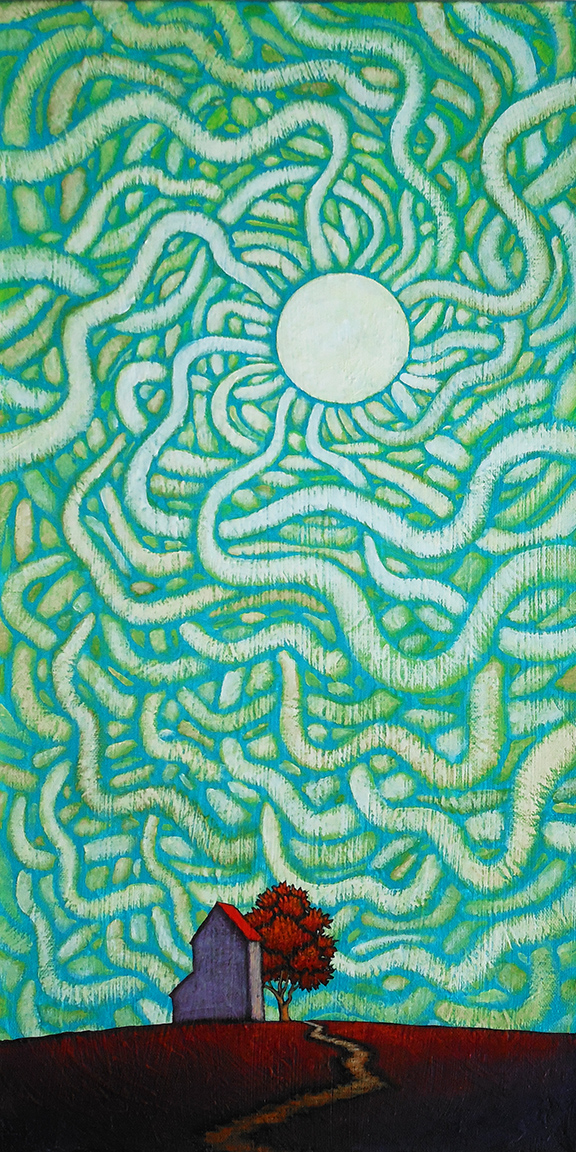
I can see this new painting, Howl, as having two distinctly different interpretations.  Probably more when the experience and perceptions of others are considered. But from my personal perspective, the first, which is how I initially viewed it, is as a howl of indignation and defiant resistance against the prevailing winds of injustice, cruelty, and indecency.

Obviously, that interpretation takes current events into account. However, such a howl is certainly applicable in all times and places. There’s never a shortage of injustice, cruelty, or indecency.

The other way of reading it comes from a poem, A Prayer for My Daughter, William Butler Yeats wrote days after his daughter was born in 1919 during the early days of the Irish War for Independence. It, too, takes the current events of its time into account. It is written with the hope that as his daughter can resist the winds of hatred and anger and that she is not pulled along with them. And with the hope that she recognizes that she will always have the choice to find strength and contentment within herself even as the winds of hatred and anger swirl around her.

That though times are ugly, the world surrounding us can still be beautiful and wondrous.

I can easily see both of these views in this painting.  Both takes are really about resistance, about staying intact against the force that want to tear us apart. About staying true to ourselves and our humanity. About denying hatred and cruelty a place in ourselves.

It’s about holding our ground and issuing a howl. a bellow, a yawp borrowed from Whitman, that comes from the core of our being that says we will remain as we are and will not become that which we stand against.

Well, that’s what I see in it…

Howl is 8″ by 16″ on canvas and is part of my solo exhibit, Guiding Light, that opens next Friday, October 17 at the West End Gallery in Corning, NY. The show’s Opening Reception, which is free and open to all, runs from 5-7 PM on the 17th. The work for the show has been delivered and will be available for previews in the coming few days.

Gallery Talk is also scheduled at the West End Gallery for Saturday, November 1, beginning at 11 AM. Keep an eye out here for more details.

Not sure if this song applies at all to the painting or words above. I just felt like hearing it this morning. This is Stand from REM.


Witnesses

RedTree: Continuum— Coming to West End Gallery


“We’re only here for a short while. And I think it’s such a lucky accident, having been born, that we’re almost obliged to pay attention. In some ways, this is getting far afield. I mean, we are — as far as we know — the only part of the universe that’s self-conscious. We could even be the universe’s form of consciousness. We might have come along so that the universe could look at itself. I don’t know that, but we’re made of the same stuff that stars are made of, or that floats around in space. But we’re combined in such a way that we can describe what it’s like to be alive, to be witnesses. Most of our experience is that of being a witness. We see and hear and smell other things. I think being alive is responding.”

—Mark Strand, interview with Mihaly Csikszentmihalyi (Flow)


Mark Strand (1934-1914) was a Pulitzer Prize-winning poet and essayist who served as the US Poet Laureate in the early 1990s.

I often wonder what, if any, purpose we have here on this planet. This thought from Mark Strand that we are put here in our present form as an assemblage of the molecules and matter of the universe so that the universe could see and analyze itself intrigues me.

Are we some sort of diagnostic tool? Is this planet a testing ground to reveal what works and what falls short? 

As I said, it’s intriguing. I have dozens of more questions pertaining to it. 

But perhaps Strand is closer to the reality of the matter, whatever the hell that is these days, when he opines that our ultimate purpose might be as witnesses. I guess that might still fall into diagnostic tool category as we would be serving as sensory indicators for the universe, cataloging everything–all the sights, sounds, smells, tastes, textures, emotions, etc.– that we encounter in our time here. 

I like this idea of us as witnesses or observers. I have thought for some time that many artists of all sorts began their lives as observers, as the quiet kid off to the side taking in everything in great detail.

Maybe in those formative years, we are simply new and fresh out-of-the-box sensors that work at full speed and capacity? That makes sense to me since I now often feel that many of my particular sensor’s storage unit is just about full and my operating speed is greatly lagging. 

But beyond that, it is this idea of us being witnesses that speaks to me. We all want to believe that the thoughts, feelings and experiences that make up our existence have served a purpose, that they matter beyond our own small bit of self.

That our voice will be heard somehow as testimony to our existence, as well as to the lives and existence of those around us.

I know that this desire to have my voice heard, to articulate somehow my purpose and experience of living in this world, was the primary reason behind my beginnings as an artist. 

To add my data to the catalog of the universe as fulfill my purpose as part of its continuum.

I will finish by adding the following from Tennessee Williams, in an interview with James Grissom:

All of us require a witness. A witness who will let us–and the world–know that we have lived, that we have contributed. As artists we need to know that our contributions mattered, touched the heart, evoked a thought, led someone else off to their own pale judgment to scribble something out. When we create characters, we are witnesses to ourselves and to those to whom we have reacted, to those we have loved, to those who inspire us.

The greatest artists are, I think, witnesses. They have been, to steal a line, present at the creation….of whatever they have seen.


The painting at the top is RedTree: Continuum, 18″ by 36″ on canvas, that is included in my solo exhibit Guiding Light, that opens next Friday, October 17 at the West End Gallery in Corning, NY. The show’s Opening Reception, which is free and open to all, runs from 5-7 PM.

A Gallery Talk is also scheduled at the West End Gallery for Saturday, November 1, beginning at 11 AM.

Here’s Doctor My Eyes from Jackson Browne. Seemed right this morning.


Color and Glide

Color and Glide— Coming Soon to West End Gallery


So scanty is our present allowance of happiness that in many situations life could scarcely be supported if hope were not allowed to relieve the present hour by pleasures borrowed from the future.

–Samuel Johnson, The Adventurer No. 69, Idle Hours (1753)


The other day I mentioned not wanting to write about my work when so many wrongs were being spread among us. I didn’t want my focus on art or that of anybody else appear to be a distraction or seem ignorant of what is taking place.

Thinking about it in the days that followed, I realized that I was mistaking the function of art in such times. It is not a distraction at all. It is instead a release, a form of relief that is badly needed if one is aware and stays informed on what is taking place. Anyone who is disturbed by injustice and possessing even an iota of empathy and compassion for their fellow humans can be eaten alive with stress and anxiety in such times.

They need relief of some sort at some point. But not as a distraction nor to make them ignore their fears and cares. No, they need something that calms and gives hope in some way. Something that allows them to step out of the parade and stand hidden in a cool dark shadow for a few moments in order to catch their breath and take in the small details and wonders of this world that may have been overlooked in the hubbub of this moment. To find hope in a small glimpse of beauty, something that reminds them of why they need to continue to care and to stay involved.

No, art is not distraction at such times. It is a needed breath of clean air that keeps us going.

Relief. Release.

It is hope.

Hope and relief are what I find in this new painting. I had a hard time titling it because it does so many things for me that focusing on one thing seemed to leave out others that seemed as vital for me. But it was the ease of the boat going into the many colors and pattern of the sky that captured me. I feel as though I can get lost in the colors of the sky here, each block of color like a new burst of flavor and feeling.

But more than that, it makes me feel hopeful. it reminds me of the freedom of the mind and feeling, that part of us that can’t be captured, dictated to or governed by others.

It is boat gliding under a sky of wonder.

I call this painting, 16″ by 20″ on canvas, Color and Glide. It is included in Guiding Light, my solo show at the West End Gallery that opens October 17.

For this week’s Sunday Morning Music, I am going with a song whose title, along with its lyrics, might also fit this painting. This is Drift Away by Dobie Gray from 1973. The song was originally recorded by others as a country song, but Dobie Gray’s version far outstrips them in depth of feeling in my opinion.


Guiding Light

Guiding Light– Coming to West End Gallery


Beauty, Inspiration, Magic, Spellbound, Enchantment, as well as the concepts of Serenity, Silence, Intimacy and Amazement. […] They have never ceased to be my guiding lights.

–Luis Barragán, acceptance speech for the Pritzker Architecture Prize, 1980


Luis Barragán (1902-1988) was an influential Mexican architect whose buildings were a blend of Modernism and traditional Mexican culture. They are marked by his use of bold colors, simple natural forms and materials, the play between light and shadow, and spaces that invited introspection and contemplation. Looking at his work, I was struck by his use of color, particularly his vibrant yellows and pinks that were bold but surprisingly calming. It was easy to see why his work is considered emotional architecture.

I was also struck by the qualities he listed above in his acceptance speech for the Pritzker Prize. We all follow guiding lights of some sort in our lives, attributes that form the paths we follow, the dreams we dream, the beliefs we hold sacred, and the standards– the ethics and morals– to which we personally adhere.

I would like to think that my list is not too far removed from the list of Barragán, especially those final four concepts he mentions: serenity, silence, intimacy, and amazement. I might throw in harmony. They certainly were close to the surface of consciousness while at work for my new exhibit, Guiding Light, that opens two weeks from today, Friday, October 17, at the West End Gallery.

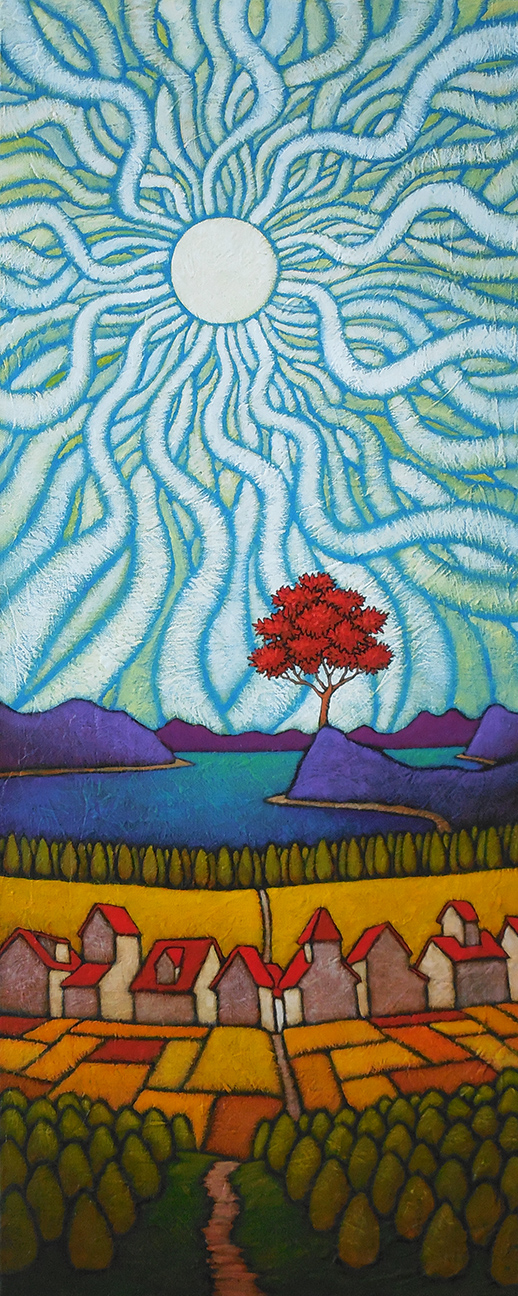
The painting at the top, Guiding Light, 24″ by 30″ on canvas, provided the title for this show. I also believe it perfectly transmits those four concepts, particularly the serenity and silence. And though it depicts a landscape with distance and depth, there is also a sense of intimacy, as though the moon here is communicating directly to the viewer. That might also be the source for amazement, something that often comes with revelation.

This piece also makes me think about what other guiding lights each of us follow. Were they always influencing us from day one or did they one day rise up and become visible to us, like the moon rising in the evening? I think some of my guiding lights were present from childhood, but some have risen in my own sky, becoming more apparent and important to me as I age.

And how closely does each of us follow what we believe to be our guiding lights? I certainly follow mine more than when I was much younger. Well, at least I think I do.

Maybe self-deception is also a guiding light? I sure hope not though I think many folks do see it as one.

I have often employed the simple shape of the sun/moon in my work as a symbol of guidance and of something greater than ourselves.  This show, my 24th solo exhibit at the West End Gallery, is filled with moons and suns. I have come to see the sun/moon as being equal in importance to my work as the Red Tree or any other of the icons that often inhabit it. As an element, it creates a palpable presence in each piece.

The third eye of the painting? I have to think on that.

As stated above, Guiding Light opens at the West End Gallery two weeks from today, on Friday, October 17, with an opening reception that runs from 5-7 PM. Also, on Saturday, November 1, I will be giving a Gallery Talk at the gallery beginning at 11 AM. Keep an eye for more details in the coming weeks.

Here’s a song that has been in my head for a couple of days. I was big fan of the album Pontiac from Lyle Lovett years ago when it first came out, but in the confusion of time and space, it somehow, for no reason, fell off of my playlist. While building frames the other day, I found the CD and played it for the first time in quite a while. It reminded me of why I liked it so much and made me wonder what other music that really hit the mark had fallen to the wayside. This song, Simple Song, has been stuck in my head ever since and seems to fit this painting this morning.


Revisiting the Past

Revisiting the Past— Coming to West End Gallery October


The images selected by memory are as arbitrary, as narrow, as elusive as those which the imagination had formed and reality has destroyed. There is no reason why, existing outside ourselves, a real place should conform to the pictures in our memory rather than those in our dreams.

–Marcel Proust, Remembrance of Things Past


The past is a foreign country; they do things differently there.

—L.P. Hartley, The Go-Between (1953)


Just remember that the things you put into your head are there forever, he said. You might want to think about that.
You forget some things, don’t you?
Yes. You forget what you want to remember and you remember what you want to forget.”

― Cormac McCarthy, The Road


I am using three passages above for this new painting, Revisiting the Past, mainly because I simply couldn’t decide between them. Each speaks to feelings I get from this piece, particularly the last line from Cormac McCarthy:

You forget what you want to remember and you remember what you want to forget.

That’s one of those things that is so filled with truth that you don’t question its veracity. While we may remember many of the better moments from our past, it is our lived moments of trauma that hang with us forever, often near the surface of our consciousness and in vivid detail.

It might be said that the kiss and the caress dwell easily in our memory, ready to be pulled up at our prompting whereas the anguish and suffering we have experienced is like a scar over a deep wound, on the surface that sometimes aches in a way we cannot ignore, constantly reminding us of how it came to be there.

There is a dreamlike quality to this painting that reminds of the passage from Proust. I, of course, interpret his words though my own filter. I certainly would not want my reality to consist of my dreams since I have only a few truly good dreams that I can recall, sitting here this morning. The dreams I remember are the ones that still haunt me, the nightmares and night terrors–those that left a scar.

Hardly the stuff on which I would want to build a reality.

The past is a foreign country; they do things differently there, the famous first line from the Hartley novel, fits perfectly with this painting for me. We revisit the past from a point in time beyond it. We are not dealing with the past as the same person or with the same circumstances or dynamics.  Time has passed and things have changed in many ways. What was once the norm has been lost or altered and the future has revealed things that were hidden at the time.

We have changed, hopefully growing in wisdom and understanding. Our perspective is from more distant point now, one that allows us to have a more objective overview. We can now hold it up and turn it to get a better idea of what it was and now means to us, like a scientist examining a specimen.

It might still hurt and haunt but at least we know the what and how of it. Maybe even the why, though sometimes the why of anything can be elusive, living completely hidden in the mind of others.

This is one of those paintings that can say a lot to someone who has ever been haunted by the past or their dreams. I can’t speak for those who haven’t experienced either.

They might be the lucky ones. Or not. Maybe we need some form of haunting in our lives.

I don’t know.

I have to stop now. Time to go to work. The painting, Revisiting the Past is 14″ by 14″ on canvas and will be available as part of Guiding Light, my solo show at the West End Gallery that opens October 17.


Gorey Times


There are so many things we’ve been brought up to believe that it takes you an awfully long time to realize that they aren’t you.

–Edward Gorey


I couldn’t write about painting this morning. I think it was the specter of yesterday’s meeting of the Generals, with the president’s spoken threat and desire to pit our military against the citizens of this country. If anyone still had any doubts as to what is happening, yesterday’s little get-together, along with last week’s nightmare address to the UN, should have dispelled them. Throw in the government shutdown along with so many other atrocities that have become everyday occurrences that don’t even raise an eyebrow, and it is obvious that we are treading in deep, dangerous waters.

Writing about my work seemed out of place this morning. So, let me rerun a post from several years about someone else’s work, namely Edward Gorey. Actually, I just wanted to post the clip at the bottom which is tangentially connected with Gorey. I needed to hear the defiant sound of this version of La Marseillaise from Casablanca this morning. It always fills me with hope.


I love the work of the late great illustrator Edward Gorey which very often took matters to dark and quirky places. His Gashlycrumb Tinies, a primer style book with small children being done in in a variety of curious ways, is a prime example. I’ve shown a few here. At face value, it’s awful yet there is a quality to it that still makes you smile at the macabre absurdity of it.

It’s often thought that Gorey, who passed away in 2000 at the age of 75, was English, mainly because much of his work looks very Victorian and Edwardian. Lots of well-appointed gentlemen and gowned matrons brandishing cigarette holders. However, he was from Chicago and lived most of his life there, in NYC and on Cape Cod, where he died. He actually only left the USA once in his lifetime.

One little factoid that interested me was that one of his stepmothers was the actress who played the cabaret musician who sang and played guitar in the movie Casablanca. She was playing the guitar during one of my all-time favorite scenes which featured Resistance fighter Victor Lazlo leading the band in a rousing version of the French anthem, La Marseillaise, that drowned out the singing of the Nazis in Rick’s bar. I guess that doesn’t mean much as far as Edward Gorey’s work but I thought it was a neat little detail.

I also like the quote at the top from Gorey. It’s one of those realizations that come only with the passing of time, after years of trying to fit one’s self into a mode of behavior that is acceptable to others. At a certain point one realizes that they don’t have to satisfy anyone’s expectations or beliefs but their own. It’s the beginning of freedom.

Anyway, have a good and Gorey day.


The Heart is Free

The Heart is Free— Coming to West End Gallery


Stone walls do not a prison make,
Nor iron bars a cage;
Minds innocent and quiet take
That for an hermitage;
If I have freedom in my love
And in my soul am free,
Angels alone, that soar above,
Enjoy such liberty.

― Richard Lovelace, To Althea, from Prison, 1641


Some folks that freely walk around are as imprisoned by their behaviors and beliefs as anyone behind the stone walls of any prison. As the 17th century poet Richard Lovelace pointed out nearly four hundred years ago, freedom is a state of mind.

For the most part, we often make our own prisons and do our own time. And conversely, we have the ability to define and make our freedom in any situation.

I was struggling to title this new painting that is headed to the West End Gallery for my annual solo exhibit in October. I saw it as representing the type of solitude that I enjoy, one that is not hindered by imposed restrictions or apartness.

The freedom of the heart and the mind.

But I also realized that my perception is not shared by a majority of folks. Most people don’t relish extended periods of time alone.  They need the sound and engagement of others and look outward, avoiding reflection and introspection.

I am not criticizing here, just noting the difference. As with everything, to each their own.

As I said, I wasn’t sure about expressing the type of solitude I saw in it in its title. Then I came across the lines from Lovelace in a prior blog entry from a few years back. It seemed to speak directly of what I was seeing in this painting.

The freedom of the heart and the mind cannot be caged or restricted. It is an island and world unto itself.

Hence, the title The Heart is Free came to be. 

I can only speak for myself, but for me it fits.

The Heart is Free is 14″ by 14″ on canvas and is included in Guiding Light, my 24th annual solo show at the West End Gallery that opens Friday, October 17.


A Bellow to the Void

A Bellow to the Void– Coming to West End Gallery


He who does not bellow the truth when he knows the truth makes himself the accomplice of liars and forgers.

–Charles Péguy, The Honest People in Basic Verities: Prose and Poetry (1943)


I didn’t know much about him when I came across the words above, but the author of them, Charles Péguy, was an interesting character from what little research I have done this early morning. Born into poverty in Orleans in 1873 and fatherless since the age of one, Péguy transcended his rough start in life with education, becoming a well-known essayist and poet in France. deeply nationalistic, Péguy enlisted at the outbreak of WWI and was among the first soldiers sent into battle. He died in combat at Marne in 1914.

The Poetry Foundation article on him states:

French poet, philosopher, and journalist Charles Péguy grew up poor in Orléans, France. He combined fervent Catholicism with socialist politics to create a body of work unlike any other. As a Twentieth-Century Literary Criticism writer suggested, “Most critics find that Péguy’s literary works exist outside the mainstream of modern French literature.” George E. Gingras, writing in the Encyclopedia of World Literature, noted, “Ultimately unclassifiable, Péguy was a solitary, best remembered for resisting all forces seeking to make political capital out of moral issues.” Péguy composed lengthy poems and plays, but philosophical journalism is his trademark.

In my brief research, I am finding he it is hard to attach a label on him. Unclassifiable is probably the right word for him. There seems to be a contrarian streak to him, one that made him willing to speak the truth as he saw it even when it went against the prevailing tides of sentiment. The next lines that follow the passage at the top are:

One must always tell what one sees. Above all, which is more difficult, one must always see what one sees.

A word is not the same with one writer as with another. One tears it from his guts. The other pulls it out of his overcoat pocket.

All three of these short lines speak a truth, at least in the way I perceive them. If you see what you see, you must say what it is and to remain silent, refusing to bellow out what it is that you do see, you then become complicit with those who seek to deceive and abuse. That certainly seems applicable to the current situation. Actually, it’s a truth that speaks to any time because there have always been those seeking to deceive and abuse along with the many who have remained mute as it happens.

That final line about a word not being the same with one writer as with another translates to artists as well. The work of some artists from the gut, is part and parcel of their being, while other artists maintain a distance in their work from their gut, their true self. This distance can sometimes be cloaked in beauty, but it is often perceptible, bringing a coolness and aloofness to the work.

Like the soul is not fully engaged.

Obviously, I hope that my work falls in that from-the-gut and with a bit of soul category. At least, I try to create it in such a way. Maybe I am not always successful, but I try to say what I see.

And I do try to bellow the truth in what I see. We have so little time here and the voice of each of us needs to ring out in some way that to not bellow what is right and true is a deception of ourselves and our souls.

That is what I see in the new painting at the top, A Bellow to the Void. It is 14″ by 14″ on canvas and is included in my October solo show, Guiding Light, at the West End Gallery. There is a primal quality in the image of someone yelling their truth into the night sky. Like Whitman’s barbaric yawp echoing over the rooftops of the world.

As I said, we have so little time here. We are witnesses to our lives and times. To say what we see, to bellow it out to the void, is a duty to ourselves, our descendants, and our souls.

That’s enough said for now. I have to get upon the roof now. A bellow will soon commence.

Here’s Mumford and Sons with their Awake My Soul. Good stuff to kickstart your soul on a Monday morning.


Running the Moons— At Principle Gallery


He began to search among the infinite series of impressions which time had laid down, leaf upon leaf, fold upon fold softly, incessantly upon his brain; among scents, sounds; voices, harsh, hollow, sweet; and lights passing, and brooms tapping; and the wash and hush of the sea.

–Virginia Woolf, To the Lighthouse (1927)


I’m a bit tired this morning and have to get right back to work this morning to finish up work for my upcoming West End Gallery show so this is going to be shorter than it should be. It was a long day yesterday, most of it spent on the road, but it was a good day with what I felt was a fun Gallery Talk.

Well, I had fun.

I just want to extend a special Thank You to all that came out to participated. I could not be more appreciative of the warmth and friendliness that I received from you. Your attention, kindness, questions, and comments were the real strong points of the talk yesterday, making me feel as comfortable as possible in my uncomfortable role of standing and speaking before a group.

You folks made it fun for me as well as providing a large boost of energy and a positive affirmation of sorts, something much needed in a year that has been filled with doubts, loss, and uncertainty along with several health concerns.

I received much more than I gave yesterday– and I needed it all. You deserve all the thanks I can muster.

And, of course, a special Thank You to Michele and her wonderful group at the Principle Gallery– Clint, Taylor, Owen, and Brady. I could write a lot of words here (and probably should) about how much your friendship and affection, your caring attitude, and your hard work has meant to me in the 28+ years we have worked together, but my words would never properly capture the depth of feeling I have.

So, I will simply say Thank You with the hopes you know how much I truly mean those two simple words.

Hard to believe I’ve been with the Principle Gallery for over 28 years now. Like the title song chosen for this week’s Sunday Morning Music says, it’s Funny How Time Slips Away. This version is from the great Al Green and Lyle Lovett.

Here’s to many more years…


Racing Chaos— At Principle Gallery Today!


On the road this morning, headed down the highway to Alexandria for today’s Gallery Talk at the Principle Gallery. I’m hauling a group of new work (above), a painting (below) and maybe another to give away, some stories to tell, and the hope that I don’t fall off the highwire that I am stumbling around on while I talk.

But even if that happens– and it very well could– I am looking forward to today’s Gallery Talk and getting to chat with friends, old and new. Hopefully, they’ll take away something from the Talk that will stick with them for a while. 

The Gallery Talk takes place at the Principle Gallery today, Saturday, September 27, beginning at 1PM. Come early to grab a seat. We can talk a bit before the proceedings begin and you can also fill out your entry for free drawing for the painting below which is going to be given away at the end of the talk.

It could be a good time. And these days, we could use all the good times we can grab, right?

Here’s a song, Mess Around, from Eilen Jewell. I don’t know if this applies in any way to today’s Talk but it has a sound and feel that always makes me stop in recognition whenever it comes on. Good traveling song. Hope to see you there so we can all mess around together.


A Place of Sanctuary— You Could Win This Painting!