Feeds:
Posts
Comments

Continuity

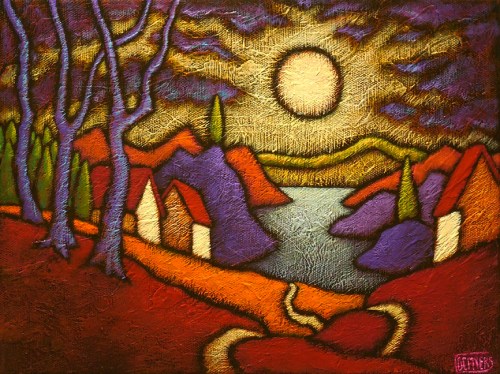
GC Myers- The Allure 2022

The Allure— At the West End Gallery


I know only that I was born and exist, and it seems to me that I have been carried along. I exist on the foundation of something I do not know. In spite of all uncertainties, I feel a solidity underlying all existence and a continuity in my mode of being.

-Carl Jung, Memories, Dreams, Reflections


Well, this year’s solo effort at the West End Gallery draws to a close after today. There is always a bit of sadness when the work comes off the walls.

It feels like a true ending.

But having done this job, if I can call being an artist that, for many years now, I have seen a lot of shows come to an end. With that comes the realization that it is not the end of anything but a period of time.

The end of a short chapter in a long and endless book.

I am not sure why I began thinking this thought this morning. Maybe it was looking closely at the painting above and some of the others in this show recently.

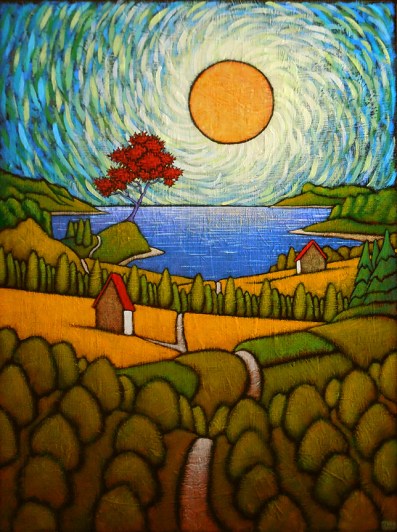
I paint my suns and moons in a very distinct way, with a dark outline around the lighter center. It’s almost childish in the way it presents the sun as big ball with a black line around it. I have been doing it that way for so long that it feels perfectly natural to my hand, eye, and mind. It has become its own continuity and I never even give a thought to doing it in any other way.

This morning I wondered why that was.

I came up with a variety of answers, most applicable but unsatisfying in the end. But one really struck me and seemed to ring true when I viewed these suns and moons in a variety of my other paintings where they served as prominent features.

That one answer was that perhaps that line represents for me the continuity and circular nature of time and life. The lines around the suns and moons emphasize the consistency in their existence. They rise and fall in the sky above, followed by the same the next day.

That continuity is soothing in that it keeps us in a state of equilibrium. Whatever our problems and losses might be– or even our triumphs– it serves as constant reminder that there is another day and with it comes the new. Some good, some bad, some indifferent. But each is generally only for the short term. Ultimately, there should be balance.

I know I am not explaining this fully or well. But it helps me to realize that I am seeing these suns/moons as a symbol of continuity and balance. It makes me look at my own work with a slightly altered eye.

And it makes the end of things like this show seem inconsequential in the context of the bigger picture. As I said, it is the end of a chapter.

Turn the page and another begins.

If you have made it in to see the show, I sincerely thank you.

If not, it is not the end. Another chance comes around that circle eventually. Maybe then…
The Inside Man

GC Myers- Imitatio

Imitatio– At the West End Gallery


There is probably no point in my going into your questions now; for what I could say about your tendency to doubt or about your inability to bring your outer and inner lives into harmony or about all the other thing that oppress you – : is just what I have already said: just the wish that you may find in yourself enough patience to endure and enough simplicity to have faith; that you may gain more and more confidence in what is difficult and in your solitude among other people. And as for the rest, let life happen to you. Believe me: life is in the right, always.

–Rainer Maria Rilke, Letters to a Young Poet (1934)


When in doubt, always go to Rilke’s Letters to a Young Poet. I thought the passage above would go well with the painting at the top and the piece of music at the bottom.

He writes of the young poet’s inability to bring his inner and outer lives into harmony. That’s something I understand, this trying to find a sense of balance between the inner and outer me that meets the criteria needed for survival in both.

I see this in this painting that is part of my soon-to-be-gone show at the West End Gallery. It’s called Imitatio and, for me, it’s about this struggle in a way. It asks questions: Is art a reflection of our inner or outer self? Or is our inner self a reflection of art? How do we find that balance between the art we feel inside and the life we live in the outer world?

Yeah, I know. You’re looking and asking where those questions are in the painting. But, trust me, I see them there in the signs of both a struggle and a celebration.

What you see is on your shoulders.

The song I chose is called The Inside Man. I have no idea about its title’s meaning but for today it refers to the inner part of us. It feels right somehow. It’s a piece I stumbled across awhile back, a piece of dance music from a Croatian DJ/ musician, Funky Destination, that I find myself going back to time and time again. It never fails to grab my attention and stir both my inner and outer self

Finally, a reminder that there are two days– just today and tomorrow– left in this year’s show at the West End Gallery. Hope you can make it in to see Imatatio and the others. Let’s give Rilke the final word here:

And as for the rest, let life happen to you. Believe me: life is in the right, always.


End of the Line

Show Final 3 Days ver 2


Well, it’s alright, even if they say you’re wrongWell, it’s alright, sometimes you gotta be strongWell, it’s alright, as long as you got somewhere to layWell, it’s alright, every day is judgment day

–The Traveling Wilburys, End of the Line


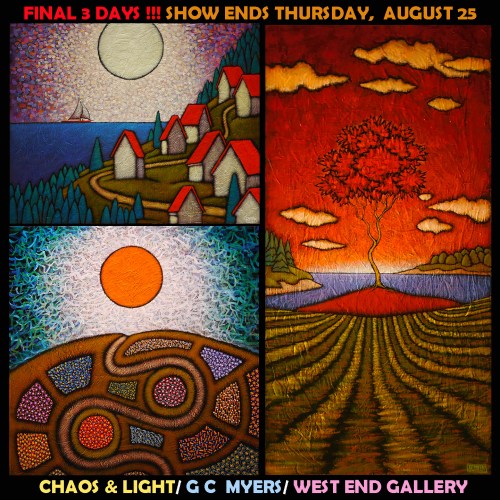
This morning, I am just going to point out that my exhibit now hanging at the West End Gallery, Chaos & Light, is in its final days. It comes off the walls at the end of the day on Thursday, August 25, so if you have any desire to take in this show, you have to get into the gallery pronto.

It’s a show that has felt good for me in many ways, really clicking off a lot of the boxes in my list of things in which I take satisfaction. It has a sense of fullness and completion that pleased me in a surprising way when it was all together.

That’s something that I can’t really explain because it’s just a gut feeling, an intuitive reading of the work as it hangs together. I used the word surprising because I am always on the search for what might termed deficiencies or, at least, weak links in the chain that the work forms. I can generally find something, even if it’s a mere triviality of no consequence in the end, that I use to temper any excessive pride or hubris I might have built up.

I couldn’t find much of anything to fret about in this show. It just felt right.

And that’s a rare thing. Which is why I might be feeling a bit more wistful about this show ending. But as they say, all good things must come to an end.

And this week marks the end of the line. So, if you can, make your way to the West End Gallery before this coming Friday.

Here’s a song from the Traveling Wilburys that sums it all up– End of the Line. The Traveling Wilburys were, if you remember, a supergroup assembled in the late 1980’s, comprised of Roy Orbison, Bob Dylan, George Harrison, Tom Petty, and Jeff Lynne. This was probably their best-known song and it holds up pretty well.


Klee’s Secret Place

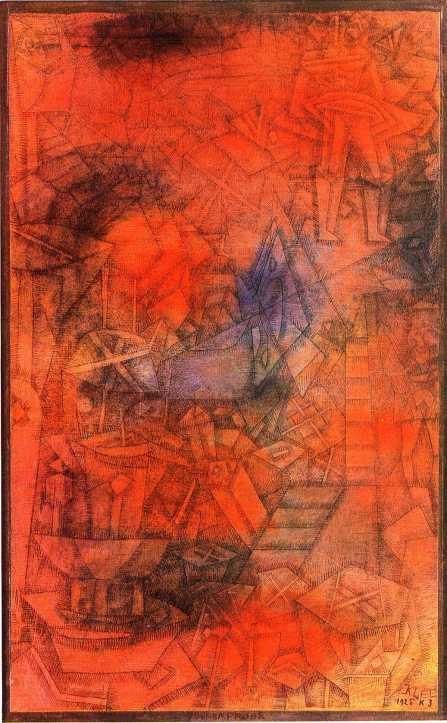
Paul Klee Groynes 1925

Paul Klee, Groynes, 1925


Chosen are those artists who penetrate to the region of that secret place where primeval power nurtures all evolution. There, where the powerhouse of all time and space call it brain or heart of creation activates every function, who is the artist who would not dwell there?

–Paul Klee


I featured Wassily Kandinsky here last week, pointing out that he was one of the artists who really sparked me with both their works and words. I can almost always find something in his work or his writings that sets my mind racing.

It might come in the form of a visual cue in his paintings or an ideological one in his writings. The interesting part of this is that it’s not always apparent where this inspiration is sending me. It generally feels like something new to me.

And that’s always exciting.

Another artist who does the same thing for me is Paul Klee.

A few days ago, I came across the piece at the top, Groynes, from 1925. Like the Kandinsky piece from last week, this was a painting that I had never viewed before. I can tell, even with my faulty memory, because there is a reaction to certain pieces of art of any kind that leaves a mark.

Maybe it’s a burn from the sparks it sets off. I don’t really know. But I would have remembered seeing it.

The funny thing is that I don’t expect many others to react as strongly to it as I did. There are pieces of art that have an obvious intrinsic appeal– the classically beautiful– where one would not be surprised by a widespread positive reaction. I would not anticipate that kind of reaction to this piece.

But something in it just stopped me. I have been coming back to it over the past few days and can’t put my finger on what I am seeing in it, why it made say “oh!” aloud when I first saw it. And I can’t tell how– or if– I will metamorphize and incorporate it into my own work or thinking. 

It’s perplexing. But in the best sort of way.

By the way, I couldn’t find out much about this piece, even to what the title refers. Groynes are typically barriers that extend out into the water perpendicular to the shore of a river or large body of water to control erosion. But Klee often used words in his own way so it may have another meaning altogether.

I don’t know and it doesn’t really matter to me much. The fire has been already lit.


Stay the Road

GC Myers- Last Kind Words

Last Kind Words- At the West End Gallery


The tree the tempest with a crash of wood
Throws down in front of us is not to bar
Our passage to our journey’s end for good,
But just to ask us who we think we are

-Robert Frost, from On a Tree Fallen Across the Road


Sunday morning. Quiet. Gray skies, waiting for a little thunder in a bit. Maybe an hour or two of showers, something we can always use.

I am getting ready to work this morning, as always. I say work but that gives the wrong impression. It’s not really work. It’s more of an ingrained pattern, a necessary compulsion that keeps me on my path.

It’s sort of my respirator. Keeps me breathing, keeps me alive.

We’ll leave it at that this morning, with me breathing, working, and living. All good things.

For this Sunday morning’s musical selection, here’s a song, Stay the Road, from Glen Hansard. He’s one of those great talents that is so personally unassuming that he sometimes gets overlooked yet his work is consistently rock-solid in all ways. I can’t think of a creative misstep he has taken in all the years I have been aware of him. Always worth a listen.


GC Myers-  Lake Life  2022

Lake Life — Now at the West End Gallery


It is the artist’s business to create sunshine when the sun fails.

–Romain Rolland, The Market-Place  (1908)


One of my favorite parts of writing this blog is that there are often days when I don’t feel like writing anything and don’t have much to say that end up with me finding new people or art or music that was unknown to me before that morning. A bit of unexpected education that falls into my lap.

It’s that way this morning. I had no plans on writing much. Maybe tell people that there are only a few days to see my current show at the West End Gallery before it comes down after this coming Thursday. Maybe show a painting from the show, like Lake Life, shown at the top.

But I thought I’d throw in bit of music, something that seemed to match up with the painting. That came quickly. I immediately found a piece from a jazz trumpeter, Takuya Kuroda, whose work I did not know until this morning. The song, Everybody Loves the Sunshine, really hit me and has been replayed seevral times in the studio this morning. Feels like the perfect song for starting off this Saturday and a good match to go with the tone of Lake Life.

Since that came so easily, I thought I’d throw in a quote and came across the one at the top:

It is the artist’s business to create sunshine when the sun fails.

I don’t know if I completely agree with that in all cases, but I think sometimes this is a true statement. It’s a business of trying to create reaction and feeling. And everybody loves the sunshine. So, often an artist is trying to bring some form of sunshine to others.

That sounds pretty good so I chose to go with that short quote. But I couldn’t quite place the author, Romain Rolland. It sounded familiar but I didn’t really know who he was or any of his work which is a shame. It turns out he was French writer and dramatist who lived from 1866 to 1944. He had a most interesting life and he was friends and frequent correspondent with some of the most influential people of the time– Sigmund Freud, Hemann Hesse, Richard Strauss, Gandhi, and even Joseph Stalin.

Most notably, Rolland won the Nobel Prize for Literature in 1915 for his 10-volume novel Jean Christophe, from which the short quote here today was taken.

Makes me want to do a little more research. Like I said, I didn’t want to write anything this morning. Maybe just listen to some music, read the news, and drink coffee. But I now unexpectedly have some new music to explore and a new writer to research and, most likely, soon lose in some corner of my memory.

But that’s okay. It’s a sunny pleasant morning and as we know, everybody loves the sunshine.

Enjoy your day.


Cloths of Heaven

GC Myers- Chaos & Light sm

Chaos & Light— Show Closes August 25 at the West End Gallery


Had I the heavens’ embroidered cloths,
Enwrought with golden and silver light,
The blue and the dim and the dark cloths
Of night and light and the half light,
I would spread the cloths under your feet:
But I, being poor, have only my dreams;
I have spread my dreams under your feet;
Tread softly because you tread on my dreams.

William Butler Yeats, Aedh Wishes for the Cloths of Heaven


I wanted some bit of writing to pair with the title painting, Chaos & Light, for my current West End Gallery show which ends next week, on Thursday, August 25. I thought of a poem from W.B. Yeats originally called Aedh Wishes For the Cloths of Heaven. Aedh was an Irish name derived from a god from Irish mythology, sometimes referred to as the god of death. It was also a character name used by Yeats in some of his works such as this poem. 

The title was later changed to He Wishes For the Cloths of Heaven, dropping the Aedh from its title. I don’t know if this was done by Yeats or later editors who felt that the change might broaden the understanding and appeal of the poem. It probably cut down on people asking who or what this Aedh was, as well.

This poem, at eight lines, is Yeats’ shortest poem and covers territory, the love offering, that has been explored by countless poets through the ages. I read a short analysis of this poem and it was pointed out that the thing that made this poem stand out among the many other similar poems of this type is the repetition of key words, especially in piece with such a limited number of lines: cloths (three times), dreams (three times), light (three times), spread (twice), tread (twice), under your feet (twice). 

The writer of this analysis points out the effect of this repetition changes the rhythm of the lines as well which makes it unique among other such poems while at the same time giving the poem a sense of simplicity, even one of familiarity and banality, that belies its depth. This allows the reader to easily take in the whole of the work before they even recognize or understand the true depth of feeling contained.

I mention this because this idea the simplicity of form, of the repetition of forms giving a work a sense of familiarity and banality that masks its depth of feeling is how I often see my own work. Rearranging these familiar, oft-used forms in my paintings is like moving repeated words within a poem to create new rhythms and depths. 

I can certainly see that in Chaos & Light at the top. It has many forms that will be familiar to those of you who know my work. But the arrangement of these forms combined with variations of light and dark, colors and contrasts, surface textures, etc., make it into something unique, something with its own sense of feeling and depths. 

Or maybe it’s just me wishing for the cloths of heaven. Who knows? Below is a very short reading of the Yeats poem from Tom O’Bedlam. Might be worth 35 seconds of your time.


Night's Desire sm

Night’s Desire— At the West End Gallery


I have studied many times
The marble which was chiseled for me–
A boat with a furled sail at rest in a harbor.
In truth it pictures not my destination
But my life.
For love was offered me and I shrank from its disillusionment;
Sorrow knocked at my door, but I was afraid;
Ambition called to me, but I dreaded the chances.
Yet all the while I hungered for meaning in my life.
And now I know that we must lift the sail
And catch the winds of destiny
Wherever they drive the boat.
To put meaning in one’s life may end in madness,
But life without meaning is the torture
Of restlessness and vague desire–
It is a boat longing for the sea and yet afraid.

-Edgar Lee Masters, George Gray


I hear the plans of scientists and moguls and find myself wondering why we so want to return to the moon, more than fifty years after we first stepped on its surface. It doesn’t seem to be far away enough to serve as an outpost for further exploration of space nor does it seem to be the perfect new home. It would take a lot of work to make it amenable to humans which doesn’t make a lot of sense when we have a perfectly good fixer-upper right here on Earth just waiting for some TLC.

Maybe it’s because it’s just hanging there before us there in the sky on most nights, so near yet so far away.

Maybe because it is there and not here.

Maybe it has become a constant symbol of our desires. That would make sense then, that all our desires lie there somehow in the form of the unblinking eye of the moon.

Why wouldn’t we want to reach that place?

That might make some sort of sense but then again, obtaining the thing we so want does not always bring us the fulfillment we thought it might. Unless one’s wish is to be free of desire, it often only brings a new set of desires.

A new moon to gaze upon, and with it, more restlessness and vague desires.

For me, I am content to have the moon as a mere object that reflects light on all that we have at hand here on this eternal fixer-upper, this Earth.

Amen.

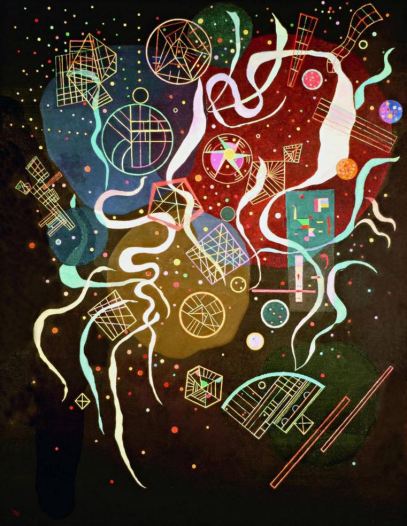
Kandinsky Movement I 1935

Wassily Kandinsky- Movement I. 1935


The artist must have something to say, for mastery over form is not his goal but rather the adapting of form to its inner meaning.

–Wassily Kandinsky, On the Spiritual In Art


I had been feeling a little blah in recent weeks, especially as far as my work is concerned. Not motivated. Everything seemed like a slog or heavy toil. I couldn’t focus and couldn’t see anything on the canvas before me.

No motivation whatsoever.

But two things occurred yesterday that gave me a kick in the pants, in the creative sense.

First, I had a commissioned piece that I needed to start. I had the canvas prepped and ready to rock but I still felt like putting it off. And I might have, except for the fact that I had already burned through every excuse and roadblock I could come up with to prevent me from starting.

It had to be done.

So, I started, and a funny thing happened: It felt damn good, much better than I had imagined. Things came easy and I was soon pulled fully into the piece.

It was like an adrenaline injection, one that was desperately needed. It started my engine and I was mentally pulling things– color combinations and forms and angles– I was seeing in this piece to be employed in the next pieces.

It’s a form of self-generating momentum that I greatly depend on. It was good to feel that again after the past few weeks of dull listlessness.

Then, while taking a short break, I came across the image at the top online from Wassily Kandinsky, Movement I. I am a fan of Kandinsky’s works and words, especially his book, On the Spiritual in Art, which I keep close at hand here in the studio. I have seen much of his work but this one seemed to have evaded my eye before yesterday.

Seeing it was like a second shot of adrenaline. It set off all sorts of creative sparks within me and I was seeing things in it that would be employing in future works. I felt a giddiness to get to this new unrealized work as soon as possible.

I can’t fully describe how the things I see in this piece will translate into my own work. It will most likely be undiscernible to the casual viewer or even the most ardent follower of my work. That’s how inspiration works.

However, I have had similar bursts of energy and ideas before that I just couldn’t bring across the line in a way that fully satisfied me. Many of them are in stacks and boxes in a room here in the studio and will likely never be shown. So, while I can say that this burst of energy will create something new, I can’t guarantee that this surge will result in good work.

That is also how inspiration works.

Even so, I am grateful for it this morning. Now, I gladly get back to work.


Sadly, last night was the final episode of the television series, Better Call Saul. I am not going to go into the wonderful characters and storytelling that made it great viewing. No spoilers here, either.

Instead, I wanted to comment on the beauty of the black and white filming employed in the final couple of episodes to portray the most recent section of the story’s timeline. The black and white was gorgeous, in deep contrasts of black, white, silver and gray. It really accentuated how well composed the images were that you were viewing.

Many were put together with the eye of a great photographer or painter. Many of the individual images from these episodes could be reproduced to make credible art prints. It reminded me of the beautiful use of similar black and white in the film Nebraska. I wondered if the fact that much of the last episodes took place in Nebraska had any influence. This in turn made me think of the work of Nebraska-born photographer Wright Morris who I wrote about here a number of years back.

I wonder if there is an actual line of influence that runs through the three: Morris -Nebraska- Saul? Maybe, maybe not. Doesn’t make much of a difference in how any of them are perceived. I just like to see how work integrates influences and how that integration is passed onward to influence the work of others.

Anyway, Below is that earlier entry on Wright Morris. You might see how I integrated his influence in my own work.


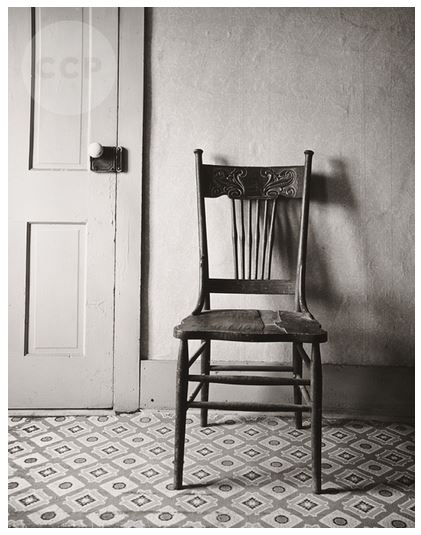
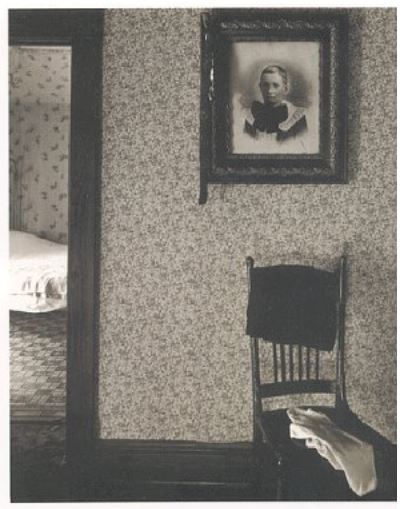
Wright Morris Straightback Chair- The Home Place

Writght Morris- Straightback Chair, The Home Place

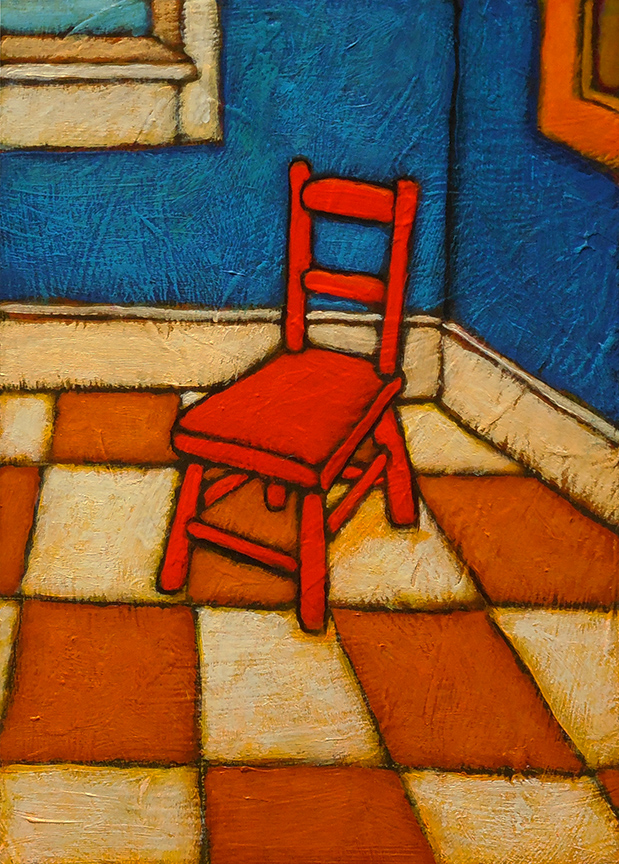
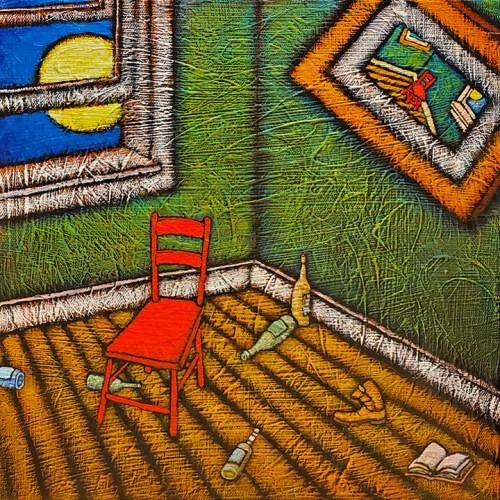
One of the most common questions I am asked at gallery openings or talks is about the meaning behind the Red Chair in my paintings.  I always struggle to answer. Maybe because the answer is always changing for me.  I don’t really know. I do know that I use it in my work because the chair is such an identifiable image that is known to anyone in nearly any culture and has an inherent meaning in its form. A place to sit and rest. Or eat. Or converse. Or any number of things.

It is simply an icon of human existence.

But looking through some photo sites I came across the work of Nebraska-born photographer/writer Wright Morris (1910-1998). His stark and striking images of the Plains will seem very familiar to anyone who saw last year’s Alexander Payne film, Nebraska. I don’t know but would not be surprised if Morris’ imagery was a big influence on the visual look of the black and white film.

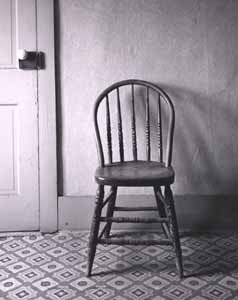
Wright Morris- Chair, The Home Place

Wright Morris- Chair, The Home Place

But while looking at some of these photos I came across a few images of chairs in a farmhouse. They were from a book of his titled The Home Place, a photo-novel telling the story of a man’s one-day visit to where he had spent his childhood in Nebraska, the home place. The images were very evocative and looking at them, it dawned on me that the meaning of the Red Chair was the same. It was so obvious– it was the Home Place. The place where you have a chair in which to sit, accepted as a part of that place.

It is simple yet powerful, like Wright Morris’ photos.

It’s good to have an answer to give now when someone asks…

Wright Morris Picture of Boy- The Home Place

In a Corner– At the West End Gallery