Feeds:
Posts
Comments

Merton/ Comforter

PG GCMyers-- Comforter sm

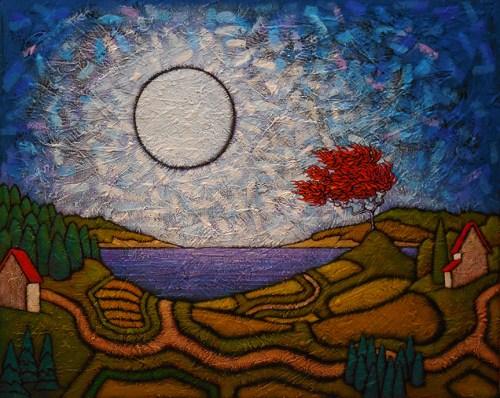
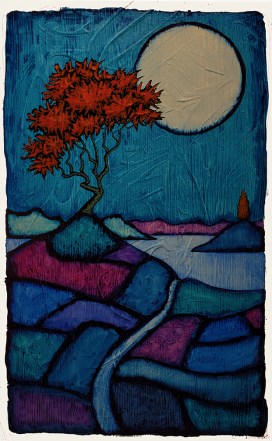
Comforter – At the West End Gallery


But there is a greater comfort in the substance of silence than in the answer to a question. Eternity is in the present. Eternity is in the palm of the hand. Eternity is a seed of fire, whose sudden roots break barriers that keep my heart from being an abyss.

The things of Time are in connivance with eternity…

― Thomas Merton, “Fire Watch, July 4, 1952”


The painting above is titled Comforter and is part of my current show at the West End Gallery in Corning. The title feels self-evident in the painting with its shades of blue that are underlaid with layers of magenta that give it a warmth that I find comforting. The warm light of the moon also has a calming effect and the patchwork effect of the fields speaks directly of a quilt or comforter.

As I said, the title speaks for itself.

Merton’s passage adds a layer of spiritual comfort to this piece. It comes from an epilogue for his book The Sign of Jonas and details one of his first duties as a novice monk performing a fire watch. It entailed walking through the monastery in the early hours of the morning making sure that all was well, that no accidental fires or water leaks were taking place. It was a task filled with silence and vigilance but also one that offered comfort in the knowledge that all was well.

And that seems to fit with this small painting. The Red Tree seems to be overlooking all while pondering its own existence, its own purpose. And in doing this silent duty, it finds comfort.

Another passage from Merton’s essay seems applicable as well:

And now my whole being breathes the wind which blows through the belfry, and my hand is on the door through which I see the heavens.  The door swings out upon a vast sea of darkness and of prayer.  Will it come like this, the moment of my death?  Will You open a door upon the great forest and set my feet upon a ladder under the moon, and take me out among the stars?

Perhaps the Red Tree is looking for that ladder under the moon.

I need to think on that a bit more. In the comfort of silence.


GC Myers- Where the Road Ends sm

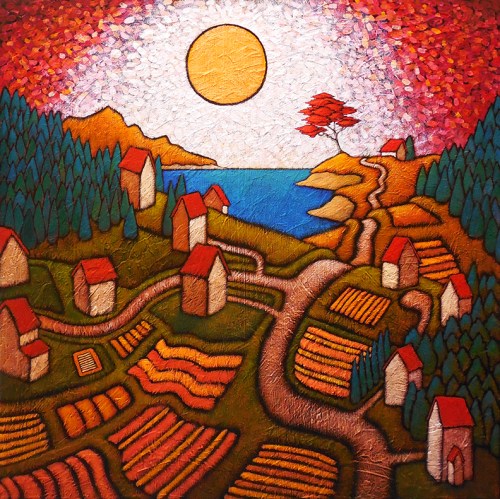
Where the Road Ends— At the West End Gallery


‘Light came from the east,’ he sang,
‘Bright guarantee of God, and the waves went quiet.
I could see the headlands and buffeted cliffs.
Often, for marked courage, fate spares the man
It has not marked already.’

And when their objection was reported to him —
That he had gone to bits and was leaving them
Nothing to hold on to, his first and last lines
Neither here nor there–

‘Since when,’ he asked,
‘Are the first and last line of any poem
Where the poem begins and ends?’

― Seamus Heaney, The Fragment


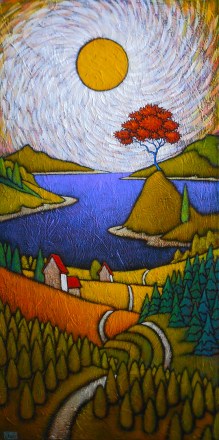
The short poem above from Seamus Heaney made me think about this painting, Where the Road Ends, and a number of my other pieces.

So often I think of my paintings as taking the viewer into the picture toward an ending point. Everything carries the eye inward to a desired point within the picture.

The end of the painting, its destination.

But maybe I should reconsider and see it as being a beginning, a point of departure where the central object of the piece, the Red Tree in this case, begins an outward journey, one that takes it away from me and all I have both invested and taken from it.

Maybe the poem that I see in it is not coming to an end but only beginning.

I guess, in a way, I have always known that. The tree in my Red Tree paintings is always the last element added and that carries with it a finality. That final brushstroke on the Red Tree generally marks the end of my creative input.

It is the place where the road ends for me.

But at that point, the painting is just beginning its life, its journey. Like the lives of many people, its journey in this new life may be one filled with days of boredom, of neglect, and feeling underappreciated. It might even be hidden away or discarded, replaced with something newer

But on the other hand, it might be the beginning of a life where it inspires and is loved and appreciated.

I can never know for sure which way it might go when my ending with these works becomes a beginning for them and someone else. I can only hope for good things for them and savor my time and experience with them.

And a poem ends with a line that begins another…

GC Myers-  Symphony of Silence  2021

Symphony of Silence– Now at the West End Gallery


Out beyond ideas of wrongdoing
and rightdoing there is a field.
I’ll meet you there.

When the soul lies down in that grass
the world is too full to talk about.

― Rumi, 13th century Persian poet


The new painting at the top, an 18″ by 36″ canvas, is titled Symphony of Silence. It is currently included in my Chaos & Light show at the West End Gallery.

I have written in the past about what I see as the connection between painting and music, how I see some of my pieces as simple songs and others as more intricate compositions. Perhaps symphonies or concertos.

This, in my eyes, is one that seems simple at a first glance. It is sparse and without many details. But the more I look at it, the more I see in it. How each element and color plays off the next and how they are fortified by each. It feels like there are rhythms and melodies running through it, from side to side as the terrain flows and up and down with rise of the moon.  There is inward and outward movement with the light of the stars and the undulation of the trail. The blocks that make up the night sky seem to swirl and rotate in all directions. The far mountains appear almost as sound waves.

There is seemingly constant movement throughout the landscape and the skyscape. Almost a cacophony.

Almost.

It is silence.

Somehow the movements, the rhythms, and contrasts all run together at some point.

Harmony. Made up from the light of stars in motion countless lightyears away. Made from the ancient wisdom contained in the stillness of the land and water. Made from the poetry of landscape shaped by the forces of nature.

A harmony that is always there, existing in silence.

It is a simple piece but one that never fails to divulge something more to the viewer who is willing to share their own silence with it.

Here’s a piece of music to accompany it, a longtime favorite of mine and one that has played a large part in how I came to view my own work. It’s from composer Arvo Pärt and his composition Tabula Rasa. This is the second movement, fittingly titled Silentium. It feels right with this painting.


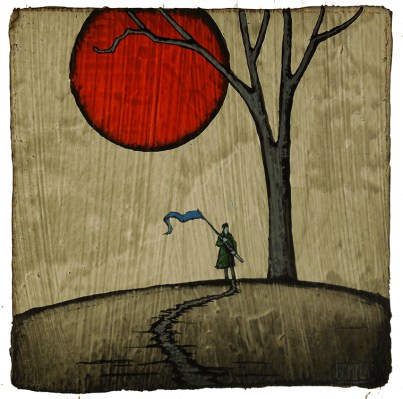
GC Myers- Carry the Blue Flag

Carry the Blue Flag— At the West End Gallery


I can’t run no more
With that lawless crowd
While the killers in high places
Say their prayers out loud
But they’ve summoned, they’ve summoned up
A thundercloud
They’re going to hear from me

Ring the bells that still can ring
Forget your perfect offering
There is a crack, a crack in everything
That’s how the light gets in

–Leonard Cohen, Anthem


Storm clouds came across and a thunderbolt rocked the Plains last night.

One word: Kansas.

I am not going to say anymore, not going to explain. But I will add, as in the lines from Leonard Cohen, there are cracks appearing and light is beginning to come through.

Kansas, of all places, gives me hope for the future. It makes me believe that people are finally recognizing the fragility of this democracy and are capable of standing in large number against the threat and treachery of minority-rule authoritarianism.

I sometimes think we have become too distracted and complacent, too docile in trusting that things will just naturally work out without our attention and effort.

However, it doesn’t work that way. Our history is one of an almost constant battle to gain and maintain basic rights and freedoms for all. The events and potentials which we face now may exceed those fevered battles of the past because all of the prior victories are at risk again. and could be quickly lost.

Kansas gives me hope that victory is possible.

It is a distinct moment in our history so please embrace it.

Look for the light and relish the fight.

As Ralph Waldo Emerson wrote of another such time:

If there is any period one would desire to be born in, ⎯ is it not the age of Revolution; when the old and the new stand side by side, and admit of being compared; when the energies of all men are searched by fear and by hope; when the historic glories of the old, can be compensated by the rich possibilities of the new era? This time, like all times, is a very good one, if we but know what to do with it.

Here’s Leonard Cohen and his classic Anthem.


Struggle and Will

GC Myers- Struggle and Will

Struggle and Will– At the West End Gallery


There is scarcely any passion without struggle.

Albert Camus, The Myth of Sisyphus and Other Essays


Or, to put it a different way:


having nothing to struggle
against
they have nothing to struggle
for.

–Charles Bukowski


Just asking questions this morning. I certainly don’t have answers, at least, none that have actual proof of being correct. Most of my questions refer in some way to what I see in the painting at the top, a new piece titled Struggle and Will, which is included in my current show at the West End Gallery.

As the title suggests, I see it as being primarily about struggle and perseverance against opposing forces, both external and internal. The struggle between desire and reality. Between justice and injustice, right and wrong. Between truth and illusion. Between comfort and impoverishment.

I have been thinking lately about how passion, particularly creative passion, is often fed by these same struggles.

This begs the questions:

Is there creative passion without struggle?

What is the primary driver of creative passion?

Does sheer ability or craftsmanship equate to or even supersede passion? That leads to: Can the talented truly produce art without possessing passion?

I hope the answer to that last one is a no but then again, I don’t know.

I am certain I could answer from differing viewpoints on any of these questions and each would be valid, anecdotally. I suppose creative passion, like art in general, exists without rules. Creative passion might grow in someone who seems from the outside to have had an easy life with, if any, few struggles. Conversely, it may not exist at all in someone who has had to fight and struggle every day of their life.

Probably not a right answer to any of these. Maybe these aren’t even the right questions to be asking.

Maybe the question should be: What defines struggle?

Or: For what do you struggle?

Again, no answers here. But writing this just now, I am reminded of a line from the classic film The Third Man. Orson Welles, playing the post-war racketeer Harry Lime, speaks in a roundabout way about passion produced in struggle:

After all, it’s not that awful. You know what the fellow said – in Italy, for thirty years under the Borgias, they had warfare, terror, murder, and bloodshed, but they produced Michelangelo, Leonardo da Vinci, and the Renaissance. In Switzerland, they had brotherly love, they had five hundred years of democracy and peace. And what did that produce? The cuckoo clock.

He was factually off a bit as the cuckoo clock is a German creation, but the point is well made.

Maybe passion does require struggle…

Forgetfulness


July is gone and we stumble forward into the dreaded, steamy days of August. I wish I had better memories of Augusts from the past but somehow such memory fails me.

Maybe that’s a good thing. Sometimes the fading or loss of a memory allows us to move on.

This thought came to mind when I came across the poem Forgetfulness from former US Poet Laureate Billy Collins. At its beginning the poem describes forgetting the author or title or plot of a book or even whether one has read that particular book. It struck a chord because it’s a feeling I have experienced many times in recent years.

A back bedroom of my studio is a makeshift library with bookshelves lining the walls. Even the shelves in the top of that room’s closet are stacked with books. There are hundreds and hundreds of books picked up over the decades.

To be honest, I have not read them all. Probably the majority of them. There is too little time and too many other demands on it.

But more troubling is that feeling when I enter the room and scan the shelves and come upon a title and can’t quite remember if I have read it. I might think I have but can’t pull up any of the details, can’t recall the idea behind the book or even vaguely remember the style or rhythm of the writing. I’ll pick it up then and start reading a bit before suddenly recognizing something that makes me realize that I have indeed read this book before.

But it still feels like a mystery to me, and I have no doubt that I will be no less surprised by any revelations the book might offer if I continue reading now as I did the first time.

Those moments make me chuckle a bit but also make me a little sad. It just feels like evidence of something lost. Oh, this book might not be of any great significance in my life so perhaps it is no big deal. But what significant things might have also been misplaced in the corners of my memory?

Maybe that’s a coping mechanism that emerges as we age. You can’t regret or worry about those things you have forgotten.

Oh, well. Or so it goes as Vonnegut would say.

I urge you to give a listen to the reading of the poem at the top. It’s over the top of a film of San Francisco from 1904, two years before the Great Earthquake of 1906. I have watched this video (without the Collins poem) several times before. It’s almost like meditation. The straightforwardness of the camera’s path and the chaos of the crowds and the vehicles that constantly cross it make for interesting observations.

It has the wistfulness of a lost memory of a book.

Elan Vital

GC Myers-  Elan Vital sm

Elan Vital– At the West End Gallery


Seen from this point of view, the mental reactions of the inmates of a concentration camp must seem more to us than the mere expression of certain physical and sociological conditions. Even though conditions such as lack of sleep, insufficient food and various mental stresses may suggest that the inmates were bound to react in certain ways, in the final analysis it becomes clear that the sort of person the prisoner became was the result of an inner decision, and not the result of camp influences alone. Fundamentally, therefore, any man can, even under such circumstances, decide what shall become of him – mentally and spiritually. He may retain his human dignity even in a concentration camp. Dostoevski said once, “There is only one thing that I dread: not to be worthy of my sufferings.” These words frequently came to my mind after I became acquainted with those martyrs whose behavior in camp, whose suffering and death, bore witness to the fact that the last inner freedom cannot be lost. It can be said that they were worthy of their sufferings; the way they bore their suffering was a genuine inner achievement. It is this spiritual freedom – which cannot be taken away – that makes life meaningful and purposeful.

― Viktor E. Frankl, Man’s Search for Meaning


Élan vital was a term coined in the 1907 book Creative Evolution from philosopher Henri Bergson. Loosely translated, it means life force or vital force. It’s that part of us that gives us that feeling of being alive, of being connected with the greater forces and energies of the universe.

I used the term for the title of the painting at the top which is now at the West End Gallery. as part of my Chaos & Light show, which runs until August 25. I see the Red Tree here as being aware in the moment of that life force, feeling itself connected to the elements of the world around it– the sun, the winds, the water and the landscape. The winds move it. The sun attracts it. The water nourishes it and the landscape provides a place in which to stand.

I chose the excerpt from Viktor Frankl to accompany this today. It describes another aspect of élan vital, that which allows us to endure the suffering of this life. Frankl writes of how those inmates of the Nazi concentration camps who survived did so by an inner decision, either conscious or subconscious, that allowed them to view this life force as a form of freedom, something that could not be taken from them.

Hopefully, we will never have to make that sort of decision in that circumstance. But we all must endure suffering of some sort in this life. It is unavoidable. Loved ones die. Illness, injury, tragedy, and insult take their toll on us all. It is this élan vital that allows us to persevere, that drives us onward.

At first glance, this painting has a bright and decidedly optimistic feel but the underlying darkness in it brings in that element of the suffering required to endure.

Perhaps this darkness, this suffering, provides the needed contrast so that we can better appreciate the magnificence of the elan vital within us and how it connects us to the greater forces of this world.

For this Sunday Morning Music, here’s a song that has a connection to this concept. It’s Alive from Pearl Jam from their 1991 debut album, Ten. Hard to believe that this song is over 30 years old.

Makes me feel old. But alive.


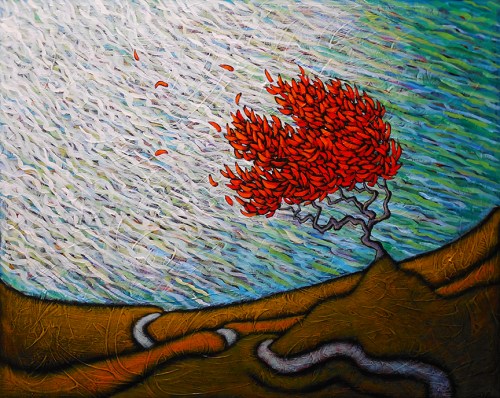
Absorbing Light

GC Myers- Absorbing Light sm

Absorbing Light– Now at West End Gallery


When you get to the end of all the light you know and it’s time to step into the darkness of the unknown, faith is knowing that one of two things shall happen: either you will be given something solid to stand on, or you will be taught how to fly.

 Edward Teller


To the end of all the light you know

Interesting thought from physicist Edward Teller, the man known, much to his chagrin, as the Father of the Hydrogen Bomb. Not sure that we are thinking about the same things or that his thought aligns completely with what I see in this new piece, Absorbing Light, that was a late addition to the West End Gallery show, arriving there just yesterday.

But then again, maybe it does.

In any pursuit, one must trust that the knowledge and understanding gained along the way will allow them to manage and even flourish once they find themselves in unknown territory, far beyond their previous ventures.

That kind of faith, as Teller calls it, is something I wish I had more often. I believe that I sometimes have it but it seems such a fleeting feeling at times.

Trying to be more ready for that moment when I come to the end of all light– speaking in the creative sense, not the existential, though that might well apply– is all I can do.

Maybe what I see in this piece, this trying to gain knowledge and understanding for that moment when I find myself in the absence of known light.

Hmm. Let’s think about that for a bit. While we’re doing that here’s a version of the classic Creedence Clearwater Revival song, Long As I Can See the Light, performed by Marc Cohn. Nice interpretation. You probably know Cohn best for his song Walking in Memphis. I throw that in, too. What the heck…


Ready For Day


GC Myers-  Lure of the Lake  2022

Lure of the Lake– At West End Gallery

Say to them,
say to the down-keepers,
the sun-slappers,
the self-soilers,
the harmony-hushers,
“Even if you are not ready for day
it cannot always be night.”
You will be right.
For that is the hard home-run.

Live not for battles won.
Live not for the-end-of-the-song.
Live in the along.

Gwendolyn Brooks, Speech to the Young


“Even if you are not ready for day
it cannot always be night.”

Love that line from Gwendolyn Brooks.

Are we ever fully ready for the day?

Maybe we often carry the night with us as we head into the day?

Bits of dreams and nightmares, the fear and worry, the doubt and negativity– those things that lurk in the blackened corners of the nightmind are sometimes hard to shake each day.

The trick comes in shutting out the inner din and disharmony of the night and recognizing that you are standing in the light of day.

You are awake and the day is filled with the reward that comes in simply being.

Take a moment and look around. Take it all in.

Live in the along, as Ms. Brooks advises. It cannot always be night


Mountain Dance

GC Myers- The Mountain Dance 2022

The Mountain Dance– At the West End Gallery


And those who were seen dancing were thought to be insane by those who could not hear the music.

― Friedrich Nietzsche


One of those days when I am tired of talk and words so I don’t have much to say this morning. In fact, I spent far too long trying to figure out something to say before finally coming to this conclusion.

So let me just show a new painting from the West End Gallery show called The Mountain Dance. It’s a piece I like and one that I feel deserves plenty of words.

But today it stands pretty much on its own. 

But I think it’s one of those paintings that can do just that.

Here’s a piece of music that I thought was an interesting pairing. It’s an interpretation of a piece from the Peer Gynt Suite by  Norwegian composer Edvard Grieg. Most folks know his work from In the Hall f the Mountain King from this same work. Well, the Mountain King had a daughter and there is a piece with her performing a dance. Thus, you have Dance of the Mountain King’s Daughter.  I am sharing a traditional version of that piece along with one that is a blend of the Norwegian folk tale, classical composition and Brazilian jazz.

Kind of an interesting way to get through a morning of few words.