Feeds:
Posts
Comments

Gun Flag


If we could learn to look instead of gawking,
We’d see the horror in the heart of farce,
If only we could act instead of talking,
We wouldn’t always end up on our arse.
This was the thing that nearly had us mastered;
Don’t yet rejoice in his defeat, you men!
Although the world stood up and stopped the bastard,
The bitch that bore him is in heat again.

Bertolt Brecht, The Resistible Rise of Arturo Ui


The Great American Fourth of July.

Barbecues. Fireworks. Parades. Flags waving.

Mass shootings. Bodies in the streets.

I am not just speaking of the horrific scene at the Highland Park, Illinois parade. Over the long holiday weekend, the four days from Friday until yesterday, there were 16 mass shootings that resulted in 17 deaths and 97 wounded citizens. That doesn’t even count the two police officers shot last night at the Philadelphia fireworks display.

[ Late addition: Gun violence spiked over Fourth of July weekend, with shootings reported in nearly every U.S. state that killed a total of at least 220 people and wounded close to 570 others, according to the Gun Violence Archive.  Mass shootings get our attention but the underlying carnage that we just accept as somehow being normal is even more staggering]

Can it get any more American than this?

I can’t say I am shocked. I think anyone who says they are shocked and surprised is being a bit disingenuous. I am no psychic nor prognosticator, but to anyone who has been paying attention during the past few decades this seemed to be totally predictable and practically unavoidable.

It is what we have chosen to be. It is the result of choices we have made and of the power we have ceded to people who only seek to serve themselves and their monied constituency– not we the people. We have too often placed our trust in those not worthy of our trust

It’s the result of our inability to think for ourselves and our easy acceptance of any information, however farfetched or wrong it might be, that confirms our own beliefs and biases. This leaves us susceptible to falling into cult-like behavior.

The cult of guns. The cult of trump. The cult of personality and fame. The cult of money and power. The cult of conspiracy. The cult of religion. The cult of race supremacy. The cult of ignorance that despises and distrusts science and education.

The cult of victimization. This might the most potent of all in that it enables all the others. All the followers of those other cults– and those are just the ones that came immediately to mind– share a sense of victimization. They feel they have been wronged in some way and that others are responsible for everything that has gone wrong in their lives.

Answers? I got nothing this morning, folks. This has been building and building over the decades and there are no easy answers. No quick fixes.

It will take a wide societal change that requires real effort and sacrifice from each of us. And I don’t think we, as selfish people who always seek the easy way out, are up to that.

Will we ever be up to the task?

I just don’t know. But the odds seem set against it.

We possess so much potential for good in this country, yet we seem set on squandering it at every turn. We could be a beacon of hope for the rest of the world but instead we opt for serving as both a horrorshow and a laughingstock.

It leaves me just bone tired of it all, both its senselessness and its inevitability. You and I both know that some other event like this will happen again in the coming days, maybe three or four times. And we’ll go through the same bullshit with the hope that someone will suddenly unveil the easy answer that has evaded us for so long.

Brace yourselves: That ain’t happening, folks.

Wish I had something more hopeful to say this morning. But things need to be said if only to say that I did so. That job, that futile task, is done and I will venture back to the refuge of art tomorrow, I promise.

Hassam’s Flags

This is a compilation of a previous post with a few more images and a video showing the breadth of the work from artist Childe Hassam.


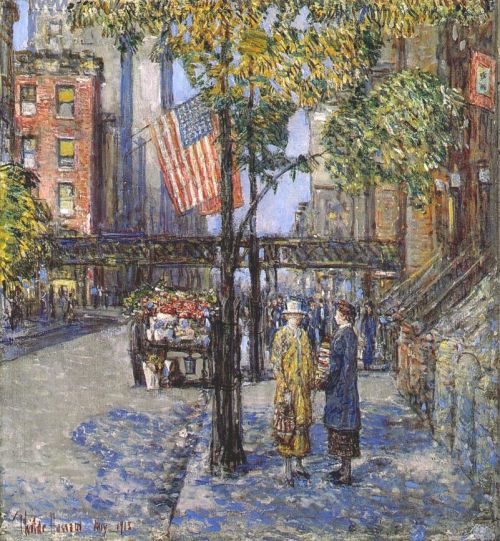
Childe Hassam Flag PaintingWe’re quickly moving into our most American of holidays, the 4th of July. It brings to mind images of fireworks, parades and picnics. And flags, plenty of American flags, that familiar red, white and blue.

I am a big fan of the flag paintings of Childe Hassam, the American Impressionist painter who lived from 1859 until 1935. His flag series was the most popular work in his long career.

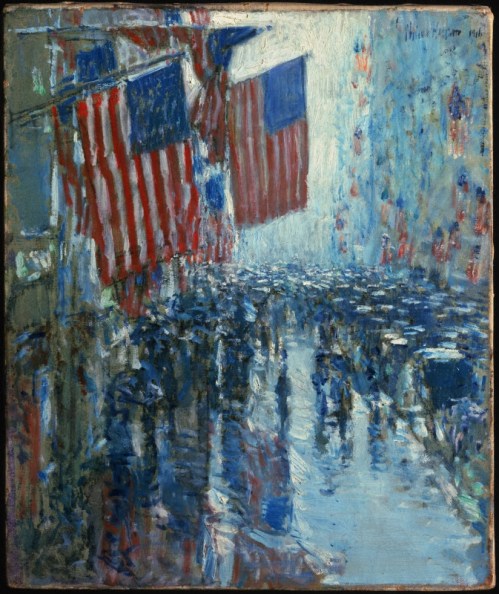
He started this series of paintings in 1916 as the buildup to our entry in World War I was reaching a crescendo.  In many cities around the country there were Preparedness Parades that displayed the general population’s escalating enthusiasm for entering the fray.  The most famous of these was in San Francisco where, at one such parade in July of that year, a bomb was exploded by radicals of the time that killed 10 bystanders and injured many more. However, Hassam was in NYC and the displays on the avenues of multitudes of flags among the canyons of the growing city inspired him to produce a number of powerful paintings, not bombs.

Childe Hassam Fourth of July 1916I think these paintings say a lot about America, especially at that time. The cityscape shows an expansion of urban growth brought on by the influx of an immigrant population and a prospering, industrialized economy. The flags represent a unifying bond that ties together all these diverse groups, a simple symbol that speaks easily to the wants and desires of the population. Their dream of America. Perhaps it also covered up many of the injustices and inequalities rampant then. And now.

But I tend to think of it in the better light, as a call to our better nature and to a society of choice and opportunity. An image of possibility and hope.  And Hassam’s paintings do that for me in a beautiful, graceful manner. The flag in its best light…

So, as we prepare for this year’s Fourth of July, I think of these paintings and the symbolism that they hold for myself and hope that we find a return to being that nation of possibility and hope, a society of choice and opportunity. Have a great Fourth!


Childe Hassam The_Avenue_in_the_Rain- 1917

Childe Hassam flags-on-the-friar-s-club 1918Childe Hassam Rainy Day Fifth AveChilde_Hassam-Avenue_of_the_Allies-1917Childe Hassam-Flags_on_the_Waldorf- Amon_Carter_Museum

flag_hassam_4th_16_lg

Childe Hassam- Flag

woody_guthrie

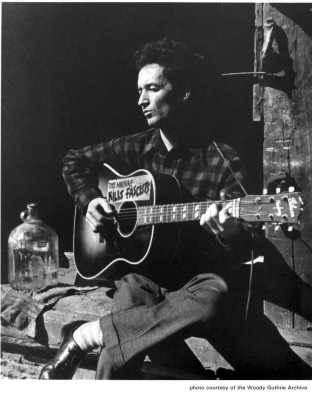
Woody Guthrie- This Machine Kills Fascists

Since we’re in the midst of the Fourth of July weekend, I thought this Sunday’s musical selection should be something with a definite American flavor. The song is This Land Is Your Land from the great Woody Guthrie.

You are no doubt familiar with this song, probably thinking of it as a cheery, upbeat song about the beauty and breadth of our democracy, sung often by smiling church and school choruses. It’s become a kind of populist national anthem which is sort of ironic given its beginnings and the words of the song. You see, there are verses that are seldom sung by the choruses and flag waving nationalists, verses that very much change the tone and meaning of the song.

Guthrie wrote the song in the late 1930’s in response to the immense popularity at that time of the Kate Smith version of God Bless America, written by Irving Berlin. Guthrie saw the world coming apart due to the nationalistic extremism that had spread through Europe, producing fascist leaders such as Hitler in Germany, Mussolini in Italy and Franco in Spain.

The original intro to God Bless America had the lines: 

While the storm clouds gather far across the sea / Let us swear allegiance to a land that’s free / Let us all be grateful that we’re far from there, / As we raise our voices in a solemn prayer.

That phrase that we’re far from there was later changed to for a land so fair.  Guthrie saw it as a call to an isolated form of nationalism, one that cast a blind eye to the perils lurking abroad that were beginning to spread here as well as our own problems at home. Problems like poverty and inequality.

Guthrie wanted to address these problems in his retort to Berlin’s song.  At first, Guthrie sarcastically called his song God Blessed America For Me before naming it This Land Is Your Land.

Below are the two verses in the original version of This Land Is Your Land that are always omitted from those cheery civic versions speak to the ills of this country as Guthrie saw them, most noticeably the greed which led to the great chasm of inequality between the wealthy and the poor of this land. He questioned how a land with so much wealth and beauty, one based on the equality of man, could tolerate the extreme poverty and injustice he saw in his travels across this land.

There was a big high wall there that tried to stop me.
The sign was painted, said ‘Private Property.’
But on the backside, it didn’t say nothing.
This land was made for you and me.

One bright sunny morning in the shadow of the steeple,
by the relief office I saw my people.
As they stood hungry,
I stood there wondering if God blessed America for me.

It’s an interesting song that speaks to this perilous time in the world as blind nationalism rises abroad and here in the USA.  Give a listen to this wonderful version below of the song from Sharon Jones and the Dap Kings and pay special attention to the words. Have a great Sunday and a great 4th.


I ran this post six years ago on this day. At the time, in the months before the 2016 presidential election, writing about the possibility of an insidious amalgam of fundamentalist/fascist/nationalism grabbing control of this nation seemed hyperbolic.

Six years later, it doesn’t seem so far-fetched, doesn’t feel like wild-eyed conjecture. In fact, it sounds like the monster we once laughed off and downplayed as a mythic creature is very much real and is now on the porch, kicking in our front door.

We got work to do. people.

As in the original post, I am including the Sharon Jones version of This Land Is Your Land below. I have added the Avett Brothers’ roots-americana version, which also includes the original lyrics, to give you a musical choice.

Or you can choose to not listen to either.

Freedom is about choice, after all.


mark_rothko


It is a widely accepted notion among painters that it does not matter what one paints as long as it is well painted […] There is no such thing as good painting about nothing.

Mark Rothko


From 2015:

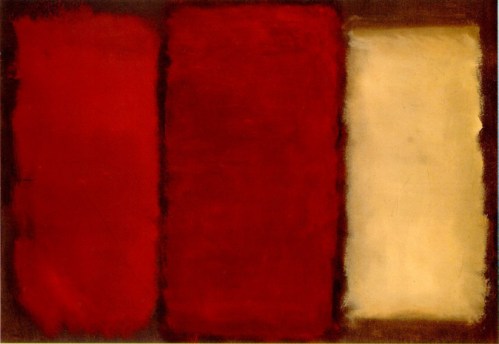
I have often said, often without much grace, that the subject for a painting is secondary, not really that important so long as the painting says something, expresses feeling and evokes emotion within the viewer. I think the work of Mark Rothko is a good example of this sentiment. They are simple of blocks of opposing colors set one over the other or, as in the case of the piece above, one alongside another.

Seemingly without subject.

Seemingly about nothing.

But as Rothko states, there is no such thing as a good painting about nothing. And this is a good painting. It allows the viewer’s own emotions into its space, lets their own story become the story and subject of this work. That space is the subject and purpose of this work.

So, every picture does tell a story. Some dictate the story, forcing the viewer to follow a set storyline through the picture as though they were the plot of a murder-mystery novel. Others do so like a song or poetry, evoking feeling with a suggestion or a gentle nudge. The viewer here is complicit in the fulfillment of the art.

For myself, I prefer the latter but have enjoyed works with more obvious subjects.  Perhaps not as deeply felt but enjoyable, nonetheless. I still question where my work falls on this scale. I am sure it has been both and I know I am much more satisfied when it appears more poetic. But being able to dictate the nature of the work is often beyond me. It sometimes appears in the poetic form seemingly on its own, without my direction.

And that is most satisfying.  And elusive.

Here’s a song that echos Rothko’s sentiments. Sort of. It’s the classic Every Picture Tells a Story from Rod Stewart. I am not a big Rod Stewart fan but when he hits the mark, it’s pretty special. He hits the mark pretty hard here.


Coming to an End


If I were writing a novel I would end it here: a novel, I used to think, has to end somewhere, but I’m beginning to believe my realism has been at fault all these years, for nothing in life now ever seems to end. Chemists tell you matter is never completely destroyed, and mathematicians tell you that if you halve each pace in crossing a room, you will never reach the opposite wall, so what an optimist I would be if I thought that this story ended here.

Graham Greene, The End of the Affair


Just a reminder this morning that my annual solo exhibit at the Principle Gallery in Alexandria, VA is in its final days. This year’s show, Depths and Light, ends this coming Sunday,  July 3. So, if you want to see the show, time is limited.

But like so many have pointed out before, including Graham Greene above, the end of anything is merely a point in time, that some part of all matter continues on. That’s a fine point and most likely a disputable one, I know. But it applies for art.

Art almost always lives on in some way. For this show, that life is in the works that find their way to new homes, hopefully adding to or reinforcing the lives of their new caretakers

The thought that the individual works move forward after they come off the gallery wall makes the end of shows much more palatable.

Hope you can make it in.


En Rose


GC Myers-  Flower Shadow June 1995 sm

Flower Shadow“, 1995 – at West End Gallery


I don’t have a lot of time this morning. With the broken foot so time becomes even more of a premium these days as I prepare for my upcoming July show at the West End Gallery. Everything takes a little longer and every movement requires thought and planning. And that’s not my strong point.

My friend, Brian, went through a major physical ordeal this past year that I outlined here and is adapting to new limitations after finally coming home from the hospital after 10 months. He calls his daily routine living in slow motion.

Though hardly in the same ballpark, I understand that a little more now.

But even with limited time, I felt like sharing something with a bit of beauty, something with a bit of optimism. To that end, I am sharing a favorite song, La Vie en Rose, the old French classic. The Edith Piaf rendition is the gold standard but this version from the supremely talented Rhiannon Giddens is gorgeous, as well. The song’s title basically translates as seeing life through rose-colored glasses.

We could all use that once in a while.


9921042 Dispersing Darkness sm

Dispersing Darkness” – At the Principle Gallery


What makes night within us may leave stars.

― Victor Hugo, Ninety-Three


I like the words above from the last novel, Ninety-Three, from Victor Hugo. They sum up, in a poetic way, my own feelings on what can sometimes happen in the aftermath of those bad things–the darkness and nights– we are doomed to encounter in life.

If we can endure those nights of darkness, we may discover positives among what is left behind.

Stars in the night.

Everything that happens is dependent on our ability to find those stars when the night feels endless and overwhelming.

We must just remember that they are there if only we would look up in the sky for them.

GC Myers- Bruised Orange  2022

Bruised Orange– At the Principle Gallery 


I Worried

I worried a lot. Will the garden grow, will the rivers
flow in the right direction, will the earth turn
as it was taught, and if not how shall
I correct it?

Was I right, was I wrong, will I be forgiven,
can I do better?

Will I ever be able to sing, even the sparrows
can do it and I am, well,
hopeless.

Is my eyesight fading or am I just imagining it,
am I going to get rheumatism,
lockjaw, dementia?

Finally I saw that worrying had come to nothing.
And gave it up. And took my old body
and went out into the morning,
and sang.

— Mary Oliver


I failed to mention yesterday that, after hearing the news of the Roe v. Wade decision as I turned my car into our driveway, I proceeded to break a bone in my mid-foot within minutes of that moment. Ended up spending several hours in the ER that afternoon, which presented me with a cast and a pair of crutches as my work companions for next several weeks.

Friday sucked in so many ways.

I am hobbling around now, trying to figure out ways to do tasks that once seemed easy and effortless. Even getting a tube of paint takes thought and effort.

I am not complaining. This minor inconvenience is just that. In a time when so many have died or been stricken with long term symptoms from covid and when the political machinations of the Supreme Court have put so many more lives at grave risk, it could be a lot worse.

My little problem will undoubtedly get better eventually. There is no guarantee that those other problems will improve. It’s going to take an effort to make things change.

And the prospect for that has the worrying part of me, that well from which all my anxiety springs, on high alert in recent days.

I am using two pieces here today to try to quell that worry. One is the poem from poet Mary Oliver at the top that tells me to set aside my worries for the moment and sing.

It’s something good to hear on this Sunday.

The other is this week’s Sunday Morning Music selection which is the Otis Redding version of the eternal Sam Cooke song, A Change is Gonna Come. It’s a song instills in me the hope that we the people are up to the task of creating change.

It’s something good to hear on this Sunday.


Take a clue from the title of Otis’ album. Vote blue until you bleed red.

GC Myers- Navigating Chaos  2022

Navigating Chaos– Now at the Principle Gallery


Once By The Pacific 

The shattered water made a misty din.
Great waves looked over others coming in,
And thought of doing something to the shore
That water never did to land before.
The clouds were low and hairy in the skies,
Like locks blown forward in the gleam of eyes.
You could not tell, and yet it looked as if
The shore was lucky in being backed by cliff,
The cliff in being backed by continent;
It looked as if a night of dark intent
Was coming, and not only a night, an age.
Someone had better be prepared for rage.
There would be more than ocean-water broken
Before God’s last Put out the Light was spoken.

–Robert Frost


Yesterday morning, I came home from a regular checkup with my doctor and as I was about to turn in the driveway the news came across the radio that Roe v. Wade was overturned. It was not unexpected, of course. We knew for months that this was coming. But even so, it still was shocking to hear the news.

Stunning, actually.

Before that moment, I had been envisioning imagery from possible scenarios going ahead but they still seemed just figments of the imagination. Daydreams, both good and bad. But the news was like a starter’s pistol going off. It was now real and the race was on.

I came across these lines from Robert Frost :

It looked as if a night of dark intent
Was coming, and not only a night, an age.
Someone had better be prepared for rage.
There would be more than ocean-water broken
Before God’s last Put out the Light was spoken.

The lines struck me deeply, especially in the aftermath of the events of the last several days that coupled the reversal of Roe v. Wade and several other politically driven court decisions that conflict with the sentiments of the majority of Americans with the revelations of treasonous treachery of the former president* and his cronies that have emerged during the Jan. 6 hearings.

Frost’s words gave me a feeling of dark foreboding, that these ideologues do not realize the force and intensity of the rage they may have unleashed upon themselves. They have used hypothetical threats and created fears to energize their base of support but in doing so they have now created an opposition force that is built on legitimate fear and desperation.

Add a sense of righteous rage to the fear and desperation of the majority and you have a pretty potent cocktail. And that’s something much more powerful than anything these smug ideologues have ever tasted.

And that potency is only going to grow in coming days as the true ramifications of this reversal become evident. For example, in many of the states that now outlaw abortion rights, in vitro fertilization (IVF) will become illegal because these states decree that life begins at fertilization and the excess and unused fertilized eggs are discarded.

Or take the case of a pregnant woman with the unfortunate luck to have cancer at the same moment. In many of the states whose anti-abortion laws went immediately into effect, it becomes potentially criminal for a cancer doctor to administer chemotherapy to a pregnant woman.

There are plenty of other scenarios out there pertaining to the effects of this reversal. But it doesn’t necessarily stop there. In his assent, Clarence Thomas stated with little equivocation that other rights of privacy presently in place– birth control, same-sex marriage, choice of sexual preferences– are on the chopping block.

Make no mistake- this is not the end of what these people want.

There are no moderate theocracies. No moderate authoritarian states.

They will not stop here.

Unless we stop them. Now.

That’s not hyperbole, people.

You might ask why I care. I am, after all, an aging white man in Whitemanistan with all the privileges and benefits attached to that. I just think that everyone should have every right and every opportunity to live their lives as they choose so long as they respect the lives and choices of others. I don’t want people bothering me or meddling in my life and I sure as hell don’t want to meddle in the lives of others.

The happiness of others makes my own happiness deeper. And the anguish of others makes my own deeper, as well. Much as John Donne wrote, my life and work is involved with mankind:

No man is an island entire of itself; every man
is a piece of the continent, a part of the main;
if a clod be washed away by the sea, Europe
is the less, as well as if a promontory were, as
well as any manner of thy friends or of thine
own were; any man’s death diminishes me,
because I am involved in mankind.
And therefore never send to know for whom
the bell tolls; it tolls for thee.

The bells are tolling, folks. The starter’s pistol has went off. It’s real now and the differences between two sides in this momentous competition are as stark as one can imagine. One is a side standing for personal freedom and choice while the other has a burning desire for even more control over the individual in the form of theocratic authoritarianism.

It’s 2022.

It is now or never.

And someone had better be prepared for rage…


Beyond Mediocrity

GC Myers- The Steadying Light

The Steadying Light– Included in the Principle Gallery Show


Excellence is its own master, owes no allegiance, bows its head to no regimen. It exists pure and whole like the silver face of the moon. Untouchable, unreachable, exquisite. But frustrating because it reminds us of how much mediocrity we put up with, just to get through the week.

― Harlan Ellison


I don’t have much time to write this morning. Maybe I shouldn’t share anything at all. But have been thinking about how our lives are affected by our willingness to settle for mediocrity, about how we opt for choices that are easy, that require little exertion of effort or thought.

Like I said, I don’t have time to put this into any sort of context right now. I just wanted to put this out into the world this morning with the hope that I won’t accept my own mediocrity and that we, as a people, will put in the effort and thought required to achieve excellence.

That might be asking too much…

In Situ The Steadying Light 2022 Principle Gallery