Feeds:
Posts
Comments

Three-Musicians-By-Pablo-Picasso


For those who know how to read, I have painted my autobiography. 

-Pablo Picasso


I would like to write an autobiography but can’t decide who I want to write it about.

I run this Picasso quote and painting every few years. It always makes me wonder if that will apply to my own work at some point in the future when I am long gone, if people will be able to discern any part of my real self or life in the work.

I guess I hope that they will though I’m not completely sold on that. Maybe it doesn’t matter. I am sure it won’t matter to me at that point, having moved on to whatever fate awaits one after death. So, if they can’t read my autobiography in the work that survives me, it won’t be a tragedy.

But on the chance that they do see something of my life in the work, what might it be? Will it be accurate or some idealized version?

And how accurate is our own self-image most of the time? After all, it’s normal for most of us to overestimate those things we see as our strengths and downplay our flaws and weaknesses. Nobody wants to write in their autobiography that they’re not that smart or strong, that they have at least as many, if not more, glaring flaws as the average person. That they have lied and stole and hurt people along the way.

That being said, maybe an autobiography in one’s art rather in writing might be more honest. It is always in the moment in which it was formed and not mere recollection. It is as it is, not written as we want to remember it.

Plus, it is both precise and ambiguous. It very seldom says anything overtly but is filled with unavoidable clues to its meaning and the person behind it– if the work is honest.

And I hope- and believe- that my work is honest and earnest. So maybe it will serve as an autobiography just as it does for Picasso.

Let’s hope it’s worth the trouble…

GC Myers- Journey and Light

Journey and Light– Coming to the Principle Gallery


To see a World in a Grain of Sand
And a Heaven in a Wild Flower,
Hold Infinity in the palm of your hand
And Eternity in an hour.

― William Blake, Auguries of Innocence


I didn’t want to write this morning, worried that I would begin to spout angry opinion that would serve no purpose. But, supposing that I can retrain myself and feeling a sense of obligation, mainly to my work, I will push onward.

I am in the last couple of weeks of painting for my upcoming show, Depths and Light, at the Principle Gallery, opening June 3. It’s always a hectic and nervous time, filled with both elation and extreme doubts. I find myself loving and doubting– and loving and doubting again– each new piece, sometimes within a matter  of minutes.

It would be so much easier if I didn’t give a damn.

I guess that could be said for most things.

But I do care about my work, about my expectations for it and how myself and others perceive it. By expectations, I mean that I want the work to have some level of meaning and purpose, even if it is only discernible to me.

The new painting at the top is part of this show and it fills those expectations. It is a 16″ by 40″ canvas that I call Journey and Light.

The meaning I attach to it is very much in line with the lines above from William Blake. Each iota, each part of this natural world, ourselves included, is a reflection of the whole.

We come from stardust after all.

It should be a simple thing to realize but we spend our lives chasing other ends and purposes which end up being trivial and meaningless in the end. We chase and chase and come to a point where we see that all that matters is within reach, is found in the understanding that we can, as Blake points out, hold Infinity in the palm of our hand and see heaven in a wild flower.

And that’s the sense I get from this painting, that emerging into an opening where the sun rises on the far horizon, we realize that our chase for things and beliefs has been futile. Everything we need is in that sun, the gras that surrounds us and the dirt beneath our feet.

It sounds too simple, I know. You most likely will say that life seems far more complicated, that this understanding gives no real answers for our day-to-day questions and concerns.

And maybe you’re right. But maybe we need that understanding in order to find momentary escape and clarity.

Respite from the chase. Moments of peace and quiet amidst the din and chaos.

Maybe that understanding allows us to feel as though we are standing in that sunlight, feeling the breeze on our face as it comes over the hills and across the grasses.

That’s the sense I get from this piece.

And that’s enough for me this morning.

Strange Victory - GC Myers 1997

Strange Victory, 1997


Up early this morning, checking in on the news from Ukraine. The death and destruction just tear at the soul, but the reports and images of the Ukraine force’ gains bring moments of hope that sometime in the hopefully near future they will feel the joy that comes in overcoming long odds to emerge victorious.

It’s hard to reconcile the images of loss and devastation with any sense of victory’s elation or relief. But in any war where the invader is defeated or repelled, those two poles of reality often stand together in the aftermath. It made me think of a favorite poem from Sara Teasdale and an earlier painting from the 1990’s that was derived from that poem. It’s a poem that will no doubt have meaning for the people of Ukraine in the future.

Thought today would be a good morning to rerun a post on both from ten years ago. From 2012:


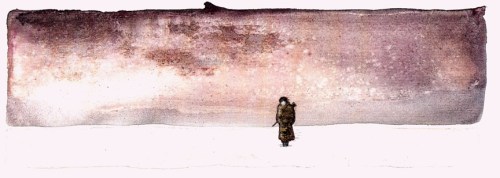
I woke up very early this morning with many things running through my mind. All sorts of thoughts and  imagery crowded my thoughts and I found myself thinking of this painting above, Strange Victory. It was painted many years ago and this is the only image I have of it, a photocopy that is much more washed out than the original so it doesn’t quite catch the subtlety of the snowfield. Though long gone, it has long been a favorite of mine as well as of my wife who calls it the Dr. Zhivago painting. It is perhaps the piece I regret letting go most of all. But at least I know where it is and know that it is loved and well cared for with its current owner.

I particularly like the barren feel of the snowy plain and the way the sky dominates and sets the emotional tone of the piece, its red tones set against the cold setting in a way that makes the moment seem large as the figure trudges slowly forward. The rifle slung over his shoulder with the gun barrel down gives it an ominous sense, as though this figure was returning from battle or returning empty-handed from a hunt for sustenance. The moment just seems to loom large in this piece.

The title came after the painting was complete and was based on a favorite poem from Sara Teasdale, the great and tragic American poet. Published in 1933 after her death via suicide in that same year, it is short and elegant, filled with the grand emotional swing of going from the depths of despair to an elation in finding someone familiar who has somehow survived where others have not. This simple discovery of a familiar survivor as something to rejoice in the face of what seems to be total loss is a victory in itself.

Just a powerful statement of existence.

So, while I am up much earlier than I normally would be, I find myself thinking of this painting and these words. There are worse things…

Strange Victory

To this, to this, after my hope was lost,

To this strange victory;

To find you with the living, not the dead,

To find you glad of me;

To find you wounded even less than I,

Moving as I across the stricken plain;

After the battle to have found your voice

Lifted above the slain.

Sara Teasdale

GC Myers- From a Distance  2020

From a Distance“- At the Principle Gallery


I got ceilings right up in the sky
all my ceilings give you room to fly
feel like a castle when you step inside
feel like a castle where a queen reside
I’ve got all these spaces above my head
but no space at all in my heart for your loneliness

–Miriam Jones, Room In My House


Went on YouTube early this morning to search for a Sunday Morning Music selection and there was a surprise in my feed. It was a new video of singer/songwriter Miriam Jones unboxing vinyl copies of her new album, Reach For the Morning, which features the painting at the top on its cover. I think I was as eager as Miriam to see it.

Though I don’t want to put labels on her or make comparisons, Miriam’s music is what I guess would be considered Americana. She established herself while she was based in England over the past decade or so before moving to Vancouver just a few years ago.

When Miriam and her manager approached me last summer to ask for permission to use the image for the album cover, I went online to find her music. I very much liked what I found. Strong voice to go along with strong writing and playing and a knack for finding the hook in her songs. I found myself holding onto the refrains from several of her earlier songs for a long time, often humming them while I worked.

Good stuff.

But her new album, Reach For the Morning, which is being released on June 17, feels like a step up. I was able to get a preview of the album awhile back and was thrilled. Everything is heightened. Her voice sounds great and her songwriting is on mark. Great production and performance across the album.

She also has several songs from other artists that she covers masterfully. For me, the sign of a great cover is shaping a song it in a way that respects the meaning and composition while still making it into something that has a unique quality. Miriam succeeds on all counts.

I am really pleased to have my work on Reach For the Morning ( great title which I will no doubt borrow at some future point) and wish her much success with it. I will be playing more of her work from the album after its release date but for today here is her first release from it, Room In My House.

As I said, just good stuff.

I’ve also included the new video of Miriam unboxing the album to give you an idea of how it looks as well as the song Warning from her last album, Between Green and Gone. Warning is one of the songs that sticks with me.

Please give a listen and keep an eye and an ear out for Miriam’s upcoming album.


Botanica Hereditas

GC Myers Botanica Hereditas  2022

Botanica Hereditas– Soon at the Principle Gallery, Alexandria VA


I had an inheritance from my father,
It was the moon and the sun.
And though I roam all over the world,
The spending of it’s never done.

― Ernest Hemingway, For Whom the Bell Tolls


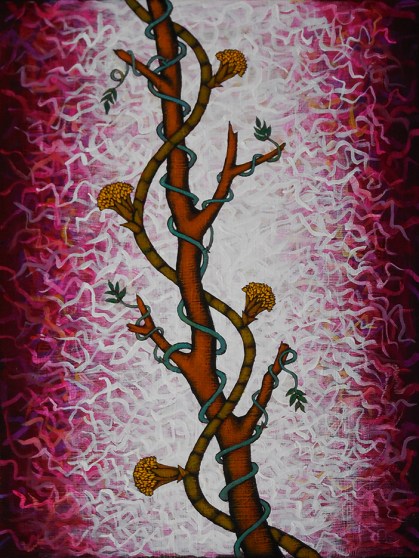
The new painting above is 16″ by 12″ on aluminum panel and is part of a small group of similar pieces that I am calling the Botanica series. Each of these paintings in this series are simply constructed with sections of stems or trunks or vines rising up through the picture plane and bisecting a shaft of light that fades into color at both sides.

The plants themself are imagined. I didn’t want to rely on faithfully replicating nature, as magnificent as it is in its original form. This is mainly because I am not a botanist and, outside of but a few, have never been able to hold the details and names of most plants and trees for very long in my mind. I have to be constantly retold, year after year, the name of this or that plant. So, any resemblance in these created organisms to reality is coincidental, not intended in any way.

There’s a sort of liberation in this. Not having to compete with what is real allows the viewer to see what is before them without the prejudice of knowledge, to judge it on its own merits.

Hey, that sounds pretty good. I’ll think I’ll keep that line for use in the future since it applies to much of my other work as well.

This particular piece is titled Botanica HereditasBotanical Inheritance. I saw the dead tree trunk here as what is left behind for future generations, a structure on which they can build on and rise. Here that inheritance is literally a structure that supports the subsequent growth. The thicker vine uses the structure merely as guide and rises much on its own while the thinner vine clings closer to the inherited trunk, needing its support in order to continue moving upward.

It is all set against a backdrop of chaotic and slashing colors, symbolizing the peril and chaos against which all life is set. We spend much of our existence in seeking order out of this chaos and often find it first and sometimes solely in the supportive structures provided by family.

Our inheritance.


Botanica Hereditas is part of my 23rd annual solo exhibit at the Principle Gallery in Alexandria, this year titled Depths and Light, which opens Friday, June 3, 2022.

In Times of Doubt

GC Myers- Rest Stop sm

Rest Stop – At the West End Gallery


And your doubt can become a good quality if you train it. It must become knowing, it must become criticism. Ask it, whenever it wants to spoil something for you, why something is ugly, demand proofs from it, test it, and you will find it perhaps bewildered and embarrassed, perhaps also protesting. But don’t give in, insist on arguments, and act in this way, attentive and persistent, every single time, and the day will come when, instead of being a destroyer, it will become one of your best workers–perhaps the most intelligent of all the ones that are building your life.

Rainer Maria Rilke, Letters to a Young Poet


Ah, it’s that time of my painting year, the time of doubt. It arrived yesterday afternoon.

I had finished a new painting and was pleased with the results.

Very pleased.

I was excited and eager to throw myself into the next piece immediately, armed with all that enthusiasm and energy that I had built up over the months. This self-propelling momentum is a driving force in prepping for my annual shows, something I seek throughout the year but seldom find.

But somewhere in between finishing the last stroke on that new painting and standing before the next blank surface placed on my easel, self-doubt smashed me over the head like an ugly giant with a fifty-pound sledgehammer.

I suddenly began to wonder if I was totally wrong about my judgement of my new work, that the excitement and confidence I was getting it from it was misguided. Was I somehow blinded to the glaring flaws that others might immediately see in the work? Was I the tone-deaf guy who sings loudly and confidently in public?

If you’ve read this blog for any time, you probably recognize this. It happens every year, especially at this time of the year in the weeks and months leading up to my shows when I doubt whether I my work is good enough or that I have done enough.

I know by now, after decades of going through this feeling, that all I can do is wait it out and to simply work through these periods of doubt.

It’s like dealing with a very specific and narrow band of depression.

It sometimes leaves as quickly as it comes and sometimes lingers a bit longer, always nagging and heckling me from the back of my mind.

And the more excited I am about the current work, the more intense the doubt. The fervor of this current makes me think I could be on the right track with my current work.

Either that or I am very wrong in my estimation of it and the giant of doubt was right all along.

At the moment, I want to believe in the work and not in the doubt. And that little bit of belief — and the immersion into the next painting– might be enough to get me through.

Always has in the past. No reason to believe it won’t this time as well. Makes me grateful for having gone through this before.

I wonder how many talented people have fallen before the sledgehammer of doubt and given up much too early on their own abilities?

I imagine it is a high number. Why wouldn’t it be? Why would anyone want to go through the churning stomachs, the headaches, the self-loathing and the many other nasty little tics that arise out of such doubt?

I don’t have a specific answer for this except that it is all I know and that the end result is worth the trauma that comes with such bouts of doubt. And like Rilke points out above, recognizing then overcoming doubt can become a valuable tool in judging and building one’s work and life.

As a result, I have come to see this doubt, as inconvenient and uncomfortable as it is, as a necessary and somewhat beneficial evil. Its current reappearance was expected and perhaps right on time.

Hoping it does what I need it to do. And hoping that those other folks who go through these times of doubt early on can see that this doubt can morph into some form beneficial self-criticism if they initially fight through it.

It’s worth the fight.


I didn’t want to show one of the new paintings for this post for fear that someone might think that particular piece somehow made my doubt arise. Instead, I am showing a piece from a few years back that remains a fave. Rest Stop has yet to find a home but that doesn’t not give me a bit of doubt about its appeal to me.

Monde Parfait

GC Myers- Monde Parfait


The transformation of the world is brought about by the transformation of oneself, because the self is the product and a part of the total process of human existence. To transform oneself, self-knowledge is essential; without knowing what you are, there is no basis for right thought, and without knowing yourself there cannot be transformation. One must know oneself as one is, not as on wishes to be, which is merely an ideal and therefore fictitious, unreal; it is only that which is that can be transformed, not that which you wish to be. To know oneself as one is requires an extraordinary alertness of mind, because what is, is constantly undergoing transformation, change; and to follow it swiftly the mind must not be tethered to any particular dogma or belief, to any particular pattern of action. If you would follow anything, it is no good being tethered. To know yourself, there must be the awareness, the alertness of mind in which there is freedom from all beliefs, from all idealization, because beliefs and ideals only give you a color, perverting true perception. If you want to know what you are, you cannot imagine or have belief in something which you are not. If I am greedy, envious, violent, merely having an ideal of non-violence, of non-greed, is of little value. The understanding of what you are, whatever it be – ugly or beautiful, wicked or mischievous – the understanding of what you are, without distortion, is the beginning of virtue. Virtue is essential, for it gives freedom.

Jiddu Krishnamurti, The Book of Life


It’s a little longer than the typical quote I use to open a blog entry but I felt the words from philosopher Jiddu Krishnamurti (1895-1986) matched up well with this new painting as well as lining up with some things I have been thinking lately. Things about our personal transformations in life and our sometimes skewed self-perceptions.

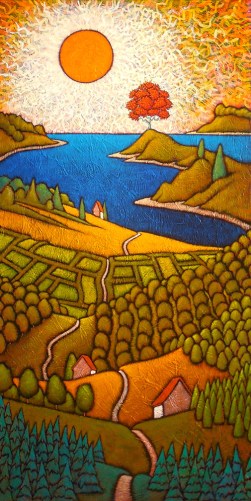
I see the new painting above as being about the transformations between each ascending layer in the landscape. Ideally, the eye takes in the whole of the piece then moves up from layer to layer, rising from the fir treed layer at the bottom up to the Red Tree on a seaside peninsula pushing up toward a warm sky.

When I was done with this piece, I was struck by the layers in this piece. Actually, it was the difference between each layer that struck me. Each felt like it was in place and right, yet each was complete and self-contained yet detached and unique. Each felt like a different time and place to me with its own atmosphere and meaning.

It seemed like I could see myself being in each layer. And moving up to the next layer was a transformation to a different place and time with its own feel.

Maybe it was hopeful biography of my own personal transformation?

Actually, it seemed like a parfait to me, the tasty multi-layered dessert whose name comes from the French word meaning perfect. And there certainly was an idealized sense of a perfect place and time in this painting.

From that thought came the title for this painting, Monde Parfait.

Perfect World.

Of course, we have ample evidence that there is no perfect world. But perhaps this parfait can serve as something to aim for, something that might be achieved if we can recognize then set aside our egos, our envy and our inflated sense of self, along with a host of other negative traits, that have long taken hold in ourselves.

Maybe.

I have doubts but I do know that transformations can occur, that things can change. And so long as we can see and feel and experience beauty, so long as we can imagine a better and more perfect world, there’s hope.

Hope is often a sustaining force.


Monde Parfait is a 36″ by 18″ painting on canvas that will be included in my annual solo exhibit at the Principle Gallery, opening Friday, June 3, 2022.

La Marsellaise

vive la france


Let’s go, children of the fatherland,

The day of glory has arrived!
Against us tyranny’s
Bloody flag is raised! (repeat)
In the countryside, do you hear
The roaring of these fierce soldiers?
They come right to our arms
To slit the throats of our sons, our friends!

La Marselllaise, first verse


Big victory for democracy around the world yesterday in the French elections, as President Macron defeated far-right winger and Putin proxy, Marine Le Pen. It was also victory for Ukraine because a Le Pen victory would have no doubt upended the French support — and perhaps the whole of the European Union’s support– of Ukraine in its struggle against the Russian invasion. And that may have opened the floodgates to a new era of fascism/ authoritarianism unlike anything since WW II.

Make no mistake about it, the rise of far-right extremism we are seeing around the world, including here in America, is in a direct line from the fascist movements of that era. These movements may use modern technology and shade their end game with misdirection, disinformation and outright lies but their goals are the same.

And none of those goals bode well for the average person.

So, it was heartening to see Macron’s victory. It made me think of the French national anthem, La Marsellaise, which has its origins in the French Revolution of the 1790’s. It is a song of resisting and overcoming the forces of authoritarianism which is why it was banned at times by the kings and emperors (Napoleon) in later French history before taking its place as the official national anthem after the end of WW II.

For me, it might be the most stirring national anthem in the world, speaking to my own sense of defiance and democracy. The defiance in its words could certainly could apply to the people of Ukraine.

The song is at the center of one of my favorite movie scenes, from 1942’s Casablanca. In this scene, the occupying Nazi entourage at Rick’s Cafe are singing the German anthem boisterously.  The French resistance fighter Victor Laszlo furiously rushes to the house band to have them play the French anthem La Marseillaise in response. The club’s patrons respond with a unity that drowns out the German voices with even Yvonne, the bar girl who has flirted with collaboration with the Nazis, shouting out Vive la France! 

This clip has the whole of the scene. It always moves me.


Dona Nobis Pacem

GC Myers- Dona Nobis Pacem

Dona Nobis Pacem– Coming to the Principle Gallery, June


Praise be to God I’m not good,
And have the natural egotism of flowers
And rivers following their bed
Preoccupied without knowing it
Only with blooming and flowing.
This is the only mission in the World,
This—to exist clearly,
And to know how to do it without thinking about it.

― Alberto Caeiro, The Keeper of Sheep


Time for some Sunday morning music and while getting it around, I came across the lines above from  Alberto Caiero, a poet of which I had never heard. It turns out that he is the creation of the Portuguese poet, Fernando Pessoa (1888-1935) who I have talked about here before.

Pessoa, who died from cirrhosis at a relatively young age, is considered one of the giants of Portuguese literature and poetry. One of the more interesting aspects of his work is that he assumed and wrote under many different names. But these were not simply pseudonyms, were not just different names. No, they were mostly different personas as well. He termed them as heteronyms. In fact there is a list of over 80 of these heteronyms that he employed over his relatively short life.

Each had a distinct voice. Caiero was one of Pessoa’s voices. Described as being born in Lisbon in 1889,  having blond hair and blue eyes, and being the author of bucolic poems about sheep and shepherds. I believe Pessoa had him dying from tuberculosis in 1915, one year after Pessoa had written about 30 Caiero poems in a mad rush for the book The Keeper of Sheep.

I thought the lines above from Caiero described the sort of metaphysical peacefulness that many people seek– to simply be, without having to think about it, without fears or worries. Just to exist, alive and in peace.

I think that is what a lot of my work is about– finding that place or feeling or time that allows us to be in a state of peace, even if only for the moment. I know that the new work for my June show at the Principle Gallery is focused on finding these small bits of momentary tranquility.

An example is at the top, a new 12″ by 24″ canvas that I am calling Dona Nobis Pacem which translates as Give Us Peace. I am using a chaotic sky in this piece, and several others in this show, to represent the turbulence and uncertainty that threatens our peacefulness. The rising sun and its light represent a contrasting counterpoint, with certainty in its movements and providing light and heat and energy for us.

For this week’s musical selection, I am going with contemporary Max Richter and his take on Dona Nobis Pacem, which is from the Agnus Dei, the liturgical texts sung or said performed during the Catholic communion rites. This version of Richter’s Dona Nobis Pacem 2 is performed by Canadian violinist Angele Dubeau and La Pieta.


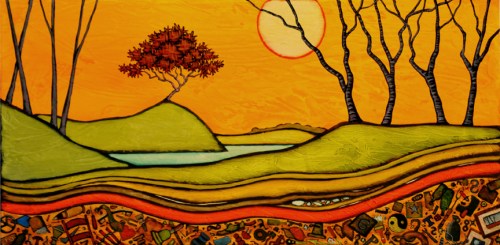
GC Myers- Archaeology- The Golden Age Beyond sm

Archaeology: The Golden Age Beyond


I am convinced that the stratigraphic method will in the future enable archaeology to throw far more light on the history of American culture than it has done in the past.

–Edward Sapir (1884-1939), American Anthropologist


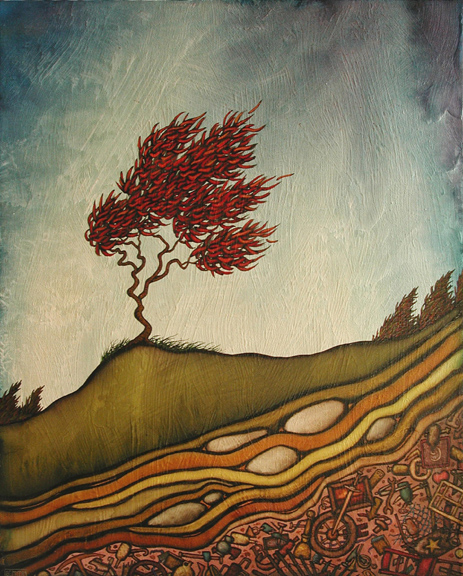
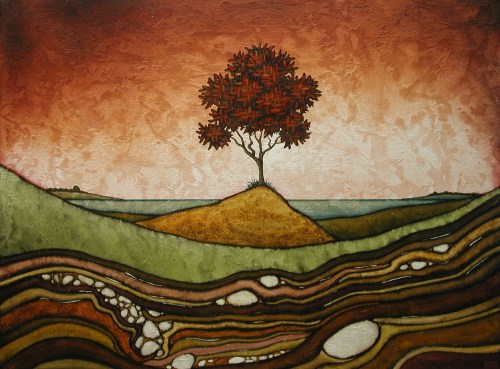
Whenever I drive past a landfill, one of those new looming hills that rise weirdly from the surrounding landscape, I wonder if they will be considered treasure troves in some distant future. Will the inhabitants of the Earth in ten or a hundred thousand years from now dig into them and stare in wonder at some of what they uncover in those vast heaps?

Of course, that’s supposing that there will still be an Earth or inhabitants with the same sort of curiosity that drives archaeologists and anthropologists in our time. Perhaps someone will be here but not give a damn about the prior residents. Or maybe those landfills will be under new towering mountains or at the bottom of a deep, dark ocean.

Who knows? Or should I say, for that matter, who cares? 

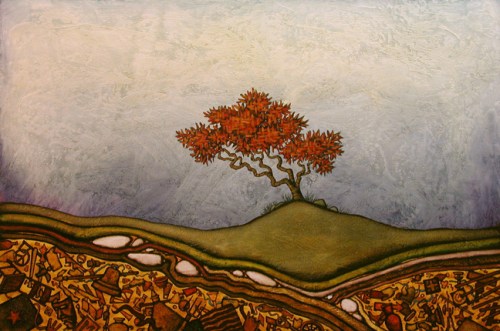
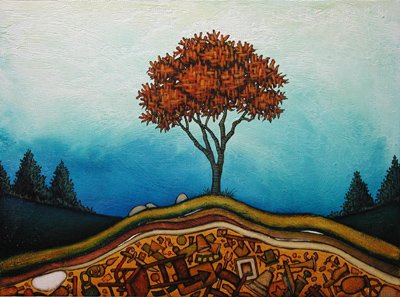
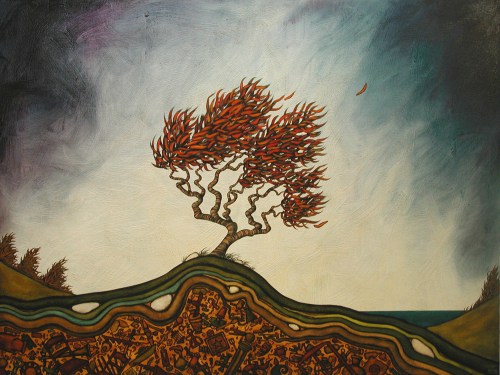
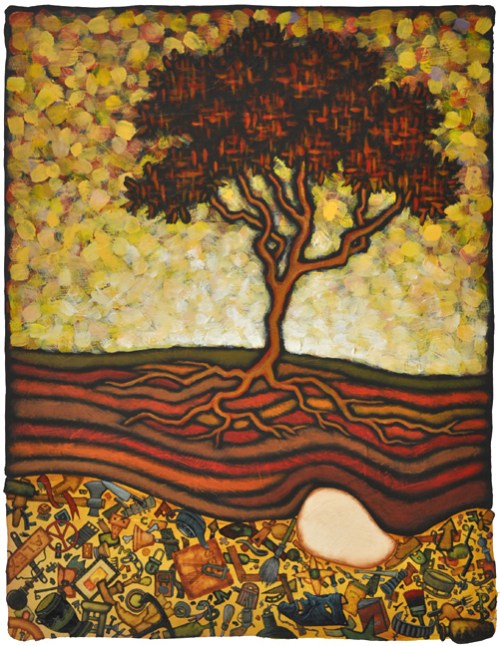
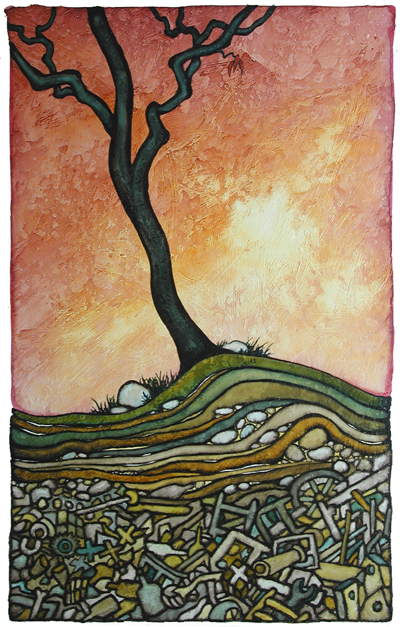
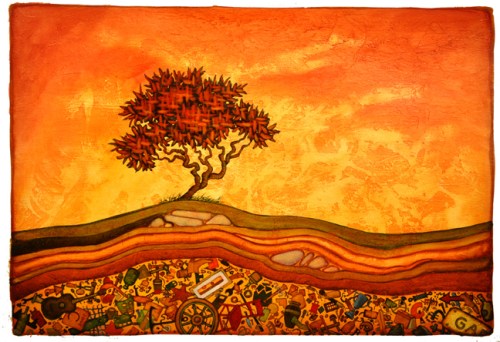
This brings me to a what I want to be a quick post this morning. The break from the blog in the past several days has worked out well for me, workwise. Getting a lot of what I consider very good work done. I thought I would share some images from my Archaeology series which was perhaps the most popular of the various limited series of paintings that have emerged over the years. I am also rerunning a segment from an early blog post that outlines how the work came about back in 2008.


Archaeology: Under the Same SunFrom 2008:

This is a piece titled Archaeology: Under the Same Sun which is part of my Archaeology series of paintings that was new for this year. It came about early in January when I was struggling to find the direction in which my work was headed.  By that I mean, I am always trying to find ways to expand the scope of my work, to create something new in the work that will excite me in the studio and, by extension, viewers in the galleries.

I really felt lost this year as I began preparations for my June show. My work felt uninspired and every day was a battle to create anything that seemed alive. I needed something that would light a fire under me, something that would excite me in the work.

 I reverted to a exercise that my 5th grade art teacher, John Baglini, in Chemung, NY taught me back in what must be 1969. Mr. Baglini was pretty cool, especially to a 5th grader. He drove a late 50’s Porsche, wore big bellbottoms, drew comic books and always had really neat projects for the class. For example, since it was the year of the moon landing, we made a huge papier-mache lunar landscape.  

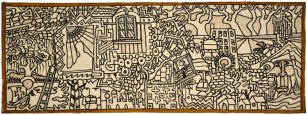
Another project had him passing out large sheets of paper and pens and ink. He would have us start at the bottom (or wherever you wanted to start) and totally fill the paper. He told us to draw a junkyard, to fill the sheet with items that we knew, to stack them from bottom to top and top to bottom.

It was a great exercise that made me think of how one item related to the next and how small detail contributed to the whole image. It has been something I have used for nearly forty years, often filling the margins of the newspapers with doodles and little objects.

GC Myers Archaeology-sketch

Early Archaeology Sketch

So, when I felt blocked this time, I pulled out some large sheets of paper and a Sharpie and started doodling at the bottom. I did this for several days and eventually the pieces went from masses of objects to a smaller group of objects that grew seamlessly upward into a landscape.

It all merged together so well that I began to wonder why I hadn’t painted in this fashion before. It made such sense. It allowed me to paint my trademark landscapes but to add a new dimension. From a distance one can tell it’s my work but upon closer inspection one finds a new level of detail that reveals something new with each subsequent look. It also allowed me to paint detail in a free flowing, stream-of-consciousness manner, one object leading to the next.

There was also the opportunity to create a new vocabulary with the repetition of objects within the context of my paintings. There are a number of objects that make appearances in all or most of the paintings of this series.  Peace symbols, shoes, bottles, the letter “G”, etc.

And periodically, a nod to my own work as it, like most of what we have around us, finds its way to the future in some sort of landfill that some archaeologist might uncover in a distant future.


GC Myers- Archaeology- A New Wind Rises sm

Archaeology: A New Wind Rises

Archaeology: The New DawnGC Myers- Archaeology-Rainbows End

GC Myers- Archaeology- Formed in the Past small

Archaeology: Formed in the Past

 Archaeology- The Story Told    / GC Myers 2008 Archaeology- A New History Archaeology: Rising From Blue / GC MyersArchaeology: A New WindArchaeology: Man's FootprintArchaeology - GC Myers

 Archaeology-New Day  - GC Myers

Archaeology: New Day


GC Myers-  Archaeology: Legacy

Archaeology: Legacy


GC Myers -- Archaeology-Peace Comes

Archaeology: Peace Comes