Feeds:
Posts
Comments

60-MPH, Again

Still not ready to resume writing. The painting is going really well, and I am hesitant to change the rhythm right now. But I will soon start showing new work from my Principle Gallery show that opens in early  June. Until then here’s a replay of a blog entry from back in 2012.


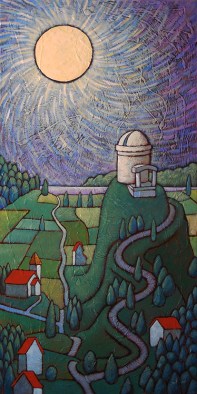
Above the Babble- GC Myers

Above the Babble, 2000

There are times when ideas for a piece come from seeing something once or twice and taking what you remember of it and using that in your work.

For example, a number of years ago I remember driving through the Poconos on the way to NYC. As I drove down a hill, I glimpsed to my right a group of trees, maybe an orchard. It was early morning and the sun was low behind them, casting long individual shadows in the damp, long grass. The whole scene was taken in in the blink of an eye.

I call that the 60-MPH view. Actually, it’s closer to 75 MPH but who’s really keeping track?

From this split-second glance I returned to the studio a few days later and took the elements of that scene that remained in memory and created several versions of that scene. They were vibrant and alive. It was as the speed of the glimpse took away interfering details and distilled the remaining elements into something stronger.

The painting above, Above the Babble, is another kind of this taking in quickly and using the elements from memory. My sister had a small print that has hung for many years in her home. I always would notice the print when I visited but didn’t spend much time in front of it. One day in the studio a number of years ago– I believe it was back in 2000– the composition of that piece, as I remembered it, came to mind. This was the result along with several subsequent versions over the years. None of them really look like the print in any specific detail but for me they echo the rhythm and feel of the inspiring print.

I try to use this viewing process when I look at other artists’ works as well, taking in the work quickly then trying to remember what I saw. This forces the strengths, as I see them, forward and they remain in my memory. This allows me to find things in work that is very unlike mine that I ultimately use in my own work. A form of synthesis, I suppose….


GC Myers-  Climb Ever Higher

Climb Ever Higher– At the West End Gallery, Corning, NY


It always amazes me to look at the little, wrinkled brown seeds and think of the rainbows in ’em,” said Captain Jim. “When I ponder on them seeds I don’t find it nowise hard to believe that we’ve got souls that’ll live in other worlds. You couldn’t hardly believe there was life in them tiny things, some no bigger than grains of dust, let alone colour and scent, if you hadn’t seen the miracle, could you?

L.M. Montgomery, Anne’s House of Dreams (Anne of Green Gables #5)


A few thoughts on this Easter Sunday.

Not off my break from this blog quite yet. The break has proven to be beneficial as I have been very productive in the past several days in this time. Feel like I have made a quantum leap ahead in readying my work for the upcoming shows. My anxieties have eased up a bit on this front and I find myself in a good painting groove at this moment. So, maybe the break was a good idea.

As I mentioned earlier, my friend, Brian Pappalardo, has went through a medical ordeal over much of the last year, spending 10 1/2 months in hospitals including over 2 months intubated and on a respirator. He has had to undergo much physical therapy in order to regain his speech, use of hands and arms and walking.

With the help of a great staff at Cayuga Medical Center, he has worked hard, and it has paid off, as hard work often does. On Friday, he finally went home. On a holiday weekend based on a resurrection, perhaps the timing was fitting.

But he still has a lot of very hard work ahead of him with hopes of being out of his wheelchair for good at some future time. The first days at home have shown new challenges to be overcome and he is still adjusting to the situation in a non-hospital setting. But I have no doubt he’ll figure it out and persevere.

In the fundraiser we set up to help offset Brian’s amassing medical expenses, almost $12,500 was raised. This will help immensely and takes off a little of the pressure of financial worry for Brian, allowing him to focus on and continue his physical therapy.

I want to extend my warmest thanks to everyone who donated, from Brian’s longtime friends to those who have never met Brian. Your generosity in terms of money and goodwill was inspiring and moving. Thank you.

Okay, here is a song for this Easter Sunday. It’s a gospel song from the Soul Stirrers, best known for being the launching pad for the career of one of my all-time favorites, Sam Cooke. This song is Out on a Hill and features the vocals of Johnnie Taylor, who sounds an awful lot like Cooke, who had recently departed for his solo career when this track was recorded. Taylor also had a celebrated career, most notably for the classic R&B song from 1968, Who’s Making Love.

Give a listen, have a good Sunday, and hopefully I will be back soon. Thanks!


If I cease searching, then, woe is me, I am lost. That is how I look at it – keep going, keep going come what may.

― Vincent van GoghThe Letters of Vincent van Gogh


GC Myers- Reaching Out sm

Reaching Out– Part of the June Principle Gallery Show

Like many of my paintings, this piece, Reaching Out, a canvas measuring 36″ by 18″, is concerned with the Search.

The search for something that we think is missing or that we need.

Love. Friendship. Knowledge. Wisdom. Fame. Fortune. Peace. Acceptance. Truth. God.

Answers to those needs and questions that never rest within us. Those things that define us as who we truly are and what place we occupy in this universe.

I think that this searching will always be with us, that we shall never find all of the answers we seek. I know that I will never find all of the answers that I desire. But finding just a few answers, even if only a glimpse of an answer, satisfies me for a time, giving me a prod to continue scanning the horizon even when I am most content in my life as it is.

So, I maintain my own personal search.

As, I am sure, you do as well.


The post above is from a few years back, concerning the painting above, a favorite of mine called Reaching Out, which is headed to the Principle Gallery for this year’s June show.

I reran this post because I am thinking about taking a short hiatus from the blog, maybe just a few days. Maybe longer. I am feeling a bit stressed about running short on time for show preparations this year and am trying to find ways to make my time in the studio more productive.

You probably would be surprised at the time it takes to write this thing. It seems like it should only take a few minutes to bang out a few paragraphs of my typical blather. But it’s not the actual writing, which still takes me a while because I struggle with putting words together, but the task of just trying to come up with something each day takes a lot of time in scanning websites, doing research, searching music and videos, etc. I spend quite a bit of time this way, maybe too much.

I am not complaining. I like doing it most days and always feel it contributes something to my actual work. But as I have aged, my painting and prep process take more and more time to complete. Some of it is due to my process becoming more and more layered than in past years. As a result, each new piece takes quite a bit longer than in earlier years. I often feel the pressure of finishing work weighing on my mind when I am trying to get past the blog during these times. Even now, I have several tasks running through my mind as I write this.

And that makes it harder to think about the blog and write effectively to my satisfaction. So, maybe a short break is in order. Of course, I might change my mind tomorrow morning. As Walt Whitman said in Song of Myself:

Do I contradict myself?
Very well then I contradict myself

We’ll see.

In the original post I included the Richard Thompson song below. It’s a lovely song, so if you have time, give a listen. If not, then I’ll see you down that winding road sometime in the future. Maybe tomorrow.  Maybe not.

Who knows?


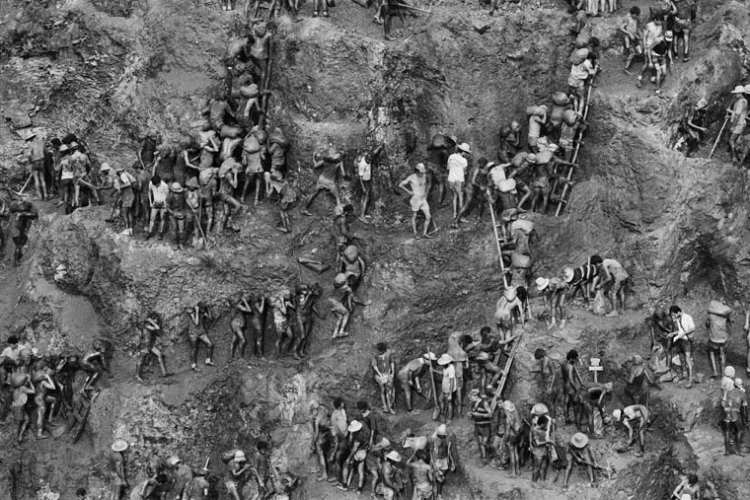
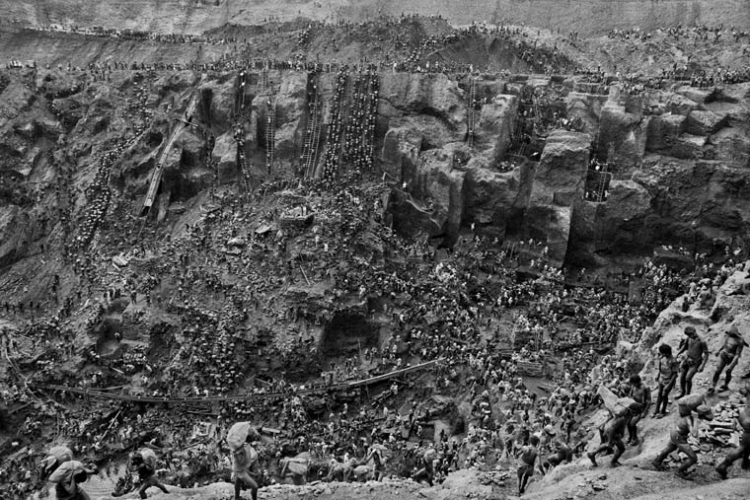
Sebastaio Salgado Serra Pelada Gold Mine 1986 1


“We are animals, born from the land with the other species. Since we’ve been living in cities, we’ve become more and more stupid, not smarter. What made us survive all these hundreds of thousands of years is our spirituality; the link to our land.”

– Sebastiao Salgado


This post came about in a weird way this morning. I was up earlier than normal and without much enthusiasm for writing a blog post, took a look at YouTube. I came across a new Jack White song, Fear of the Dawn, which was a loud, driving piece. The video for it was kind of modern expressionistic with a claustrophobic feel. But the part that struck me was that I realized after a few minutes that much of the sound was being produced by a what looked to be a modern theremin.

You know the theremin, that strange electronic device that produced the weird soaring sounds from 1950’s horror movies by the player simply moving their hands near two protruding metal rods. Turns out the device in the Jack White video was a modern theremin, the Moog Theremini. This, in turn, sent me to a video of a theremin musician, Caroline Eyck, playing her version of The Ecstasy of Gold composed by Ennio Morricone for the movie The Good, The Bad, and The Ugly.

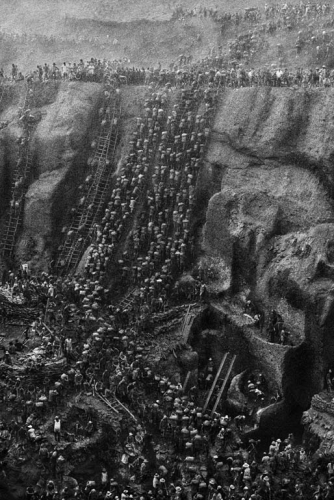
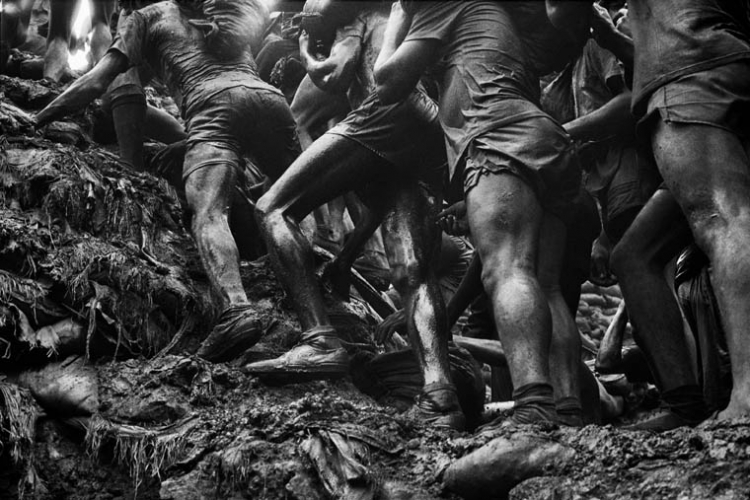
It was sort of mesmerizing and it made me think of the incredible photos from photographer Sebastiao Selgado of workers in the gold mines of Brazil. I went back to a post from several years ago to look at them and decided that they were worth repeating today.

Funny how one thing often leads to another. Here’s the post and photos with the Caroline Eyck video of The Ecstasy of Gold below it.


I featured the photos of the Brazilian photographer Sebastiao Salgado here several years back. Originally an economist, Salgado took up photography in his thirties and embarked on an epic journey to document the great beauty and darkness the of this world, photographing grand vistas and wildlife along with refugees fleeing genocide and workers in the grimmest of conditions. He does so in a wondrous fashion that has a way of connecting us in the present day to all the ages that came before.

This feeling of connection definitely hits me every time I come across his photos of the gold miners in Brazil, taken in 1986 and included in his 2005 book, Workers: An Archaeology of the Industrial Age. I love this title. The work has that archaeological feel, like artifacts that will stand as lasting images of our time here on Earth.

These images feel absolutely biblical to me. It takes away any doubt I may have previously held about how man created the ancient wonders that still stand today. The workers shown may be contemporary miners, but they could just as easily be slaves in the age of the Egyptian pharaohs.

Or lost souls trapped in one of the circles of hell in Dante’s Inferno.

If you get a chance, please take a look at some of Salgado’s work. It is amazing imagery and truly human in every sense of the word.


Sebastaio Salgado Serra Pelada Gold Mine 1986 2

Hard Running

GC Myers Hard Running sm

Hard Running– Part of the June Principle Gallery Show


Whenever I find myself growing grim about the mouth; whenever it is a damp, drizzly November in my soul; whenever I find myself involuntarily pausing before coffin warehouses, and bringing up the rear of every funeral I meet; and especially whenever my hypos get such an upper hand of me, that it requires a strong moral principle to prevent me from deliberately stepping into the street, and methodically knocking people’s hats off–then, I account it high time to get to sea as soon as I can. This is my substitute for pistol and ball. With a philosophical flourish Cato throws himself upon his sword; I quietly take to the ship.

― Herman Melville, Moby Dick


I am not a sailor but I do understand the allure. The idea of the freedom of movement, the feeling of being engaged with the forces of nature, the absolute solitude and independence, the escape from the worries ashore, and the accompanying peril that requires knowledge and skill in order to survive are powerful lures.

There may be little to compare for us landlubbers. Perhaps those rock climbers who attempt free climbs  El Capitan and other great rock faced mountains without ropes. That might be close. But I don’t know if there’s a moment when they can relax and just ride for a moment with the wind in their hair as they glide over the surface.

For a free climber, if you’re gliding over the surface with the wind in your hair, you’re most likely plummeting to the bottom of the cliff.

And I’ve been told that is not a good thing.

So, not being a sailor, I am forced to be content with imagining the feel of it. Maybe this imagined feel is why I enjoy painting my boat pieces so much.

A vicarious thrill.

The piece at the top, a 16″ by 20″ painting on aluminum panel, is titled Hard Running and is slated to be part of my annual June show at the Principle Gallery in Alexandria, VA. This painting certainly felt like a vicarious thrill for me while I was at work on it.

I tried to imagine the feeling of riding over those choppy seas, tried to imagine the sheer thrill and the sense of accomplishment as it felt as though the boat’s sails were locked tight to the winds.

Like I said, little to compare here it to here in my studio in the woods. Perhaps the closest thing I have is my imagining and the thrill that comes when it appears on a surface.

And that is often enough for me.

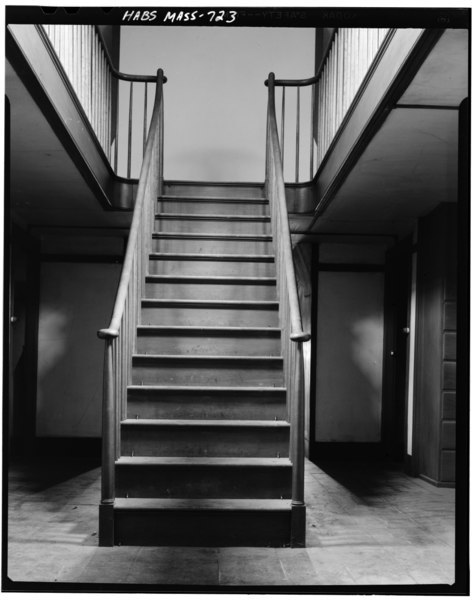
stairway


ANTIGONISH

Yesterday, upon the stair,
I met a man who wasn’t there!
He wasn’t there again today,
Oh how I wish he’d go away!

When I came home last night at three
The man was waiting there for me
But when I looked around the hall,
I couldn’t see him there at all!
Go away, go away, don’t you come back any more!
Go away, go away, and please don’t slam the door…

Last night I saw upon the stair,
A little man who wasn’t there,
He wasn’t there again today
Oh, how I wish he’d go away….

-William Hughes Mearns, 1899


The poem above is said to be about ghost that haunted a home in Antigonish, Nova Scotia back int he 1890’s. It is sometimes cited as at least a partial inspiration for the 1970 Davd Bowie song, The Man Who Sold the World. You can see bits of the influence in the first stanza of the song’s lyrics:

We passed upon the stair
We spoke of was and when
Although I wasn’t there
He said I was his friend
Which came as a surprise
I spoke into his eyes
I thought you died alone
A long long time ago

The song is also said to be about Bowie’s internal conflict about how much of himself he was willing to bare in order to sell his music. It’s a question every artist in any creative field has to face and answer for themselves.

These things, his personal thoughts and feelings, Bowie saw as his world and his willingness to sell it all for money sometimes seemed a bridge too far.

After all, if you sell the world, where do you live?

When I hear the song, I often think of a different meaning for it, one that doesn’t really match the lyrics. It always makes me think of the ultra-wealthy and powerful who are so willing to trade the lives and homelands of others for their own gains, to satisfy their own thirst for acquisition.

More, more, more…

We see it time and time again. Those who are willing to sell the world are the source of most of the problems in this world now and through the ages. You see it in Putin’s War in Ukraine. You see it here in the States in the willingness of one party to throw aside all principles and morals, abandoning democracy to regain power.

So many willing to sell the world.

But again, if you sell the world, where do you live?

Here’s the song for this week’s Sunday Morning Music.

Now get off my lawn.


johnnycash1bMost people immediately think of Roberta Flack when they think of the song The First Time Ever I Saw Your Face, and for good reason. Her 1972 version was  truly beautiful and deserved every bit of the acclaim it earned. But the song didn’t originate with her and has had many versions through the years, including one of my favorites from Johnny Cash, which you can hear below. 
The song’s history began in 1957. It was written by Ewan MacColl,  a British folk singer who is a very interesting character in his own right. He was a married man who fell in love with the much younger Peggy Seeger, the half-sister of folk icon Pete Seeger. He later married Seeger. 

MacColl wrote the song about her and for her to perform. She needed a song for a play she was appearing in here in the USA so MacColl wrote the song and taught it to her via the telephone as he was barred from entering the States because of his Communist ties. As I said, he was an interesting character.  Her original version is lovely with different phrasing than the better known Flack version. I’ve also included a similarly performed and charming version from Peter, Paul and Mary.

Cash’s version is much more ponderous. It is from his American series near the end of his life. His voice was weaker and even rawer than in his younger days but Cash used it in an incredibly expressive way, giving the song the feeling of a dirge as he looked back from a point near the end of his and his wife’s life, to an earlier time in his life and the fresh discovery of love. It is both beautiful and sad. 

Just a great song.


I ran this post on this date ten years ago and it seemed to fit for reasons that I don’t want to share here. And the reasons don’t really matter because as I said, it’s just a great song.


Baseball is like church. Many attend, few understand.

― Leo Durocher


GC Myers- Looking For the Curve smMyers

Looking For the Curve– Part of the June Principle Gallery Show

Leo the Lip was right.

When I flipped on the tube early yesterday morning the first thing that greeted me was someone on a news show telling me that the Yankees/Red Sox season opener was already rained out. I had been anticipating the game for weeks and was totally primed for a day in the studio with the game on, a Spring afternoon pleasure that seldom comes around.

Baseball is a game whose pace and rhythm fits perfectly with painting for me. It is, as someone noted, a conversational game, one that you can keep up with even as you are engaged in some other activity, like talking to your neighbor in the next seat or, in my case, pondering which color or brush to use next. There are useful and numerous pauses in baseball unlike most other sports whose constant motion require your full attention.

But the rains came and washed out my long-expected game. I then made an executive decision and cancelled Opening Day, moving it back until today.

Of course, my decision didn’t hold much water and the other scheduled games went on despite my edict.

But I guess I am glad they did. After all, with so much tragedy and tension in this world right now, who could begrudge anyone a respite with some Opening Day joy at the ballpark?

Not me, that’s for sure.

So, I’ll regroup and try to make today my Opening Day. I am sure it will just as sweet.

Unless the Yankees– god forbid!— lose to the rival Bosox. That could ruin a guy’s day.

Let’s hear an old baseball song to mark the day. This is a tune that is from 1912, the year that the Red Sox won the second of their 9 World Series championships and 11 years before the Yankees won the first of their 27 World Series titles in 1923. It’s been around awhile and this is a modern remake made for the great Ken Burns series on the game. It’s a mouthful but this is If You Can’t Make A Hit At The Ballgame, You Can’t Make A Hit With Me.

Oh, and the painting shown is a new one called Looking For the Curve which will be part of my annual June show at the Principle Gallery. Really enjoyed painting this piece. Maybe it was the anticipation of this day.

I don’t know.

Now, Play Ball!


Graveyard Shift

GC Myers- Graveyard Shift sm

Graveyard Shift– At the West End Gallery


Some folks like working the graveyard shift. I know a number of people who have worked it and relished that shift. Less muss and fuss, especially in those jobs that deal with people. My mom worked for about a decade on that shift as an aide in a local nursing home and I know several corrections officers who have spent a lot of time working the graveyard shift in local prisons. I can understand opting for that shift in those jobs.

But I never enjoyed my experience on that shift. I am just not wired for sleeping during daylight and the way it messes with your eating patterns and such. After a while, I always felt sort of zombie-like when working on that shift.

I worked the shift as a waiter at a Perkins pancake house for many months before moving to the dayshift and eventually falling into this career. Dealt with a lot of drunk guys and idle kids who just wanted to find a place to sit and drink coffee and smoke, back when smoking was allowed in restaurants. The kids were fine for the most part, but the drunks tested one’s patience greatly. I can’t even imagine dealing with those guys now.

I also did it for a while early in my working life in the old A&P factory in Horseheads, a huge building with a 37-acre roof that processed a huge variety of foods. It was a weird vibe in that place during the graveyard shift. During the dayshifts when all the lines were running, the huge space was filled with workers and was a beehive of activity.

But at night, most lines shut down and the cavernous spaces became still and ghostlike, blackness contrasting against the harsh fluorescent lights. It often felt like the vast empty hotel in The Shining.

And I was Jack.

I worked one job there where I worked completely alone all night in a huge space making fondant. Fondant is the dense sugar/corn syrup base for many candies that were made there. Turning old cast iron valves, I would fill the large steam kettles with liquid sugar and corn syrup. Then just wait as it cooked then went transferred it to a large beater that churned it into a thick heavy paste that would empty into these little stainless-steel carts, each holding about 400 pounds of the stuff.

I would line these carts up to be ready for the dayshift when the space would come alive again with human activity.

I felt sort of like a ghost on that job. It was boring and hot and isolating. Even the breaks were weirdly different. The cafeteria, normally loud with chatter and laughter, held only a handful of workers who often seemed to sit in an absolute silence with a sort of dazed, blank look on their faces.

It was the same look I had long noticed when I worked the dayshift and would pass the graveyard shifters as they left the building, squinting at the daylight as they shuffled slowly towards the parking lot. They had a blankness in their faces that was hard to miss.

I often thought of them as empty cartridges and would always be grateful that I wasn’t on that shift at that instant, feeling that drained-by-a-vampire feeling.

I am glad there are people who like that shift and do the needed work that can only be done in those hours. I salute their efforts. But, man, it makes me appreciate what I do now.

Here’s a song from Steve Earle and the Del McCoury Band. It’s called, of course, The Graveyard Shift.


Comprehension

GC Myers- The Understanding 2021

The Understanding– At Principle Gallery, Alexandria, VA


Because we want to be inwardly secure, we are constantly seeking methods and means for this security, and thereby we create authority, the worship of another, which destroys comprehension, that spontaneous tranquility of mind in which alone there can be a state of creativeness.

― Jiddu Krishnamurti, The First and Last Freedom


I am not going to expound any more this morning. Just going to let the image of the painting and the words of Krishnamurti hang out there.

You can fill in the blanks, if you so desire.