Dance me to your beauty with a burning violin Dance me through the panic ’til I’m gathered safely in Lift me like an olive branch and be my homeward dove
Dance me to the end of love Dance me to the end of love
-Leonard Cohen, Dance Me to the End of Love
I have a piece on the easel that is calling out to me this morning that needs my attention. It’s nearing that point where it takes on its own life so I am eager to get to work. Thus, I don’t have much to say this morning though there certainly is enough craziness and danger in the world right now on which to comment.
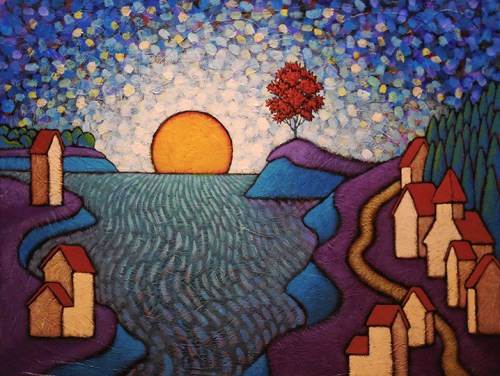
The painting above, Everlasting Bond, and the song below have a common theme, one that is the antithesis to the perils of these times: Love.
The song is Madeline Peyroux‘s version of Dance Me to the End of Love from the late Leonard Cohen. It has a jazzy, swingy feel. A good way to kick off what I hope will be a good work day.
In times like the present, men should utter nothing for which they would not willingly be responsible through time and eternity.
–Abraham Lincoln, December 1, 1862 Message to Congress
Short on time but wanted to just put out a reminder that this is President’s Day. Abraham Lincoln always held high esteem in our family. Growing up, there was a photo of Lincoln in our family photo albums. It was very old, small sepia-tone photo that most likely belonged to my mother’s grandmother, who had raised my mother from early childhood after her own mother had died.
From my genealogy work, I know that my great-grandmother was born just after the Civil War but her father and many of her uncles and cousins had fought for the Union Army in the conflict. There are plenty of offspring along the line named after the great Union generals Ulysses Grant and William Sherman but surprisingly none named after Lincoln.
I think they felt that would be going too far, that the name was too sacred, too burdensome a load to put on the shoulders of a child..
I have read similar accounts from other families who also had photos of Lincoln in their family photo albums. It speaks volumes for Lincoln’s moral and steadfast leadership in times of peril.
After the four years of the former guy’s tenure, it’s hard to believe that such leadership is possible. Let us hope that that are those out there in our future with same strength of character, with similar depths of honesty and moral courage willing to take on this difficult role.
Here’s reading of Oh Captain! My Captain! from Walt Whitman, that captures the loss felt by the American nation at the time of Lincoln’s death.
Wasn’t sure what I would write about this morning. I came across a performance of a favorite Philip Glass piece, one from his soundtrack of the film Mishima, that I was going to use for this week’s Sunday Morning Music selection. It was performed by a saxophone quartet, the Multiphonic Quartett.
I was intrigued by the setting for their performance. It was some sort of industrial building with gray concrete walls and these strange, huge inverted pyramid structures hanging from the high ceiling. At first glimpse, I thought they might be in some sort of experimental recording location and these were some type of acoustical structures that moved or enhanced the sound.
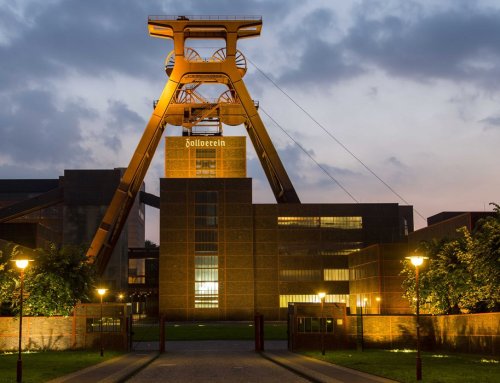
The more I watched the video, the more intrigued I became. Looking through the details I saw that the location was Zeche Zollverein. Doing a little research I found that it was once one of the the largest coal mines and coking plants in Europe, located near Essen, Germany.
It was a marvel of industrial architecture and the shaft shown in the photo at the top, Shaft 12, is considered the most beautiful coal mine in the world. It has been out of service since 1986 and the complex has been transformed into a massive cultural/arts center for the region. It is now a UNESCO World Heritage site. I have included a video below that shows a bit of the complex.
Those inverted pyramids turned out to be huge chutes that fed coal into the processing plants where t was transformed into coke used for steel production.
There’s no doubt a lot more to be said about the place but I thought I would pass on some basic info. I like the idea of transforming industrial sites that are potential eyesores into something beautiful and useful. It certainly makes an interesting setting for the Glass piece.
The heart can think of no devotion Greater than being shore to ocean – Holding the curve of one position, Counting an endless repetition.
-Robert Frost
Things to do this morning keep me from writing much. But here are a few things that kind of line up with one another. A painting, a Robert Frost poem and an Arvo Pärt composition, Da Pacem.
A good way to ease into a Saturday morning in a world that seems a bit on edge.
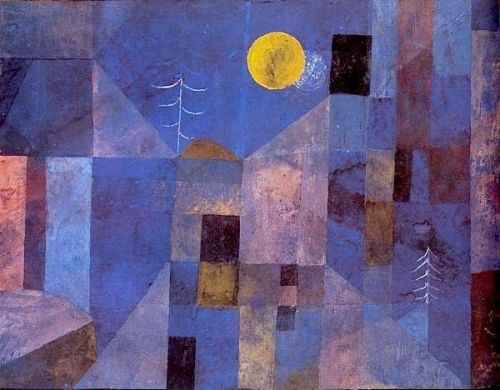
The excerpt above is from On Modern Art, the 1924 treatise from the great Swiss artist Paul Klee, someone who I have featured here a number of times over the years. Yesterday, I wrote about how it often feels like everything has been done before. With Klee, I often wonder if he was one of the exceptions to that rule.
His work always felt like it was a jumping off point, an origin, rather than an extension of something that had come before. It was work that didn’t owe anything to the past and set the able for the future.
I know for me, he was a big influence if only in his attitude and the distinctness of his work. I always think of his work in terms of the color– sometimes muted yet intense and always having a melodic harmony to it.
It always feels like music to me.
I like his idea that the world is in the process of creation, a constant and ongoing Genesis, and that it is not a final form. It allows for visionary work, for imagining other present worlds that extend beyond our perception because, as he writes, “In its present shape it is not the only possible world.”
And to me, that is an exciting proposition, one that gives my little created world viability.
This was a reworking of a post from back in 2015. It’s the post I needed this morning.
n. the frustration of photographing something amazing when thousands of identical photos already exist—the same sunset, the same waterfall, the same curve of a hip, the same closeup of an eye—which can turn a unique subject into something hollow and pulpy and cheap, like a mass-produced piece of furniture you happen to have assembled yourself
–The Dictionary of Obscure Sorrows
The artist forever wants to be original. Unique and different from the pack of other artists with that same impulse.
And this desire applies to their own work, wanting each piece to be absolutely distinct and unrepeatable, totally different from their other pieces of created art.
But despite all best efforts, for most artists there is a dreadful feeling that is often near at hand.
The fear that everything has already and always been done.
It’s can be a crippling feeling for an artist.
Why go on when everything has been done, when there is nothing new under the sun?
Standing in front of the easel holding a blank canvas, that question and many more often arise.
Will this piece be something new, something never seen before? Or will it be a reworking of a theme and a pattern that has been repeated numerous times through the decades and centuries before this moment? Or a repetition of a similar work or pattern of my own?
Why go on?
That’s a good question. And an existential one for an artist.
The answer, at least in the way that I see it, is that it doesn’t matter whether it has been done once, twice or a thousand times before, either by myself or artists of distant past generations.
The simple act of creating is what counts. This moment with this thought, with this effort and concentration, with this interpretation of how it feels to be in this moment, is what counts.
Attempting to reach out from this moment and connect with another mind and soul in whatever manner and form is possible within our limited abilities– that is all that counts.
Everything has been done. But it doesn’t matter because it wasn’t done in this place nor point in time.
The opportunity comes in this distinct moment.
Knowing that takes away the fear, allows the artist to continue. And to do so with the hope that today is unlike any day before, that something new and never seen before will come to life.
And if that doesn’t happen, that’s okay because the artist fought through the fear and made the attempt.
There is always a new opportunity to contribute to the continuum of creation tomorrow.
Lawren Harris- Ice House, Coldwell, Lake Superior 1923
Art is the distillate of life, the winnowed result of the experience of a people, the record of the joyous adventure of the creative spirit in us toward a higher world; a world in which all ideas, thoughts, and forms are pure and beautiful and completely clear, the world Plato held to be perfect and eternal. All works that have in them an element of joy are records of this adventure.
—Lawren Harris
I love this quote from the great Canadian painter Lawren Harris. I know that whenever I am working and am excited with the joy of what is unfolding before me, I feel closer and more connected to some sort of power that is beyond my knowledge.
It’s as though I feel tapped in to that winnowed result of the experience of a people as Harris puts it.
Connected to a universal oneness.
That is a great feeling, exhilarating and calming at the same time. It is ultimately the feeling that brings one to art, both as a viewer and a creator.
Unfortunately, in the course of creating, it is sometimes a feeling that is forgotten, put aside for ends other than this element of joy.
It’s easy to do, believe me.
But rediscovering that joy is like coming across it for the first time. Because even though you know you have experienced it before, it feels all new and shiny, full of promise.
Effervescent– that is the word that comes to mind when I think of these moments of joy.
So, let me stop right here. I am close to my own joy and don’t want to delay it for another minute.
Effervescence and joy will not wait around too long, you know, and I don’t want to miss it.
Trying to find some of that effervescence this morning so I am replaying this post from several years back.
Why did I pray? A strange question. Why did I live? Why did I breathe?
“I don’t know why,” I said, even more disturbed and ill at ease. “I don’t know why.”
After that day I saw him often. He explained to me with great insistence that every question possessed a power that did not lie in the answer. “Man raises himself toward God by the questions he asks Him,” he was fond of repeating. “That is the true dialogue. Man questions God and God answers. But we don’t understand His answers. We can’t understand them. Because they come from the depths of the soul, and they stay there until death. You will find the true answers, Eliezer, only within yourself!”
“And why do you pray, Moshe?” I asked him. “I pray to the God within me that He will give me the strength to ask Him the right questions.”
― Elie Wiesel, Night
The passage above from Night, the memoir of the Holocaust from the late Nobel Laureate Elie Wiesel, has stuck in my mind for a long time. Decades. It has informed my life and outlook as well as my work.
Life comes down to being a matter of not what we know but rather a matter of what we want to know.
A matter of the quality of our questions and how willing we are to accept the answers.
I think, as Moshe says above, that the true answers are only found within ourselves. And while we can’t always understand the answers to our questions, we sometimes refuse to accept those answers we do comprehend because they reveal us to be less than we hope.
They are not the answers we wished to receive.
But these may be the most important answers we ever receive because to know fully yourself you have to be able to recognize every aspect of your being, good and bad.
After all, each day contains about the same amount of darkness as it does light. You can’t know a day without knowing that there is both.
Hmm…
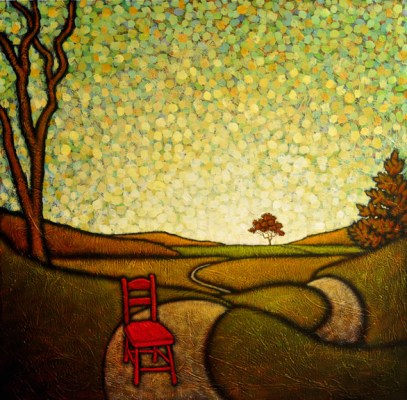
The painting shown here is from about a dozen years back, a 30″ by 40″ canvas that is titled In the Revealing. It’s a favorite of mine, reminding me of this passage from Wiesel. Reminding me to ask questions and accept answers when they are revealed. It hangs in the studio where I can see it from my desk and has never hung in a gallery. Nor will it ever.
There must be some other possibility than death or lifelong penance … some meeting, some intersection of lines; and some cowardly, hopeful geometer in my brain tells me it is the angle at which two lines prop each other up, the leaning-together from the vertical which produces the false arch. For lack of a keystone, the false arch may be as much as one can expect in this life. Only the very lucky discover the keystone.
― Wallace Stegner, Angle of Repose
The lines above from the 1972 Pulitzer Prize winning novel, Angle of Repose, from the late Wallace Stegner really jumped out at me this morning. To be honest, I haven’t read the book so can’t speak to its context but its concept of two vertical lines tipping together so that they meet and prop each other up to create a self supporting false arch just seemed like the perfect imagery for today, Valentine’s Day.
Every lasting relationship depends on this arch. I hesitate to use the word “false” though I understand it is in reference to the distinction between “true” arches that have angled stones and a keystone at its apex that binds it all together and “false” arches that have the appearance and serve the same purpose but are constructed in a less sophisticated manner, sometimes haphazardly or by sheer accident.
Two trees falling against one another in the forest, for example.
Or maybe even two trees that grow together and eventually seem almost as one. a la the trees in my Baucis and Philemon based paintings.
I’ve been part of such a false arch for a very long time and as a result Valentine’s Day takes on a different look for me. Though it maintains a romantic aspect, it is more about a deeper recognition and appreciation of all the many aspects that make up that other vertical line that somehow fell my way all so many years ago to create our false arch.
And, as the Stegner lines above point out, this false arch might be as much as one can expect in this life. I certainly can’t ask for anything more.
Here’s one of my favorite Rickie Lee Jones songs, one that seems fit for this post. Here’s We Belong Together, from her classic 1981 album, Pirates.
To feel the love of people whom we love is a fire that feeds our life.
– Pablo Neruda
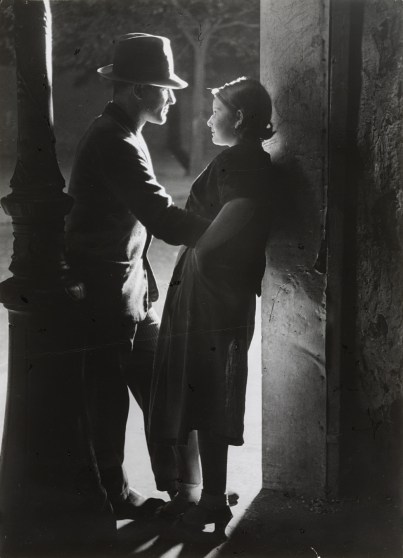
Since Valentine’s Day falls tomorrow, I thought I would just focus on love today with one of Brassai’s photos of Parisian lovers in the the 1930’s, a line on the fire of love from the poet Pablo Neruda, and a song that kind of sums it all up, The Fever.
The song was written by Bruce Springsteen in 1973 and somehow never made it onto his early albums. It ended up being passed on to Southside Johnny and his band, the Asbury Jukes, by Steve Van Zandt who was managing them at the time.
Southside Johnny was a Jersey Shore blue-eyed soul belter and the song was perfect for his delivery. It became one the main tracks from the Jukes’ first album in 1976, I Don’t Want to Go Home. That album spent a lot of time on my turntable back then and this song is one that is feels like it is meant to be heard in the dark with only the faint glow of the stereo receiver setting the tone.
I would bet anything that Neruda and those Parisian lovers under that street lamp felt The Fever.







 Redtree Times