Feeds:
Posts
Comments

Featherlight

GC Myers-  Featherlight sm

Featherlight– At Little Gems


I always figured we were born to fly, one way or other, so I couldn’t stand most men shuffling along with all the iron of the earth in their blood. I never met a man who weighed less than nine hundred pounds.

― Ray Bradbury, A Medicine for Melancholy


This new small painting, headed to the West End Gallery for their annual Little Gems show, is titled Featherlight. I chose this title because the contrast between the weightiness of the earth and sun and the feathery lightness of the sky.

Plus, it seemed to me that the Red Tree here is filled with a distant longing, as though it knew it was born to fly.

Yet, again and again, it finds itself unable to break free of the heaviness of the bonds it holds with this earth.

But even though it finds itself trapped between the weight of the earth and the feather-lightness of the sky, it holds tight onto its dream of flight.

Even for a nine hundred pound man with all the iron of the earth flowing in his veins, simply having the dream creates its own lightness.

Inside, the tree is forever featherlight.

Ventura

GC Myers- Ventura 2022

VenturaLittle Gems at the West End Gallery


The only thing that makes life possible is permanent, intolerable uncertainty: not knowing what comes next.

― Ursula K. Le Guin, The Left Hand of Darkness


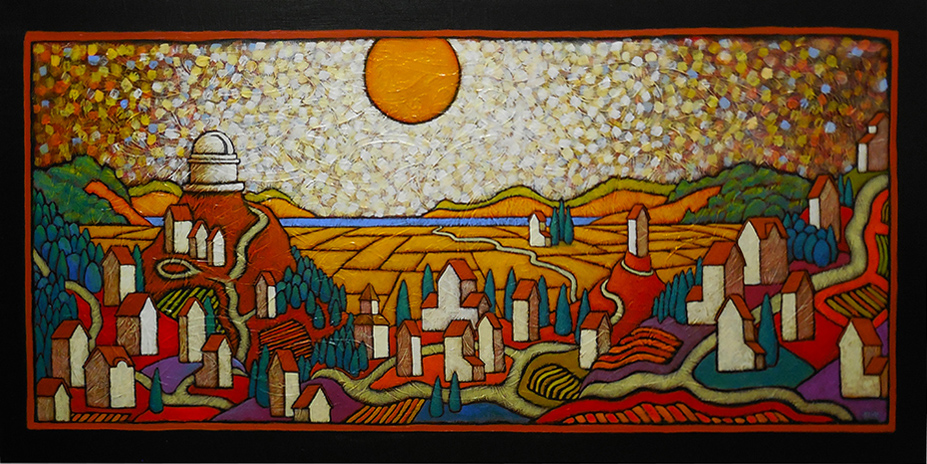
The painting shown above, Ventura, is a late addition to this year’s Little Gems show that opens this coming Friday, February 11 at the West End Gallery.

The title is taken from the Latin word that means future or the things that will come. And that is how I view the underlying meaning in this small piece.

A journey forward toward the future, forever following light but never truly knowing what lies ahead. As Le Guin points out, this uncertainty itself might be the thing that drives us forward.

If so, we must be aware of each step of the journey, to pause occasionally to take in and savor the colors and textures of the moment.

I think that sums up this painting well, at least in how I read it. You may well see it differently.

For this week’s Sunday Morning Music I am going with an old favorite that I haven’t heard in awhile, one that might fit well with Ventura. The song is Wayfaring Stranger from the late great Doc Watson. I sometimes forget to listen to Doc’s music and when I hear it again, the eloquence and power in his simple and plaintive voice is like a soothing balm. Good stuff.


Assassins

GC Myers Two Sides  2006


“Legitimate political discourse”

Those three words set me off yesterday.

And to be honest, I am as angry this morning not to mention a little worried for what the use of these three simple words mean in the near future.

Legitimate political discourse” was how the Republican Party described the actions of the January 6 insurrectionists yesterday in their censure of Rep. Cheney and Rep. Kitzinger, the only two Republican members of congress who clearly viewed the events of January 6, 2021 for what it was– a violent threat to our democratic system.

As would any breathing human with a shred of honesty and integrity.  Or eyes.

The idea that someone could look at that day and the violence that it entailed and say that this was just a another example of citizens reaching out to their elected officials is maddening. Thus, my anger.

But as I said, it worries me as well.

It is a public declaration that such activity is now within the bounds of normal behavior. This acceptance and legitimization of political violence– along with the recent race to ban books, intimidate school boards and teachers, erase certain parts of our history, and continuously distribute falsehoods and misinformation–confirms my fear that the Republican Party has wholeheartedly embraced a form of fascism.

That is a dangerous proposition for every one of us, whether or not we choose to pay attention.

But I wonder how well they have thought out this public declaration. Where does the leadership of the Republican Party think this will lead?

There are always unintended consequences to any action, some favorable and some devastating. And declaring that violence and mayhem is okie-dokie seems to be leaning towards devastation, at least in my mind.

I mean, what is the dividing line between what they see as legitimate and illegitimate?

If I don’t see eye to eye on things with my congressperson, can I run them over with my car if I see them on the street?

And is Antifa, who stands against this new form of the GOP, now okay with them? After all, their most extreme actions are certainly as legitimate a form of political discourse as those who bear-sprayed police and beat them with flags and such.

Would John Wilkes Booth’s assassination of Lincoln be now seen as a citizen rightfully expressing his discontent with a public official?

Under today’s GOP, would Lee Harvey Oswald have qualified to run for congress under their banner?

Where does it take you when you have chosen a path built on the acceptance– and encouragement– of violence?

I am a person constantly filled with uncertainty and doubt but I can tell you with absolute certainty that the answer to that question is: Nowhere good.

That a major political party with all its resources, money, and mechanisms would choose to make such a declaration should open all of our eyes a bit wider and make the hair on the back of our necks stand up. Like a wild creature who senses a nearby predator and is ready to fight, flee, or hide.

There is danger at hand and we need to take action.

Fight, flee, or hide.

I am not going away and I am certainly not going to hide.

Here’s a clip from Assassins, the1990 Broadway musical from the recently deceased Stephen Sondheim. The show features the ghosts of nine prominent assassins and would-be assassins–John Wilkes Booth, Lee Harvey Oswald, Leon Czolgosz, Charles Guiteau, John Hinckley, Giuseppe Zangara, Samuel Byck, Lynette “Squeaky” Fromme, and Sara Jane Moore— and explores what their presence in American history says about the ideals of their life and country.

This song is the final reprise of Everybody’s Got the Right.

It might be the new theme song of the GOP.


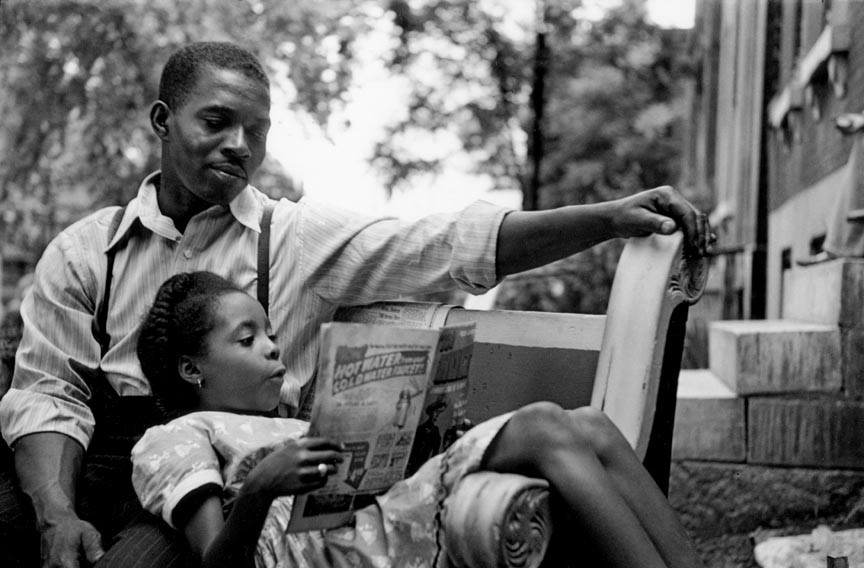
Gordon Parks Father Daughter St. Louis 1950

Gordon Parks- Father /Daughter, St. Louis, 1950


One of my favorite parts of writing this blog is the stream of consciousness part of it where I encounter something new. That part where I begin to research and one thing leads to another and another, wild tangent  to wild tangent. The result is that I end up learning of someone of whom I was previously unaware or some new concept or fact.

It often starts innocently. For example, this morning I stumbled across a short video from last night’s The Late Show with Stephen Colbert where the singer Dua Lipa turned the tables and asked Colbert about whether his comedy and his faith ever intersected. His answer was thoughtful and complete. I urge you to watch the clip at the bottom.

But in it, he invoked lines from the late poet Robert Hayden , from his 1970 book of poetry titled Words in the Mourning Time, that were very powerful and to the moment:

We must not be frightened nor cajoled
into accepting evil as deliverance from evil.
We must go on struggling to be human,
though monsters of abstraction
police and threaten us.

Words powerful enough that I immediately began looking up Hayden. I was a little embarrassed and ashamed that I didn’t know the name. His credits and the poems that I read were staggeringly impressive.

Hayden was an African-American born in Detroit in 1913 and died in 1980. He was the first African-American to hold the post Consultant in Poetry to the Library of Congress, which is now known as Poet Laureate.

Inspired by the poetry of W.H. Auden  and Stephen Vincent Benet, Hayden’s work often outlined the experience of the African-American throughout our history. But even so, Hayden rejected the idea of being called a black poet, referring to simply be recognized as a poet. This small distinction put him somewhat out of favor during the 1960’s with the black community though in essence his desire to be recognized without reference to his race represented one of the desired goals of the civil rights movement.

In fact, the whole of the verse from which Colbert quoted made just that point:

We must not be frightened nor cajoled
into accepting evil as deliverance from evil.
We must go on struggling to be human,
though monsters of abstraction
police and threaten us.

Reclaim now, now renew the vision of
a human world where godliness
is possible and man
is neither gook nigger honkey wop nor kike

but man

permitted to be man.

I am including a couple of his other poems below. One is Those Winter Sundays which movingly speaks of the simple duties of love carried out by parents that are often overlooked by their children. Powerful. The other is Frederick Douglass.

As I read this poem, I wondered as I have many time before how nobody had yet made a big biographical film about the life of Douglass, who I consider one of the most fascinating, impressive, and influential characters in our history. This led me to looking this up and it turns out that the production company formed by Barack and Michelle Obama have one currently in production based on the Pulitzer Prize winning biography, Frederick Douglass: Prophet of Freedom, from historian David Blight. Hope it brings his power and eloquence to the attention of a wider swath of Americans.

Glad I watched the video below and found out more about Robert Hayden. I feel a bit more complete now. And that’s always a good thing.


Those Winter Sundays

Sundays too my father got up early
and put his clothes on in the blueblack cold,
then with cracked hands that ached
from labor in the weekday weather made
banked fires blaze. No one ever thanked him.

I’d wake and hear the cold splintering, breaking.
When the rooms were warm, he’d call,
and slowly I would rise and dress,
fearing the chronic angers of that house,

Speaking indifferently to him,
who had driven out the cold
and polished my good shoes as well.
What did I know, what did I know
of love’s austere and lonely offices?


Frederick Douglass

When it is finally ours, this freedom, this liberty, this beautiful
and terrible thing, needful to man as air,
usable as earth; when it belongs at last to all,
when it is truly instinct, brain matter, diastole, systole,
reflex action; when it is finally won; when it is more
than the gaudy mumbo jumbo of politicians:
this man, this Douglass, this former slave, this Negro
beaten to his knees, exiled, visioning a world
where none is lonely, none hunted, alien,
this man, superb in love and logic, this man
shall be remembered. Oh, not with statues’ rhetoric,
not with legends and poems and wreaths of bronze alone,
but with the lives grown out of his life, the lives
fleshing his dream of the beautiful, needful thing.



Hasten to the Light

9922104 Hasten to the Light sm

Hasten to the Light– Included in Little Gems at the West End Gallery


A bit of a mashup today with a new small painting, a Shel Silverstein poem and a Warren Zevon song.

The painting above is Hasten to the Light which is part of the annual Little Gems show at the West End Gallery in Corning. 


Shel Silverstein Needles and Pins

Shel Silverstein- Needles and Pins


The poem and illustration above is from the Shel Silverstein book, Falling Up.

The song below is Hasten Down the Wind from the late Warren Zevon with accompanying vocals from the also late Phil Everly. Zevon wrote the song but most folks associate it with Linda Ronstadt who made it the title track of a popular album in the 70’s.

The connecting thread between these three pieces is the expression of a restless desire. Oh, and the use of the term hasten in two of them. And the allusion to sail and sailing in two others.

I am sure there are other connections one can find in the three but let’s just leave it at these and enjoy all or some of the three, okay?


O Me! O Life!

GC Myers- The Restless Edge

The Restless Edge


Oh me! Oh life! of the questions of these recurring,
Of the endless trains of the faithless, of cities fill’d with the foolish,
Of myself forever reproaching myself, (for who more foolish than I, and who more faithless?)
Of eyes that vainly crave the light, of the objects mean, of the struggle ever renew’d,
Of the poor results of all, of the plodding and sordid crowds I see around me,
Of the empty and useless years of the rest, with the rest me intertwined,
The question, O me! so sad, recurring—What good amid these, O me, O life?

Answer.

That you are here—that life exists and identity,
That the powerful play goes on, and you may contribute a verse.

Walt Whitman, Leaves of Grass


There are mornings where I really need to hear some Walt Whitman. Today is one.

This is a verse that pretty much sums up my entire life’s motivation, that being a need to contribute my own individual verse to the book of life, to leave behind some lasting evidence of my short time on this earth.

This poem reminds me very much of the first drawing and poem of my own that I can remember. It no longer exists except in my memory but I believe I was in third grade, 8 or 9 years old. It was just a couple of lines called The Rat Race illustrated with a rough kid drawing of a tall skinny rat dressed as a runner with big sneakers.

Even at that age I felt what a constant grind life could be. Feeling small and voiceless, like most third-graders, I had already had a sense of how easily each of us might be overlooked in the crush of humanity and how it was on me to make my own mark.

In fact, it was a sense that our purpose in this life was to make that mark.

I still often feel like that small, voiceless third-grader. But I rest a bit easier now with the belief that my verse is somewhat written and that I have made some sort of small scratch of my own on the surface of this earth.

It might not be much but its mine.


Approaching Eminence

GC Myers- Approaching Eminence sm

Approaching Eminence– At the West End Gallery


From the very beginning almost I was deeply aware that there is no goal. I never hope to embrace the whole, but merely to give in each separate fragment, each work, the feeling of the whole as I go on, because I am digging deeper and deeper into life, digging deeper and deeper into past and future. With the endless burrowing a certitude develops which is greater than faith or belief. I become more and more indifferent to my fate, as a writer, and more and more certain of my destiny as man.

– Henry Miller, Reflections on Writing


The excerpt above from a Henry Miller essay on writing resonated with me when I read it many years ago. But  it has rings even louder for me today as I go further into my career as an artist.

The idea of not hoping to embrace the whole but showing bits of it in each work speaks to me. And the developing certitude of which he writes, one greater than faith or belief, is something of which I am just beginning to understand.

And his indifference to his fate as a writer reflects my own burgeoning recognition that while I have no control over how my work is perceived either now or in the future, I do have a certain amount of control over my destiny as a human.

I can choose my actions and reactions. I can choose love over hate. Compassion over antipathy. Kindness over cruelty. Generosity over stinginess.

And each of those choices is but a fragment that makes up the whole, similar to that which Miller refers. Each of those choices moves me closer to a certain wholeness as a human.

Do we ever arrive at that wholeness?

Maybe it doesn’t matter. Maybe each step on our journey comprises a wholeness in itself.

As is always the case, I don’t know.

My job here is to just ask questions. Answers, on the other hand, are often hard to come by, something which you usually have to find for yourself.

Let me know if you do.

The Circle Game

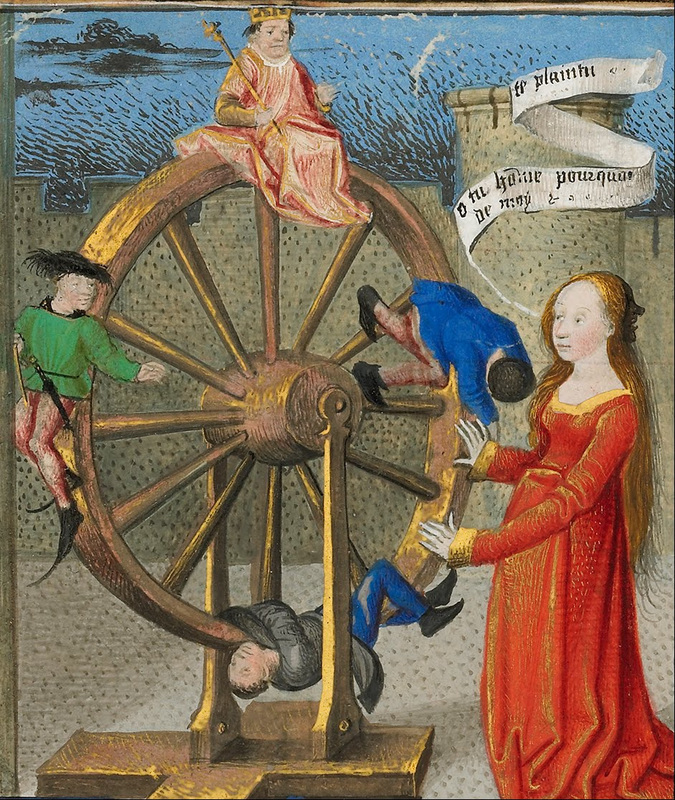
Rota Fortunae -Wheel of Fortune

Rota Fortunae— The Wheel of Fortune


You must read, you must persevere, you must sit up nights, you must inquire, and exert the utmost power of your mind. If one way does not lead to the desired meaning, take another; if obstacles arise, then still another; until, if your strength holds out, you will find that clear which at first looked dark.

― Giovanni Boccaccio, The Decameron


The excerpt above is from The Decameron from Giovanni Boccaccio. It was written in 1353 in the immediate aftermath of the Black Death that swept across and devastated Europe.

It tells of 10 citizens of Florence — 7 women and 3 men– who flee the plagued city for two weeks, settling in a country villa. Each of the ten people are required to tell one story per day though they refrain from doing so chore days or on the holy days. Thus, there are ten days of stories from ten people which brings the total of tales in The Decameron, whose title translates as ten days, to 100.

The stories deal with three primary themes: Fortune, Love and Ingenuity. The Wheel of Fortune plays  a large part in the storytelling. No, not the one with Pat and Vanna! We are talking about the wheel, Rota Fortunae, turned by Lady Fortune, on which kings and beggars both rise and fall.

It portrays the world as a turning wheel that sees each of us– and all of us– sometimes rising to or actually atop the wheel and sometimes sliding from the top toward the bottom of that same wheel. At that time, as the plague raged, they believed themselves to be at the bottom of the wheel.

It’s a fine metaphor for most times and most individual lives. We all have times when we feel that we are rising or falling with moments when we sense that we might be at the very top of our own wheel. And collectively, for all of us as a whole, the metaphor might be even more apt.

We all experience the ups and downs on the Rota Fortunae and, for the most part, we simply do our best to hang on because falling off means our time on the wheel is at an end.

And even so, it keeps spinning.

That’s my intro to this week’s Sunday Morning Music selection. It’s The Circle Game from Joni Mitchell. I thought I would play something from either Joni or Neil Young this week to highlight their decision to pull their catalogs of music from Spotify in protest of that streaming service’s commitment to carrying the Joe Rogan podcast, which has a large following and has been the source of a tremendous amount of misinformation, disinformation and conspiracy nonsense.

As an artist, I understand and agree with their decisions. Even though I believe that all viewpoints have a right to exist and be expressed, even those that are controversial and/or dangerous, that doesn’t mean that I have to share my work in that same space.

For example, if I showed my work at a gallery  and it began to display prominently work whose subject I found morally repulsive and counter to my own viewpoints and beliefs. Let’s say it was work that was filled with racist or misogynistic imagery that was spilled over with hatred and cruelty. I would certainly pull my work from that gallery if they chose to continue showing that work. I would not my name attached in any way to that work, even in the slightest tangential manner.

That is my right as well as my duty to my own moral compass and conscience.

So kudos to Neil Young and Joni Mitchell for exercising their rights. It must be noted that both are from Canada. It seems to me that sometimes those people who have been drawn to this country, the immigrants of all sorts, see things here a bit clearer than those of us who have been here forever. As a result, they often take the exercise of their rights ( and protecting the rights of others) more seriously.

Here is The Circle Game that deals with a wheel of fortune in a way, the wheel here being the carousel of life we all get on and off in an endless ride. Enjoy your ride.


Nirvana X 1000

Cesena Rockin 1000


Another cold, cold morning. Though it doesn’t reach the -18° of a week or so back, the breeze takes the wind chill down to somewhere around -10.

And this morning, the thrill and excitement of severe weather eludes me. It feels like a trudge walking to the studio and after taking care of the herd of cats that live around and with us now, I sit down with my first cup of coffee and begin looking for something that will take away my chill and glum.

One of the first things I come across is a video of a huge group of musicians in a stadium somewhere in Europe playing Nirvana’s Smells Like Teen Spirit. It is raucous and exuberant. You can see the joy in the musicians faces as they play, as though being in and part of such a sonic event is a form of bliss.

Nirvana, I guess.

And it makes me feel better this morning.

The group is the Rockin’ 1000 from Cesena, Italy. It was formed in 2015 as crowdsourced effort to attract Dave Grohl and the Foo Fighters to perform in their city. They eventually put together a show and have done several in the years since. I didn’t look up any stats or facts but it looks like they have about 200 or so each of drummers, guitarists and bass players and four or five hundred vocalists.

It’s quite a mob.

Below is the performance I first saw this morning from Cesena in 2016. Watching it, I realized that though it was only a little over five years ago, it was a completely different world at that moment.

At least, on its face. The divisions that rend us apart were there but still pushed down. Covid and a jump in authoritarian political activity and violence have altered us in many ways. We look at every situation and person through different lenses now.

It made me somewhat nostalgic for 2016, wishing that I could magically go back and somehow improbably alter the future that was to come.

But I can’t. You deal with what is in front of you. And this morning, thankfully, what is in front of me is a video of a 1000 joyful musicians.

Glumness gone.

Nirvana.


Where the Road Rises

GC Myers-  Where the Road Rises sm

Where the Road RisesLittle Gems show, West End Gallery


The artist is always beginning. Any work of art which is not a beginning, an invention, a discovery is of little worth.

― Ezra Pound


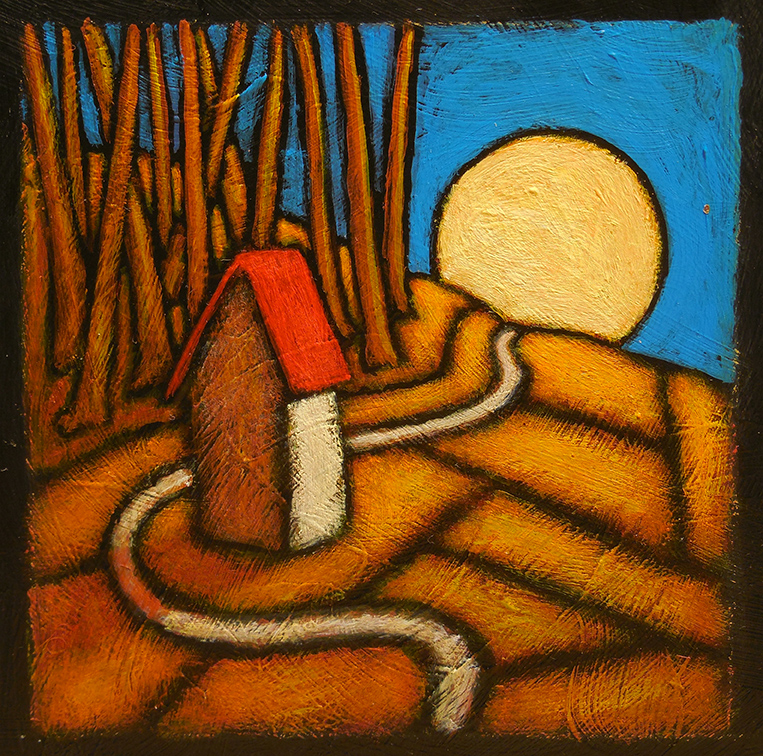
The small painting at the top is titled Where the Road Rises and is included in the upcoming Little Gems show opening in February at the West End Gallery.

I see it as being symbolic of the beginning of some sort of journey, one that might be physical, spiritual, artistic or any other type of endeavor one chooses to follow. A journey of discovery of some sort.

The Red Roof structure represents home or childhood here– the starting point. It is both a place of safety and a point from which we know we must move on, even if only symbolically.

The sun is symbolic of the desire that pulls one to the journey. It represents something we knw might well be unattainable that still sets us on a search to find it.

The rising road represents the path that requires effort to climb. The first steps away from safety often feel the steepest and most difficult.

The forest represents the hidden perils and distractions they must skirt as they begin their journey. Most journeys of discovery often fail before they really begin. Second thoughts on leaving the safety one knows and the prospect of hardships and difficult toil ahead keep most potential travelers in place.

The top of the rise, where one loses sight of safety once they pass that point, represents the unknowns– good and bad– that the trekker will face as they move further along.

But despite the fears that grip most of us, many do begin a journey of discovery. And regardless of the outcome, the mere act of beginning the journey is a triumph of some kind.

Perhaps if only in being able to say one tried for a brief time to reach the unattainable.

The title for this piece refers to the first line from the well-worn Irish Blessing below which offers best wishes and blessings for the traveler:

May the road rise to meet you,
May the wind be always at your back.
May the sun shine warm upon your face,
The rains fall soft upon your fields.
And until we meet again,
May God hold you in the palm of his hand.

The road rises to meet you but you must also move to meet the road and begin your journey of discovery.

Blessings to all you travelers out there.