Feeds:
Posts
Comments

Where the Road Rises

GC Myers-  Where the Road Rises sm

Where the Road RisesLittle Gems show, West End Gallery


The artist is always beginning. Any work of art which is not a beginning, an invention, a discovery is of little worth.

― Ezra Pound


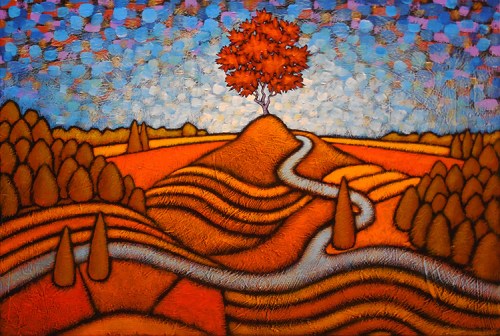
The small painting at the top is titled Where the Road Rises and is included in the upcoming Little Gems show opening in February at the West End Gallery.

I see it as being symbolic of the beginning of some sort of journey, one that might be physical, spiritual, artistic or any other type of endeavor one chooses to follow. A journey of discovery of some sort.

The Red Roof structure represents home or childhood here– the starting point. It is both a place of safety and a point from which we know we must move on, even if only symbolically.

The sun is symbolic of the desire that pulls one to the journey. It represents something we knw might well be unattainable that still sets us on a search to find it.

The rising road represents the path that requires effort to climb. The first steps away from safety often feel the steepest and most difficult.

The forest represents the hidden perils and distractions they must skirt as they begin their journey. Most journeys of discovery often fail before they really begin. Second thoughts on leaving the safety one knows and the prospect of hardships and difficult toil ahead keep most potential travelers in place.

The top of the rise, where one loses sight of safety once they pass that point, represents the unknowns– good and bad– that the trekker will face as they move further along.

But despite the fears that grip most of us, many do begin a journey of discovery. And regardless of the outcome, the mere act of beginning the journey is a triumph of some kind.

Perhaps if only in being able to say one tried for a brief time to reach the unattainable.

The title for this piece refers to the first line from the well-worn Irish Blessing below which offers best wishes and blessings for the traveler:

May the road rise to meet you,
May the wind be always at your back.
May the sun shine warm upon your face,
The rains fall soft upon your fields.
And until we meet again,
May God hold you in the palm of his hand.

The road rises to meet you but you must also move to meet the road and begin your journey of discovery.

Blessings to all you travelers out there.

Maus

Maus -Art Spiegelman


Thou shalt not be a victim, thou shalt not be a perpetrator, but, above all, thou shalt not be a bystander.

― Yehuda Bauer, Israeli Historian and Holocaust scholar


In a week when I write about current spate of book banning, it should come as no surprise that the news came out yesterday that a school board in McMinn County, Tennessee voted unanimously, 10-0, to ban the book Maus from its school libraries.

Maus is a graphic novel written and illustrated by American cartoonist Art Spiegelman. It details the experiences of his father, a Polish Jew and Holocaust survivor, during World War II. Employing an Animal Farm style of metaphoric storytelling, it depicts the Jews as mice, the Germans as cats, and other nationalities as a variety of other animals. Widely praised and banned in many countries under repressive regimes, it is the only graphic novel to ever win the Pulitzer Prize.

As small minded and dangerous as this school board’s decision was, there is also added callousness and insult in the action as it was done on the eve of today’s International Holocaust Remembrance Day, a day of dedicated to the memory of the millions of victims murdered at the hands of the Nazis during World War II.

Did they choose to do so on this day for a reason? Or was this simply a case of sheer ignorance of the timing?

I tend to lean towards ignorance– they are banning books, after all— but even if they were aware, I doubt it would alter their timing or their decision. They are simply part of a movement that seeks to erase history that they find uncomfortable or that might make their kids think.

I take no pleasure in writing about this subject and realize many of you who do read would prefer that I talk about art or music or anything other than a subject as uncomfortable as this. But we are at a time when these types of acts are rapidly stacking up and to avert our eyes now is to signal a sort of acceptance of these actions and the hatred, ignorance, and darkness that drives them.

On this day of remembrance, please do not look away. Pray that it should never happen again to any people anywhere. But unless we educate ourselves and our children to the possibility, it may very well occur once again.

Our silence normalizes atrocity. Callous ignorance breeds it anew.

Now is not a time for bystanders.

occhiolism

GC Myers- Imitatio

Imitatio– At the Principle Gallery, Alexandria, VA


occhiolism

–n. the awareness of the smallness of your perspective, by which you couldn’t possibly draw any meaningful conclusions at all, about the world or the past or the complexities of culture, because although your life is an epic and unrepeatable anecdote, it still only has a sample size of one, and may end up being the control for a much wilder experiment happening in the next room.

— The Dictionary of Obscure Sorrows


This definition from the Dictionary of Obscure Sorrows made me both chuckle and sigh a bit. I think that might be an indicator that it might have some actual truth in it.

Is it better to feel that everyone sees things and thinks just as you do, that your view represents most people? Or is better to believe that you are singular in your thinking, that it has no relevance to nor little effect on the wider world?

I tend to go with the latter, the one that has me aware of the smallness of my perspective, the one that doesn’t really represent everyone or everything. This way I am pleasantly surprised when I do come across someone who shares some of my views.

But maybe that’s just me. The crowd in the next room might be seeing something altogether different.

As usual.

The Book Burners

Book Burning Saint Dominic and the Albigenses (1480). A painting by Pedro Berruguete depicting Dominic, founder of the Inquisition, checking books for heresy with a trial by fire.

Saint Dominic and the Albigensians- Pedro Berruquete, 1480

We are witnessing a worrisome trend in this country , one that is an echo from every repressive, authoritarian regime throughout history.

The banning and burning of books. In fact, some places require that any book– any book— that is reported by a parent must be removed from school or or public libraries. Any book.

School districts and states threatening librarians and teachers with large fines, loss of employment and even prison. Constant reconnaissance of teachers in the classroom.

Banning the teaching of Critical Race Theory, a grad school level concept that has never been taught below the collegiate level, which in turns leads to banning anything that deals with race or civil rights. A seminar for high school educators led by a college professor dealing with MLK and the civil rights movement was cancelled recently for just this reason.

There is an attempt to eradicate huge swaths of history and literature because the sheer idea of it makes some weak-minded folks uncomfortable.


“Censorship is telling a man he can’t have a steak just because a baby can’t chew it.”

― Mark Twain


As I said, this is nothing new. Censorship, rewriting history, and attempting to control the thoughts and minds of citizens are tricks right out of the authoritarian handbook. It has been with us since somewhere around the beginning of time. It was no doubt first written on a cave wall somewhere.


“All these people talk so eloquently about getting back to good old-fashioned values. Well, as an old poop I can remember back to when we had those old-fashioned values, and I say let’s get back to the good old-fashioned First Amendment of the good old-fashioned Constitution of the United States — and to hell with the censors! Give me knowledge or give me death!”

― Kurt Vonnegut


The irony here is that the very people who employ these tactics have usually come to power as a result of freedom of thought and expression. In the society they envision, their type of antics would be squashed.

But they don’t see it that way, of course. Their belief system is very binary, black and white with no shades of gray at all. They cannot believe that free thought and expression is the defining characteristic of this nation, as imperfect as it is or has been.

It has shaped our history and by extension the history of the world. How many consequential things would we be without had our freedom to think and dream been restricted?

Everyone deserves to have their voice heard. And that includes the craziest and most conspiratorial of us. because in a free society one can express almost any idea. But, in a free society, others are able to freely protest and counter those ideas.

In a free society, you can say what you wish but do not expect to have it go unanswered. You can expect pushback, an argument and even repercussions.

In a society that bans thought and ideas, there are no longer two sides to any argument.


“There are worse crimes than burning books. One of them is not reading them.”

― Joseph Brodsky


If all the people trying to ban and burn books had ever read a book they would know how misguided and futile their efforts will be in the end. No nation that has stifled free thought and tried to eradicate history has persevered. All eventually fall.

And that is because ideas and thought and truths– the voices and souls of those books– do not burn.

They persist so long as one mind holds them.

And if we are lucky, these minds and ideas challenge us, making us question the limits of our worldview and expanding our mind to surpass those limits. They inspire greater dreams and aspirations, those that bring us progress and the betterment of all mankind. 


“Don’t join the book burners. Don’t think you’re going to conceal faults by concealing evidence that they ever existed. Don’t be afraid to go in your library and read every book…”

― Dwight D. Eisenhower


It’s a real sign of weakness when we attempt to stifle free thought. It signals that we don’t believe that our children or ourselves do not have the ability to comprehend new ideas and evaluate them without somehow tainting our values and beliefs.

The hallmark of a healthy, functioning society is one whose citizens have inquisitive minds that are open to all ideas and intellectually strong enough to distinguish between those that are right and those that are wrong.


“When truth is replaced by silence, the silence is a lie.”

― Yevgeny Yevtushenko


This book banning and these other extreme measures taking place currently can be quelled if we don’t just shrug it off and say that it’s none of our business what takes place in some county a thousand miles away. 

It will be our business at some point. Silence is always complicity. Our silence enables.


“Once a government is committed to the principle of silencing the voice of opposition, it has only one way to go, and that is down the path of increasingly repressive measures, until it becomes a source of terror to all its citizens and creates a country where everyone lives in fear.”

― Harry S. Truman, Message to the Congress on the Internal Security of the United States, August 8, 1950


Keep your eyes and ears open. Speak out against this type of censorship. The freedom to think and speak is not our enemy. No, it is our greatest asset and once lost it is not easily regained.

Controlling what one thinks or says is the true enemy of all mankind. It is an existential danger for reasons best summed up in the oft-used quote from the poet Heinrich Heine:


Those who burn books will in the end burn people.

— Heinrich Heine, Almansor


Twilight of Memory

GC Myers- Twilight of Memory small

Twilight of Memory– Coming to the West End Gallery


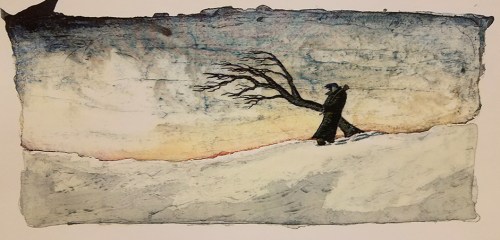
Another cold morning here. It’s winter in these parts so this is just a statement of fact, not a complaint. As much as I dislike the cold spot that settles in the middle of my back on such mornings, I have no longings for warmer climes.

No, I chose this place, this life that sometimes tests your stamina, patience, and willpower. Not always easy. You sometimes feel like you have earned it when the cold of winter finally subsides. There’s a bit of gratitude when the green of the grass begins to show and you realize you made it through another winter season.

Maybe that’s why I chose to stay here, that feeling of being tested and the gratitude that comes from passing that test.

But I do have some warmth in this cold, even if it is a mere painted surface. Take the piece at the top, Twilight of Memory, which is a small painting from quite a few years back that is just now finding its way to the West End Gallery for the annual Little Gems show in February. For me, the warm colors in it represents the warmth that comes for me in good memories.

Perhaps the memories that carry us through these cold days of testing.

And maybe that’s the purpose of memories of the past, to serve not as a place to inhabit but as a reminder of what life has been. Perhaps as a template for what can be, even if it takes a different form in the present.

I don’t know. of course. Just thinking out loud on a cold morning.

Here’s a song from the late Long John Baldry that pretty much sums it up. Here’s It Ain’t Easy.


Such a day…

GCMyers- Such a day... sm

Such a day…– In the upcoming Little Gems show at West End Gallery


People give pain, are callous and insensitive, empty and cruel…but place heals the hurt, soothes the outrage, fills the terrible vacuum that these human beings make.

― Eudora Welty


I hesitated a moment before inserting the words above from author Eudora Welty. It seems a bit cynical at first glance, seemingly placing negative aspects to all people. But thinking more about it, I could see the sense in it.

After all, our emotional scars inevitably come from other human being, from their callousness and cruelty. As a result, we seek a place in which we feel safe and secure, a place in which we can heal and live beyond the wounds we carry.

We seek a place we can call home.

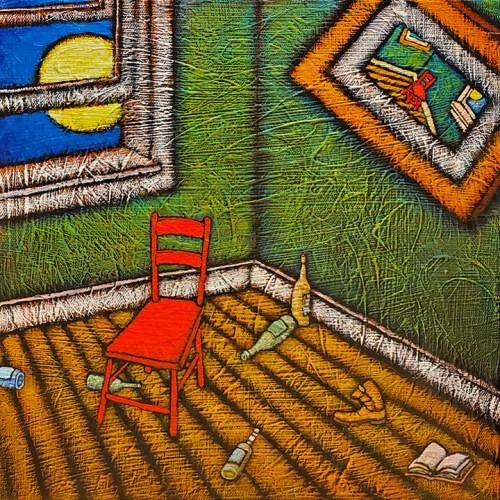
I see this as a recurring theme in my work. The new piece at the top, Such a day…, very much has that sort of feel for me. It reminds me of times and places in my life when I felt at ease and at peace. Content and safe.

At home.

I have a number of these days, those memorable times and places. But when I consider the number of days spent in my life to date, there are not really that many. Too few, actually. That makes the existing ones even more precious in my mind.

This little painting serves as a constant reminder for me. And that’s all I can ask of it.

Here’s song for this Sunday Morning that has some of that same feel. It’s a version of the Talking HeadsThis Must Be the Place (Naive Melody) performed by the Postmodern Jukebox featuring vocalist Sara Niemietz. They transform the song into a 1940’s Swing Band version and despite my affinity for the original, it somehow works, albeit in a different way than the original.

I also put up a version of the original with David Byrne. You can see what you think for yourself.


Extremes

GC Myers--Strange Victory II sm

GC Myers–Strange Victory II


You can’t possibly judge your ability to control something until you’ve experienced the extremes of its capabilities. Do you understand?

― Richard Russo, Empire Falls


Relax. This post is not about politics or political movements though the excerpt above from Empire Falls could certainly describe the devil’s pact the GOP made with the far right many years ago whose fruition we are currently witnessing.

Anything taken to its furthest extreme takes on forms that we can never fully anticipate, some absurd, some dangerous and deadly. But invariably coming to a point that is unsustainable.

This came to me this morning as I stepped outside into the frigid air.

It was -18°.

I’ve been in these temps and much lower before. There is something dramatically different between these sorts of temperatures and even 0° or -5°. The extreme temps and their visceral effect on my eyes, my breath and my exposed skin ( I should have put on shoes and pants before heading over to the studio!) tells me that I am in a danger zone, that this is not something with which to be trifled.

This makes me move quicker and increase my focus. Everything sharpens visually and sounds pop and erupt in the icy air. The boards on our walkway and the bridges in the woods blast out cracking protests with each step, sounding like iced cherry bombs snapping in the dark. Even the crunch of the snow and leaves underfoot booms with electric crackles.

Getting to the garage outside my studio, I am relieved to find that the kerosene heater I have set up for the feral cats is still burning. It’s not warm in there but it is enough to make it bearable and they seem to understand and appreciate that.

This made me think about the extremes we experience, in temperatures as well as in ideologies. We best survive and prosper in moderate temps. Frigid or burning temps both strain and imperil us. We may think we crave heat or coolness but our tolerance is only a short bit either way from the median. Beyond that we  reach into areas where we may not fully anticipate or understand how we may be affected.

I don’t know that I have a cogent point here. Maybe it’s: Be careful what you wish for. All I know is that I am sitting here in the studio, pleased that all my systems and utilities are working and excited at the prospects of the temperature reaching 20° later.

The extremes often force you to lower your expectations, I guess.

Here’s composer Max Richter‘s reimagining of  Winter from Vivaldi’s Four Seasons as performed by the New Ideas Chamber Orchestra. Some violin heat to warm up your morning.


Choice

GC Myers- The Choice

The Choice— GC Myers


What we call our destiny is truly our character and that character can be altered. The knowledge that we are responsible for our actions and attitudes does not need to be discouraging, because it also means that we are free to change this destiny. One is not in bondage to the past, which has shaped our feelings, to race, inheritance, background. All this can be altered if we have the courage to examine how it formed us. We can alter the chemistry provided we have the courage to dissect the elements.

― Anaïs Nin, The Diary of Anaïs Nin, Vol. 1: 1931-1934


I have been thinking and writing a lot about our ability to choose lately. Our life and all it encompasses consists of and is shaped by our choices. We even have, as Anaïs Nin asserts above, the ability to choose to alter our character and, therefore, our destiny.

It’s puzzling to me that having this choice hasn’t made the world a better, kinder and gentler place. We can choose to be better. Choose to be kind or gentle. Choose to be forgiving. Choose to be generous and fair minded.

Yet we often make none of those choices. Why?

Oh, I don’t have any answers. Plenty of guesses and half-baked theories, the most obvious being that people don’t want to have to choose, especially when it requires thought or mindfulness. Most will take what is placed before them because to do so alleviates them of taking responsibility. Without personal culpability, they feel free to moan and complain and place blame on others. And these are the seeds, the starting points, for hatred, greed and envy.

And these, too, are choices.

Mindful choice and the accountability that comes with it might well serve as a buffer, a deterrent against these darker choices.

That’s one theory but, f course, I don’t really know. I don’t even know why I chose to write this this morning. Probably for myself more than anything, to serve as a reminder that I still have the choice to be the person I wish to be.

A reminder to be alert and mindful.

Or just my way of cutting this world in two to see what is eating at its core, as the late poet Langston Hughes writes below.

Like the title, I too am tired. But do what you will with this world– it’s your choice.


Langston Hughes poem

Tired— Langston Hughes

Finding Duty and Joy

GC Myers- And Dusk Dissolves sm

And Dusk Dissolves – At the West End Gallery


I slept and dreamt
that life was joy.
I awoke and saw
that life was duty.
I worked — and behold,
duty was joy.

–Rabindranath Tagore


When I first read the short poem above from the great poet and philosopher Rabindranath Tagore some time ago, it struck a chord with me. It so simply, in just a few lines, put across an observation that takes most of us a lifetime to realize. That is, if we ever do realize it.

Duty was joy.

But what is duty? Is it in being a good parent? A faithful spouse and a loyal friend? Is it in what we do to make a living? Or is it in simply being a decent and caring human being?

Perhaps, it is how our lives touch the lives of others? Could that be a duty?

I don’t know for sure. Most likely, duty and joy is not a one-size-fits-all proposition.

My own feeling is that duty is much like having a purpose, a motivating reason for living that can be seen as a personal obligation or promise that we will finish the mission we have accepted as our own.

This reminds me of the transcendent book, Man’s Search For Meaning, from Holocaust survivor Viktor Frankl, which described his time in the Nazi’s Auschwitz death camp. Frankl observed that those who were able to survive the horror were those who somehow had a purpose for their life, who saw a future that they needed to reach ahead for. This purpose, even a modest one, often served as their given mission, providing the motivation needed for survival, creating a path forward for them into the future.

In the year after being liberated from Auschwitz, Frankl gave a series of lectures that were the basis for his book. In one he spoke of the poem above from Rabindranath Tagore and its final line: Duty was joy:

So, life is somehow duty, a single, huge obligation. And there is certainly joy in life too, but it cannot be pursued, cannot be “willed into being” as joy; rather, it must arise spontaneously, and in fact, it does arise spontaneously, just as an outcome may arise: Happiness should not, must not, and can never be a goal, but only an outcome; the outcome of the fulfillment of that which in Tagore’s poem is called duty… All human striving for happiness, in this sense, is doomed to failure as luck can only fall into one’s lap but can never be hunted down.

In short, lasting joy and happiness cannot be pursued as a goal on their own, without a responsibility to some higher purpose.

I am writing this because sometimes I need to be reminded of this. I have been struggling at times recently in the studio, seemingly fighting with myself to find something that just doesn’t seem to be there. The harder I tried to find it, the further away it seemed. It was like I was looking for something to quell my anxieties and bring me some form of easy happiness. To bring me effortless joy.

I should have known better.

Yesterday, I just put down my head and worked without thinking about the end result. I focused solely on my purpose in each moment, the task at hand. Concentrating on doing small and simple things with thought and care was my duty, as it were. As the day went on, my burden felt lessened and I began to feel joy in the work, joy in small aspects that I had been overlooking in prior days.

It was a satisfying day, one that left me feeling that I had moved in some way toward fulfilling a purpose. It may not be a grand, earth-shaking one but it doesn’t need to be.

It is mine. My purpose. My duty.

And that is enough to bring me a bit of joy.


I didn’t feel like writing this morning. I have lost a bit of the glow off my committed optimism and find myself more concerned than ever about the future of this republic as a result of last evening’s events in DC. So, instead of venting, I thought that I should focus on what I can do in a constructive way. This post from a couple of years back seemed to hit the mark for what I needed this morning, describing the link between duty and joy.

A lot of us believe that joy, like our rights or freedoms, is something that just comes to us without our input. But joy seldom comes without duty and sometimes duty may not be pleasant or easily accomplished.

But those difficult duties often yield the greatest joys.

Let’s keep that in mind.

How Can I Be Sure?

GC Myers- Last Kind Words

Last Kind Words– Headed to the Principle Gallery


It may be that when we no longer know what to do, we have come to our real work, and that when we no longer know which way to go, we have begun our real journey. The mind that is not baffled is not employed. The impeded stream is the one that sings.

― Wendell Berry


I often wonder about our minds, how they work and how things move in and out of our consciousness. It baffles me.

Take this morning. I go through my process of dressing in the dark of the house, putting on my outerwear for my walk to the studio in the cold in a way that makes me feel like I’m an astronaut about to walk in space.

The morning is cold, though not as cold as the temperatures forecast for the next several days that will go down to around -10°, and the moon is full and now low in the sky. Everything outside is sharply defined in blue and yellow shades of moonlight. The snow sparkles.

It is gorgeous.

As I start walking a song comes into my mind. How Can I Be Sure? by the The Rascals from way back in 1967. I am soon humming and singing the parts I can recall as I trudge along the shoveled trail.

And I begin to wonder why this particular song entered my mind in this early morning darkness. What combination of subtle indicators or observations prompted its arrival at the front of my mind? Is it something left over from the nightly data purge that my brain undergoes while dreaming?

Why this song this morning?

Of course, I don’t know and maybe it doesn’t matter. After all, I enjoyed the song. It seemed to fit the emotional tone of the moment.

Maybe I needed to hear it. Maybe my mind was seeking it before I even knew that I needed to hear it.

Who knows?

Like I said, I am baffled.

Here’s the song. Maybe you need to hear it, as well.