Feeds:
Posts
Comments

New Age Blues

Cam Cole Album cover- I See

Cam ColeI See Album cover art


I came across a video of a song, New Age Blues, from a busker named Cam Cole who earns his living playing his music on the streets of London. I had never heard of him and decided to give it a look and a listen. The video was a running record of a typical day of busking, from morning until evening. 

I found it pretty engaging. I admire the bravery of street performers for the fact that they put themselves so directly out in the face of the public. But there is also something so brave in daring to attempt to make your living on what amounts to a mixture of your wits and whatever talent you might possess.

As an artist, I can identify with that. I often find myself stopping and smiling at the sheer absurdity that I have made a living over the past 25 years by my willingness to share my inner world. I often don’t understand it at all but by now it’s all I know. 

So I watch this young guy baring himself on the streets, playing his heart out, and I feel like I sort of understand the freedom he must be feeling in knowing he can survive on doing just that. And in doing so, maybe the onlookers feel a bit of that as well. I know that’s what I hope for my work on some level.

Take a look at the video, if you have a few moments. It’s interesting and really well done as are several of his other videos including one, I Don’t Need to Live Your Way, which sort of lines up with this blogpost. As I said, I had never heard of Cam Cole before this morning but for those of you who have watched the highly acclaimed Apple TV series Ted Lasso, which I haven’t yet watched, you might recognize him from an appearance on that show. 

Take a look. It’s New Age Blues and a day in the life of  a busker.


Higher Self

GC Myers- The Durable Will sm

The Durable Will – Now at the West End Gallery, Corning, NY


Traffic with one’s higher self. Everyone has his good day, when he finds his higher self; and true humanity demands that we judge someone only when he is in this condition, and not in his workdays of bondage and servitude. We should, for example, assess and honor a painter according to the highest vision he was able to see and portray. But people themselves deal very differently with this, their higher self, and often act out the role of their own self, to the extent that they later keep imitating what they were in those moments. Some regard their ideal with shy humility and would like to deny it: they fear their higher self because, when it speaks, it speaks demandingly. In addition, it has a ghostly freedom of coming or staying away as it wishes; for that reason it is often called a gift of the gods, while actually everything else is a gift of the gods (of chance): this, however, is the man himself.

–Friedrich Nietzsche, Human, All Too Human, Aphorism #624


For those among us who have spent their lives observing people, this current time in our history is filled to the brim with all the widest possible array of examples of human behavior, from the noblest to the most awful and base.

Of course, it’s always been that way throughout history. It just seems to become more apparent in certain times of great conflict and stress.

And much of this can be attributed to the thought behind the entry above from an 1878 book of aphorisms, Human, All Too Human, from the German philosopher Friedrich Nietzsche. We sometimes lose sight of those parts of us that comprise our highest sense of being, instead opting to act in ways that seem easier and less taxing on our willpower.

We choose to do that which is expedient but not necessarily in line with our higher self.

And it is a choice. We all have our own higher self, our highest level of being, always at hand. It is built in, the gift of the gods as Nietzsche calls it. But we often choose to ignore this gift and act in less worthy ways.

I don’t know if this higher self can be extinguished in someone. I am pretty sure that the Nazis that appropriated some of Nietzsche’s writings in the 20th century and twisted them for their own evil purposes had lost much of their higher self or at least had a most distorted sense of it. But for most of us, we have the choice to serve our higher self on an everyday basis, to elevate our personal sense of grace while pushing down our darker urges and biases.

I want to believe this is applicable to the real world. I do believe it, actually. But I worry that too many of us will not be willing to answer its call because, as Nietzsche points out, it speaks demandingly. It is not always easy to deny our base urge or reaction, to opt for reflection over reaction.

But it’s there for us, if we so choose.

Just letting you know.

Now get off my lawn!

See? I am still looking for my higher self…

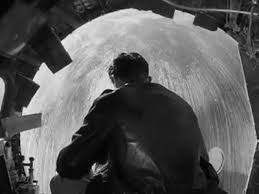
The-Best-Years-of-Our-Lives-  Dana Winter


Today is Veteran’s Day and I thought I might have an image that somewhat represents the experience of some vets on their return home.  There are a lot of  really powerful images  in the great 1946 movie, The Best Years of Our Lives, which shows tonight on TCM. It gives a credible depiction of the veterans’ experiences, telling the story of three veterans of varying economic classes as they return to their shared hometown and the challenges each faces.

In the film, Dana Andrews‘ character, who had been an Air Force bombardier, struggles on his return to his hometown. After losing his job as a soda jerk for punching out an obnoxious America First customer and breaking up with his wife, he decides to leave his hometown and find a new life somewhere elsewhere. While waiting for a flight, he comes across a local airfield where they are junking old war planes from the recently ended World War II. He crawls into an old B-17 bomber and takes a seat in the nose cone of a plane just as he had in his many bombing runs,  peering through his bombsight for his appointed target.

best years of our livesIn a brief moment of PTSD, he vividly relives the terror from his experiences that still haunted him, tainting every moment of his life. Though still alive, his life was a casualty of war. The harrowing image of Andrews appearing ghost-like in the nose of that B-17 is a powerful one in a movie filled with powerful scenes, one that doesn’t sugarcoat the experiences and hardships of the returning vets. It remains relevant to this very day.

For this day that honors those who served in our military services, I would like to play something in the spirit of this upcoming holiday. It would be easy enough to play something patriotic but this isn’t really a holiday of nationalism and a call to arms. No, this is a holiday that celebrates an end to war, namely World War I when the holiday was originated as Armistice Day, and honors the service of all soldiers with the hope that they will soon return home and resume their lives there.

This holiday honors those who have served and sacrificed so much, not the wars to which they are sent.

The song is Johnny I Hardly Knew Ya which is the original tune on which the Civil War era song When Johnny Comes Marching Home is based. While When Johnny Comes Marching Home is more celebratory and martial in tone, the original Johnny I Hardly Knew Ya is pointedly antiwar and mournful. It was supposedly written in the 1790′s as a protest to the British imperialist invasion of Ceylon, present day Sri Lanka. It tells of a young woman seeing her lover, who left her after their illegitimate child was born to join the army, as he returns home from the war. He is much changed in appearance and she mourns for his loss.

This is a very emotional version of the song from British opera and folk singer Benjamin Luxon accompanied by American Bill Crofut on banjo. On this Veteran’s Day, give some thought to the men and women who have given their time and their selves to serving their countries.

Let’s honor them by creating a world in which their lives do not have to be sacrificed.

This post is derived from an earlier post that ran back in 2014.


Imitatio

Imitatio sm


Life imitates art far more than art imitates life.

— Oscar Wilde, The Decay of Lying, 1889


Mimesis. The act of imitation.

The classic philosophers Plato and Aristotle both held that all art was reflective, imitating nature or the world of life around us.

Art imitates life.

Oscar Wilde and other writers throughout the years have challenged this thought. Wilde’s assertion was that humans are basically imitators whose aim is to express themselves and that Art offers a variety of forms or templates in which they might realize that aim.

Life imitates art.

This question of whether Art imitates Life or vice versa is the idea behind this new painting, a smaller 12″ by 12″ canvas that I am calling Imitatio. I am not sure which side this piece takes.

Maybe both?

Life imitating Art might make the most sense here. The scene in the painting– the Art here–is much more orderly while the scene representing Life is cluttered and in disarray. Life, even in its best attempts to imitate Art, is generally messier and subject to the whims of character and conflict.

But again, I can’t be positive of this in this case.

Maybe it should be a little of both, with a flow running back and forth between the two, Life and Art. This in turn forms an endless cycle, a sort of perpetual energy creator.

Now, that sounds like the best option. We may have a winner here.

And I can live with that…

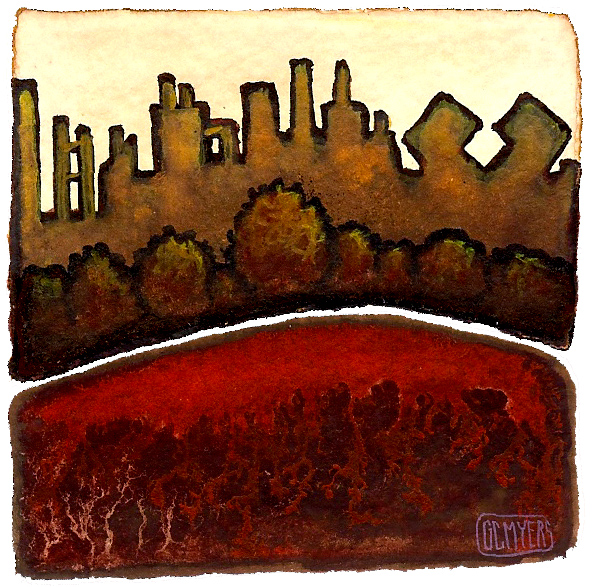
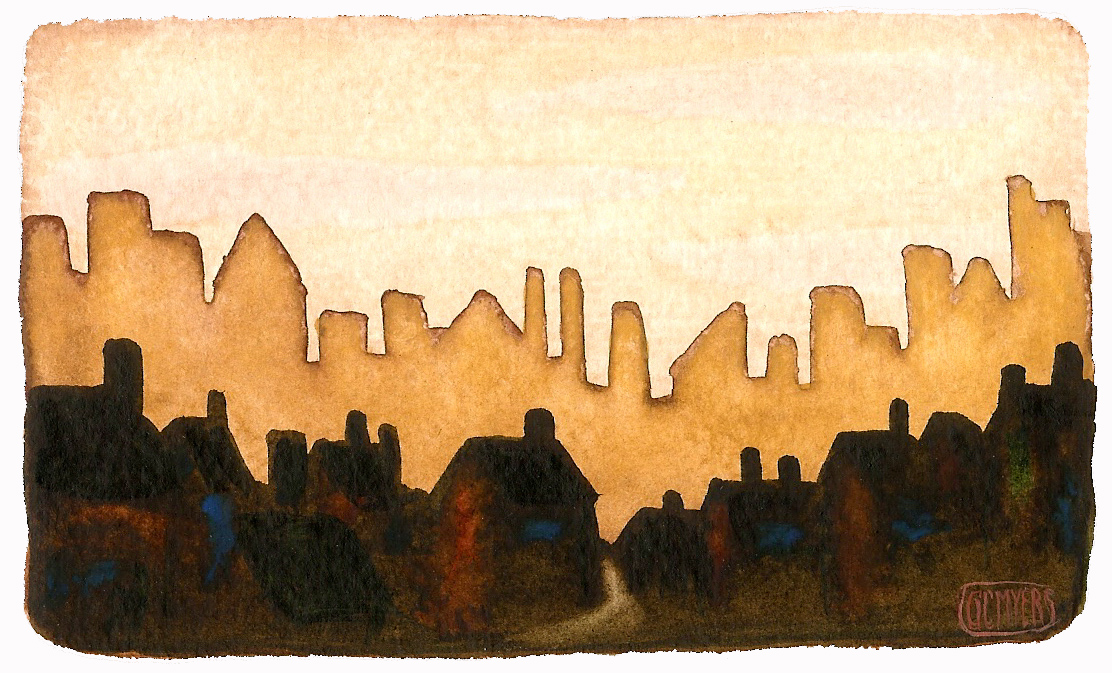
Skyline Blues

996-404


GC Myers-  There Is Still a Sun...I’m a little behind this morning and my computer is acting sort of wonky so I am going to keep it short. Maybe just play a piece of music to accompany an older piece or two from a group that I painted about 15 years ago.

They were small cityscapes, mainly simple skylines that were actually more about color and shapes. I always enjoy going back to these and wonder why I don’t revisit this.

Maybe I will sometime soon. You never can tell.

To go along with these pieces here’s a bit of  piano from contemporary boogie woogie pianist Henri Herbert. It’s New York Skyline Blues and features a great view of NYC from where he’s playing. Even with the spectacular views, I still find myself watching those hands.

A little boogie woogie– it’s always a good way to kick off the day, right? Get’s the blood moving.

I feel mine moving right now…


996-430 Moving On Up

The Last Paintings

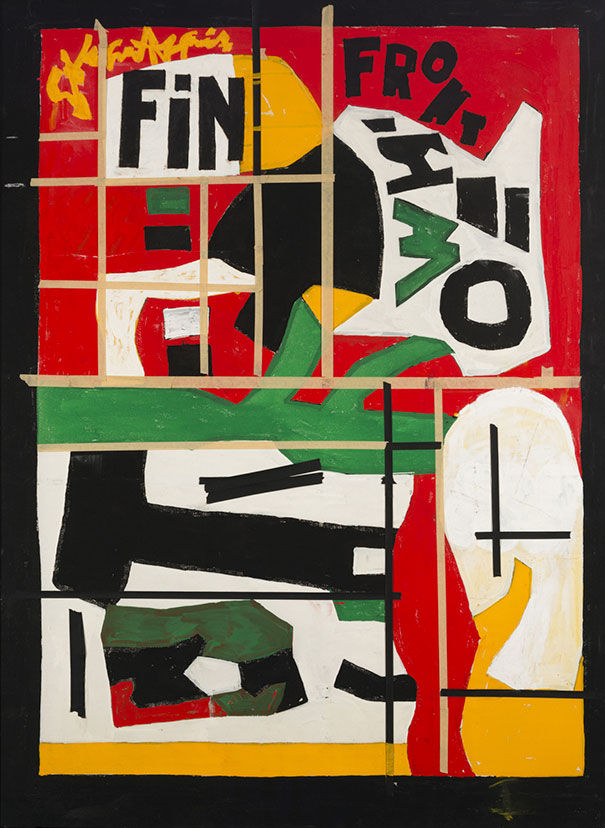
artists-last-works-Stuart davis 1964

Stuart Davis — Fin ,1964


We had dinner with our good friends last night and somehow the conversation came around to the idea of me painting until the last moment of my life. No retirement here, I guess. We agreed that my final painting should have a big slash of paint, most likely red,  going down through it, made while I slump to the ground for the last time.

I suggested that maybe I paint one now just to insure that I am not caught off guard. Death can sneak up on you sometimes and foil your best laid plans. 

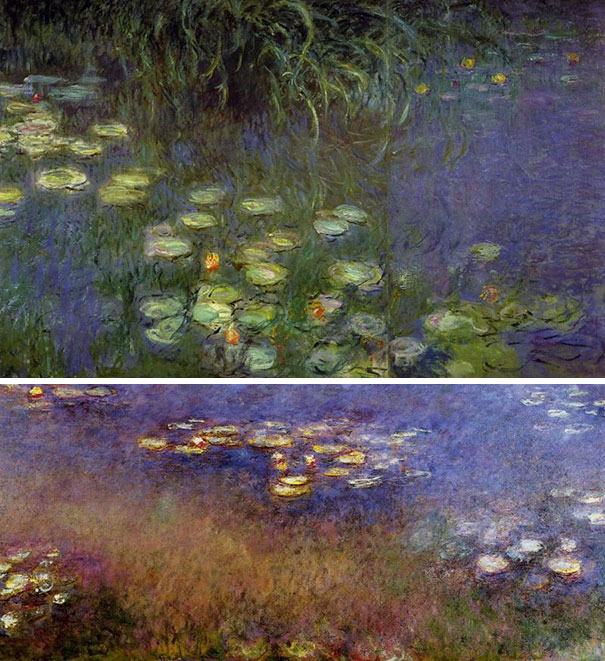
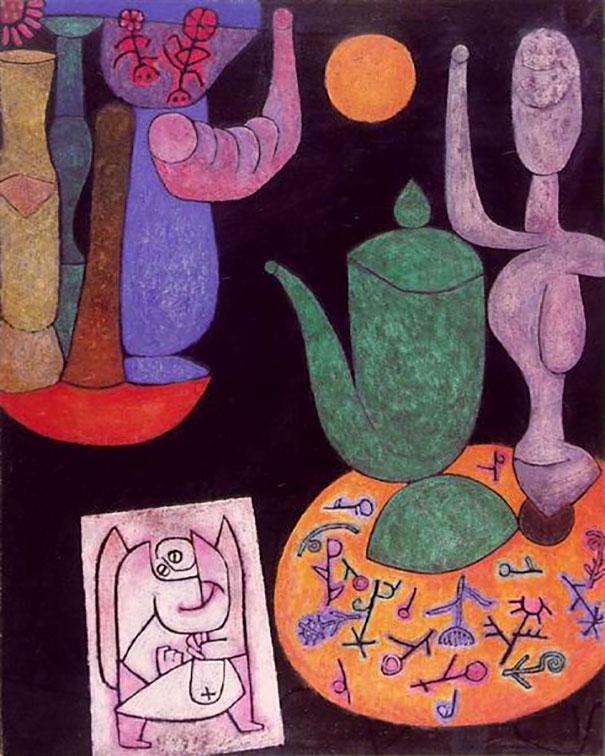
Of course, that was all in fun but it made me think about the final paintings of well known artists. There are plenty of great examples. Some are complete and well known pieces by these artists in their final days. For example, Claude Monet‘s last work was the completion of his massive multipart mural the Grande Decoration. An epic and fitting way to finish to his painting life. Or you can look to the final painting Edouard Manet, A Bar at the Folies-Bergère, which may be the best known of his works. Or there’s Paul Klee and his The Last Still Life, which was titled by his son after his death.

My favorite final painting is the one shown here at the top, Fin, from Stuart Davis. On a June night in 1964, after watching a French movie on TV that concluded with the word “fin” (which means “the end” in French), he added the word on the painting on his easel before going to bed. He suffered a stroke that very night and died in the ambulance while on the way to a NYC hospital. It truly was the last painting for him. Fin.

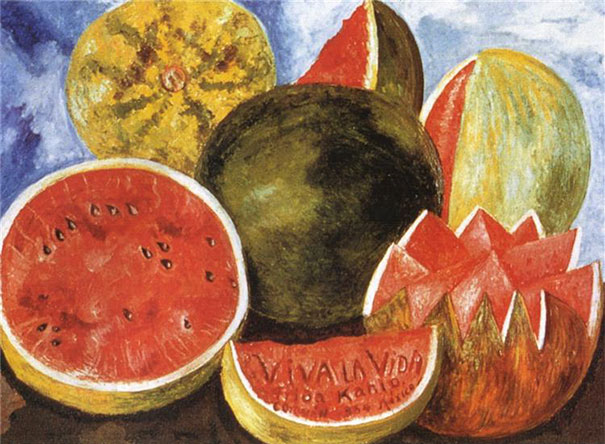
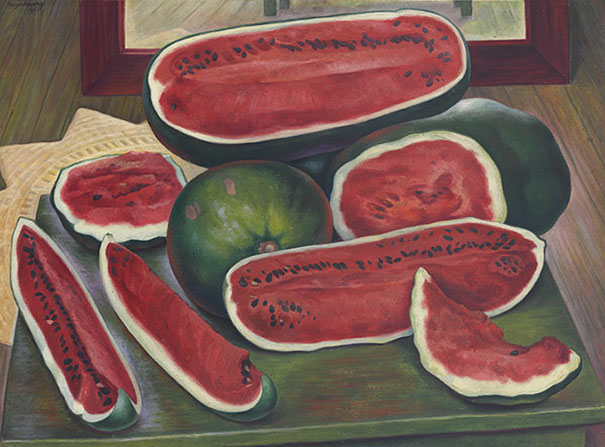
Both Diego Rivera and Frida Kahlo painted watermelons the subject of their final paintings. This is fitting because the watermelon is a symbol associated with the Mexican Dia de los Muertos, the Day of the Dead. In Rivera’s case, he didn’t want to paint it but did so at the insistence of a collector. Maybe he knew it would be his last painting?

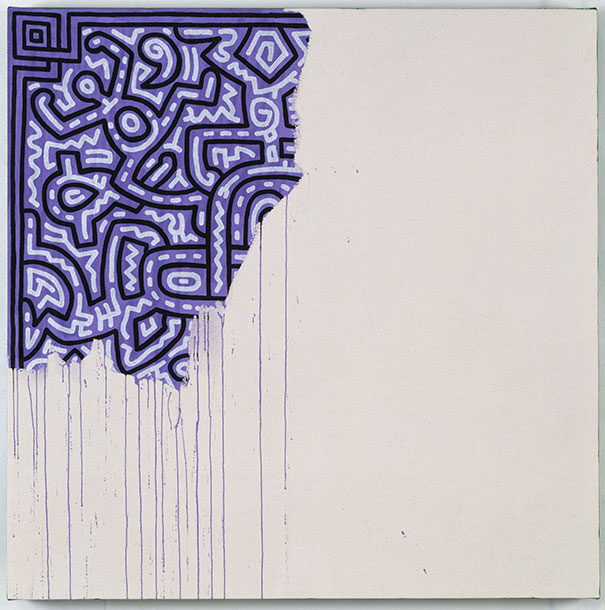
There are some final paintings that are unfinished, the process cut short by death. I don’t believe Keith Haring‘s final piece, Unfinished Painting from 1990, shown below, falls in this category. I think it was meant to appear unfinished as a statement on the lives, his included, being cut short by AIDS at that time.

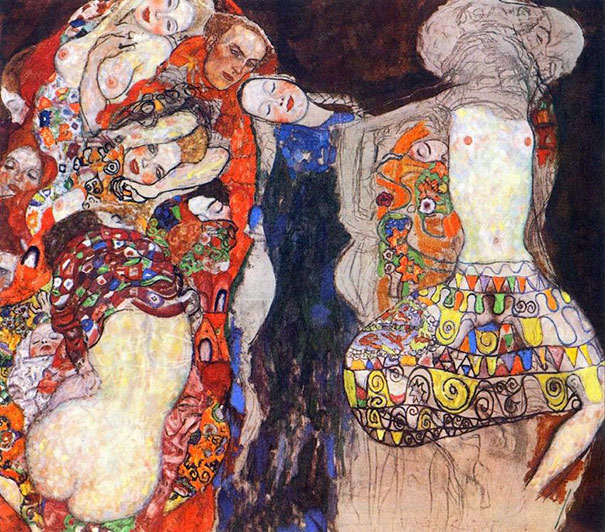
A favorite of mine from the unfinished last paintings is The Bride from Gustav Klimt, shown below, mainly because it reveals an interesting part of his process which was that he would paint his figures as completed nudes before painting on their clothing. I don’t know if that was simply part of his process or part of his deeper sexual obsessions. Either way, it’s kind of interesting.

There are plenty of other examples and there will be plenty more in the future, I am sure. Artists don’t really ever retire, after all.

Now, I have to go. There’s an unfinished painting waiting for me put a red slash through it…


artists-last-works- monet The Grandes Décorations 1920 26

Claude Monet- The Grandes Decorations mural

artists-last-works-haring 1990 Unfinished Painting

Keith haring- Unfinished Painting 1990

artists-last-works-Klee the last still life 1940

Paul Klee- The Last Still Life, 1940

adorn the bride with veil and wreath by Klimt.jpg

Gustav Klimt- The Bride, 1918

artists-last-worksKahlo Viva La Vida

Frida Kahlo — Viva La Vida, 1954

artists-last-works-Rivera The Watermelons 1957

Diego Rivera– The Watermelons, 1957

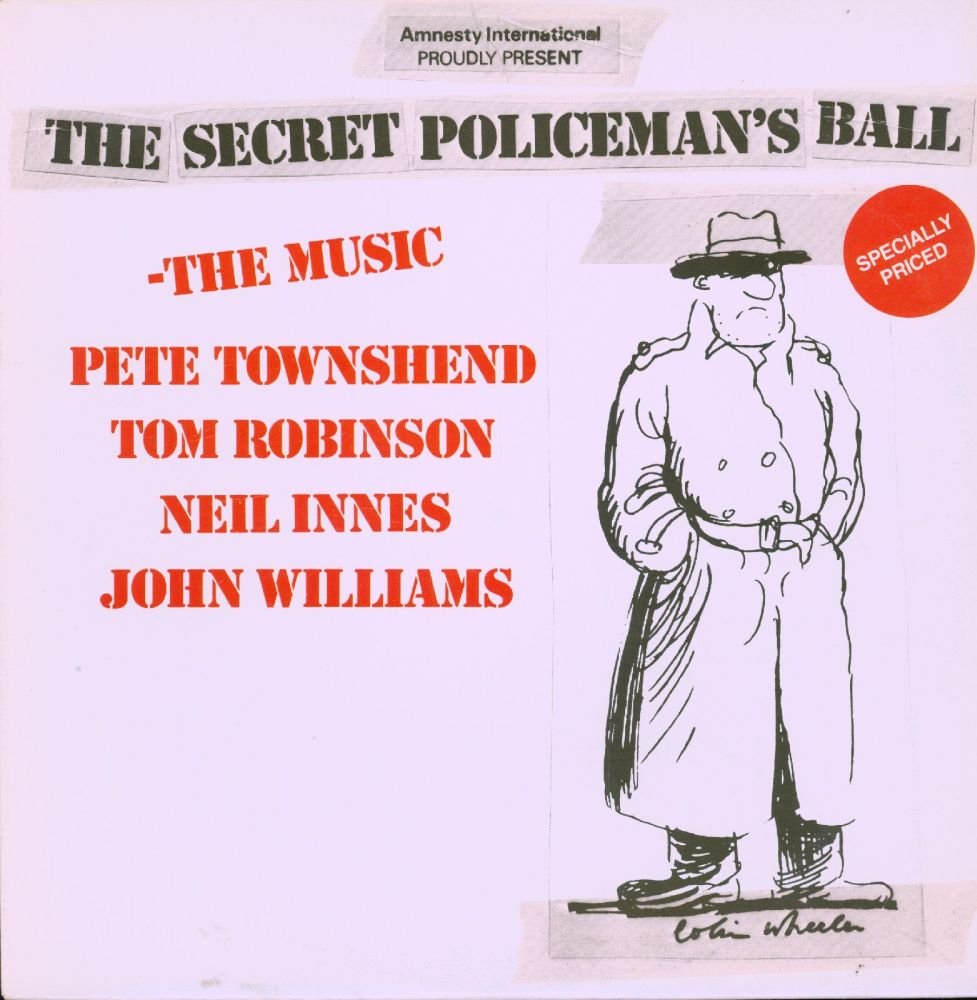
Secret Policemans Ball 1979


I’ll tip my hat to the new constitution
Take a bow for the new revolution
Smile and grin at the change all around
Pick up my guitar and play
Just like yesterday
Then I’ll get on my knees and pray
We don’t get fooled again, no, no

Pete Townsend, Won’t Get Fooled Again


Things are finally beginning to click a little in the studio. Even though I have been through this process for twenty-plus years, it’s always surprising how quickly one or two good days of work completely washes away that feeling of mental stagnation that comes with being creatively blocked.

It’s like the blockage is a dam and once you make a crack, a trickle comes through that soon turns into a torrent And in what seems to be the blink of an eye, the dam, the blockage, is gone.

I want to say it’s forgotten but like I said, I have been doing this fo awhile now and know there’s another blockage waiting in the wings, somewhere downstream. The trick is in putting that out of mind and enjoying the ride until it comes. And maybe when it does come, the memory of this most recent blockage will help me get past this new one a little more quickly.

We all hope we absorb these little lessons in our lives so that we don’t have to constantly ( and needlessly) go through the same traumas over and over, right?  I would like to think that, like the song says, we won’t get fooled again. Unfortunately, our memories are flawed or we just ignore our own recollections and history. We often seem destined to continuously renew our relationship with the same sufferings that have haunted us for eons.

But on a personal level, maybe this time, I will finally learn this lesson and avoid the next blockage that rises up before me.

Probably not. My memory and ability to learn is no better than that of anybody else. Maybe worse than most, in fact.

But I can try to remember. It’s the best I can do.

That brings us to the aforementioned song that I featuring as this week’s Sunday Morning Music. It’s Won’t Get Fooled Again from Pete Townsend. It was originally released by The Who in 1971 on their Who’s Next album and became a true rock anthem. This is the first acoustic version that Townsend performed of this song, with accompaniment from the great acoustic guitarist John Williams. It came at The Secret Policeman’s Ball in 1979.

The Secret Policeman’s Ball was a series of benefit shows featuring comedy and music performances that were given many times over the years to benefit Amnesty International. The last show was in 2012 at Radio City Music Hall to commemorate Amnesty International’s 50th anniversary. Many of the performances, like this one, were memorable.

I hope the message of this song is memorable, as well.


Style Is Character

Georgia O'Keeffe Sky Above Clouds IV

Georgia O’Keeffe- Sky Above Clouds IV, 1965


I recall an August afternoon in Chicago in 1973 when I took my daughter, then seven, to see what Georgia O’Keeffe had done with where she had been. One of the vast O’Keeffe ‘Sky Above Clouds’ canvases floated over the back stairs in the Chicago Art Institute that day, dominating what seemed to be several stories of empty light, and my daughter looked at it once, ran to the landing, and kept on looking. “Who drew it,” she whispered after a while. I told her. “I need to talk to her,” she said finally.

My daughter was making, that day in Chicago, an entirely unconscious but quite basic assumption about people and
the work they do. She was assuming that the glory she saw in the work reflected a glory in its maker, that the painting was the painter as the poem is the poet, that every choice one made alone– every word chosen or rejected, every brush stroke laid down or not laid down– betrayed one’s character. Style is character.

— Joan Didion, Georgia O’Keeffe


This anecdote opens the essay Georgia O’Keeffe that is included in author Joan Didion‘s 1979 book of essays, The White Album. I can only imagine the wonder in the eyes of her daughter along with the awe and the questions it inspired, on seeing O’Keeffe’s huge painting– it’s 8 feet high by 24 feet wide!– in a large open space.

It raises an interesting question: Is style character?

That’s a tough question. I am not positive it holds true for all artists across the spectrum of artistic disciplines but, for the most part, I would like to believe this is true if the style of the artist is genuine and true to their self.

Determining what is genuine and what is contrivance is another question.

I think the reaction of Didion’s daughter is one reliable indicator of authenticity. There is something about the reaction of a child to art that I trust implicitly. Their perception is still unclouded and intuitive and they usually don’t yet feel the need to categorize or rate everything that they come across. They have an ability to see things clearly that I sometimes think we lose in adulthood.

They just react on a gut level, quickly and decisively, to some inner intuitive cues.

In my experience, I generally am most pleased with my own work when it catches the eye or mind of a child. It’s perhaps the purest form of validation, letting me know that the work speaks on an emotional level.

But is this, the style that speaks to that child, character?

I can’t say for sure. I know a number of artists for which this holds true and I believe it is true in my own case.

Or at least I want to believe that. A person can’t attest to their own authenticity without some form of bias. That puts it out of my hands.

But I hope so. My intention for my work has always been to be transparent and open, for it to be an expression of my character, for better or worse. It is work that is meant to communicate. Or so I hope.

I don’t know that an artist’s work can ever fully mask the strengths or deficiencies contained in their character.

For myself, I am okay with that. I am willing to be judged because I know that few will be as critical of my work and my character as myself.

As Georgia O’Keeffe said:

To create one’s world in any of the arts takes courage.

And don’t we all aspire to have courage?

Past, Present, Future and Beyond- GC Myers 2021

“To live on a day-to-day basis is insufficient for human beings; we need to transcend, transport, escape; we need meaning, understanding, and explanation; we need to see over-all patterns in our lives. We need hope, the sense of a future. And we need freedom (or, at least, the illusion of freedom) to get beyond ourselves, whether with telescopes and microscopes and our ever-burgeoning technology, or in states of mind that allow us to travel to other worlds, to rise above our immediate surroundings.

We may seek, too, a relaxing of inhibitions that makes it easier to bond with each other, or transports that make our consciousness of time and mortality easier to bear. We seek a holiday from our inner and outer restrictions, a more intense sense of the here and now, the beauty and value of the world we live in.”

― Oliver Sacks, The New Yorker, August 27, 2012


I read this passage from a 2012 Oliver Sacks article and attached it in my mind to this new painting, a 10″ by 20″ canvas that I am calling Past, Present, Future, and Beyond. The meaning I pull from this piece is that we are ensnared in the three known phases of time– the past, present and future.

And none are totally satisfying. We have a need to move beyond our states of being.

The past has an appeal for some. It seems complete, set in stone, so it must be easy to comprehend and place our own roots and existence in the context of our past. But it is anything but solid. It is subject to the whims, desires, and prejudices of whoever looks back on it. Exaggerations, mischaracterizations, and pure fictionalization make history malleable as soft clay. It is and will always be shaped to fit some narrative for those in present or future times.

As for the future, it is subject to all sorts of factors from a a variety of sources.  It can only be predicted which makes it as pliable as the past though at least with the past we know the general outcome. The future is a big and broad question mark which makes it terrifying for many. However, there are some who believe there is hope in the future but it is largely a mystery due to the things yet unknown to us– people, circumstances, scientific advancements, and specific monumental events.

H.G. Wells made a speech in 1902, The Discovery of the Future, where he stated that while individual futures were not predictable, the general future could foretold, that we could take the knowledge gleaned from science and history and accurately predict what might be in store for us as a species. Though he speaks briefly about what might be in store for this world after humanity has departed, his speech was an optimistic take on his belief in the greatness of our  human destiny. I don’t know that he would say the same today.

This was, after all, 1902. It came before two world wars, before two modern pandemics, before popular fascist movements, and before nuclear weaponry. Hell, it was before tanks, mustard gas and automatic weapons. They were still fighting with swords and horses at times.

The future will always be nebulous, always a moving target that is just beyond us despite our desires to meet it. Or avoid it.

The present is, as it should be, the most important phase in this web of time. It is the only one of the three that we can physically change or effect. The only one in which our reactions and responses are genuine and not yet edited. The only one that we can experience. People, myself included, are always saying that we have to live for the present. But the trick is being able to do that, to block out the echoes of the past and ignore the ominous storm clouds — or the beautiful cleansing sunlight for those more optimistic among you out there– of the future.

How do we get beyond the three phases of time? Maybe the question should be can we?

If you’ve read my blog for any time at all, you know I don’t have any answers. The Buddha spoke of the empty mind, one freed from human desire, as the way to a higher state of being. That sounds pretty good to me but I suspect though my head is fairly empty, it will take a lot of practice to shake out all the stuff that inhabits that space.

And even then, I don’t know. The anticipation of what it might be like with the timeless existence of an organic particle might in itself be a stumbling block to ever reaching that state of being.

But who knows? All I know is that my second cup of coffee is getting pretty cold and I’ve went on way too long about something that you might not even see for yourself in this new painting. Whatever the case, I like this piece and it makes me think and that makes me feel as though I am human and alive.

And somedays even a simple reminder like that is enough to meet the new day…

GC Myers- Enduring Bond sm

Enduring Bond“- Now at the West End Gallery


My brother asked the birds to forgive him: that sounds senseless, but it is right; for all is like an ocean, all is flowing and blending; a touch in one place sets up movement at the other end of the earth. It may be senseless to beg forgiveness of the birds, but birds would be happier at your side –a little happier, anyway– and children and all animals, if you yourself were nobler than you are now. It’s all like an ocean, I tell you. Then you would pray to the birds too, consumed by an all-embracing love in a sort of transport, and pray that they too will forgive you your sin.

― Fyodor Dostoyevsky, The Brothers Karamazov


There is much to be done this morning so I am sharing these few things this morning– a painting from my Baucis & Philemon series that depicts the eternal bond given to them by Zeus, a passage from Dostoyevsky on the interconnectedness of all things and a Nick Cave song, And No More Shall We Part. Sense a theme here?

Anyway, this will have to suffice for this morning.

As the old saying goes: beats a stick in the eye.

At least, I think that’s a saying. Maybe we will look into that tomorrow.

Maybe not…