Feeds:
Posts
Comments

The Creeper-- GC Myers 1995 sm


I don’t have any illusion that The Creeper is as popular or will ever be as popular as any of the classic movie monsters, but I think in the heart of every young horror fan is his desire to create his own creature.

–Victor Salva


The quote from director Victor Salva is about his character who menaced filmgoers in the Jeepers Creepers series of horror movies in the early 2000’s. I didn’t know it when I began writing this article this morning but a new  entry in the series premieres today. What an odd — and kind of creepy– coincidence.

To be honest, I have never seen any of the films and most likely will not. But I like the idea behind Salva’s words above. Wanting to see something that fully clicks with something inside ourselves is the basis for art of all sorts. Even horror movies.

My version of that is the advice I give to aspiring artists of any medium: Paint the paintings you want to see. Write the books you want to read. Write the music you want to hear.

This quote also reminded me of this painting of mine from about 25 years ago that bears a similar title called The Creeper. It predates Salva’s films so it was not inspired by them in any way. I have written about this painting before, mentioning that it was one of the paintings that I regret selling. This was part of my Exiles series that were painted in the mid 90’s, mostly grieving figures painted with segmented features. 

 It was the first real series I had painted and was the basis for my first solo show. I think I only sold three of those pieces and regret having taken any of them from that group of work. I think because those pieces were so much the product of a specific emotional state at a certain time, I will not be able to capture that exact feel again. I have periodically painted figures in that style over the years since and while they have their own emotional impact, they don’t strike me as personally as these earlier pieces.

These few pieces are gone but at least I have images to take a look at when their memories start to creep in, much like that fellow above.

Here’s a song that I featured here a decade ago when writing about this painting. It’s The Creeper from the Ventures. This song is very reminiscent of Wipeout ( with maybe a little Peter Gunn thrown in) but is really distinguished by some super organ work  from the late, great Leon Russell in an early appearance in 1964.  It’s a good listen as we head into Halloween.



Wretched -Faces Off


Because night has fallen
and the barbarians have not come.
And some who have just returned
from the border say
there are no barbarians any longer.
And now,
what’s going to happen to us
without barbarians?
They were,
those people,
a kind of solution.
C.P. Cavafy, Waiting For the Barbarians


Been reading some verse lately from Constantine P. Cavafy, the great Greek poet who lived from 1863 until 1933. He lived his entire life in Alexandria, Egypt and his work often captured the sensual and exotic cosmopolitan feel of that time and place. Readers of Lawrence Durrell and his Alexandria Quartet, in which Cavafy appears as a character, will know what I mean.

Though Cavafy was known for his poetry among the Greek community in Alexandria he spent most of his life working as civil servant. He didn’t actively seek widespread acclaim, turning down opportunities to have his work published while often opting to print broadsheets of his poetry that were distributed to only a few friends. His work didn’t realize wider acclaim until later in his life (and afterwards) when his friend, novelist E.M.Forster, wrote about his work, describing him as a Greek gentleman in a straw hat, standing absolutely motionless at a slight angle to the universe.

I love that description.

The lines at the top are from one of his most famous poems, Waiting For the Barbarians. It’s about a small principality in decline, with its governing bodies and citizens frozen in anticipation of an invasion from unnamed barbarians. It has a timely feel as it describes the power that fear plays in autocracies, how vilifying one’s opposition — the barbarians– is used as a tool to both govern and stoke fanatic nationalism in its fanatic followers, who in turn intimidate those seeking reasonable discussion and solutions to the problems faced by the nation as a whole.

The problem with this sort of strategy is that once that the strawmen created out of fear are proven to be less than formidable or even nonexistent, how does an autocrat keep control? 

Most likely they create new barbarians, someone newly found to fear and despise. Even if those strawmen turn out to be those people who hold the key to best addressing the needs of the citizens.

But, of course, even that strategy has an endpoint. We may find out for ourselves here, unfortunately, if we fail to pay attention in the next few years.

Here’s a fine reading of Cavafy’s poem from Miles Young, Warden of New College Oxford though I probably chose this particular version because of its use of gargoyles. There is also a bit of commentary at its conclusion.


The River

GC Myers-  Symphony of Silence  2021

Symphony of Silence“- At the Principle Gallery, Alexandria,VA


I woke up on the couch last night just as a Stephen Colbert interview with Bruce Springsteen was coming to an end. Springsteen then finished the show with an acoustic version of the title track from his 1980 album, The River.

It’s a song that has always hung close to my heart and one, as Springsteen claimed last night, that has aged well. I spent a lot of hours in the dark back around that time, 40 some years back, listening to this song on my stereo, the soft blue light from my old Fisher amp setting a quiet and deep tone in the room.

Much of this album seemed to be made for listening in that blue light in the darkness. Sometimes I wonder if I am trying to recapture the feel of that blue light in some of my paintings such as the piece at the top. The feel, for me, is much the same. And the interesting thing is that though the circumstances of my life have changed dramatically for the better in the intervening decades, my reaction to this song is the same as it was when I was a depressed 20 year old married factory worker with little idea how to make my way in life with the few prospects available to me.

The fact is that I didn’t even know at that point that one could dare to dream of better things for themselves. And I think that’s the core of this song, that the inherent sadness of this life is not so much about unrealized dreams but more about undreamt dreams, about our inability to imagine ourselves in better circumstances in a better world.

Throughout the years, I knew so many folks without dreams or goals who languished in their day to day lives. When asked, many didn’t even know what they wanted for themselves.

They didn’t dare to dream. They were much like the  the narrator of this song, always looking back or in a sad present with nothing to pull them into the future. We need to dare to have a dream if only to have something that gives us a path into the future.

Failing to reach your dreams is a sad song but not having a dream at all is the saddest song of all. It is living without hope. Maybe the reason this song resonated so strongly with me is that I was in the midst of realizing this back then. It’s a realization that helps me still.

Here’s the song from Bruce Springsteen, pared down and still as powerful as it was forty one years ago.


The Waiting Room

GC Myers- The Waiting Room

The Waiting Room– At West End Gallery


We are always falling in love or quarreling, looking for jobs or fearing to lose them, getting ill and recovering, following public affairs. If we let ourselves, we shall always be waiting for some distraction or other to end before we can really get down to our work. The only people who achieve much are those who want knowledge so badly that they seek it while the conditions are still unfavorable. Favorable conditions never come.

― C.S. Lewis, The Weight of Glory


Fighting distraction is a big part of being an artist. Or for non-artists, in just getting anything done at all.

It’s much too easy to fall prey all sorts of distractions when you’re alone in the studio, waiting for some sort of divine– or even less than divine– inspiration to appear. It gets to the point that you are actually waiting more for the distraction than the actual inspiration or act of creation that comes from it.

I know that I often feel like I spend the better part of my time waiting for something that most likely will never come. Or, as C.S. Lewis points out above, favorable conditions that will never materialize.

He’s right on that account. Waiting for favorable conditions is a favorite excuse of the distracted among us, myself included. I often put off projects or ideas because it’s just not the right time to start a new piece or work out a new idea.

When exactly will the right time show itself?

The answer is, of course, when you say so, when you simply say you’ve waited long enough. You just get out of that chair and start, conditions, favorable or otherwise, be damned.

Conditions adjust to the effort.

I would like t say that this is advice for others but in reality it is a reminder more for myself. It’s something I have to constantly remind myself  so much so that it almost becomes a mantra that is always running in my mind. Otherwise, I fall prey to every sort of distraction, from shiny new objects of the images and sounds that come over the interwebs to the lingering doubts and worries of every shape and size that inhabit every corner of my studio.

There is part of me always looking for a reason to not start working and another part that is constantly at battle with that urge. Even that sometimes creates its own sense of waiting.

So, it’s time to get to work. But first, I have a couple of things that need to be done. Then, I promise myself that I will start.

Well, get ready to start.

Break out the mantra…

GC Myers Early Work mid-1994

This post ran several years ago and I felt that it was fitting for today since, as we head into the week before Halloween, I was looking for a somewhat creepy song without going full blown psychobilly. This seems to fill the bill:

It’s Sunday morning which means I usually play a little bit of music. This morning I didn’t have anything in particular in mind so I went to YouTube and just punched in something general then let myself be led by randomly choosing from the selections that come up on the right side of every video. It’s amazing where this will sometimes take you, down rabbit holes of all sorts. Sometimes it takes you to music that you know really well and other times to people and places that are totally new. Today it led me to a song that I have always liked by the Stray Cats from back when they were leading a little rockabilly resurgence in the 1980’s.

It wasn’t one of their hits from the time and I’m not even sure it is on any of their widely released albums. But it is one of my favorites from them. It’s called Crawl Up and Die and has a nice build up and finish, the perfect thing to kick off a sleepy Sunday morning despite the somewhat gloomy title.

While trying to find an image to accompany this post and song I came across the old piece above from back when I was still forming a voice and working on processes. This is among my earliest attempts at my reductive process where I put on a lot of very wet paint and pull off what doesn’t belong. I usually describe this process as kind of like carving in paint.

I wasn’t sure at this point what I wanted to say or where I was going with my work, or even what it should look like. I was still considering straight  representation. While I don’t think this is a bad piece, especially from where I was in my evolution, it didn’t have enough to make me want to move further in this direction. So I moved down a different path and, fortunately, I believe it was the right choice I. do like the mood of this piece however and feel it fits the title here.

Have a great Sunday!


GC Myers- Carried Across sm

Carried Across– At West End Gallery

While working here in the studio yesterday, I was listening to a podcast from TCM (Turner Classic Movies) about the making of the screen adaptation of Tom Wolfe’s The Bonfire of the Vanities. Even though it was not a movie in which I found little worth watching and the novel, filled as it was with unsympathetic characters, did not thrill me in any way, I found the backstory of the movie’s production pretty interesting.

There was one bit where the movie reviewer from the Wall Street Journal, who was given total access at the time to the production, spoke of how director Brian DePalma would often isolate himself from the chaos from the production that swirled around him– and for which he was almost totally responsible– by putting on his earphones to listen to a favorite opera on his Walkman. As the huge budget overruns and other problems mounted, he tried to block it out with something he found beautiful.

The reviewer said that she thought this typical for artists, that they had to be able to block out all the noise and naysaying in order to be able to maintain their own belief that whatever work was at hand was the most important thing in the world at that moment.

That struck a chord. It’s something I struggle with on a regular basis especially at times like those which we are collectively going through. Unless you have an overly giant and problematic ego, it’s easy to see that in the bigger scheme of things that the world doesn’t revolve around one’s personal creations.

This is healthy from a psychological standpoint.  But creatively, it creates a problem because in order to make work that is truly vital the artist has to maintain total belief in the validity and importance of their work. That total dedication of self is an imperative.

If the artist doesn’t maintain belief why would anyone else?

I’ve said this before, that I recognize my own relative insignificance both as a human and in the grand sweep of art history. I’m okay with that. But when I am at work I have to have total belief that the piece in front of me has something vital to express.

That it has some degree of importance.

That is not comparing my work to that of anyone else. That is not for me to do. I am talking about the basis of my expression, the belief in what I trying to say. In that moment I have to believe that my expression is as valid and important as that of any other artist or person, now or in the past.

But sometimes in the midst of the swirl of the chaos of this world, self doubts creep in and that belief is weakened. It’s hard to create at those times.

I certainly know that feeling.

Hearing that yesterday on the TCM podcast was a reminder of the need to isolate myself in some ways in order to maintain that belief that whatever is at hand is the most important thing I can be doing at that moment.

I don’t know that I adequately described what I want to say here but the time has come to end this for this morning. I am once more finding  that belief and have to get to work before it decides to run away again.

So, you must leave now.

Here’s some exit music in the form of a lovely rendition of a Leonard Cohen song, Came So Far For Beauty, from Lisa Hannigan.


Kinship

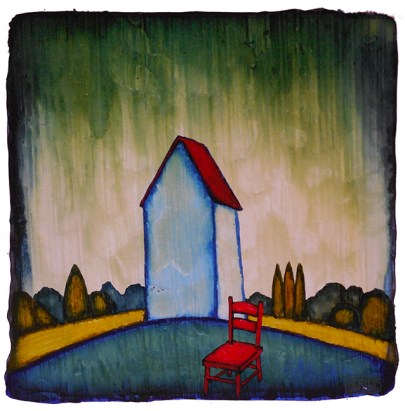
GC Myers- Cool Rising sm

Cool Rising– At West End Gallery, Corning


Very slowly burning, the big forest tree
stands in the slight hollow of the snow
melted around it by the mild, long
heat of its being and its will to be
root, trunk, branch, leaf, and know
earth dark, sun light, wind touch, bird song.

Rootless and restless and warmblooded, we
blaze in the flare that blinds us to that slow,
tall, fraternal fire of life as strong
now as in the seedling two centuries ago.

–Kinship, Ursula Le Guin


It’s pretty obvious by now that I am a tree person. I have always felt most comfortable in the company of the trees of the forest, more so than in the company of people. Well, most people– you guys are okay.

I grew up wandering in the woods. I have lived and worked in the woods for decades now. My great-grandfather and many other ancestors worked the forests of the Adirondacks and northern Pennsylvania. Some died in those woods.

I have planted trees and cleared trees to build, cutting down my fair share of trees. That is the one act that is my least favorite and done now only when absolutely necessary. And even then, it is done with great sorrow and with reverence toward the life of that tree. You see, after all the time spent among the trees one begins to sense and respect the rhythm of their life’s slow and patient metabolism.

They simply are.

There is something greatly comforting in their presence, their quiet and unflinching witnessing of the other worlds that live under and around them. Being among them slows my own heart rate, immerses me in a quiet state of mind that I find in few other places.

It’s a kinship of some sort, to be sure. Though most will long outlive me, I find myself acting as a protective guardian for them now. There is the hope that someday someone will meet one of the large shagbark hickories around our home and feel the presence of their being as I do.

And will then feel as enriched as I have felt.

The verse at the top from the late author Ursula Le Guin (1929-2018) aptly describes how I see the being of trees. Below is a reading of it from Amanda Palmer.


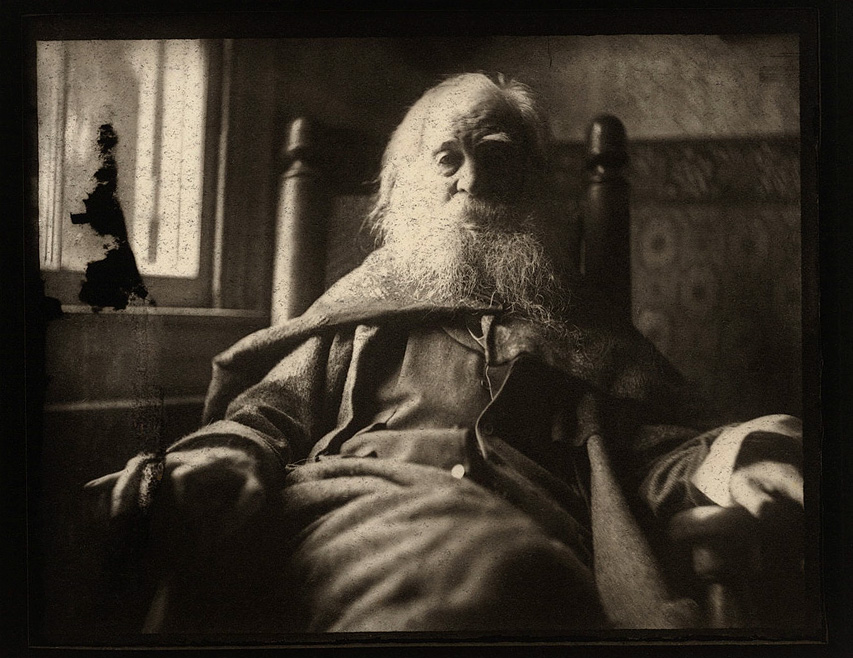
Walt Whitman-  Thomas Eakins 1891


….This is what you shall do: Love the earth and sun and the animals, despise riches, give alms to every one that asks, stand up for the stupid and crazy, devote your income and labor to others, hate tyrants, argue not concerning God, have patience and indulgence toward the people, take off your hat to nothing known or unknown or to any man or number of men, go freely with powerful uneducated persons and with the young and with the mothers of families, read these leaves in the open air every season of every year of your life, re-examine all you have been told at school or church or in any book, dismiss whatever insults your own soul, and your very flesh shall be a great poem and have the richest fluency not only in its words but in the silent lines of its lips and face and between the lashes of your eyes and in every motion and joint of your body….

—Walt Whitman, Preface to Leaves of Grass


I am running this post from several years back as a result of some recent genealogy research I have been doing lately. It’s always interesting while I am doing the research. especially when I uncover evidence of distant relations that have long evaded me or uncover bits of what I consider interesting connections to American history. Part of my brain allows me to imagine the lives of these distant ancestors and wonder if I have any of the same characteristics that allowed them to survive– if they did.

For example, I recently found a distant great-grandfather from about 8 or 9 generations back who came here from Scotland as an indentured servant after being captured by Cromwell‘s forces in the English Civil War. After around 8 or 9 years of servitude he gained his freedom and became a prosperous brickmaker and was the progenitor of an entire American family line that has grown exponentially over the centuries and is widespread across this country now. Unfortunately, less than two decades after becoming a free man this ancestor was one of the first deaths in King Philip’s War that took place between the colonists of New England and the Native American tribes in the late 1670’s.

His track record as a warrior has me a bit concerned.

But while interesting, the story of this man’s life has little connection to me and my current life outside of perhaps a few strands of DNA here and there that most likely do little more than determine the length of my big toe or the pattern or ever increasing abundance of the hair growing inside my ears. But every so often you come across an ancestor or distant relative that you hope you share something more than these tenuous mitochondrial bonds and you let your mind wander into that possibility.

Like my Cousin Walt:


I have always been moved and inspired by the writings of the American poet Walt Whitman. I can find something that speaks directly to me in almost everything of his I come across. For me, he remains one of the most intriguing and unique characters in the American experience in so many ways.

This comes across in the photos of him, including the remarkable portrait above that was taken by the great American painter Thomas Eakins, who was also a pioneering figure in photography, in 1891, a year before Whitman’s death. It has a remarkable feeling of earned wisdom and understanding.

I had always felt a familial bond with him anyway, having called him Uncle Walt for as long as I can remember. He seemed like he was the wise old uncle I wanted growing up, someone who watched over me and imparted bits of wizened advice to me from time to time. So with this great reverence for the man, you can imagine how excited I was when my genealogy revealed that we were related.

Not an uncle.

Cousins.

Okay, 6th cousins. We share a grandparent going back to the early 1600’s, five generation before Whitman and nine generations before me. So, that makes us 6th cousins, 5 generations removed.

That’s like being in the furthest reaches of relationship in the game of Six Degrees of Kevin Bacon. Sure, we’re related by these tenuous bonds but it is so far removed that it is academic at best. There are probably several hundred thousand, if not a million or ten million, people with this same bond.

So it is certainly no big deal. Interesting but absolutely meaningless and without value.

But when I read a line from Whitman that makes my heart race a bit, that makes my brain and soul stir, I have to admit that it makes me happy that we share that silly, insignificant bond.

I just call him Cousin Walt now.

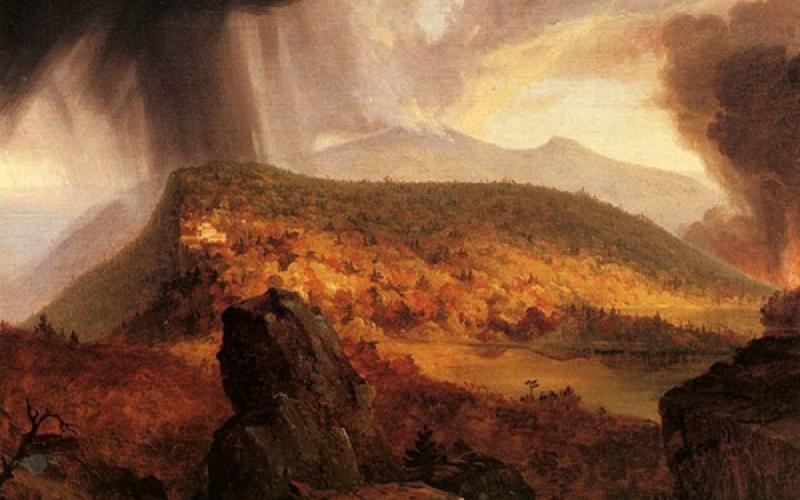
Thomas Cole- Round Top


How I have walked… day after day, and all alone, to see if there was not something among the old things which was new!

— Thomas Cole (1801-1848)


I am not sure if the words above from Thomas Cole refer to revisiting his older paintings to glean inspiration or if they have some other meaning. I immediately took them as meaning he sometimes looked back at his older work to see if there was something in them that could be explored once more and perhaps enhanced with the knowledge and expertise he had gained in the intervening time.

I know that this is my own purpose in periodically going back through the archives. I am looking for the inspiration that might come in seeing past compositions and uses of color or forms that may have changed over the years. Or simply ways of seeing and thinking thatmight have went in different directions and are ripe for a new examination.

If this is what Cole was intending then I am very pleased. I find his work, though worlds away from my own, intriguing. His body of work is pretty impressive, even for someone like me who isn’t always immediately drawn to traditional landscapes. Maybe that is because Cole’s works were not completely traditional. Perhaps it’s that he took such creative license with his subject matter, never being afraid to add his own romantic depth to landscapes that were already boldly dramatic in their own right.

The big got bigger and the wild, even wilder. His paintings and those of  the other painters of the Hudson River School of painting were the face of 19th century America to the rest of the world, creating a romantic vision of a beautiful and wide open nation, one that drew masses to its shores.

I am also intrigued by the fact that he was primarily a self-taught artist and his prodigious productivity. And that he did this all before his death at age 47 at his home in Catskill, NY. Impressive by all accounts.


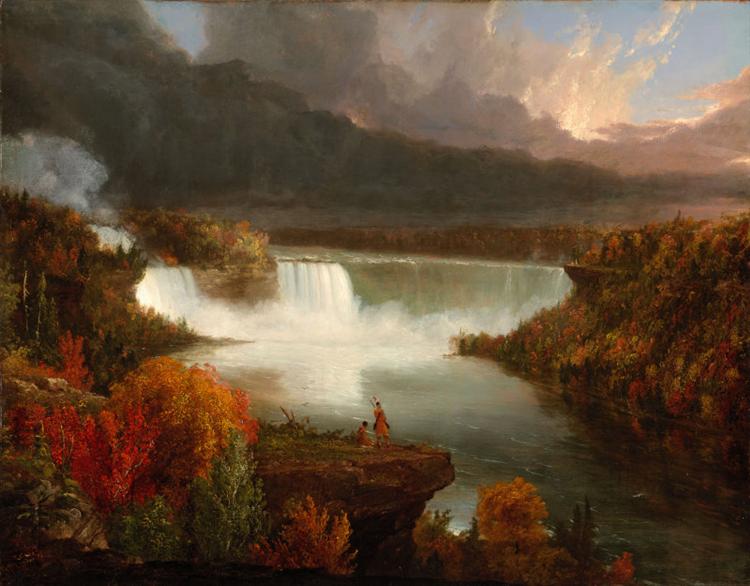
Thomas Cole distant-view-of-niagara-falls-1830

Thomas Cole- Distant View of Niagara Falls 1830

Thomas Cole Evening in Arcady 1843

Thomas Cole- Evening in Arcady 1843

thomas cole- Sunset

Thomas Cole – Sunset

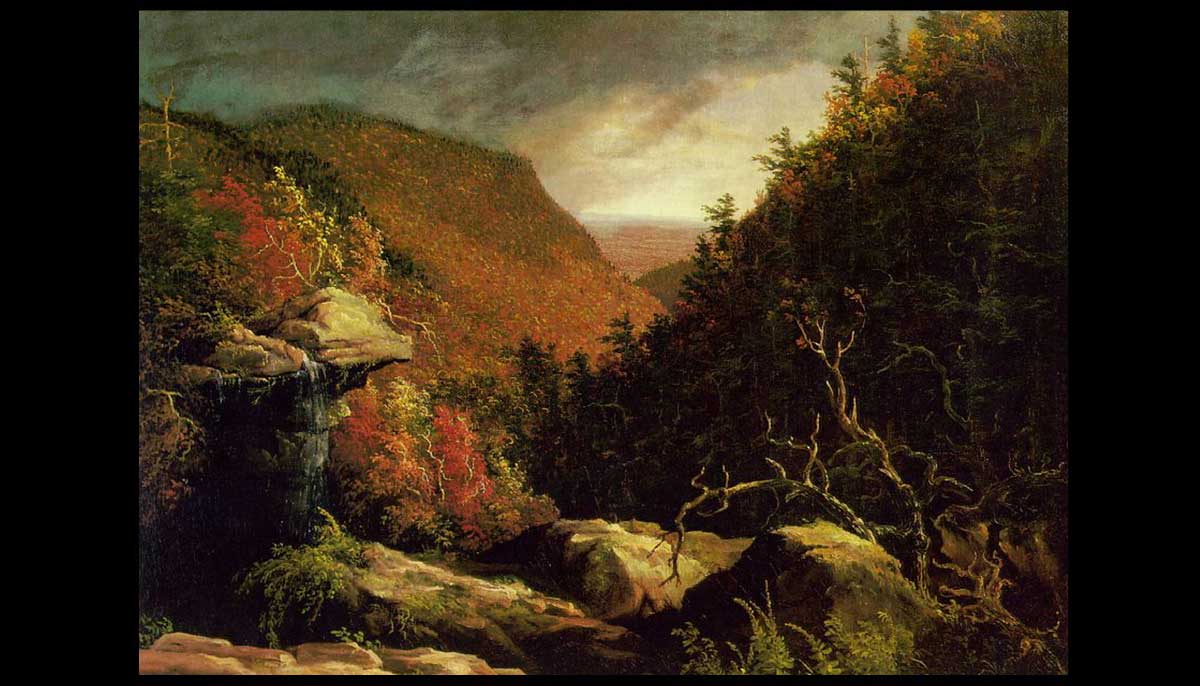
Thomas Cole- The Clove- Catskills 1827

Thomas Cole- The Clove, Catskills 1827

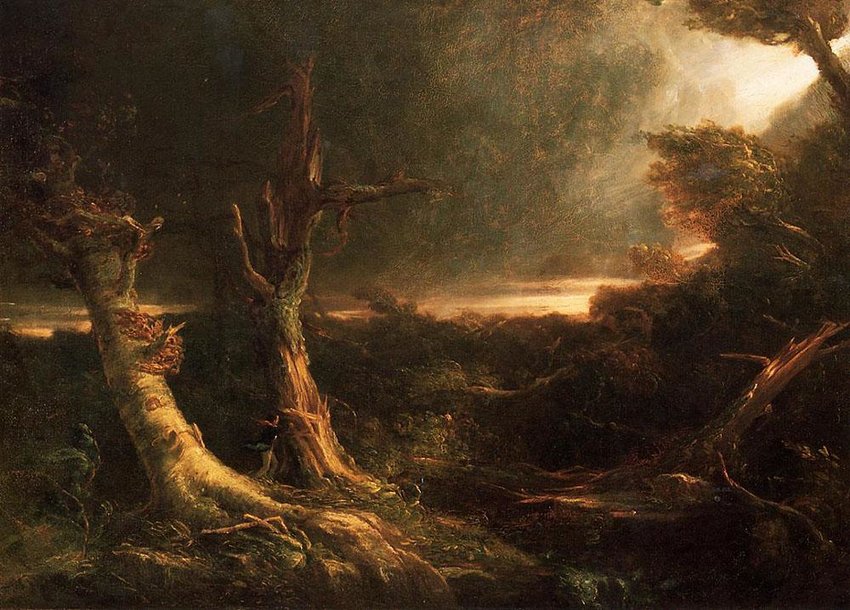
Thomas-Cole-A-Tornado-in-the-Wilderness-1830-

Thomas Cole- A Tornado in the Wilderness 1830

Anthony Bourdain Empathy


I don’t know what your destiny will be, but one thing I know: the only ones among you who will be really happy are those who have sought and found how to serve.

― Albert Schweitzer


The two quotes above are both about the gains of being in service to others though I imagine that Albert Schweitzer was not speaking about schlepping pork chops or pancakes to hungry folks in a restaurant. But maybe he was. And even if he wasn’t, the happiness gained from being in service that he describes goes hand in hand with the words above from late chef Anthony Bourdain.

I have often said that I thought everyone should be required to work as a server in a restaurant for at least a short period of time. There are so many lessons to be learned from the experience.

Empathy, as Bourdain points out, is one. I often dealt with people who were obviously down and out or going through trying times. It was hard to not put yourself in their shoes or at least make their time with you comfortable. 

Humility, for me, was a big one. There was nothing more centering than going from an opening filled with compliments and praise on a Friday evening to pouring coffee for a hungover trucker on a Saturday morning. Puts everything in perspective in quick fashion.

You quickly learn that the world does not revolve around you.

That brings us to restraint. You have to learn to turn a deaf ear to insults and barbs then deliver the same service to that offending person that you give to all. Restraint also keeps you from making a kneejerk reaction. I had a diner one  morning who was as rude and unpleasant as could be, snapping at me with every interaction. I felt like snapping back but retrained myself and just did my job as efficiently as possible so that I wouldn’t have to have any real problems with him.

Later, after he finished his meal and went to the rest room, he called me over to his table and apologized for his behavior. He had just been released that morning from the hospital and was not feeling well at all. He wasn’t sure about the outlook for his future and had taken it ut on me. I told him I understood then we chatted for a bit, me learning that he had been on the beaches of Normandy on D-Day. 

I was glad I hadn’t reacted to our initial interaction.

That brings us to consistency and endurance, two qualities that allow a server to be successful, which is to make a living wage since the base pay was and is well below the minimum wage. There were people who were notorious bad tippers and when you had the misfortune of them ending up in your station, you still had to give them exactly the same level of service as your best tippers. Inconsistency can be contagious, in my opinion, so its easier to just do the same rather than try to alter your routine to deprive someone.

Then there is, of course, teamwork. You learn that even though you might be a highly capable server, you need the assistance of a variety of people– cooks, bus people, dishwashers, and other servers– in order to be successful. 

You also learn that you even if you are exceptionally good at your job, you are not indispensable. The world will go on without you. Food will still emerge from the kitchen and people will enjoy their meals without you. This probably belongs above under the humility label but I am writing off the cuff here and am not going back now.

The main lesson is probably that there is great gratification in serving others. Making a meal pleasant and seamless isn’t life-altering in any way but to make someone else comfortable and at ease for even a short time is something that pleases me.

It’s a small bit of evidence of humanity.

And in these days, when so many folks have lost sight of their humanity and its accompanying empathy, maybe we could all use a reminder that there is happiness to be found in service to others, to paraphrase Mr. Schweitzer.