Feeds:
Posts
Comments

Pieces in the Puzzle

GC Myers-The Memory of That Time sm

The Memory of That Time– At the Principle Gallery, Alexandria, VA


There was a long hard time when I kept far from me the remembrance of what I had thrown away when I was quite ignorant of its worth.

― Charles Dickens, Great Expectations


Do we know what we should remember? Do we remember what we should know?

Do we have the ability to recognize the importance of any moment in our lives at the time it occurs? Of course, there are the huge moments that affect the whole of a nation such as the 9/11 attacks which we all remember, most in graphic details from our reactions to the moments of that day.

We certainly immediately knew that the memory of that day would last.

But what about those days and events that affect only ourselves and perhaps a small group of other folks? Do we know in any of those moments that we would or should carry that memory forward?

Sometimes those small moments bring on large consequences for those involved. But do we recognize what part these small, seemingly insignificant moments played in bringing them about?

I don’t know the answer. Perhaps it differs for each of us and maybe it doesn’t even matter in the larger scheme of things.

I ask these questions because I am often baffled by my life and the path it took. There is some gnawing inner need to understand the pattern it followed, to uncover those small moments of importance hidden in the mists of the past.

For the most part, it’s a fool’s errand. But occasionally a forgotten moment from the past will push forward and I will hold it up and examine it as though it were a newly found specimen, letting the light shine on it as I examine it from different perspectives.

Sometimes, these found memories are oddly gratifying, as though I have finally found a missing piece that fits in the billion piece jigsaw puzzle that is a life. Of course, there are still millions of other missing pieces– lost memories of other small but important moments– in that puzzle.

Been writing this and my coffee got cold. Wonder if that should be remembered?

Hmm…

Chagall


When I am finishing a picture I hold some God-made object up to it / a rock, a flower, the branch of a tree or my hand / as a kind of final test. If the painting stands up beside a thing man cannot make, the painting is authentic. If there’s a clash between the two, it is bad art.

–Marc Chagall


Below is a post from 2015:

Marc Chagall Sun of ParisI haven’t mentioned Marc Chagall here but once over the 6+ years I have been doing this blog and I very seldom list him as one of my influences or even one of my favorite artists. But somehow he always seems to be sitting prominently there at the end of the day, both as a favorite and an influence.
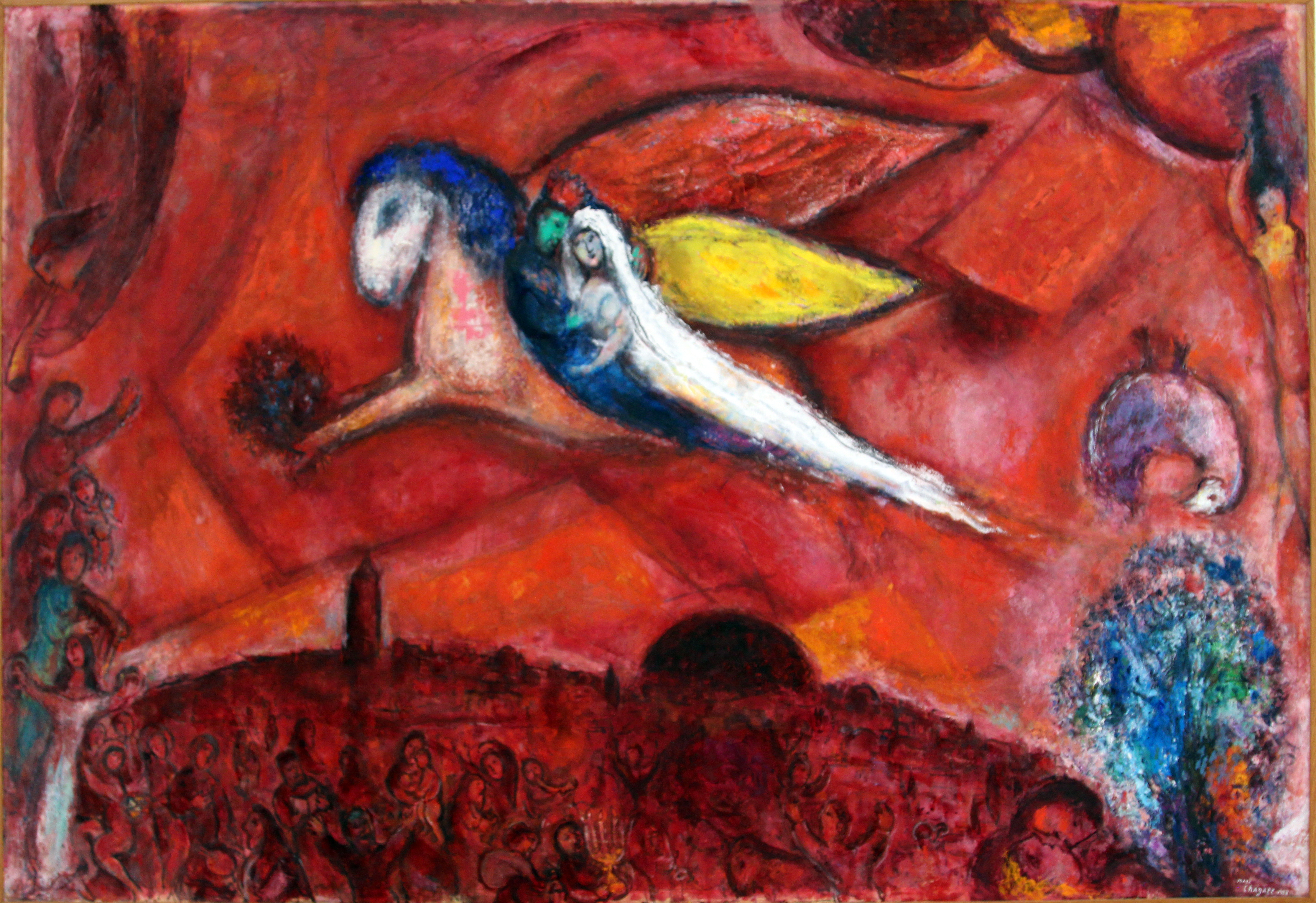
One way in which his influence takes form is in the way in which he created a unique visual vocabulary of symbolism within his work. His soaring people, his goats and horses and angels all seem at once mythic yet vaguely reminiscent of our own dreams, part of each of us but hidden deeply within.

They are mysterious but familiar.

And that’s a quality– mysterious and familiar– that I sought for my own symbols: the Red Chair, the Red Tree and the anonymous houses, for examples. That need to paint familiar objects that could take on other aspects of meaning very much came from Chagall’s paintings.

marc-chagall-fishermans-family-1968He also exerted his influence in the way in which he painted, distinct and as free-flowing as a signature. It was very much what I would call his Native Voice. Not affected or trying to adhere to any standards, just coming off his brush freely and naturally.

An organic expression of himself. And that is something I have sought since I first began painting– my own native voice, one in which I painted as easily and without thought as I would write my signature.

So to read how Chagall judged his work for authenticity makes me consider how I validate my own work.  It’s not that different. I use the term a sense of rightness to describe what I am seeking in the work.

It is very much the same sense one gets when you pick up a stone and consider it. Worn smooth through the ages, untouched for the most part by man, it is precisely what it is. It’s form and feel are natural and organic. There is just an inherent  rightness to it.

I hope for that same sense when I look at my work and I am sure that it is not far from the feeling Chagall sought when he compared his own work to a rock or a flower or his own hand.

Marc Chagall Song of Songs

Waiting For Columbus

little_feat-200


Columbus Day 2021.

I have never mentioned this particular holiday in the thirteen plus years of this blog. I’ve always been somewhat indifferent to the holiday. It never made much of a mark in my life and my only early memories of it are of a couple of Columbus Days spent at the horse track. Nothing says holiday like pari mutuel betting.

But the holiday itself meant little to me. Even to the mind of a kid, celebrating the idea that some European explorer “discovered” an entire continent already occupied by indigenous people seemed a little off.

Should it be a holiday? Probably not. I certainly understand the outrage of the Native Americans who oppose it. But at this current point in history, with so many other pressing issues currently shaping our day to day life and future that deserve our absolute focus, depleting our stores of outrage on this issue seems counterproductive. Unless we face up to these current matters, the issue of what this holiday should be or who it should honor will be a moot point.

So, as you can see, I have little interest in celebrating Columbus Day.

It’s just another Monday.

I am willin’ to celebrate that fact by playing a favorite track from the great live album, Waiting For Columbus, from Little Feat released in 1978 with the late Lowell George at the helm. The song is Willin’.

Maybe we should designate today Waiting For Columbus Day. Hmm…


You Are My Sunshine

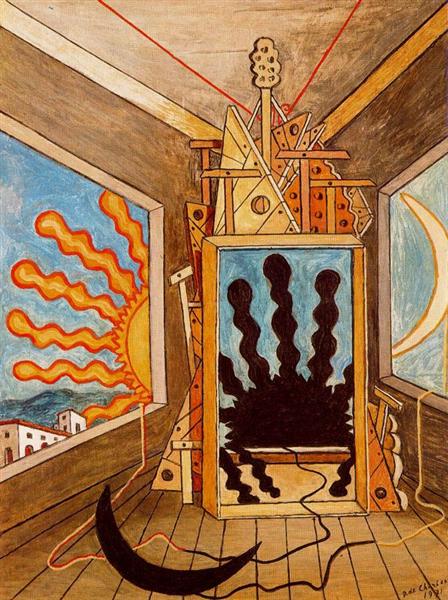
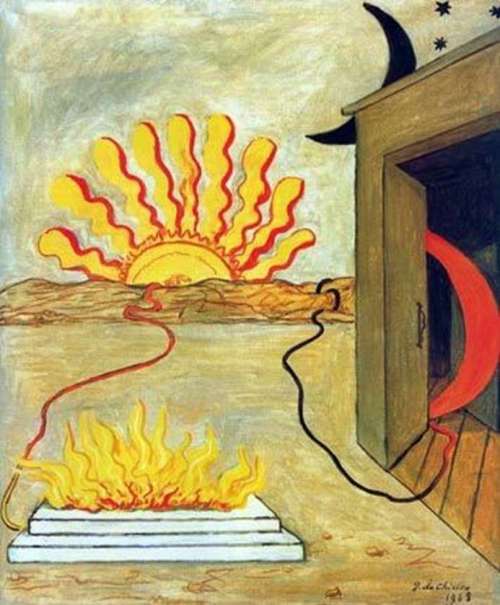
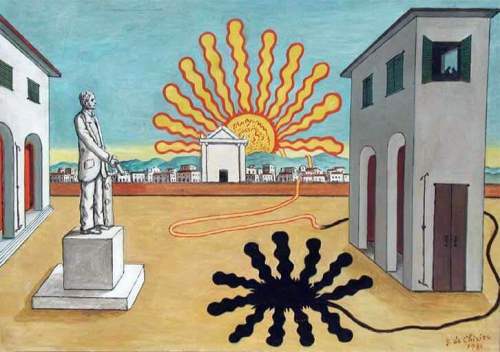
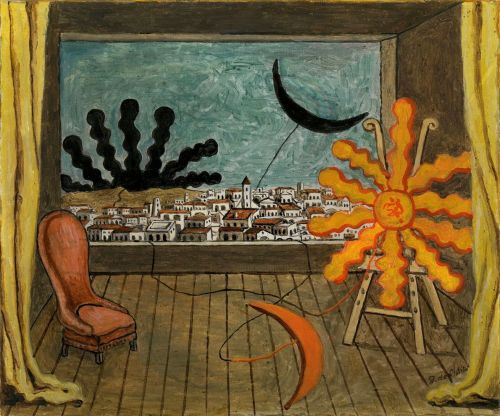
Giorgio de Chirico metaphysical-interior-with-sun-which-dies-1971

Giorgio de Chirico-Metaphysical Interior with Sun Which Dies 1971


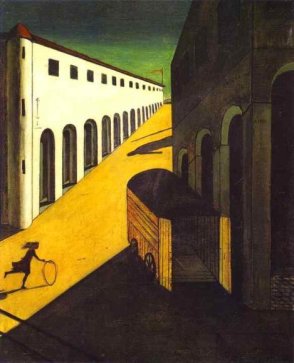
I am a fan of painter Giorgio de Chirico (1888-1978) and his early metaphysical paintings. They were strongly colored with a darkness beneath that pushed the colors forward while heightening the sense of de chirico_mysterymystery in each painting. This work was a large influenced on my early work.
I have described here in the past how de Chirico tried to change the style and look of his paintings to a more traditional and mundane style in mid career, which never garnered the same sort of acclaim as his earlier more surreal work for which he is best known, such as Mystery shown here on the right.

This lack of enthusiasm for his newer non- metaphysical work was a cause of consternation for de Chirico. In response he began to produce self-forgeries in the style of his earlier work and would backdate them so that they appeared to fall into the period where his work garnered the most acclaim, 1909-1919.

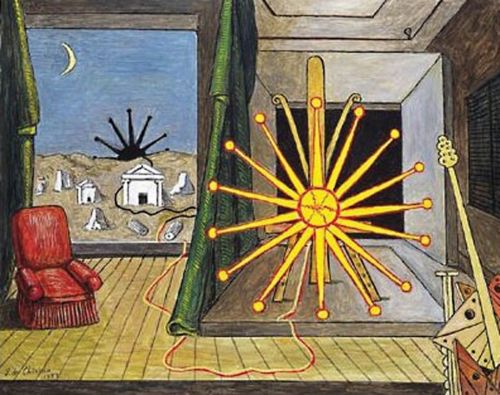
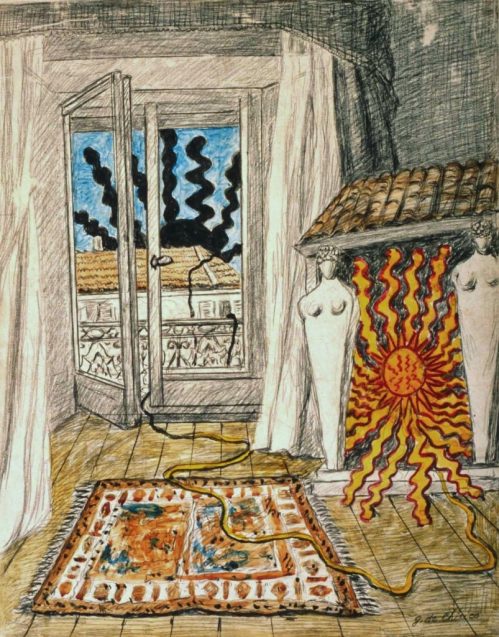
Later in life, in the 1970’s before his death in 1978, he returned to his metaphysical roots using the actual dates. To my eye, the work lacks the depth and style of his early work but it is still interesting, especially in the context of his entire career. I came across this group of sun paintings from this later period that I had never seen before. While they are not my favorites, lacking the same sort of mystery and depth ( and polish) of his earlier work, I thought they deserved to be entered into the conversation.

Plus they sort of line up with this week’s Sunday Morning musical selection which is a song most of us know well, You Are My Sunshine. It is generally performed in an upbeat fashion that makes it seem ike an optimistic tune. But if you listen to the lyrics closely it is about a person who has lost their love to another and is issuing threats in a way, as seen in this verse:

I’ll always love you and make you happy
If you will only say the same
But if you leave me to love another
You’ll regret it all one day

The version selected for this morning is from The Dead South who I featured here in the past with their song In Hell I’ll Be in Good Company. Great song. Their new version of You Are My Sunshine captures the real brooding tone of the song. It certainly made me think about the song in a different way than I had in the past.

Give a listen and see what you think. There are more of de Chirico’s later pieces below the song.


giorgio-de-chirico-piazza-ditaliagiorgio-de-chirico--the-two-sunsGiorgio de Chirico Sun on the EaselGiorgio de Chirico sole-sul-caminetto-1970Giorgio de Chirico Sacrifice to the Sun

Autobiography

Three-Musicians-By-Pablo-Picasso

Three Musicians– Pablo Picasso


For those who know how to read, I have painted my autobiography. 

-Pablo Picasso


I have been trying as of late to find a way out a deep funk in my work. Between working on a couple of maintenance projects around my home and the studio and a swiss-cheese mind that has been wandering and distracted in recent months, my work has been somewhat dormant, much to my dismay. 

This happens every so often and it generally leads me back to a reexamination of my previous work from a wide span of time, from the earliest days up to the near present time. I am trying to find the same sort of inner pattern or track that spawned that earlier work, something that might fire up my synapse now once more when I examine it a bit closer.

In doing so, I am sometimes reminded of the Picasso quote above that has been bouncing around in my head for many years now. Looking at the work spread across the years, I wonder how people will read it in the future, what it will tell them about myself.

Will my work truly serve as my autobiography?

That is, of course, if they read it at all. That’s a big if.

Nobody really knows if one’s autobiography– that being their life’s work– will be read or relevant in the future. But I guess you just try to keep forging ahead, carrying the hope that if someone in the future does happen across your work that they will be able to fully take in that autobiography, to experience the sensations and feelings you tried to capture in your life.

Now back to the search…

GC Myers- Standing Proud  2021

Standing Proud“–At the Principle Gallery, Alexandria, VA


A man on a thousand mile walk has to forget his goal and say to himself every morning, ‘Today I’m going to cover twenty-five miles and then rest up and sleep.’

― Leo Tolstoy, War and Peace


How do we continue to persist? That’s a question I ask myself more and more as I age, as the aches and pains and breakdowns of the body mount up. And even beyond the physical, I find myself asking that same question of myself, creatively and intellectually.

How does one endure?

I can’t say for sure. I guess you do what you can do when you can do it and hope for the best.

Maybe that’s the answer. That’s pretty much what Tolstoy wrote above said in describing the French retreat from Moscow in War and Peace. They were trying to get back to their native land as soon as possible but it was still a matter of just doing the same thing as always–doing what they could do and hoping for the best each day.

That pretty much works most of the time and maybe that explain one’s endurance in any way. Just keep at it.

Or maybe you take the Charles Bukowski route as in the video reading of his poem The Secret of My Endurance below from Tom O’Bedlam. I can’t say I am the biggest fan of Bukowski but sometimes he hits one out of the park or, at least, makes me think or laugh.

This one makes me laugh. Now, where I do I find a ten-foot square cage?


What Star Is This?

GC Myers-Souls Adrift sm

Souls Adrift– At the West End Gallery


Do not spoil what you have by desiring what you have not; remember that what you now have was once among the things you only hoped for.

― Epicurus (341-270 BC)


The word desire is derived from the Latin de siderefrom the stars. Our desire is a search for a guiding star, a purpose, to follow.

Can you say what you really desire, what star guides your life?

How many of us even give that question a moment’s thought? From my experience. limited as it is, I would say the answer is that many folks think about it in terms of material things and physical experiences, things outside of themselves. Or they avoid asking that question of themselves altogether.

Many just drift along, either without a guiding star of their own or, not caring to ponder the thought, following the stars of others.

The stars each of us follow will eventually take us to our chosen desires so think about before just hopping into any old boat: What do you really want?

Or perhaps the question should be: What sort of person do you want to be?

I have to admit that there have been times in my life where I have lost sight of the star I have chosen to follow. But even then, I only wanted to follow my own chosen star, even if I had to flounder around a bit in the dark in order to locate it once more. I figured that wherever it led me, it would be enough because it was ultimately my star, my choice.

Don’t know what purpose this little post serves but it felt like it needed to be said this morning, if only for myself.

If you’re following your own star, you’ll know what I mean…

silience

GC Myers Early Work 1994-Winter Park

Winter Park -1994


silience
n. the kind of unnoticed excellence that carries on around you every day, unremarkably—the hidden talents of friends and coworkers, the fleeting solos of subway buskers, the slapdash eloquence of anonymous users, the unseen portfolios of aspiring artists—which would be renowned as masterpieces if only they’d been appraised by the cartel of popular taste, who assume that brilliance is a rare and precious quality, accidentally overlooking buried jewels that may not be flawless but are still somehow perfect.

–The Dictionary of Obscure Sorrows


I came across the word above. silience, while browsing through a site I’ve mentioned here a number of times in the past, The Dictionary of Obscure Sorrows. It reminded me of the many bits of serendipity that brought me to the life and career I have been so fortunate to have and how lucky I have been in encountering people who didn’t just walk by without noticing my work.

It makes me feel grateful, indeed. It also makes me feel somewhat guilty for my good fortune when I know with absolute certainty that there are equally talented people out there whose work and abilities has gone unnoticed. I often see or hear the work of folks who have yet to find an audience and wonder how this could be. I find myself rooting for them, wanting them to continue to do whatever they do so that their work might someday find its way into a situation that will shine a light on it.

It also makes me somewhat guilty for the time that I have wasted, for the bits of hubris I have displayed at times when mistaking the serendipity I have encountered for some sort of entitlement.

Its a needed reminder that any notice my future work receives must be earned anew and that I must take notice of and encourage the talents of others.

On the The Dictionary of Obscure Sorrows site, I noticed there is an actual book coming out in November from the person behind the whole shebang, John Koenig. Looks like something I will look into. But while there I also noticed that they have a YouTube video channel that features visual representations of the definitions contained in the dictionary. Quite well done and effective.

Here’s the video for silience:


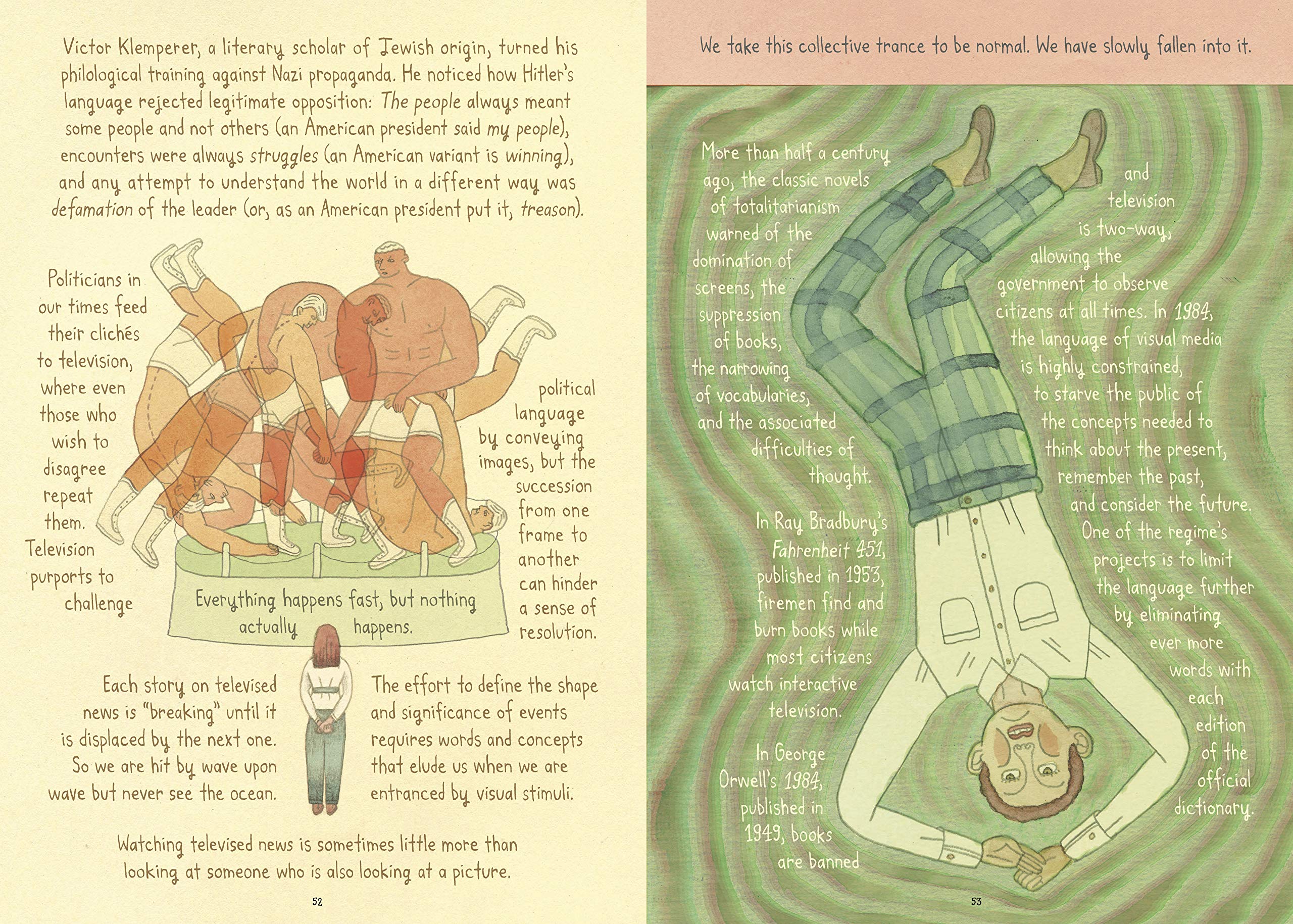
Nora Krug On Tyranny Tim Snyder

Tim Snyder’s On Tyranny, Illustrated by Nora Krug


I have a little book in a couple of spots around my studio, one stained from multiple coffee spills. It’s On Tyranny, from historian Tim Snyder, first published in 2017. 

It’s a book that I have given copies away to a number of people and one that I often pick up to read just a few of its short pages when I am need of some affirmation that there are people out there who are paying attention and seeing the same patterns and behaviors observed in the past taking place now. You wouldn’t think that would be comforting but in a time when previously unacceptable acts of corruption and malignance have become normalized and all too commonplace, it is good to know that there are folks out there sounding the alarm.

Evil in the form of tyranny and fascism doesn’t happen in fell swoops. It is an insidious growth, often overlooked until it has fully taken hold. As the late chronicler of authoritarianism Hannah Arendt put in her book Eichmann in Jerusalem: A Report on the Banality of Evil:

Good can be radical; evil can never be radical, it can only be extreme, for it possesses neither depth nor any demonic dimension yet–and this is its horror–it can spread like a fungus over the surface of the earth and lay waste the entire world. Evil comes from a failure to think. It defies thought for as soon as thought tries to engage itself with evil and examine the premises and principles from which it originates, it is frustrated because it finds nothing there. That is the banality of evil.

Snyder’s book lays out the warning signs of authoritarianism in a way that is easily digested and applied to current events. It has been a huge success and went through many printings in the past 4 years.

Today, October 5, is the publication date for a new edition of the book in collaboration with acclaimed illustrator Nora Krug. The graphics add a layer of depth to the already engaging narrative.

I thought I would share a few of the pages here this morning, just to give you a taste of how the imagery interacts with the words.


Nora Krug On Tyranny Tim Snyder 2Nora Krug On Tyranny Tim Snyder 3Nora Krug On Tyranny Tim Snyder 4

When the Cock Crows

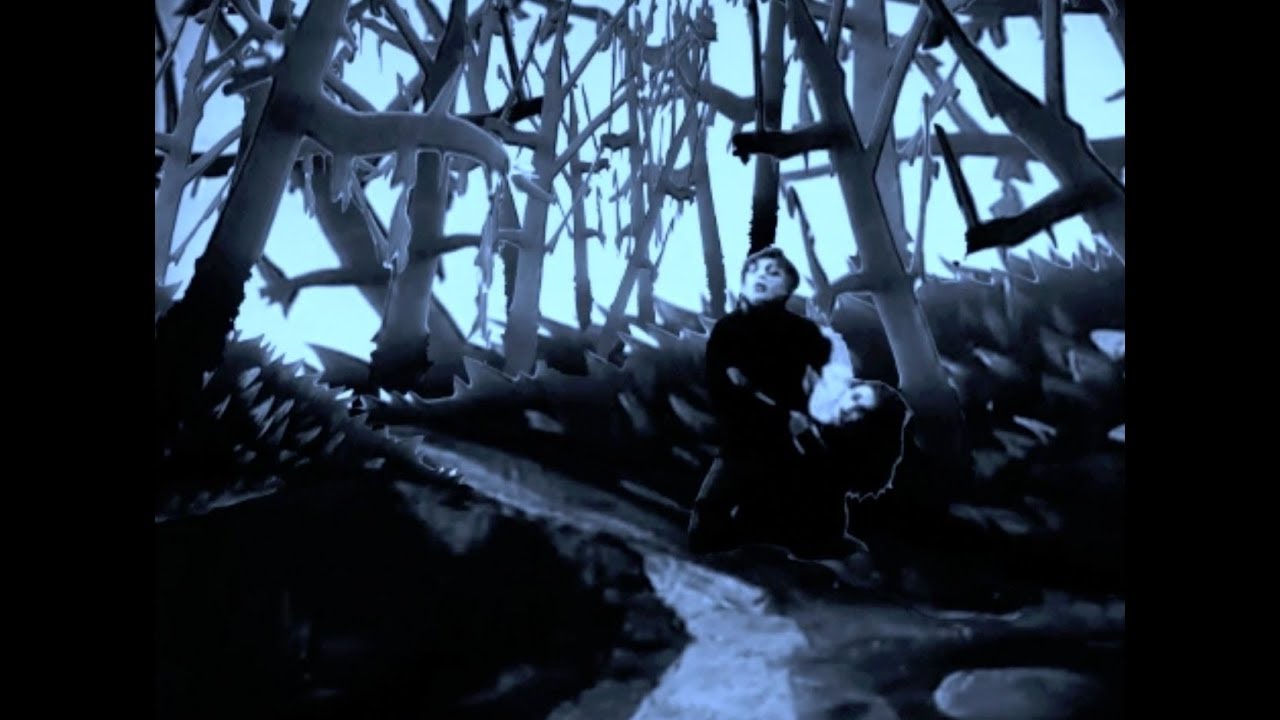
Dr Caligari Trees


In a shadowy place something white flew up. It was a heron, and it went away over the dark treetops. William Wallace followed it with his eyes and Brucie clapped his hands, but Virgil gave a sigh, as if he knew that when you go looking for what is lost, everything is a sign.

–Eudora Welty, The Wide Net 


When I came out of the house this morning to make the walk through the woods to my studio it was still dark with just the faintest light of morning beginning to brighten the sky. It was Sunday morning quiet, no roar from cars on the distant road nor sounds of any sort of human activity. The sound of a distant rooster harkening the morning broke the silence.

It was a weird crow, more like an extended screech mashed together with a normal crow. It was unlike any crow I had heard in the many years in the the early morning light before. It made me stop on our walkway to listen, to make sure that it was actually a rooster and not some omen of doom.

Because it sure sounded like one. It was like this rooster was adding a panicked warning to his normal wake-up call, like he sensed something strange was about to take place.

At that moment, as I stood there in the darkness of the woods, the black silhouettes of the trees and brush took on the tone of a dark German Expressionist film and I found myself wondering if there was some sort of omen in that strange crow, some warning I should heed.

It set off an anxiety in me that was already poised and ready to pounce. But as I walked along the path in the darkness as that odd crowing continued to echo a thought came to mind. It pretty much lined up with the passage at the top from the Eudora Welty story.

It came to me that when you’re always looking for something, especially something so deeply hidden that you’re sure it can never be found, everything becomes a clue or a warning. It leaves you wandering in this semi-darkness filed with ominous shadows and fantasized fears.

You can’t live in that place.

That all went through my mind in a flash and before I was even halfway across the dark trail, I was chuckling at the crowing and the ominous fears it had raised. If it was an omen, if something awful comes to be on this day, then I will be humbled. But if enduring the childhood fears of creatures under the bed and in darkened closets and scary attics have taught me anything, it is that what we often fear was never there to begin with.

Sometimes it’s good to be reminded of how easily baseless fears often grow within ourselves and how easily we accept ideas that based on this.

Ah, the primal fear of a crowing cock breaking the silence and darkness of a Sunday morning. It explains a lot.

Now let’s have some music, okay?

This morning I am going with a version of a Jesse Colin Young/ Youngbloods song, Darkness Darkness, from 1969 performed by Robert Plant. The Youngblood’s original version is great and there are also many good performances of this song from a wide variety of artists out there but I prefer the Robert Plant version a bit more. See what you think…