Feeds:
Posts
Comments

Kandinsky/ Composition

wassily_kandinsky-composition_5-1911-obelisk-art-history

Wassily KandinskyComposition 5, 1911


The word composition moved me spiritually and I made it my aim in life to paint a composition. It affected me like a prayer and filled me with awe.

-Wassily Kandinsky, Guggenheim Exhibit Catalog, 1945


Kandinsky is one of those artists whose words and images always seem to resonate for me, even when he’s talking about things in art that, in the writings of other artists, could quickly escalate into blathering, indecipherable artspeak.

I see it in this passage from his essay in the catalog for his 1945 retrospective at the Guggenheim Museum. The words we use to label and quantify our own work sometimes speak volumes. His use of composition signified an equivalency to a musical composition, complete and filled with movements.

More than a painting and certainly not a picture.

I seldom if ever use the term picture. It feels incomplete. Static and without flow or movement of any sort. I usually opt for painting or piece when referring to my work. I see piece in much the way Kandinsky saw composition. For me, it indicates a fullness in the work, that it contains the movement and emotional space of life.

More than a picture.

It’s a small thing and most likely of no importance to anyone but me. But the words used in referring to one’s work speaks loudly, revealing how the artist perceives and esteems their work. For example, using words like masterpiece or masterwork probably indicates a lack of self-awareness or an an excess of ego in the artist. I don’t think I’ve ever used those words when speaking about my work and would most likely cringe if I did.

I am more concerned with creating pieces or compositions that have their own fullness and reality. Work that doesn’t need me anymore and moves on its own once I have put my brush down.

The power of those simple words– pieces and compositions— is greater than one might think.

Sounds so easy and so difficult at once. But that’s art, folks.

Thin Ice


GC Myers-The Nightwatchers  2019


Civilization is like a thin layer of ice upon a deep ocean of chaos and darkness.

― Werner Herzog


Humanity always had a fragile existence on this planet. Our time here has been comprised almost solely of efforts to sustain our existence, to maintain our health and safety from the dangers that surround us at every turn. There was always peril to our existence as we tried to find ways to feed and warm our people, to evade the diseases and predators that stalked us.

Without constant vigilance and mighty efforts in our distant past, we might well not be here today.

As Herzog says, we have always dwelt on a thin layer of ice upon a deep ocean of chaos and darkness. And because of this constant presence of death and danger, where we could practically feel the thinness of the ice flexing beneath our feet, we were always aware of how fragile our existence was.

We understood how close we were to plunging into the darkness.

But for a short time in our existence, we lost sight of that awareness. We began to believe that we were safe and secure, that we were the supreme beings on this or any other planet. It took less and less personal effort for most of us to maintain our existence.

Food or water came easily and without thought for most.

Diseases that had plagued us for eons were effectively dismissed so that they no longer weighed heavily on our minds.

We no longer worried much about other predators as we effectively became the most dangerous predator on the planet.

We flew through the air, communicated instantly around the globe, explored the four corners of the planet, discovered some of the secrets of the atom and went into space. We felt invincible.

Yet all through that time, we still moved across that same layer of ice. We may have thought it had thickened, had become more secure through our innovation, but it was as thin and fragile as it was for our ancestors from centuries ago.

In fact, it may have become even more perilous because we no longer are aware of this fact and have seemingly lost the ability to put forth the effort needed to save ourselves. It’s on full display these days in the destructive actions of the anti-vaccine, anti-mask, covid denying, anti-science, anti-education, climate change denying, conspiracy embracing crowds.

They act as though we are are somehow entitled to a secure existence on this planet without any effort at all on their part.

I am here to tell you that these selfish nutjobs, or any of us for that matter, are not entitled to a future on this spinning rock. I don’t care what god or deity or belief system you embrace. Nothing here is guaranteed for any of us.

We still exist on that same thin layer of ice that has long kept us from the deep plunge into darkness. And these nihilistic nuts continue to build a bonfire on it.

I write this today just to put it into some sort of order for my own mind and to ask you to simply be aware, to recognize our responsibility in maintaining our existence atop that layer of ice. We are required to make some sort of effort to save ourselves and getting a vaccine or wearing a mask to protect yourself, your loved ones, or your neighbors doesn’t seem like too much to ask of anyone.

In the bigger scheme of things, it’s the least we can do.

See you tomorrow– if the ice holds.

Ukulele Ike R. Crumb cover


I’m singin’ in the rain, just singin’ in the rain
What a glorious feeling I’m happy again
I’m laughing at clouds so dark above
The sun’s in my heart and I’m ready for love
Let the stormy clouds chase everyone from the place
Come on with the rain, I’ve a smile on my face
I’ll walk down the lane with a happy refrain
And singin’ just singin’ in the rain

Singin’ in the Rain, Arthur Freed, 1929


Got in the studio this morning with the forecast showing us getting a couple of inches of rain today. Couldn’t watch any more of the news on the tube so flipped to a film in progress, the screwball classic His Girl Friday.

The first face I see is of one of the other newsmen in the newspaper office where most of the action takes place. It’s one that seems really familiar but I can’t quite come up with the name. Then it hits me.

It’s Ukulele Ike.

Actually, his name was Cliff Edwards but to the world at that time he was Ukulele Ike. Both names most likely won’t register with most of you. Time passes by, after all, and most stars fade or are eclipsed by newer, brighter lights.

And Ukulele Ike was a star. He was a singer, comedian and actor who starred in vaudeville, Broadway, radio, film and television. He recorded one of he first versions of the classic Singin’ in the Rain in 1929 and had a #1 hit with it.

But that was not his only hit. In fact, Ukulele Ike sold more than 74 million records in his career. To put that in perspective, Neil Diamond has sold about 50 million records and the Rolling Stones have a total of around 67 million. Plus. many of Ike’s sales took place during the Great Depression.

That would be enough for most folks but Cliff Edwards also made his way into many films, had a national radio show during the Golden Age of radio, had one of the first national TV shows in 1949, and was the voice of Jiminy Cricket in Pinocchio from Walt Disney, as well as Dandy Jim Crow in Dumbo.

Quite the resume. Of course, as with so many of these cases, there is the downside. Edwards went through his millions several times over due to a lavish lifestyle, and addictions to alcohol, drugs and gambling– the holy trinity of addictions. The last years of his life were spent in poverty as he hung around the Disney studios hoping for voice work in animated films. He was often taken to lunch by the animators who he would regale with tales from his storied past.

Ukulele Ike died in 1971 at the age of of 76. He was a charity patient in a convalescent home in Hollywood at the time. His body went unclaimed and was donated to the UCLA medical school. Disney heard about this and paid to recover his body and give it a decent burial.

It has a sad ending but the life of Cliff Edwards or Ukulele Ike, if you prefer, was one for the books. Highs and lows and everything in between. I don’t know that you can call that a wasted life.

I used a more contemporary album cover from R. Crumb to illustrate this entry. I like this cover plus the title of the song (and the song itself) make me smile. Here’s Ukulele Ike performing Singin’ in the Rain from 1929’s The Hollywood Revue of 1929, one of the earliest musicals of the sound era. Like much of Ike’s work, it’s a lot of fun. Makes me want to walk down the lane with a happy refrain…


Finding My Way Back

GC Myers- Social Distancing- Approaching Storm sm

Approaching Storm“- Now at the West End Gallery


Gray, dark morning with rain today and tomorrow. Coolness coming. A fitting first day to autumn. I hope to do some real painting today, something I have been avoiding as of late. Feeling very distracted and am trying to find focus and fight back into form.

It’ll come around at some point. I know this. I always find my way back.

I am going to try to get at it now so I am leaving you with a song that echoes the feeling of this morning here in the studio. It’s a nice remake of the Blind Faith/ Steve Winwood classic Can’t Find My Way Home. This version is from vocalist Rachel Price from the group Lake Street Dive along with Chris Thile, mandolinist extraordinaire who was formerly with Nickel Creek.

It’s a strong performance and a hopeful start to what I hope will be a good day here in the studio.


The I Am

GC Myers- The I Am sm

The I Am“- At the West End Gallery


I long for scenes where man hath never trod
A place where woman never smiled or wept
There to abide with my Creator, God,
And sleep as I in childhood sweetly slept,
Untroubling and untroubled where I lie
The grass below—above the vaulted sky.

–I Am, John Clare, ca 1845


John Clare was an interesting case. He led a troubled existence for much of his 70 years on this planet. Born from a family of rural farm laborers,  Clare bounced from job to job and place to place, living a life of poverty. In an attempt to raise money to prevent his parent’s eviction from their home, Clare, through a local bookseller, submitted his poetry to the publisher who had published the works of John Keats. His book of verse, as well as a second soon after, was published and praised. 

But even then, recognized as he was as a poetic genius in farmer’s garb, he struggled with his  own mental demons. Much of the rest of his life was spent in English asylums. His most famous poem, I Am, whose final verse is shown above, was written in one such asylum, Northampton General Lunatic Asylum, around 1844 or 1845. 

His work was somewhat overlooked after his death in 1864 at the Northampton Asylum, where he had spent his final 23 years. But in the 20th century his worked received new attention and Clare’s work was elevated and he has been deemed a major poet of the 19th century.

It’s a sad life, indeed. It reminds me of those times when I have been going through genealogy records, following an ancestor’s life as it progresses, and come upon a record from some sort of institution. It might be an almshouse– a poorhouse– or a county home, a place where they gathered the paupers, the handicapped and those with mental problems so that they would be out of sight.

Coming across these records always makes me very sad. I can imagine myself in these ancestors’ places, the feelings that I would no doubt be experiencing– the loss, the alienation, the confusion that must have plagued their minds.

But even more than that, my sadness comes from knowing that their voices were no doubt unheard by the time these records were registered. They had, by that time, become problems to be swept aside.

And they, no doubt, wanted little more than the peace of mind that Clare describes in that final verse– the untroubled sleep of a child beneath a high, clear sky.

I find my own desires for this life dwindling down to those same simple wants. And in this, I find a bond with these poor, troubled relations. And with Clare in that English asylum.

And that in turn makes me grateful for the small graces that allow me to live the life I live and to find expression for my own small I Am.

Sigh.

Here’s a lovely reading of I Am from Tom O’Bedlam:


The purpose of my work was never to destroy but always to create, to construct bridges, because we must live in the hope that humankind will draw together and that the better we understand each other the easier this will become.

Alphonse Mucha


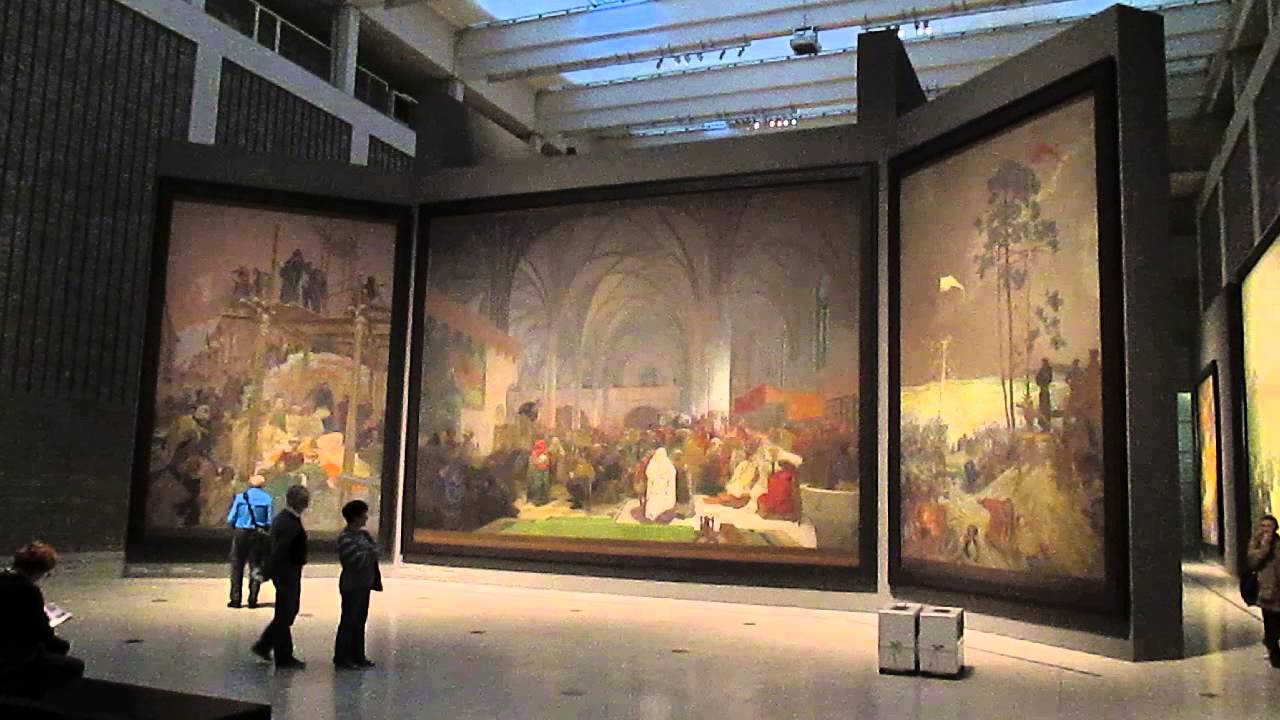
MuchaI decided to run this post from a few years again after running across it this morning and the huge works in this epic just stunned me once more. As an artist, seeing such a grand, spectacular statement from another artist  is both deeply humbling and inspiring. It makes you question all that you have done with your own work in the past and want to do more with it going forward. This series of paintings certainly did that to me early this morning and deserves another look.

You most likely know the work of Czech painter Alphonse Mucha (1860-1939) for his extremely popular posters that set the style for and were the epitome of the Art Nouveau movement. It was beautiful and graceful work, much like the piece shown here on the right.

That was definitely the extent of my knowledge about Mucha’s work. And that alone would be a worthy enough achievement for most artists. But his greatest work may well be his monumental Slav Epic series.

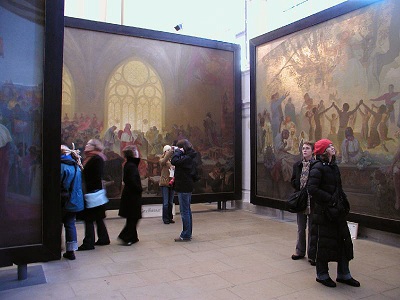
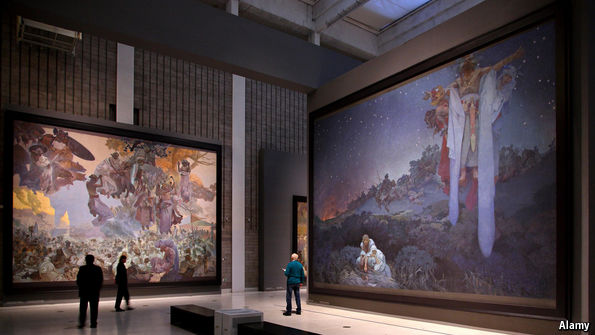
The Slav Epic is comprised of 20 large– no, 20 enormous—  paintings that depict the history and the mythology of the Slavic people. It was painted over the course of 16 years with the aid of financial support of American industrialist/philanthropist Charles Richard Crane, heir to the Crane plumbing parts empire. The works are all painted on a grand scale with some of them measuring 20 feet in height and 25 feet in width.

They somehow survived occupations of Czechoslovakia by both Nazis and Soviets who both saw the work as being counter to their ideologies. Mucha died soon after being interviewed by the Gestapo in 1939. The paintings are now in possession of the Czech government who are in the process of creating a museum to permanently display this magnificent work. I am sharing a number of images below that show them with viewers so as to give  an idea of the sheer scale of the works.

Pretty amazing. Good reason to get to Prague.

Alphonse Mucha- Slavs in Original Homeland

agnosthesia

parkeharrison3


agnosthesia

 n. the state of not knowing how you really feel about something, which forces you to sift through clues hidden in your behavior, as if you were some other person—noticing a twist of acid in your voice, an obscene amount of effort put into something trifling, or an inexplicable weight on your shoulders that makes it difficult to get out of bed.

–The Dictionary of Obscure Sorrows


Oh, so there is a name for this. I entered those exact symptoms on WebMD and got nothing.

Diddly-squat.

And they call themselves the leading source for trustworthy and timely health and medical news and information!

The real question is: How do I treat this?

I am gong to have to think on that. In the meantime, let’s listen to this week’s Sunday morning music. I can do that much for you. This week is an acoustic version of Running on Empty from Jackson Browne accompanied by guitarist and general oddball David Lindley. It’s good stuff plus it might well sum up that feeling of agnosthesia you’ve been experiencing.

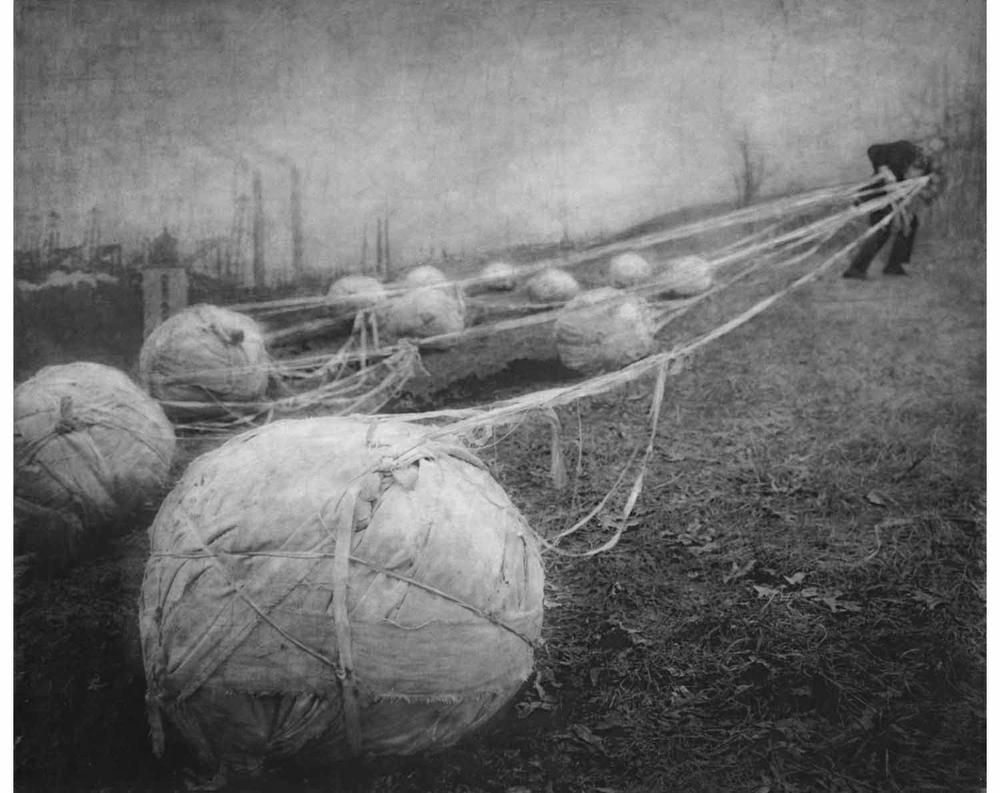
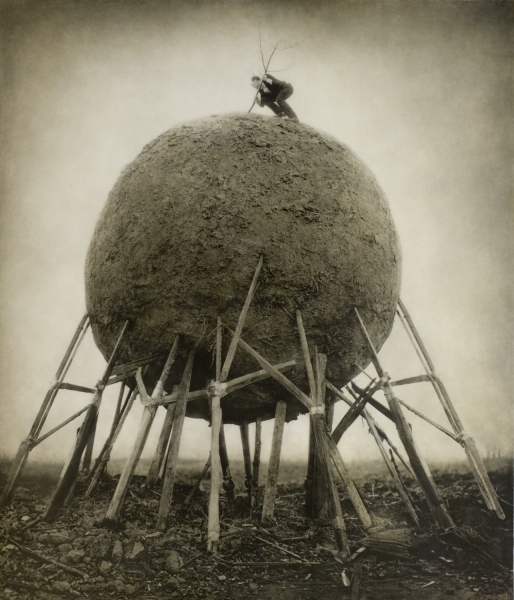
FYI, the image at the top is from a marvelous book, The Architect’s Brother, from photographers Robert and Shana ParkeHarrison, whose work I have featured here in the past. Their images are real, not digitally generated or enhanced, which means that what you are seeing is an elaborate set with real props. I have seen a lot of wonderful digital work but I feel that there is something extra in these surreal images that are not created on a computer screen. Maybe it’s because of the level of commitment it takes to create a huge sphere of mud that is propped up on rough bits of wood, like the one shown below.

I would think and maybe write more about that but my agnosthesia is flaring up this morning. Like the song, I am running on empty.


Parkeharrison_ Kingdom

Shana and Robert ParkeHarrison- Kingdom

GC Myers- Between Here and There

Between Here and There“- At the Principle Gallery, Alexandria, VA


Take a map of the world
And measure with your hands
All of the miles
Across all of the land
Write it down, add it up
And you might understand
About the distance between you and me

— Dwight Yoakam, The Distance Between You and Me


One of the casualties of these past  several years, especially the last two, has been the erosion of my trust of people I don’t know.

And some that I have known for some time.

I come to every interaction with these folks with at least a small degree of wariness. I find myself looking for any indications that they might at any moment go off into a spiel about how the election was stolen and that the former guy in charge, a proven selfish liar and cheat with fascist leanings, was somehow looking out for them and would somehow be soon reinstated to office.

Or how the vaccine contains tracking chips or makes you magnetic or sterile or changes your DNA.

Or that my mask offends them in some way, that it is somehow harmful to them that I am wearing one.

Or that how sucking down horse-paste or swilling betadine or doing shots of kerosene is the most effective defense against covid-19 which, by the way, is a hoax. Or, even if they do somehow grudgingly admit its existence, that they will do their own research to find a solution that works for them because the real truth and secret information can certainly be found online in YouTube or TikTok videos.

 Or that they might just come out and say that their beliefs– no matter how far out in the ozone they might be–are as valid as the entire body of scientific evidence and historic precedence amassed in the past millennium. 

I could go on and on because the list of conspiracies, inaccuracies, prejudices, and glaring contradictions they embrace is seemingly endless. So many that I am fatigued just trying to keep up with whatever new nonsense some rightwing nutjob on radio or TV might unleash on these gullible folks who want to hear anything but the reality of the situation.

That’s just a small bit of the baggage I find myself carrying into every interaction now.

And I don’t like that it is that way. I knew before these past years that these people were out there. They would show themselves every so often then recede back into the woodwork. Now, they wear their absurd and convoluted belief system like a badge of honor and wield it like it was the hammer of Thor.

I think that is because they believe now that everyone shares their beliefs and worldview. Their small circle of like-minded friends in life and online reinforce this, as does everything they read or view, with little resistance or pushback. It then becomes more and more concrete to these people. Why wouldn’t they feel free to spout about what they see as the obvious truth?

Like I say, I don’t like distrusting people and can generally find common ground with most folks. But it’s getting harder especially as these folks exhibit more and more violent and cruel behavior. I don’t have an answer and asking these folks what they want is fruitless.

So, I am left with looking into the eyes of everyone I come across with a deep sense of wariness, wondering what bubble of reality they are living in. And sometimes, thinking I live in that same bubble, they let me know quickly, much to my dismay. 

If only this song from Dwight Yoakam, The Difference Between You and Me, could be playing at those moments. Maybe I should put it on my phone so that once they start spouting that this or that is a hoax, I could whip it out and drown out the nonsense.

I don’t know. No answers here, of course so I am sorry for subjecting you to my moaning this morning. Try to at least enjoy the song. It’s a good one.

Well, it is, in my bubble.


Friday

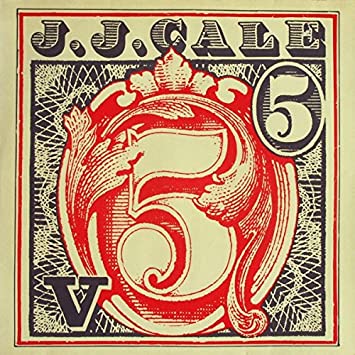
JJ Cale


Nothing to say this morning. Oh, I could and maybe want to but what would it change? I think I will stick to yesterday’s theme of emptiness as form and just play a song from the late JJ Cale, a guitarist of high esteem among his peers but not well known to most folks.

It’s called Friday— just like today!– and is a pleasant way to kick off the day. Now get off my lawn!


Sunyata

The Sky Is Always the Sky Sept 1995


Form is emptiness, emptiness is form.

–The Heart Sutra, Ancient Buddhist text


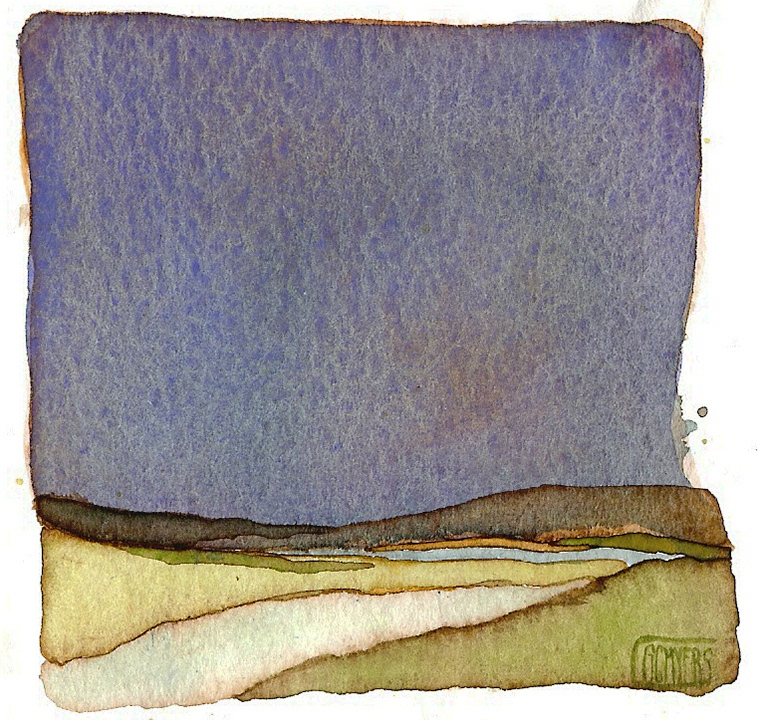
I’ve been looking at some early pieces lately, trying to differentiate in my mind how the work has changed over the years. I always come back to pieces like the one at the top, The Sky Is Always the Sky from back in September of 1995.

These early pieces focus on the emptiness of open spaces. I use the term emptiness because it seems to be devoid of all matter, save the space between the earth and sky. But I think a better term might be the Buddhist term sunyata which the Encyclopedia Brittanica defines as:

…the voidness that constitutes ultimate reality; sunyata is seen not as a negation of existence but rather as the undifferentiation out of which all apparent entities, distinctions, and dualities arise.

That infers that nothing — including human existence — has ultimate form or substance, which means that nothing is permanent and nothing is totally independent of everything else. Put in simple terms, everything in this world is interconnected and constantly changing, in a state of flux. To fully accept this concept of emptiness thereby saves us from the suffering caused by our egos, our earthly attachments, and our resistance and reaction to change and loss.

I think it was something close to this concept of sunyata that inspired early pieces like the one at the top even though I wasn’t aware to that term at the time. I do know that I felt there was more to the emptiness of vast space than met the eye, that there was meaning in the void.

As the Heart Sutra, the best known of the ancient Buddhist texts, states: Form is emptiness, emptiness is form.

Without knowing it at the time, I think this concept provided the strength in these early pieces. Their emptiness gave them form.

The reason I write about this today– and I have most likely wrote about this before as my memory is not what it once was– is that I was comparing work from back then and now and it has changed. Looking at this early work makes me realize that I was often more confident then than now. I wasn’t afraid to show emptiness with the thought that others would be able to see it as I did.

I don’t feel that I have that same confidence now.

And I wonder why this it is like this. It’s 26 years later and I have made a career out of my work. Shouldn’t I be even more confident, more assured in my message and how it will be perceived?

I don’t know that there’s an answer. Not sure I want or deserve one.

Things change. That is the natural course for all things. To fight against this change is an attempt to fill the emptiness.

And that can’t be done.

I may be talking through my hat here. I am trying to think out loud about concepts that are far beyond my meager mental skillset. But maybe just wrestling with this idea for awhile will spark something that will show itself in some new form that I can explore.

Maybe a new form of emptiness…