Feeds:
Posts
Comments

A Mirror or Window?

GC Myers-Mirrors and Windows For I do not exist: there exist but the thousands of mirrors that reflect me. With every acquaintance I make, the population of phantoms resembling me increases. Somewhere they live, somewhere they multiply. I alone do not exist.

― Vladimir Nabokov, The Eye


The painting shown here, Mirrors and Windows, hangs here in the studio and I pass it several times a day–it’s on the way to the bathroom. But even though it’s been in this spot for several years now, it usually draws my attention. It’s been that way since it was painted back in 2013.

As I wrote back then:

I found myself looking at this piece quite often in the studio, trying to ascertain what it was that was pulling me in. As I looked, I began to be more aware of the road running through which signified to me our life’s journey. We spend our lives looking in mirrors and out windows, living in reflections of ourselves and the outer world.

There must be some perfect balance in this. Somewhere, somehow, we hopefully reach a point where we know who and what we are and turn away from mirrors and begin to look for windows in which we can expand our vision of the outer world and gain greater wisdom.

Years later and it has carried the meaning well that I gleaned from it back then, that real art serves as both a window and a mirror, giving the viewer insights and views into the world and reflecting their place within it.

Just this morning, I stood in front of it and wondered if was looking at it as a mirror or a window.

I came to the conclusion that it might be both.

close_chuck_2Chuck Close died yesterday at the age of 81. His work made an interesting evolution from large scale photorealist portraits to portraits formed from pixel-like blocks that contained abstract forms. Though my own work doesn’t outwardly reflect it, I always found his work engaging and found motivation for myself in it. He also made an interesting statement concerning work and inspiration that I have shared here before. It’s worth revisiting:

chuck-close-phillip-glassI’ve been a fan of the work of Chuck Close for some time, admiring the grand scale that much of his work assumes as well as his evolution as an artist, especially given his challenges after a spinal artery collapse left him paralyzed from the neck down in 1988. He regained slight use of his arms and continued to paint, creating work through this time that rates among his best.

He also suffers from prosopagnosia which is face blindness, meaning that he cannot recognize faces.  He has stated that this is perhaps the main  reason he has continued his explorations in portraiture for his entire career. The piece shown here is a portrait of composer Phillip Glass that was made using only Close’s fingerprints, a technique which presaged his incorporation of his own unique form of pixelation into his painting process.

His determination to overcome, to keep at it, is a big attraction for me and should be an object lesson for most young artists (and non-artists, also) who keep putting off projects until all the conditions are perfect and all the stars align. Waiting for the muse of inspiration to take them by the hand and lead them forward. Sometimes you have to meet the muse halfway and Close has this advice for those who hesitate:

The advice I like to give young artists, or really anybody who’ll listen to me, is not to wait around for inspiration. Inspiration is for amateurs; the rest of us just show up and get to work. If you wait around for the clouds to part and a bolt of lightning to strike you in the brain, you are not going to make an awful lot of work. All the best ideas come out of the process; they come out of the… work itself. Things occur to you. If you’re sitting around trying to dream up a great art idea, you can sit there a long time before anything happens. But if you just get to work, something will occur to you and something else will occur to you and something else that you reject will push you in another direction. Inspiration is absolutely unnecessary and somehow deceptive. You feel like you need this great idea before you can get down to work, and I find that’s almost never the case.

Amen to that.

I’ve stumbled around for some time trying to say this but never could say it as plainly and directly as Close has managed.

A lot of would-be artists believe they have to wait for inspiration before they begin. That can be a long wait.

To begin with, it’s a rare event when and if it does come around. There’s no guarantee that it will ever come.

It has to be invited and generally the only invitation it responds to is hard work.

Work invites inspiration.

Work creates inspiration.

Thanks, Chuck. I think I’ll take your advice and get to work.

chuck close at work

Can’t Let Go

GC Myers- Show's Over, Folks

Show’s Over, Folks“- At the Principle Gallery, Alexandria, VA


The patient cannot remember the whole of what is repressed in him, and what he cannot remember may be precisely the essential part of it.. He is obliged to repeat the repressed material as a contemporary experience instead of remembering it as something in the past.

― Sigmund Freud, Beyond the Pleasure Principle


I am sharing what might seem like an odd triad this morning– a passage from Sigmund Freud on compulsion, a Red Chair painting of the aftermath of what looks to be a wild party and a song, Can’t Let Go, from the odd and wonderful pairing of Alison Krauss and Robert Plant.

I think there’s a connection in there somewhere. Just can’t be sure if anyone else will see it.

A compulsion to repeat ourselves is an underlying theme in my work. I sometimes think I know there is something more in these familiar forms and colors and lines and icons –the omnipresent Red Tree, for example– than meets the eye and that if I keep delving into them, they will at some point reveal their secrets to me.

Some tidbit of wisdom, an iota of truth, that will make it all make sense.

That must be close to a definition of compulsion. Probably much in the same way that we– both individually and collectively– seem to constantly repeat ourselves, making the same missteps and covering the same ground as though we have some sort of short term memory dysfunction that prohibits us from seeing the patterns we have followed all along, that keeps us from learning from our mistakes.

I am hoping there is some constructive effect in my own compulsion. I would hate to think that the decades of work that have came with it are a matter of me making the same mistake over and over again.

Maybe I should stop contemplating my navel this morning and get to work. Who knows? Maybe today will be the day I figure it all out, the day that bit of long sought wisdom is finally revealed.

Or not. Doesn’t matter. My compulsion would most likely blind me to it and keep me at it even if I find it now.

In the meantime, enjoy Alison Krauss and Robert Plant‘s version of Can’t Let Go, from a soon to be released album. It’s a song famously covered by Lucinda Williams on her great 1998 album, Car Wheels on a Gravel Road.

Good stuff.


You Gotta Have Heart

"Basepaths"- Now at the West End Gallery

Basepaths“- Now at the West End Gallery


I have been pretty open about my dislike of the month of August. There is a past of negative incidents and events in it that definitely taint it for me. I don’t know if it’s one of those deals where past performance creates an environment that continues to produce similar results or what.

Just not a fan of this time of year. Let’s just keep it at that.

But from past Augusts, I know that the key to getting through to September is to find something to hang your hopes on, something on the horizon to shoot for.

In July, I didn’t think it would be baseball and the Yankees, to be specific. They had went through a host of injuries to key players, some lost for the season or the better part of it, and their performance was mediocre to say the least. They looked like hell out there, nobody playing up to anywhere near their average level of performance and  they sometimes  were forced to field a team with several untested minor leaguers called up to start games in different positions. Hardly the mighty Yankees with unlimited resources.

In July, they had a bad stretch, blowing several games including being swept by their perennial nemesis, the Red Sox. They simply looked plain sloppy and distracted. That I could identify with but one of the reasons I watch baseball is to get away from that feeling.

They were what seemed a country mile back in the standings, way out of playoff contention. The season looked like it was almost time to start saying, “Wait ’til next year!”

It looked hopeless.

But it wasn’t. As long as there is a grain of hope and effort to sustain it, there’s a chance. They rebounded, got a few key additions from the trade deadline and some players returning from injury. Their level of effort  increased dramatically and there seems to be a renewed sense of purpose and enthusiasm in the dugout. They have made mad rush in the past few weeks, culminating in a sweep of a doubleheader yesterday with the Sox that catapulted the Yanks past them in the standings and back into playoff contention.

They have finally shown some heart and hope springs out of that.

There is still a long way to go and maybe they will stumble later in the season. But for now, it was a needed elixir for a guy mired in the morass of August. It was good to have this small thing to hold on to, something in which to find a grain of hope.

Some heart.

Because, as the song from the play and movie Damn Yankees goes, You Gotta Have Heart.


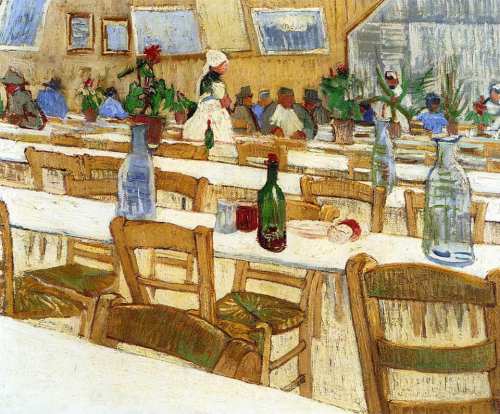
A Van Gogh Cookie

Van Gogh- Interior of the Restaurant Venissac in Arles, August 1888.

Van Gogh- Interior of the Restaurant Venissac in Arles, August 1888.


There is something intimate about painting I cannot explain to you – but it is so delightful just for expressing one’s feelings.

–Vincent van Gogh


I came across the above Van Gogh painting online yesterday. It was one of those pieces that I couldn’t recall ever seeing, even in the books with his collected works. It probably was in there somewhere but just didn’t register with me like it did yesterday.

I immediately liked this piece and just seeing it made me feel better in some small way. It was like stumbling across one more cookie when you thought the cookie jar was empty. You savor this newfound delight a bit more.

Or maybe it has to do with the intimacy that Van Gogh mentions above. He’s right, there is something intimate about painting. Every piece offers some small secret or aspect that comes from the mind and soul of the artist.

So, this morning I am greatly enjoying a morsel from Van Gogh. Not a bad way to spend a few minutes on a dark morning with torrential rain pounding the roof for the time being here in upstate NY.

Now, what’s old Van Gogh trying to tell me here?

GC Myers- Fire and Ice sm

Fire and Ice“- At the West End Gallery


Slow getting around this morning. In August, I dream of the gray coolness of fall and winter. Feels like a good moment for a short Robert Frost poem– Fire and Ice.


GC Myers- Sequester's Moon

Sequester’s Moon“- At the West End Gallery


The things that I loved were very frail. Very fragile. I didn’t know that. I thought they were indestructible. They weren’t.

― Cormac McCarthy, The Sunset Limited


Tired and achy this morning, the result of a recent lower back injury/issue, whatever you want to call it, that kept me from sleeping much the last couple of nights. Though I think ( and hope) this will pass within a week or so, it brings to mind a thought that has been rolling around lately.

Life turns on a dime.

I have seen it recently with friends and loved ones whose lives change dramatically from the sudden onset of illness or world rattling events such as wildfires. One day your world seems to be cruising into the future as well as could be expected and the next it is turned upside down. The future that was right in front of you yesterday seems much further away today, with a lot more complications and hurdles between you and it.

It might not even be the same future.

It makes one realize the fragility of our existence in this world. We can plan and visualize our futures but sometimes as the old Roberts Burns line goes:

The best-laid schemes o’mice an’ men Gang aft agley.

Or as you may better know it, without the Scottish intonations: The best laid plans of mice and men often go awry.

So we adapt. We attempt to heal or strengthen our defenses. We learn to do things in a new way. We try to fight back to that original future we foresaw.

It’s what we do. It’s all we can do.

And it’s worth the struggle because as dark and ugly as the world is on many days, it can be far more beautiful and bright on others.

So, if you’re feeling great and your future seems certain, enjoy it now because the world changes quickly. Don’t be surprised if your tomorrow is much different that your today.

For this Sunday Morning music, I am playing a song from singer/songwriter Nanci Griffith who died this past Friday at the age of 68. I don’t know what took her life, if it was an extended illness or if her life just turned on that dime. She was a wonderful songwriter best known for From a Distance, which was a giant hit for Bette Midler, as well as this song, Once in a Very Blue Moon, which was a hit for Dolly Parton. She was also an effective performer with her distinctive trilling voice. She did a marvelous cover of Townes Van Zandt‘s tragic Tecumseh Valley.

She will be missed. I thought Once in a Very Blue Moon was appropriate for today.

Please enjoy the day you have at hand.


Hartley/ Symbology

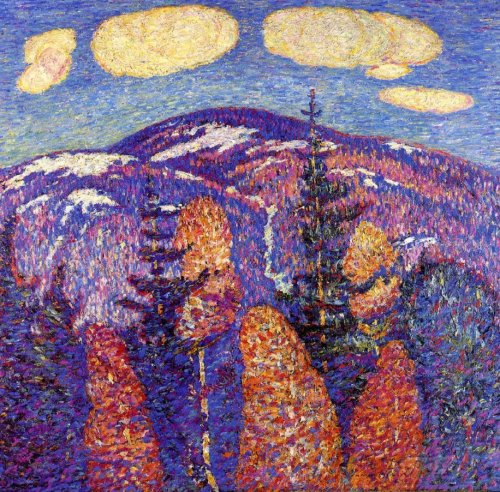
Cosmos-The-Mountains-Marsden-Hartley-oil-painting-1

Marsden Hartley (1877-1943)- “Cosmos: The Mountains


All things that are living are expression and therefore part of the inherent symbology of life. Art, therefore, that is encumbered with excessive symbolism is extraneous, and from my point of view, useless art. Anyone who understands life needs no handbook of poetry or philosophy to tell him what it is.

–Marsden Hartley


I think this is an important point from a favorite artist of mine, Marsden Hartley. Trying to paint work that is pointedly symbolic, that tries to force meaning that doesn’t naturally flow from the subject, often feels flat and lifeless to me. Or extraneous and useless as Hartley put it.

Generally, the subject evokes its own meaning and feeling and the best the artist can do is enhance it with their own skills and style — the artist’s tools for storytelling– to make it apparent to the viewer.

Sounds easy. It’s not.

We often add symbology or clutter that either clouds, alters, or detracts from the inherent meaning of the subject.

We complicate when we should simplify.

It’s the story of communication throughout time. Simplicity always triumphs.

I hope that makes sense. I am tired this morning and it sounded okay halfway through my first cup of coffee. A couple of hours from now I might have questions about this.

Here are a few more of Hartley’s landscapes, most from his home state of Maine.


marsden-hartley--an-evening-mountainscape

Marsden Hartley- ” An Evening Landscape”

marsden-hartley--hall-of-the-mountain-king

Marsden Hartley- “Hall of the Mountain King”

marsden-hartley--storm-clouds-maine

Marsden hartley- “Strom Clouds, Maine”

marsden-hartley--the-ice-hole

Marsden Hartley-“The Ice Hole”

Distraction


GC Myers- Waiting For the Fire  2002


The mind gets distracted in all sorts of ways. The heart is its own exclusive concern and diversion.

–Malcolm de Chazal


I had a whole thing I meant to write here this morning but August, my annual nemesis with its heat and anxiety, has stripped me of my willpower to do so. I am distracted and sapped of energy this morning.

So, I guess the quote I was going to use fits anyway.

By the way, Malcolm de Chazal was a writer and painter from the African island nation of Mauritius, which is east of Madagascar in the Indian Ocean. It is a former colonial outpost that now has a highly diverse ethnic mix, a high income economy, and is a welfare state with universal health care, free education and free public transportation. It is considered one of the best economies and the most peaceful of the African nations. Just so you know.

Anyway, I am shucking my earlier plans for this post and just playing a song. It’s Who By Fire from the late Leonard Cohen. Goes with the painting.


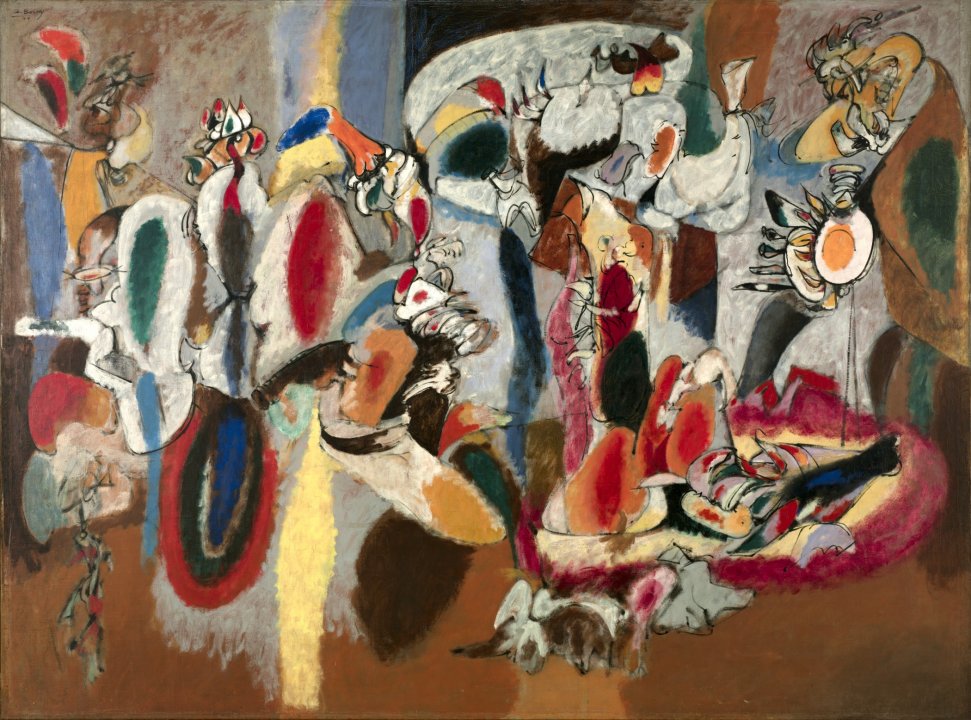
Gorky’s Rightness


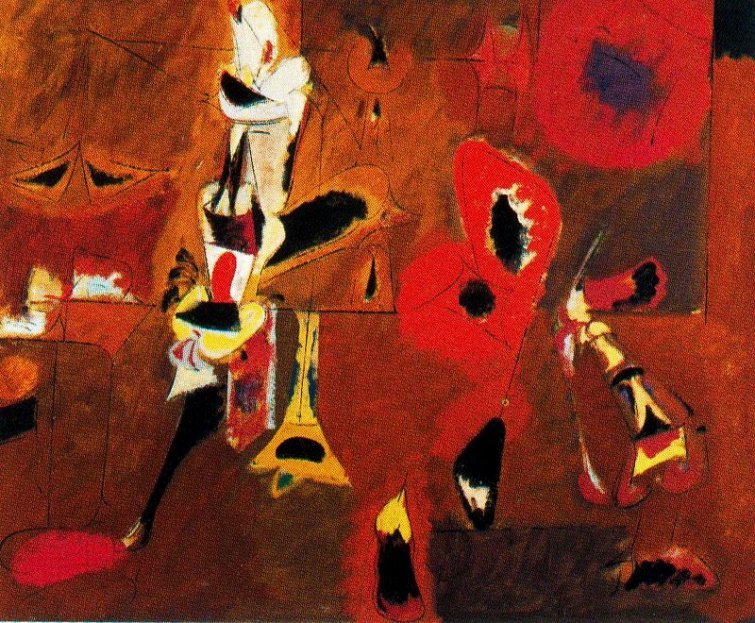
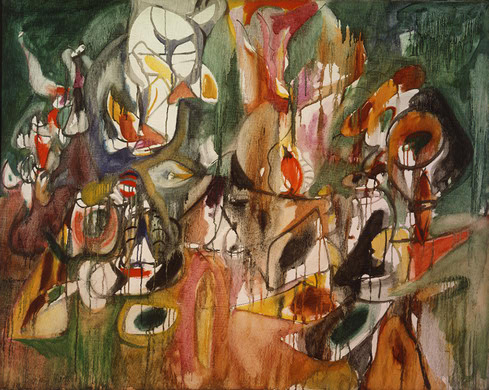
If a painting of mine suits me, it is right. If it does not please me, I care not if all the great masters should approve it or the dealers buy it. They would be wrong.

Arshile Gorky


My computer was a little wonky this morning whcih took some time to straighten out. I think I have it now but time is short so I am replaying a post from a few years back. I agree with Gorky’s words above, that only the artist can really judge the rightness of a piece of their work. I try to remember, here in the studio, that I must paint to satisfy myself only, to work to my own sense of rightness, and let the chips falls where they may in respect to how others see it. It’s not easy because you always hope to have others respond positively to your work. It takes a trust in your ability, built up over many years, to develop this sense of rightness.

Here’s a bit more about Gorky:


Arshile Gorky is one of those names that instantly stands out for me. But the reality is that I never knew much about his work. Just a unique name.

But of course there is more than the name. Gorky was born sometime around 1904 in Armenia and came to America in 1920 in the aftermath of the Armenian Genocide perpetrated by the Ottoman Empire on its own citizens of Armenian heritage. About 1.5 million Armenians died in this dark era including Gorky’s mother in 1919.

Fortunately for him, America was still a welcoming land to refugees fleeing hatred and danger.

He quickly integrated into the America of the 1920’s and spent the rest of his life here, gaining a sizable reputation as an important painter. He is considered one of the major influences on the Abstract Expressionist movement of the 1950’s, which he unfortunately didn’t live to see.

His candle burnt brightly but was short lived. He suffered several personal setbacks after 1946 including a car crash that broke his neck and temporarily paralyzed his painting arm. He hung himself in 1948, dying at around a young 44 years of age.

He hadn’t even come into his prime as a painter.

I like much of his work that I have seen. I am not a fan of abstraction for abstraction’s sake. For me, a work still has to have something to say and a sense of movement, rhythm and harmony of some sort. It has to talk, to communicate a meaning of some sort to me. It has to have have that sense of rightness that I have referred to a number of times here.

Without that, the most beautifully crafted piece of work can be sterile and cold.

Dead.

So, I agree with Gorky’s words above about rightness in his own work. That is the quality I seek most in my own. His work is often described as Lyrical Abstraction which is where the work has many of the qualities that I described above, forming in itself a visual language of sorts that transcends the image.

These are ideas that spark my imagination, that make my time spent in the studio worthwhile.