Each night I pray That it’s not too late That disappointment Won’t be my fate
But I believe deep down One day I’ll stand High on a hilltop Way, far away
–High on a Hilltop, Nick Lowe (1998)
Not going to say much this morning. I’ve done and said enough for now. The work is up at the West End Gallery and the Opening Reception for my show, Guiding Light, is tonight from 5-7 PM.
Hope you can make it to the gallery tonight.
Hope I can make it. Just kidding. I will be there to chat a bit.
But in case I somehow don’t show up, look for me high on a hilltop, just like the Nick Lowe song below. It’s a favorite of mine and really hit the spot for me as I was putting this together this morning. He seems to channel Sam Cooke here.
It is not what we have, but what we enjoy that constitutes our abundance.
—Epicurus, Principal Doctrines (ca 280 BC)
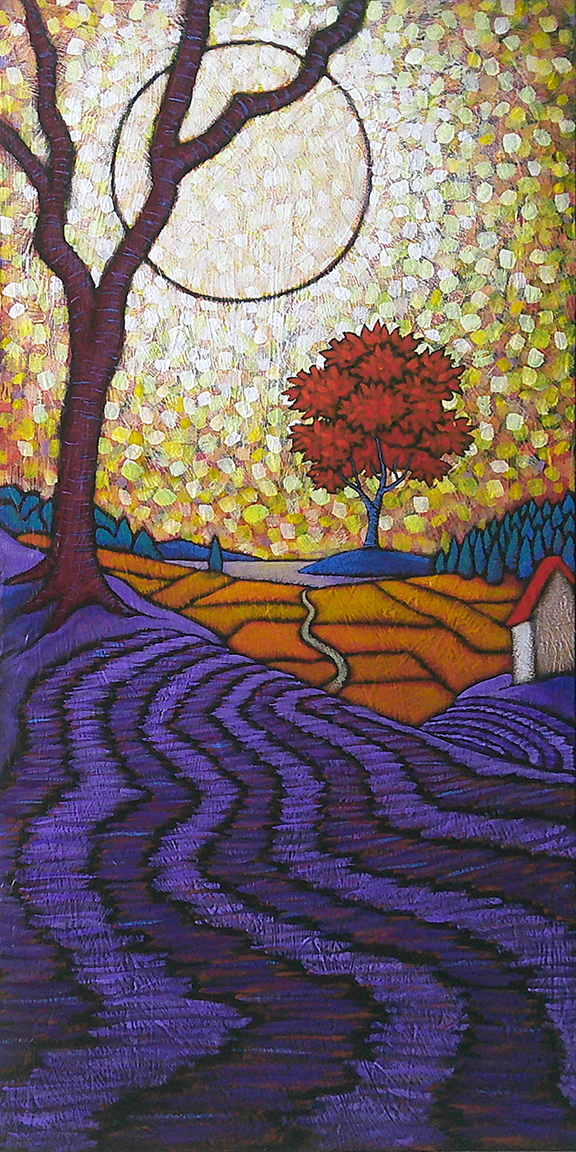
This is another new painting, 30″ high by 15″ wide on canvas, that is part of my Guiding Lightshow that opens tomorrow at the West End Gallery. It is titled Land of Plenty.
When I while I was working on it, and afterwards as well, I felt that its meaning was in how its colors and compositional rhythms expressed the beauty and plenitude of the farm fields and the surrounding landscape.
A vast cornucopia that provides for all.
That might still be correct but this morning I am not so sure. Taking the words above from Epicurus to heart, I looked at this piece from a different perspective. The lines that section off and divide the fields seemed to now serve as barriers that separated us from the surrounding abundance.
It was land owned by others. It wasn’t for everyone. As if it was owned by someone greedily saying: The land is rich and giving but only for me, not for thee.
I was seeing it as being representative of how we often talk about nations being wealthy or poor. For example, we like to boast that we are the wealthiest nation in the world. And looking at the fields and factories, the many banks and McMansions, or the numbers on multiple spreadsheets, that might be objectively true.
But that doesn’t mean it translates equally tor the average person.
Now, before you start yelling Commie, Commie at me, let me explain where that fits into my thinking.
What I am saying is that we may be indeed surrounded by wealth and abundance, but we are not defined individually by it. As Epicurus stated 2300 years or so ago, it is not what we have but what we enjoy that defines our true wealth.
In this painting, at least for this morning, I see the Red Tee as being amidst the gold of the fields that are not available to it. But what is free and open to the Red Tree is the rising sun on the horizon, the fresh air it takes in, the beauty of the mountains that call in the distance, and the open road that winds through it all.
The freedom to simply be.
All that it needs in the moment.
That’s a land of plenty.
Take this all with a grain of salt. I don’t know how this will hold up as a reading of this painting. Probably won’t last until this afternoon, let alone tomorrow or a week from now.
And that’s okay because it’s not for me to explain it now. What I saw in it this morning is just the perception of a tired, anxious person still sipping his first cup of coffee in the dark.
It speaks for itself now in its own voice. Eventually someone will hear that voice and whatever truth that is in it will be revealed to them alone.
And that is as it should be.
My annual solo show, this year titled Guiding Light, opens tomorrow, Friday, October 17, 2025. The show is now hanging in the gallery and is available for previews and prebuys. There is an Opening Reception from 5-7:30 PM. Hope you can make it there!
There is also a GALLERY TALK taking place on Saturday, November 1, beginning at 11 AM. Watch this space for further details.
One Path Ends and Another Begins— At West End Gallery
Most of us are about as eager to be changed as we were to be born and go through our changes in a similar state of shock.
–James Baldwin, The Price of the Ticket (1985)
Change is inevitable. Nature, from the expanse of the universe to the smallest microbes, is a constant series of adjustments and adaptations.
Nothing remains static or unchanged.
The courses of mighty rivers are constantly shifting. The largest boulders succumb eventually to weather.
Being creatures of born of nature and inhabitants on this spinning ball called Earth, it holds equally true for us humans. The paths we individually follow in our lives seldom run straight or forever.
Things happen. Circumstances change, sometimes drastically. Sometimes these changes come as a conscious decision. That’s pretty rare. We tend to find a level of comfort on the path we are following and seldom opt to jump to a new and unknown one.
No, change often come without us requesting or desiring it. This change arrives totally by surprise and sometimes in a most shocking manner. It shoves us off our normal path and when we regain our footing, we discover that the path we found so comfortable and homey is no more.
But there is a different path ahead. It’s not the same and we might even resist having to get on it at first. But from where we are, it is the path we must follow and somehow make our own. Change our strides to match the contours of the path and attempt to adapt to the different landscape that we now pass through.
Most of you have experienced such one path ending and another beginning. If not, you will at some point.
It is the rule of life, after all.
One path ends and another begins.
The thing to remember is that though these changes often knock us off our boots and make us feel frail and susceptible, the challenges we face on this new path we are forced to follow often reveals new strengths and aspects of ourselves we didn’t realize we possessed.
It might be a hard path, but it might well get you to where you need to be if you can embrace what it has to offer.
One path ends and another begins.
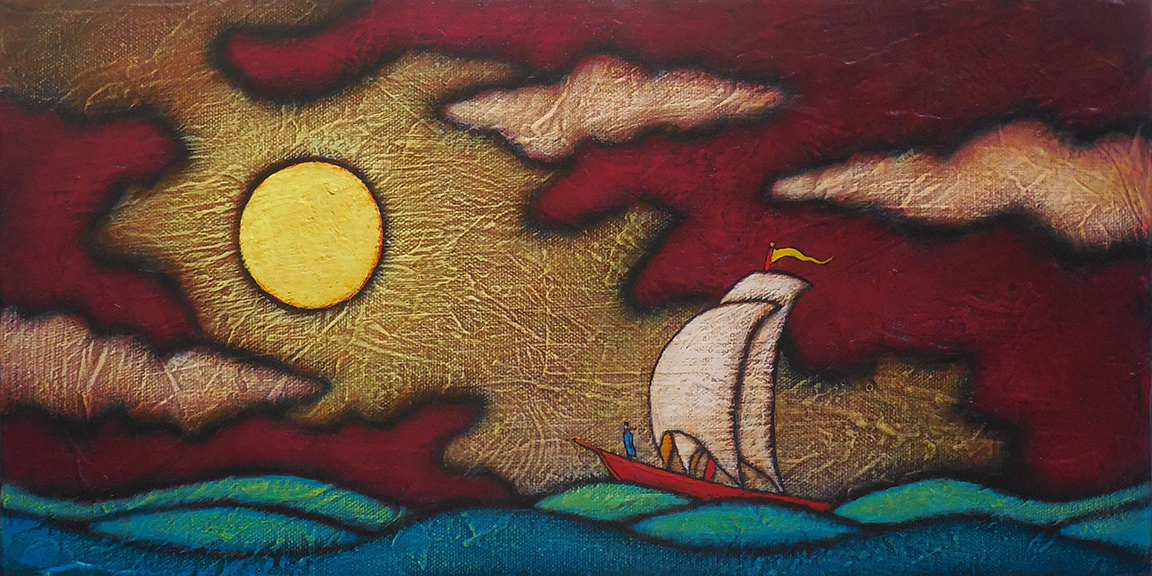
The new painting at the top is titled, unsurprisingly, One Path Ends and Another Begins. It is 10″ by 15″ on canvas and is part of Guiding Light, the solo exhibit of my new work at the West End Gallery on beautiful Market Street in Corning, NY.
Show opens this coming Friday, October 17, 2025. There is an Opening Reception from 5-7:30 PM. The show is now hanging in the gallery and is available for previews and prebuys.
There is also a GALLERY TALK taking place on Saturday, November 1, beginning at 11 AM. Watch this space for further details.
What man actually needs is not a tensionless state but rather the striving and struggling for some goal worthy of him. What he needs is not the discharge of tension at any cost, but the call of a potential meaning waiting to be fulfilled by him.
–Viktor Frankl, Man’s Search for Meaning (1946)
I spent too much time already this morning writing about the link between the image of the new painting above and the words of Viktor Frankl. It ended up feeling off the point and empty. I was trying too hard which, oddly enough, was the point I was trying to make.
We often try to force things into place in meaningless ways, hoping to chase down joy and avoid the pain, suffering, and heartbreak that life presents us as part of the deal of existing. Pursuing this sort of joy is like running after dandelion seeds in the wind. The nearer you come to them in your chase, the more the air movement from your legs and arms causes them to move further away.
Sometimes we must be reminded that joy and meaning are often hiding in the duties we are obligated to fulfill as humans. The meaning that comes in giving of yourself in the service and care of others, for example.
The joy of the selfless rather than the selfish.
I don’t know that this new painting, Chasing the Elusive, fully captures what I am stumbling around with my words this morning. I see it as being about the effort we often make in chasing down dreams and meaning that are actually within us all the time, attainable if we recognize the purpose found in our duty and love for others.
I am struggling with expressing this, as you can see. I am going to take my own advice and stop chasing it. Just let it be.
Let the dandelion seeds settle.
The painting, Chasing the Elusive, is 8″ by 16″ on canvas and is included in this year’s edition of my annual solo show at the West End Gallery, Guiding Light, which opens this coming Friday, October 17. The opening reception for the show runs from 5-7 PM.
Hope you can make it.
Here’s a favorite composition, Gnossiene No. 1from Erik Satie. This is a little different take on it from a group called Decostruttori Postmodernisti. Not sure if Satie would have ever envisioned his piece being played by with a theremin and trombone. That’s the way the world goes round, right?
Each for himself, we all sustain The durance of our ghostly pain; Then to Elysium we repair, The few, and breathe this blissful air.
–Virgil, Aeneid (29–19 BC)
This year’s edition of my annual solo show at the West End Gallery, Guiding Light, opens this coming Friday, October 17. The painting above, Idyllica, is one of the larger pieces from the show, coming in at 30″ by 48″ on canvas.
I might call this a signaturepiece, if I were to put a label on it. By that, I mean it might be a painting that I feel neatly sums up what my work means for me. A painting that symbolizes who I am and how I see the world and my existence.
Kind of like a self-portrait that portrays the artist in their best light as they see it.
I have had this feeling a number of times about paintings, feeling that they represent a totality of what I hope I am. Mybe it is really more that they represent all the things I aspire to but knowingly lack personally.
Grace, balance, and harmony, for example. You can also add boldness, confidence, and courage. Maybe throw in Inner peace and strength, as well.
Maybe I am not seeing this so much as a self-portrait, a picture of who I am now, but rather as a laundry list of everything I have yet to find fully in myself. An image of what I desire to be.
Perhaps that is what I see in this– a clear statement of my hopes for myself as a human.
Maybe in some way it can serve as a template or roadmap to the attainment of these qualities?
I don’t know. Maybe.
But for the time being I find myself basking placidly in this piece. And in these days now filled with uncertainty, lies, malevolence, and moral cowardice, it is refreshing to rest for a moment in something that aspires to the better parts of our humanity.
It’s what I need right now…
Here’s a song that haunts me for days every time I hear it. It plays, in a way, into what I am saying this morning. It’s from Glen Hansard and Marketa Irglova, best known for their performances and music from the film Once, performing as The Swell Season. I am a big fan of their work, especially Hansard’s solo work. This is their version of Don’t Want to Know from a tribute album to the late British singer/songwriter John Martyn that came out soon after his death in 2009 at the age of 60. I don’t have time to go into his life right now, but Martyn was an interesting and enigmatic character, a mass of contradictions and conflicts and talents. The 1973 album that this song is from, Solid Air, is considered a gem that is little known here.
Prayer is not asking. It is a longing of the soul. It is daily admission of one’s weakness. … It is better in prayer to have a heart without words than words without a heart.
— Mahatma Gandhi (Young India, 23rd January 1930)
I always hesitate in using the word prayer in the titles for my work. I have never had the certainty of belief that faith requires so prayers for me felt like mailing wishes in an envelope without an address on it. It felt to me like a fruitless exercise if the message never went anywhere beyond myself.
After a time though, I began to realize that prayer was not asking some astral father figure for things and situations that suited my personal preferences in any given moment. It was not about changing circumstances, about personally gaining, about winning battles or defeating enemies or overcoming disease.
No, it was more about finding the peace of mind and the sense of acceptance needed to cope with life as it is. About finding a path through chaos. About finding stillness amidst the din.
It was about simply finding an understanding of some sort.
I began then to see that prayer was as much inward as it was outward bound. It was about first affecting the change in oneself in a way that allowed one to feel as part of the light of the grand scheme laid out before us so that it no longer felt like a dark mystery.
It might be called prayer or meditation or ponderance or any number of other words. Anything that expresses, as Gandhi called it, a longing of the soul.
Anything that seeks an answer to the eternal question: Why?
That’s what I gleaned from this new painting, A Prayer For Understanding. There’s more to say, of course, but I am going to leave it right there this morning. You can fill in the blanks in your own words and thoughts, if you so desire.
Art is like that.
For this Sunday Morning Music here’s George Harrison and his hit from 1973, Give Me Love (Give Me Peace on Earth). Seems to fit here.
A Prayer For Understanding is 30″ by 15″ on canvas, and is included in my solo exhibit of work, Guiding Light, that opens this coming Friday, October 17, at the West End Gallery. The Opening Recption on Friday runs from 5-7 PM.
Right this minute across time zones and opinions people are making plans making meals making promises and poems
while
at the center of our galaxy a black hole with the mass of four billion suns screams its open-mouth kiss of oblivion.
Someday it will swallow Euclid’s postulates and the Goldberg Variations, swallow calculus and Leaves of Grass.
I know this.
And still when the constellation of starlings flickers across the evening sky, it is enough
to stand here for an irrevocable minute agape with wonder.
It is eternity.
— Maria Popova
This poem, But We Had Music, is from Maria Popova, who has written the wonderful blog The Marginalian(formerly Brain Pickings) since 2006. I have gleaned so much from her insights and sharing of the writings and thoughts of so many great thinkers. I seldom come away after reading her blog without a wealth of new perceptions.
But this time her own poem instantly hit me as a fitting companion to the painting at the top, Something Beyond. It is, of course, one of the paintings featured in my new solo exhibit of work, Guiding Light, that opens next Friday, October 17, at the West End Gallery.
For me, this piece speaks to the same realization that comes in Popova’s poem– that though our lives here are so often filled with busyness, worries, sorrows, joys, opinions, and accusations, there sometimes come moments that remind us of the temporary nature of our time here. We are so often lost in the boiling, roiling, and turmoiling of the minute details of everyday life that we lose sight of the miracle and wonder of it all.
I had such a moment as the one described in the poem just yesterday when I had to run into town early in the morning. It was cold, our first freeze of the season, and there was an icy fog hanging on the road. After a few miles there was a break in the fog and the morning sky softly broke through. There was a lovely and delicate salmon pink color created by the sunrise on the low cloud above. A group of eight or nine geese was rising out of the field off to my right and flew in line across that pale pink sky. They were flying perpendicular to me, both of us moving toward the same point ahead, so that I was able to watch them for more than mere glance. It was a lovely few moments, so tranquil and natural that it felt like a small bit of grace from somewhere beyond, a simple reminder of the wonders that surround us.
It’s easy to lose sight of that. We live our lives in what could and should be a simple and wonderful world. Unfortunately, it all too often seems tangled up with the stupidity, anger, hatred, and confusion usually brought about by those who forget that we are ephemeral beings living on borrowed time and that no amount of money or power will change that fact.
A handful of geese in the sky on a cold October morning can sometimes feel like a remedy to all that.
Below is a reading of Maria Popova’s poem from singer/songwriter Nick Cave with visualizations from filmmaker Daniel Bruson. I have also included a piano piece, Spanish Waltz, from Spanish pianist Nel Aique. It came on while I was writing this and it mirrored the feel of the flight of those geese yesterday morning. Lovely.
To romanticize the world is to make us aware of the magic, mystery and wonder of the world; it is to educate the senses to see the ordinary as extraordinary, the familiar as strange, the mundane as sacred, the finite as infinite.
— Novalis
I don’t plan on saying much today. Just going to let the spirit of the words, painting, and song do their thing. With a quick glance at these three, you can see that the theme for today is a recognition of the beauty of our world. Or as Novalis put it: the magic, mystery and wonder of the world.
Or maybe it is about how we often don’t fully recognize those things? I can’t decide.
The words are from the 18th century German poet/philosopher Novalis (Georg Philipp Friedrich Freiherr von Hardenberg 1772-1801) who was amazingly productive with work that has had lasting influence in the many generations since his death in 1801, at the youthful age of 28. He is thought to have died from tuberculosis or cystic fibrosis.
His words coincide with the hopes of many artists in wanting others to see in their work the potential for the extraordinary in the ordinary. To see that beauty is at hand at all times.
The painting above, This Beautiful World, is 10″ by 15″ on canvas and is from my West End Gallery show that opens next Friday, October 17. The exhibit is being hung today so you can see it early for a preview, if you so desire. I think this piece falls nicely in line with the words of Novalis as a symbol of the sacred mundane.
The song is the title track from the great Mavis Staples’ new album, Sad and Beautiful World. It’s her cover of a 1995 song from indie rock band Sparklehorse. It is a simple song with spare lyrics but it beautifully lays out the depth of the sadness that often comes with beauty as part of the deal.
We need the contrast of sadness to allow us to fully see how beautiful this world can be and how fortunate we are to experience its love, beauty, and wonder. And how fortunate we are to be able to feel deep emotion or to cry in both suffering and joy. To know life and death.
Life always bursts the boundaries of formulas. Defeat may prove to have been the only path to resurrection, despite its ugliness. I take it for granted that to create a tree I condemn a seed to rot. If the first act of resistance comes too late it is doomed to defeat. But it is, nevertheless, the awakening of resistance. Life may grow from it as from a seed.
–Antoine de Saint-Exupéry, Flight to Arras (1942)
What awakens us?
What are the sacrifices that created us and brought us to this point in our existence?
What seeds have been condemned to rot so that we might stand on this rock?
So many questions.
Few, if any, answers.
It sometimes like we have evolved enough to ask the questions but not enough to recognize the answers.
We are left standing on this rock with only a vague sense of what that answer might be.
A nebulous feeling of what is and what is not.
And sometimes that feeling is enough in the moment to sooth whatever it is within us that asks such questions.
It is enough to allow us to feel as though we have been given an answer.
The real question is: What do we do with that answer?
I don’t know if any of this makes sense to you this morning. It just felt right for what I was feeling from the combined stimulus from the passage along with the painting at the top and the song below. There seemed to be some thread of sense running between the three, containing some sort of answer to whatever question I was asking.
But then again, I could be delusional. I wouldn’t be at all surprised– I hear there’s a lot of that going around.
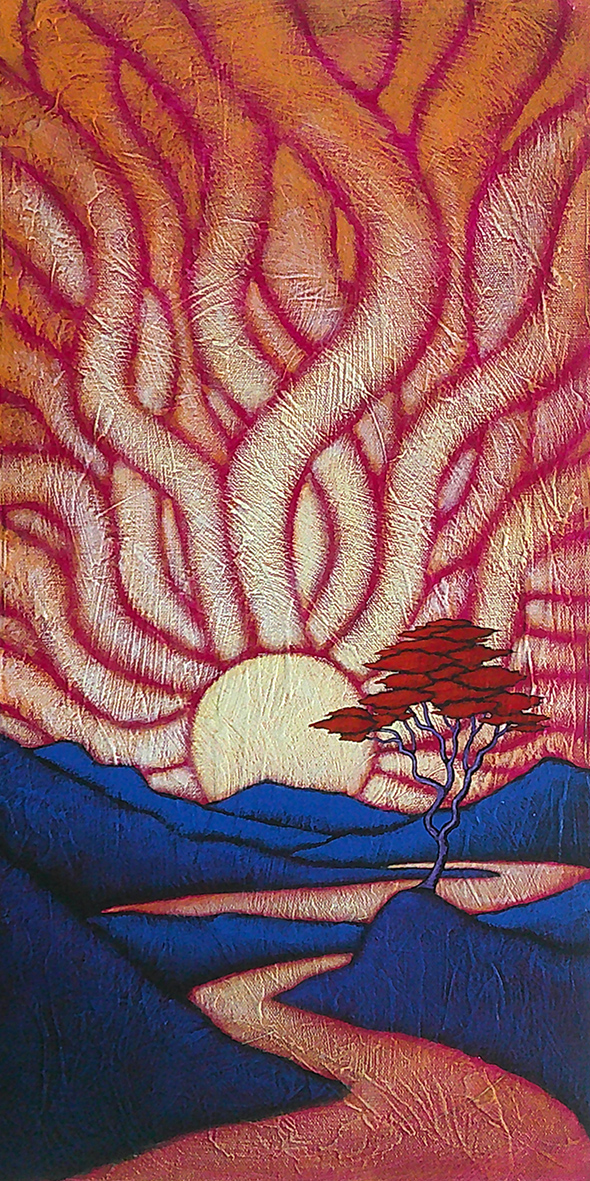
The painting shown here is The Awakening, 24″ by 12″ on canvas, that is included in my solo show, Guiding Light, that opens at the West End Gallery next Friday, October 17. The Red Tree in it represents, for me, the growth from that sacrificed seed, the newly formed consciousness that feels the wonder of the world into which it has emerged. It seeks to understand the answers it feels it is being given.
The song below is a new song from the new album from Robert Plant called Saving Grace. It features the vocals of singer Suzi Dian and the group Plant. I really like this recent performance on Jools Holland’s show and felt it fit well with some of my work, including this new painting.
Feels like there’s an answer in there somewhere if I could just make it out…
To persons standing alone on a hill during a clear midnight such as this, the roll of the world is almost a palpable movement. To enjoy the epic form of that gratification it is necessary to stand on a hill at a small hour of the night, and, having first expanded with a sense of difference from the mass of civilized mankind, who are disregardful of all such proceedings at this time, long and quietly watch your stately progress through the stars.
― Thomas Hardy, Far From the Madding Crowd
There’s often a dichotomy in art that illustrates our connection to all of humanity– our commonality with all things– while at the same time pointing out our own uniqueness and sense of difference.
It’s a delicate dance that requires a cooperative balance between the two, with neither dominating and each strengthening the other.
Having a sense of our value as individuals brings a depth of understanding and an acceptance of others that enhances our connection with our humanity.
And recognizing that connection brings a sense of humility that keeps us from thinking that, even though we perceive our own uniqueness, we are any more special than the next person in line at the grocery store.
I think art can do this; make you feel both common and special at once.
Both part and apart.
And I think that is something that we need. It’s easy to see what happens when people feel too much of one or the other, when people begin to believe that they are unimportant– faceless and voiceless– while others believe they are above all others in every way.
It is hopelessness and hubris. The delicate dance falls apart.
That’s a lot to see in a what seems like a quiet and peaceful painting on its surface. But that is how I read this new painting, Far and Away. For me, it is about that delicate dance of connection and apartness. About finding the balance and rhythm between the two and losing yourself in the dance.
You might not see it that way. That’s okay. Some dances aren’t for everybody.
Far and Away is 18″ tall and 6″ wide on canvas. It is currently at the West End Gallery where it is waiting to be hung on the gallery walls later this week as part of my solo show, Guiding Light. The exhibit opens next Friday, October 17 with an Opening Reception that runs from 5-7 PM.
Here’s an obvious choice for a song to go with the painting and the words at the top from Thomas Hardy. This is Moondance from Van Morrison from 1970, a mere 55 years ago.






 Redtree Times