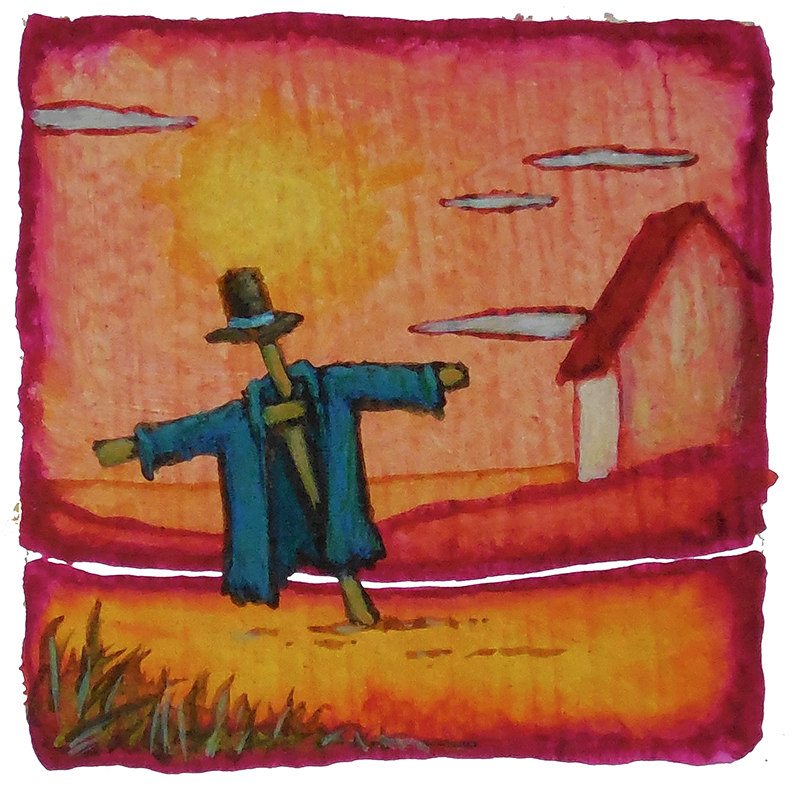
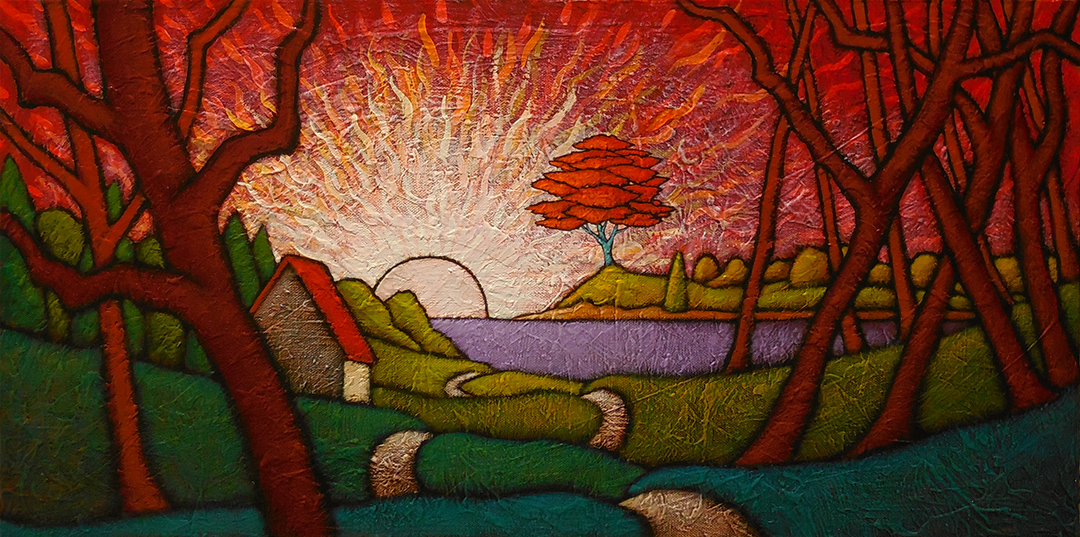
Archaeology: The Future Looms– At Principle Gallery
Time’s arrow, we are told, is a one-way thing… Memory’s arrow, like the needle of a compass too close to a lodestone, spins in all directions.
–Russell Hoban, Amaryllis Night and Day (2001)
It’s President’s Day so there’s not much to say this morning, what with the idea of having a unifying presence in the White House being just a quaint notion now. A memory of bygone days.
Speaking of memory, I came across the passage above from the late novelist and American expat Russell Hoban and it reminded me of how memory has a strange way of laying with me when I work. I can’t tell you the thousands of hours I have spent working on paintings where my mind is recalling people and moments from my past that had seemingly little or no significance to me.
I will be focusing on a section of color and all that runs through my head is the vague remembrance some kid who I didn’t really know — or even want to know for that matter– who was just a passing acquaintance in high school. Or a single word or look from a stranger fifty years removed. It’s maddening as the harder I try to shake it out of my mind’s limited space, the more it expands to fill the space. It goes on for hours as I work and leaves me exasperated, wondering why it’s even there to begin with.
But it is. And there doesn’t seem to be anything I can do to counter it. My memory’s arrow just spins out of control, unable to locate its lodestone, its true North. I would like to think that it serves some purpose, that it is some function that needs to occur. Maybe it is my mind calling for emptiness so that it can focus and this little nothing of a memory refuses to budge.
I don’t know.
I would like to say that this occurs on those days when my work doesn’t come easily but, in reality, it comes on bad and good days, often occurring on days when things are going great with the work and I am in a deep groove.
For god’s sake, it’s happening right now. Aargh…
Okay, here’s a song that will hopefully clear out those strangers lurking in my memory. I thought I was going to share an acoustic guitar version of Time from Pink Floyd. But an acoustic version of their Us and Them from Guido Mancino came up right after Time finished playing. Goven what we’re going through right now, it seemed the better selection, even if it doesn’t completely fall in line with this post.
Some humans ain’t human Some people ain’t kind They lie through their teeth With their head up their behind
You open up their hearts And here’s what you’ll find Some humans ain’t human Some people ain’t kind
—John Prine, Some Humans Ain’t Human
I came across the post below from five years ago, in 2020, in February of that year. I had to laugh at the fact that I am basically in the same state of mind now. Some things never change, I guess. Bu tit fit so well with that I felt like saying this morning that it seemed foolish to not rerun it.
From February, 2020:
Maybe it’s just being tired from wrestling with a foot of fallen snow or maybe it’s just being sick of being sick about the state of affairs taking place here in this country. I can’t say for sure but whatever the case, it has made me a little misanthropic as of late.
It bothers me and it’s not something I embrace lightly. I’ve always resolved to follow the Will Rogers maxim ofI never met a man I didn’t like, believing that I could always find common ground with anyone I came across, could find something, anything, that we could agree on. And that was generally the case for the better part of my life.
But the last three or so years have put that resolution to the test as so many of my fellow citizens have been suddenly liberated to openly express their prejudices, their hatreds, their conspiracy-based beliefs, their petty spitefulness and a whole litany of stupid behaviors that would crush my spirit completely if I were forced to list them all.
This morning, I just want to give up and embrace my angry misanthropy. Maybe walk to the end of my driveway and give the finger to the first passing car.
That’ll teach ’em, won’t it?
Oh, I know. That won’t happen. I will still try to find whatever good there is in people, still try to find even those small things we have in common. You like pizza? Me, too!
But be warned: my patience ain’t what it used to be.
So, for this Sunday morning music I have selected what I consider a fitting choice for this mood. It’s Some Humans Ain’t Human from John Prine. He wrote it in 2005 as political commentary on George W. Bush‘s decision to put us into the war with Iraq, that one we still can’t seem to shake free from. Prine said he didn’t want to die with people not being sure where he stood on Bush.
It might have been written for that purpose but it fits a multitude of situations. Actually, every situation.
Give a listen and if you want to sing along, go to this link for the lyrics. Then let yourself quietly. I’m telling you right now, do not slam that door.
And if you need me today, you will find me at the end of my driveway.
This post originally ran before John Prine died from Covid a short time later in 2020. I wish he were still around to comment on the world at this moment. The painting at the top, is Soul Boat is from 2019 and currently lives with me here in the studio just to remind me that some humans still ain’t human.
“I don’t approve of novels mentioning actual issues and going on and on about politics,” she says. “I’ve never had any urge to put politics in a novel or to even mention that it exists.” But recent events have been too momentous to ignore. “It seemed so wrong to have any character going about normal life after that horrendous election,” she says. “I am worried and anxious and depressed and everything you can be. This is such an extreme, horrifying thing to happen. I always trusted our constitution.”
— Anne Tyler, The Guardian interview
There is an interview today in The Guardian with bestselling novelist Anne Tyler, author of The Accidental Tourist, Breathing Lessons and a bevy of other novels. 25 books, actually. She has had a long and acclaimed career producing intimate novels that by design seldom, if ever, deal with whatever is taking place in the wider world. While she has a new novel coming out that adheres to this design of hers, she is already at work on her next, set in this past summer of 2024.
In the interview, she admits to not being able to keep the current situation taking place here in this country from playing a part in the new book. As a quote in the headline for this interview states: ‘It seemed wrong to write about normal life after that horrendous election.’
I understand what she is feeling. I have tried to minimize mentions of a political nature out of this blog– seriously, I have– so that it serves as some sort of diversion from the beeline to Crazytown that we seem to be on at this time. I’ve tried to make that my aim in doing this.
It’s not easy. I find myself asking:Do we really need more diversion?
We are swimming in a vast sea of distractions and diversions. We are buffeted by media and endless opinion, disinformation, misinformation, and even a little information occasionally to the point we operate with the attention span of a tsetse fly. It sometimes feels as though this was the goal, a crucial part of some insidious, larger plot. In a prophetic 1985 book, Amusing Ourselves to Death: Public Discourse in the Age of Show Business, Neil Postman foreshadowed our current state of inattention, predicting the rise and influence of infotainment news, as well the flood-the-zone strategy of the current administration. In the foreword to the book, Postman compared the two most widely accepted dystopian futures, that of George Orwell’s 1984 against Aldous Huxley’s Brave New Worldand how they might pertain to the then-future we now occupy:
What Orwell feared were those who would ban books. What Huxley feared was that there would be no reason to ban a book, for there would be no one who wanted to read one. Orwell feared those who would deprive us of information. Huxley feared those who would give us so much that we would be reduced to passivity and egoism. Orwell feared that the truth would be concealed from us. Huxley feared the truth would be drowned in a sea of irrelevance. Orwell feared we would become a captive culture. Huxley feared we would become a trivial culture, preoccupied with some equivalent of the feelies, the orgy porgy, and the centrifugal bumblepuppy. As Huxley remarked in Brave New World Revisited, the civil libertarians and rationalists who are ever on the alert to oppose tyranny “failed to take into account man’s almost infinite appetite for distractions.” In 1984, Huxley added, people are controlled by inflicting pain. In Brave New World, they are controlled by inflicting pleasure. In short, Orwell feared that what we hate will ruin us. Huxley feared that what we love will ruin us.
This book is about the possibility that Huxley, not Orwell, was right.
So, as I sit down early each morning, I ask myself a number of questions. Is it right to add even more to our distractions?Am I truly providing a service to anyone by creating a diversion at a time that demands our full attention?
It ultimately comes down to one question: Does what I do serve any function beyond diversion?
I don’t know the answer to that. Maybe if one or two people are inspired to change a view or a perception, that is enough.
Maybe it can be a diversion with a difference?
Again, I don’t know. Needless to say, there are no easy answers to anything during these anything-but-normal days.
All I can say is thanks for sticking with this and reading along to my well-meaning meanderings.
Passionata–Included in Little Gems at West End Gallery
There must be some other possibility than death or lifelong penance … some meeting, some intersection of lines; and some cowardly, hopeful geometer in my brain tells me it is the angle at which two lines prop each other up, the leaning-together from the vertical which produces the false arch. For lack of a keystone, the false arch may be as much as one can expect in this life. Only the very lucky discover the keystone.
― Wallace Stegner, Angle of Repose
Valentine’s Day in the year 2025. Though there is a lot that could be said about both the Valentine’s Day type of love and the year 2025, the two seem incompatible. At this place and time–2025– writing about romantic love seems almost trivial. And that might be a mistake as it may be only love, in its many facets, that sustains us going forward. So, for this Valentine’s Day in the year 2025, I am going back to a post from the good old days– 2022 (yikes!)– that deals with the sustaining power of love. The only difference is the painting at the top from the Little Gems show, which nonetheless serves as well as the painting shown in the original post.
The lines above from the 1972 Pulitzer Prize winning novel, Angle of Repose, from the late Wallace Stegner really jumped out at me this morning. To be honest, I haven’t read the book so can’t speak to its context but its concept of two vertical lines tipping together so that they meet and prop each other up to create a self-supporting false arch just seemed like the perfect imagery for today, Valentine’s Day.
Every lasting relationship depends on this arch. I hesitate to use the word “false” though I understand it is in reference to the distinction between “true” arches that have angled stones and a keystone at its apex that binds it all together and “false” arches that have the appearance and serve the same purpose but are constructed in a less sophisticated manner, sometimes haphazardly or by sheer accident.
Two trees falling against one another in the forest, for example.
Or maybe even two trees that grow together and eventually seem almost as one. a la the trees in my Baucis and Philemon based paintings.
I’ve been part of such a false arch for a very long time and as a result Valentine’s Day takes on a different look for me. Though it maintains a romantic aspect, it is more about a deeper recognition and appreciation of all the many aspects that make up that other vertical line that somehow fell my way all so many years ago to create our false arch.
And, as the Stegner lines above point out, this false arch might be as much as one can expect in this life. I certainly can’t ask for anything more.
Here’s one of my favorite Rickie Lee Jones songs, one that seems fit for this post. It’s a song that I never thought received the recognition it deserved. This is We Belong Together, from her classic 1981 album, Pirates, with its cover photo from Brassai of two Parisian lovers of the 1930’s.
It is the artist’s business to create sunshine when the sun fails.
–Romain Rolland, Jean-Christophe, (1904)
I am generally a fan of winter weather. I like colder weather and snow and the quiet it brings. Even so, I have to admit that I am getting tired of it this year. Tired of slipping and sliding on ice, probably because I am still working off a slight concussion from a fall this past weekend that had me stumbling around like a middleweight boxer who had just been hit flush with a haymaker and is forced to take a standing eight count to regain his bearings. Tired of the oppressiveness of the sky’s constant grayness which matches my mood or that of the country a little too much. Tired of wearing layers and layers of clothing and having to put on crampons (ice cleats) just to walk to the studio.
Even the beauty of the snow is compromised at the moment. Here in the woods, it has no fluffiness or moisture now. The thought of going out and perhaps laying in the snow to make snow angels is gone as the thin layer of snow is hard surfaced with sharp icy edges.
Just want some sunshine. Want some brightness. Something to burn away the grayness of the sky and my spirit. Want to feel its warmth on my skin again. That has been such a rare occurrence this winter.
There is some consolation in that I do, at the very least, have my work. I have the luxury of being able to go into it and make my own sunshine, much like passage above which the Nobel Prize-winning French author Romain Rolland wrote in his best-known work, Jean-Christophe.
It does help to have some capacity to create one’s own sunshine. But it only goes so far. It’s not a self-sustaining perpetual motion kind of thing. It needs some input, some help, some influx of outside energy every so often.
It needs to see and feel the real sun occasionally, even if to simply be reminded that it is still there. With it, the bitterness of cold, the trudge of snow, and the skeletal trees of winter are tolerable.
Okay, enough. The gray light of morning is coming through the studio windows. Barely. I have to go make some sunshine.
Here’s an old song from Donovan about a guy I could use right about now, Sunshine Superman.
We cast a shadow on something wherever we stand, and it is no good moving from place to place to save things; because the shadow always follows. Choose a place where you won’t do harm – yes, choose a place where you won’t do very much harm, and stand in it for all you are worth, facing the sunshine.
–E.M. Forster, A Room With a View
Choose a place where you won’t do harm…
Man, that sounds like advice coming to us from a distant time and place. So much so that it seems almost quaint, almost to the point where many of us do exactly the opposite, choosing places where we can do nothing but harm.
I know this is nothing new. There has always been a streak of malice and vindictiveness within our character. We would often rather sacrifice to harm others rather than to help them.
That’s part of the dark shadow that follows us, obscuring what little remains of our empathy. Not sure why I am writing this this morning, outside of the utter disappointment I sometimes feel in the choice many make to turn away from the sunshine of compassion and live in the deep shadows that are devoid of it.
Actually, this all started when I came across an old blog post that had a Johnny Cash performance of a Loudon Wainwright song, The Man Who Couldn’t Cry. Simply put, it’s a song about a man who lived a life without feeling. This performance is from a time when Johnny Cash was just beginning to reinvent himself, having become irrelevant, seen as a relic of country music’s past. He couldn’t get airplay for his music. He decided to make music that was out of the box.
It is written that though he was a legendary performer, he was terrified for this show as it was one of the first times he had played alone on stage without a backing band. Just a man and his guitar. I like that story, that this man who headlined around the world and had throngs of adoring fans felt the need to move ahead with deeply personal work that was meaningful and often raw. That it meant so much to him that he felt exposed, that he was nervous and afraid.
He chose a place where he wouldn’t do very much harm, and stood in it for all he was worth, facing the sunshine.
Why one writes is a question I can answer easily, having so often asked it of myself. I believe one writes because one has to create a world in which one can live. I could not live in any of the worlds offered to me — the world of my parents, the world of war, the world of politics. I had to create a world of my own, like a climate, a country, an atmosphere in which I could breathe, reign, and recreate myself when destroyed by living. That, I believe, is the reason for every work of art. The artist is the only one who knows the world is a subjective creation, that there is a choice to be made, a selection of elements. It is a materialization, an incarnation of his inner world. Then he hopes to attract others into it, he hopes to impose this particular vision and share it with others. When the second stage is not reached, the brave artist continues, nevertheless. The few moments of communion with the world are worth the pain, for it is a world for others, an inheritance for others, a gift to others, in the end. When you make a world tolerable for yourself, you make a world tolerable for others.
We also write to heighten our own awareness of life, we write to lure and enchant and console others, we write to serenade our lovers. We write to taste life twice, in the moment and in retrospection. We write, like Proust, to render all of it eternal, and to persuade ourselves that it is eternal. We write to be able to transcend our life, to reach beyond it. We write to teach ourselves to speak with others, to record the journey into the labyrinth, we write to expand our world, when we feel strangled, constricted, lonely. We write as the birds sing. As the primitive dance their rituals. If you do not breathe through writing, if you do not cry out in writing, or sing in writing, then don’t write. Because our culture has no use for any of that. When I don’t write I feel my world shrinking. I feel I am in prison. I feel I lose my fire, my color. It should be a necessity, as the sea needs to heave. I call it breathing.
― Anaïs Nin, The Diary of Anaïs Nin
Why do it?
Even after nearly 30 years of doing what I do–which is paint, if you were still wondering– I still often find myself asking why I do this. There are certainly easier and more lucrative ways to make a living but they normally don’t offer the autonomy, solitude, and non-financial rewards that this life offers.
However, I don’t think it’s as simple as putting everything on a spreadsheet and comparing columns of pros and cons, of which there are plenty of both. I don’t think any single line item on such a spreadsheet would justify doing or not doing what I do.
No, I think it’s something beyond quantification or even justification. It’s something that I know is there, and have known for some time, from a point in my life where I was yet to fully live this life. It’s something I often struggle to put into words. That’s probably why I often find a rationalization for what I do from writers who struggle with that same question. Though they are writing about the act of writing, their observations carry cross all creative disciplines.
I have recently read two wonderful books that deal with this question. One, Art & Fear from David Bayles and Ted Orland, touches on it while dealing broadly with art and creativity while the other The Writing Life from Annie Dillard, gives deep insight into the essential part of the writing impulse which moves, as I said above, across the creative spectrum. Annie Dillard’s book, by the way, was a gift from the Great Veiled Bear this past Christmas and ranks as one of my favorite gifts and reads in a long, long time.
It scratched my itch.
Reading it right after Art & Fear came at a time when I was truly struggling. The two books clarified a lot of issues that had been plaguing me. As a result, I felt that I was less alone in my struggles, that my questions and issues were much the same as other people in the creative fields, even those who appear to be at the top their fields.
I came across the passage at the top from The Diary of Anaïs Nin which neatly sums up much of what I had pulled from these two books. It also lined up well with my view of the need to create one’s own inner world or inner vision, a setting is built on your own beliefs and truths. Perhaps new and inhabitable planet?
Whatever the case, this Passage from Anaïs Nin struck a chord with me and I will be filing it along Annie Dillard’s book, Art & Fear, and Rainer Maria Rilke’s Letters to a Young Poet, so that I can pick it up at any time when I need an answer to that question.
Here’s a favorite song that I have only shared a couple of times over the many years I have done this blog. It seems to make sense with this post and for those of us who are struggling with the time we are now experiencing. This the great Mavis Staples and Jeff Tweedy with an acoustic version of You’re Not Alone.
A bitter wind blows through the country A hard rain falls on the sea If terror comes without a warning There must be something we don’t see What fire begets this fire? Like torches thrown into the straw If no one asks, then no one answers That’s how every empire falls.
— R.B. Morris, That’s How Every Empire Falls
I had a post here about eight years ago featuring a song performed by John Prine, That’s How Every Empire Falls. In recent days, that particular post has garnered quite a few views. I sometimes find it interesting how the number of views for certain posts from the past jump upward with what is taking place in the world at any given moment.
For example, a post from 2011 titled Then Who Do We Shoot? which was about the film The Grapes of Wrath has spiked upward in recent weeks. The title of that post referred to a question in the film asked by the sharecropper Muley to the bank’s henchmen who were evicting him from his family farm. Muley wanted to know who could be held responsible and the bank guys gave him the big runaround, saying that nobody was to blame, that all the people involved were just obeying orders and doing their jobs.
It seemed pertinent to this moment in time. As does the post with That’s How Every Empire Falls. Written in the early 2000’s by singer/songwriter R.B. Morris, it is a song that feels prophetic now, nearly 25 years later.
It is a simple but elegant song consisting of five stanzas, the first four describing some sort of moral compromise or failing. The first is man who is fleeing his past and the decisions he made that went against what he knew to be right. The second describes how religion is twisted in ways by men to serve their own purposes. The third is about alienation and estrangement within families and how love is often withheld. The fourth is about a man whose job requires him to do things that are morally wrong even though they may be legally correct, using the I’m Just Obeying Orders defense as justification for his actions.
The fifth and final stanza brings it all together though in the current environment it might be viewed as additional moral failing, as an indictment of the media’s failures in holding people’s feet to fire, opening the door for a growing normalization and acceptance of corrupt and criminal behavior across government and society. As the final lines say:
If no one asks, then no one answers That’s how every empire falls.
It’s a powerful yet delicate song. Our democracy might also be viewed in the same way. It’s held together with little more than shared belief, so much so that accepting even a little moral sloppiness can allow it to come apart. When we ignore or shrug off the moral and ethical bankruptcy that is unveiling before us, we have all but thrown in the towel on our democracy.
That’s how every empire falls.
Below is the song in its original form performed by R.B. Morris. I think its starkness is its power. The lyrics are below if you want to read along.
Caught a train from Alexandria Just a broken man in flight Running scared with his devils Saying prayers all through the night Oh but mercy can’t find him Not in the shadows where he calls Forsaking all his better angels That’s how every empire falls
The bells ring out on Sunday morning Like echoes from another time All our innocence and yearning and sense of wonder left behind Oh gentle hearts remember What was that story? Is it lost? For when religion loses vision That’s how every empire falls.
He toasts his wife and all his family The providence he brought to bear They raise their glasses in his honor Although this union they don’t share A man who lives among them Was still a stranger to them all For when the heart is never open That’s how every empire falls
Padlock the door and board the windows Put the people in the street “It’s just my job,” he says “I’m sorry.” And draws a check, goes home to eat But at night he tells his woman “I know I hide behind the laws.” She says, “You’re only taking orders.” That’s how every empire falls.
A bitter wind blows through the country A hard rain falls on the sea If terror comes without a warning There must be something we don’t see What fire begets this fire? Like torches thrown into the straw If no one asks, then no one answers That’s how every empire falls.
In Fond Memory— Part of Little Gems at the West End Gallery
When it is said that an object occupies a large space in the soul or even that it fills it entirely, we ought to understand by this simply that its image has altered the shade of a thousand perceptions or memories, and that in this sense it pervades them, although it does not itself come into view.
–Henri Bergson, Time and Free Will (1889)
I have talked a number of times about why I chose the Red Chair as a recurring icon in my work. It is a universal object, one that doesn’t need an explanation of what it is. It even carries with it its own meanings as a symbol. It can be a symbol of power– the seat of authority or throne. It can represent having input or of being heard– having a seat at the table. It can represent a seat in the halls of justice– a seat on the jury or a seat on the witness stand. Or a seat of cross-examination, a seat where one gives information as they know, either willingly or through harsher coercion, to some figure of authority.
I could labor on with more examples and you might even have some that pop in your mind that I might miss. But the one symbol that stands out for the Red Chair is one of memory. For me I tend to mean all memory, but it also represents, more specifically, the memory of those who have died. That empty chair symbolizes the place they hold in our memories and our hearts. This symbolism of the chair in that way crosses many cultures around the world, an empty chair being placed at a dinner table for those recently past.
I saw this come into play as I attended a memorial service yesterday for a friend who recently passed away from brain cancer, a glioblastoma. She was a lovely person and it was obvious from the sizable crowd that she had touched many lives with her own that had ended much too soon.
She had been a teacher at a local school and when the fall semester rolled around, it was obvious to her that she would not be teaching or likely to ever return to it. She and her family started a project to make Red Chair ornaments, some in wood and some in origami, to give to her students to let them know how much they meant to her and to give them something by which they might remember her and the lessons of creativity and optimism she had passed on to them. Her family created a brochure explaining the severity of her illness and the meaning of the Red Chair as she saw it.
It was a lovely and touching gesture. They had a number of the Red Chairs there for those attending the service to take with them as reminder of her life. I have mine here in the studio now and will certainly have her memory in mind when I look at them.
For this Sunday Morning Music, here’s an all-time favorite of mine from Harry Nilsson. This is Don’t Forget Me.
Fortify yourself with contentment, for this is an impregnable fortress.
–Epictetus
Epictetus probably personally knew a thing or two about building a fortress out of contentment. He was a Greek Stoic philosopherborn into slavery in the middle of the first century AD. In Rome, he served as a slave to a powerful and wealthy man who was secretary to Emperor Nero. His owner recognized that Epictetus, who also had a disability caused in his childhood which required him to use a crutch, possessed a passion for philosophy and allowed him to study under a Stoic master.
Eventually the owner released Epictetus from servitude, and he began teaching philosophy in Rome. Around 93 AD, Emperor Domitian banished all philosophers from Rome and Epictetus left for Greece where he established his school of philosophy which became well known and revered.
Having survived slavery, disability, and banishment, Epictetus was someone who knew hardship and loss. Even so, it seems as though he was able to find his own fortress of contentment that was beyond the reach– the influence, opinion, and injury– of the outside world.
I think that idea applies to the new painting from the Little Gems show (opening today at the West End Gallery) shown at the top, Heart’s Fortress. I know that it is just an idealized condition, that no one can fully isolate from the world. But we all need a place of our own, even if it exists only for short periods of time in our inner landscape, where we can be free from the world. A safe island of quiet where we can examine all that we are and find some degree of satisfaction in that.
I try.
Occasionally, I succeed.
And sometimes the world comes in the form of tidal waves that crash on the cliffs of my fortress, shaking away much of my contentment.
Still, my fortress remains. Perhaps a little disheveled and in need of some maintenance. But it stands.
And in that alone, there is some satisfaction, some contentment.
Heart’s Fortress is a small painting, 3″ by 4″ on paper that is now at the West End Gallery in Corning as part of the annual Little Gems show. There is an opening reception for the show today from 5-7 PM. Hope you can make it.
Here’s a lovely song that, while it may not be about the specific island of my heart’s fortress, is about the love of an island. This is Island in the Sun from the late great Harry Belafonte.