I do not know whether I was then a man dreaming I was a butterfly, or whether I am now a butterfly dreaming I am a man.
–Zhuang Zhou
I love this famous anecdote above from the great Daoist philosopher Zhuang Zhou, who was born sometime in the 4th century BCE. Like most things worth thinking about, it has no answers for us, only questions. In this case, the question being how we discern what is reality and what is a dream.
I am not going to get into a philosophical argument here this morning on that question. I only mention it because it reminded me of the painting above and the feeling I take away from it.
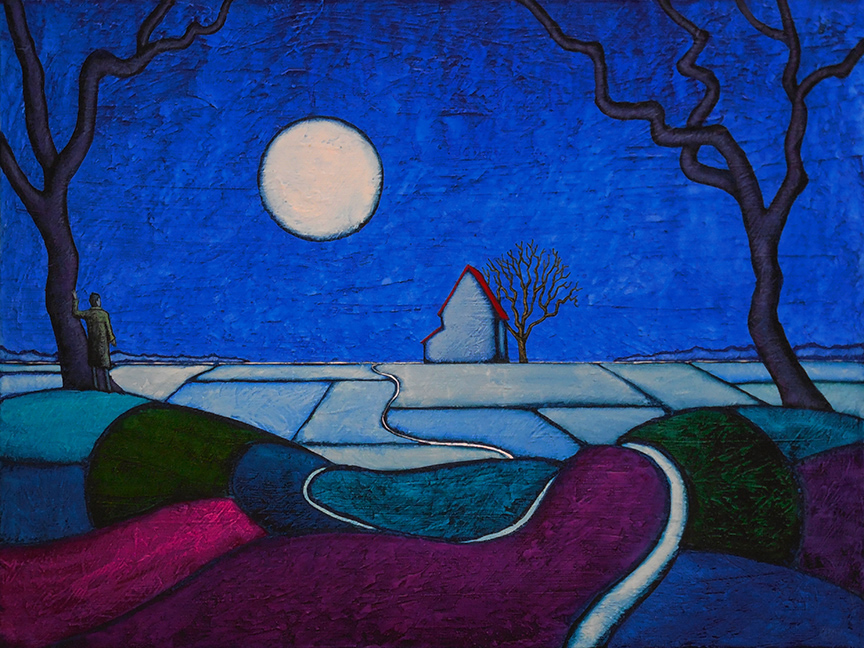
It is an early piece of mine from thirty years ago, back in 1995, that I call Summerdream. I’ve been looking at it a lot recently as I prep it to be part of the upcoming annual Little Gemsshow at the West End Gallery.
It’s a small piece that has always resonated with me. I love its forms and simplicity. But more than that, it has a sense of solidity in the way it is painted with deep saturated watercolor while still giving me a dreamy, ethereal sense of floating. I like this dichotomy, its appearance of earthly solidity alongside a diaphanous airiness in its felt atmosphere.
Like Zhuang Zhou, I find myself asking which is real and which is the dream here.
I don’t know for sure. Perhaps I am actually a butterfly dreaming that I am a man wondering such a thing? Or maybe both I and my butterfly alter ego are just a tiny part of a dream dreamt by a tiny being that dwells forty dimensions of time and space from where I sit?
Maybe or maybe not. We will most likely never know and that, in itself, might be the only correct answer. We deal with the reality in which we find ourselves at any given moment.
Right now, I am a guy sitting in the dark of a winter morning. That’s my reality right now. But later, I might look at this painting and find myself as a floating butterfly.
And that will be an acceptable reality then.
Here’s a well-worn song, from the Cranberries and the late Dolores O’Riordan, Dreams.
Summer dream is a 5″ by 7″ watercolor on paper, framed at 11″ by 14″. It will be available at the West End Gallery as part of their annual Little Gems show, which opens February 7. This painting and a group of new small paintings will arrive at the gallery later this week. The gallery is currently on a short winter break and will reopen this coming Tuesday, January 21.
And all the time — such is the tragi-comedy of our situation — we continue to clamor for those very qualities we are rendering impossible. You can hardly open a periodical without coming across the statement that what our civilization needs is more drive, or dynamism, or self-sacrifice, or creativity. In a sort of ghastly simplicity, we remove the organ and demand the function. We make men without chests and expect of them virtue and enterprise. We laugh at honour and are shocked to find traitors in our midst. We castrate and bid the geldings be fruitful.
–C. S. Lewis, The Abolition of Man (1943)
When I first read this paragraph from C.S. Lewis, I actually felt better that the lack of courage, selflessness, honor, honesty, and self-sacrifice that is openly on display among our leaders was not a new phenomenon, that even in the midst of WW II there were many weak and dishonest leaders. Maybe not so many as our current batch but they were still there.
But then I felt far worse for the same reason. It is disheartening, to say the least, that we always seem to get far less than we expect from the people we choose as our leaders.
But maybe what we end up getting is a more accurate reflection of ourselves.
We say we want to be led by people with those virtues– courage, selflessness, honor, honesty, and self-sacrifice– but when such a person is put before us, we reject them out of hand. We refuse to accept their virtue as real.
Instead, we opt for those who exude dishonesty and selfish corruption, who unendingly spew lies and false accusations that benefit only themselves. People who take credit when none is due and place blame on others when the responsibility is theirs alone. People so weak that they attack the defenseless and wither before those who they see as powerful.
We see these less than honorable people as being more real than those who display virtue.
More like us.
We understand lying. We understand selfishness. We understand evading responsibility. We understand cowardice. We understand cheating and deception.
It’s more real to us.
It’s who we are.
I know that seems like a searing indictment of us as a whole. And maybe it is. But I have to add that there are many, many people of great virtue among us, selfless and fully realized humans who lead courageous and compassionate lives that benefit their families, friends, and their communities. They hold this country together. Unfortunately, they would most likely be destroyed by the toxicity of the money-driven political machine if they ever attempted to extend their sense of virtue to a wider audience.
Which is the point of Lewis’ passage at the top. We expect the best but refuse to accept it and end up with the dregs.
And that is where we are as we head into the last weekend before a new and potentially much darker era begins on Monday. I know it sounds cynical and maybe it is rightfully so. I have been dreading this as inevitable for about 45 years when I first began to witness the inexorable march that brought us to this point. I have never wanted to be more wrong on anything. But I fear I am not.
This is going to be the last diatribe I share on this subject. I will still pay attention and do what I can but want to focus on things that give meaning and hope to people, myself included, here on the blog.
Of course, that could be a lie. That is who we are, after all. And that being the case, maybe we’re getting what we deserve.
Here’s a song from Leonard Cohen, one of his last efforts before his death. I first played it here four years ago but it seems destined for this moment. This is You Want It Darker.
I wrote this about the song before the 2020 election. It applies even more today:
With its ominous bass line and its focus on our mortality mixed with Old Testament imagery, it seems fitting for these times.
One of the words used in the chorus of the song is Hineni, the Hebrew word meaning Here I am. It was the response from Moses to God speaking to him through the burning bush. It was the answer from Abraham to the voice of God who then instructed him to slay his son. And it was the response from Isaiah when he hears the voice of God ask, “Whom shall I send, and who will go for us?” It is generally an indication of faith and total commitment without question while awaiting one’s appointed task.
Here, Cohen seems to be questioning God. He’s not asking the listener if they want it darker. Seeing the way the world has descended into darkness, he is grilling God, almost questioning whether this deepening darkness is somehow the desire of God. There’s an edge of anger when he asks and replies: You want it darker/ We kill the flame.
It’s a powerful song, one that haunted me this past week. It reminds me that we are in for some trying times in the months ahead and that we need to be fully prepared to endure whatever is thrown our way.
Ready to say, with total commitment, Hineni— Here I am.
With a secret smile, not unlike that of a healthy child, he walked along, peacefully, quietly. He wore his gown and walked along exactly like the other monks, but his face and his step, his peaceful downward glance, his peaceful downward-hanging hand, and every finger of his hand spoke of peace, spoke of completeness, sought nothing, imitated nothing, reflected a continuous quiet, an unfading light, an invulnerable peace.
― Hermann Hesse, Siddhartha
Welcome back. It’s been about ten or eleven days since I last welcomed you here. Good to be here and good to have you back. I don’t know that I needed a break from this part of what I do but I needed a little extra time to get back in the swing of things on the bigger part of what I do, which is painting.
Did I get back into the swing of things, find a groove?
Hard to say. But I was very productive. More than expected, to be honest. That’s the advantage of getting to work on the small pieces for the Little Gems as a reentry point. Smaller work obviously takes less time to complete than much larger works so rhythm builds quickly as I move from one piece to the next. There’s little time between them to lose the new spark or the new thought. Momentum is easily maintained.
This allows me to examine new spaces as well as new or enhanced takes on the normal themes of my work. Some work takes me forward and some is a reexamination of the past.
Some will surprise you. Hopefully in a good way but maybe not. I might like it but it might not be your cup of tea. And that’s okay. Nobody is required to like anything I do here, though I guess one might wonder why you’re here if that is the case.
Will this momentum or new ideas be carried into the following several months of work? I can’t tell at this point but generally the answer leans toward yes based on past decades of going through this. My own first reaction on this work is strong, creating the excitement that I was seeking so I am hoping it does take hold for me.
That being said, I will be showing this new work in the coming weeks leading up to the February 7th opening of the Little Gems show at the West End Gallery.
The first piece I am showing is an 8″ by 6″ canvas piece titled Completeness. It was one of the first pieces I worked on and, while I am not sure it breaks new ground within the body of my work, it really provided a big jolt of energy for me, doing just what I hoped it might which was to set a pretty high bar for where the work that followed in its wake might go.
I also thought this was good piece to show first since it represented a central theme in my work, which is finding a sense of wholeness within myself. This painting felt whole, as though the broken shards of the sky had been finally reassembled to reflect down on the fully formed and complete Red Tree.
It just felt right.
Here’s a song that kind of goes with this piece. It’s Love You To from the Beatles classic Revolver album. George’s sitar playing links well with the passage from Siddhartha and I could imagine the lyrics resonating with the Red Tree here:
Each day just goes so fast I turn around, it’s passed You don’t get time to hang a sign on me
Love me while you can Before I’m a dead old man
A lifetime is so short A new one can’t be bought But what you’ve got means such a lot to me
Downtime is where we become ourselves, looking into the middle distance, kicking at the curb, lying on the grass or sitting on the stoop and staring at the tedious blue of the summer sky. I don’t believe you can write poetry, or compose music, or become an actor without downtime, and plenty of it, a hiatus that passes for boredom but is really the quiet moving of the wheels inside that fuel creativity.
–Anna Quindlen, Loud and Clear
As I hinted yesterday, I am going on a short hiatus from the blog. I don’t know how long it will last, maybe a week or so. Whenever I have taken a break here in the past it usually ends up shorted that I initially intended so I imagine this will be the same.
This isn’t really going to be downtime in the way Anna Quindlen describes above. I have already had an ample amount of downtime but it wasn’t the kind that refreshes. The emphasis recently was more on the down part of downtime.
No, this hiatus is more about reestablishing the better parts of my work habit and getting back into a creative groove, the kind that becomes a motor that propels everything forward.
Besides, I build downtime into my day as a rule. It’s time to idle and think, time to look up things that pique my interest, time spent listening to music or reading, or time just looking out the window or laying on the floor with the cats.
No, this hiatus is not downtime. It’s a return to dedicated work because work is the answer to what ails me. It is the answer to all my questions. And the question to all my answers. It is the alpha and the omega, a beginning and an end.
I always go to a piece of advice that the late artist Chuck Close gave in an interview as advice to young artists:
The advice I like to give young artists, or really anybody who’ll listen to me, is not to wait around for inspiration. Inspiration is for amateurs; the rest of us just show up and get to work. If you wait around for the clouds to part and a bolt of lightning to strike you in the brain, you are not going to make an awful lot of work. All the best ideas come out of the process; they come out of the… work itself. Things occur to you. If you’re sitting around trying to dream up a great art idea, you can sit there a long time before anything happens. But if you just get to work, something will occur to you and something else will occur to you and something else that you reject will push you in another direction. Inspiration is absolutely unnecessary and somehow deceptive. You feel like you need this great idea before you can get down to work, and I find that’s almost never the case.
That pretty much describes the motor that work provides for me. Work begets work.
And I am ready to get back to work.
For this Sunday Morning Music, here’s a song that I’ve played here before, Work Song. It was written by the brother of jazz great Cannonball Adderley, who originally performed the song as an upbeat jazz piece. But it has been interpreted by a number of artists over the years, including great performances from Nina Simone and Tennessee Ernie Ford, whose version I played here only six months ago. I don’t like to replay a song so quickly but this version from a little know group called The Big Beats has its own funky feel that separates it a bit, give it a whole different flavor. The singer here is Arlin Harmon. I don’t have a lot of info on either him or the Big Beats though from what I can glean Harmon was a highly regarded performer out in the Northwest in the early 1960’s. This is a solid rocking performance of a great song.
Gets my motor running. And that’s just what the doctor ordered.
I’ll be back in a week or so. Hope you will be back, as well.
Our minds must have relaxation: rested, they will rise up better and keener. Just as we must not force fertile fields (for uninterrupted production will quickly exhaust them), so continual labor will break the power of our minds. They will recover their strength, however, after they have had a little freedom and relaxation.
–Seneca the Younger, On Tranquility of the Mind
Just a reminder that today is the last day to visit the West End Gallery in Corning, NY before they go on a short winter break from January 5 through January 20.
Everyone needs a little break, as Seneca pointed out in the passage above from about two thousand years ago, in order to recharge one’s batteries and regain some vigor. I have kind of been on a hiatus myself for the last couple of months, barely lifting a brush during that time. I had been feeling a bit beaten down and had lost a bit of pep in my step.
Just a feeling of blah. I don’t know if blah itself is a real thing but if you’ve felt it, you know what I mean.
But I believe I am emerging slowly from it. I have just finished some of a group of small pieces for the upcoming Little Gems show that opens on February 7 at the West End Gallery. It was awkward at first, but momentum grew with each small painting. The urge to pick up the brushes and see paint on a surface has returned and seems to grow with each passing day.
It has been very beneficial to me that the Little Gems show has always fallen at this time of the year when I am ebbing low. The small scale of the paintings allows me to work on things that I might otherwise put off, to explore new themes and possibilities. To learn and attempt new things. To sometimes fail then take the lesson learned from failing and make something better.
Though it is work, it is most invigorating, not depleting at all. Like priming a pump.
Or fertilizing a field– maybe that’s the more apt description?
I don’t know about that, but it feels good to feel the giddiness of creating something new again, to feel that there is something ready to come out once again. It has been absent for the last month or two and has been sorely missed. From going through this cycle many times before, I knew it would come eventually. It seemed to take a little longer this year and the wait became excruciating.
But it is close to being back in full and I am excited.
I may be taking a short break here on the blog for the next couple of weeks to more deeply reengage with this newly recovered rhythm. While I was on my short hiatus from painting my work here on the blog continued and it might be that I need a break. Might need to fertilize the field?
Maybe. We’ll see how it goes.
If you get a chance today, stop into the West End Gallery before they go on break. Hope they can fully recharge their batteries.
Here’s an absolute favorite Beatles song. I don’t know when I last shared it but it feels like it needs to go with this post. This is Tomorrow Never Knows.
I have a longing for life, and I go on living in spite of logic. Though I may not believe in the order of the universe, yet I love the sticky leaves as they open in spring. I love the blue sky, I love some people, whom one loves you know sometimes without knowing why. I love some great deeds done by men, though I’ve long ceased perhaps to have faith in them, yet from old habit one’s heart prizes them.
~Fyodor Dostoyevsky, The Brothers Karamazov
I wrote one thing already this morning but after reading it, decided against posting it. It just felt too negative, too cynical, and I didn’t really want to go that way this morning. There’s enough negativity and cynicism in our public discourse without me adding to it.
Instead, much as the character Ivan Karamazov states in the passage above–which is but a small part of a wonderful long paragraph–let’s focus on more positive aspects of this life. Though we are often disillusioned, disappointed, disgusted, and left feeling hopeless by the actions of men, this is a life worth living.
Perhaps by recognizing the intrinsic beauty in those things of this life not defined by monetary wealth or political power, we can better appreciate the value of contentment and caring.
Maybe then we can begin to see a movement away from self-serving attitudes and toward those of self-sacrifice and service to others.
That probably sounds implausible but for this morning I am willing to embrace it.
Here’s an iconic performance of Soul Sacrifice by Carlos Santana from the 1969 Woodstock festival. In a concert that featured remarkable and legendary performances, this remains a standout. Carlos Santana was only 22 at the time and his drummer, Michael Shrieve, had just turned 20.
Age is, after all is said and done, just a number. And whatever your age, as the late great bluesman John Lee Hooker said: If can’t dig this, you got a hole in your soul– and that ain’t good.
I have just three things to teach: simplicity, patience, compassion. These three are your greatest treasures. —Lao Tzu
Trying to get the new year kicked off in the right way with the words above from Lao Tzu, the Chinese philosopher and father of Taoism. I am not a big fan of resolutions but do believe in reminders. It never hurts to be nudged to the fact that those three things– simplicity, patience and compassion— are the basis for a satisfying and peaceful life. All three are critical in maintaining our balance amidst the machinations of the outer world.
I tend to believe that the three are inextricably connected, each providing sustenance and direction for the other two.
But like all great treasures, they are sometimes difficult to obtain and keep. I know that I sometimes feel like I am close to that mother lode of all three virtues, only to find that I have lost most of it.
Lost my patience with everything and everyone.
Lost any sense of simplicity through overthinking and overcomplicating things.
And worst of all, lost most of my compassion for others.
In such moments, I am penniless in the spiritual sense. And I can feel the darkness of this.
But if even a tiny iota of these three things remains, if my pocketbook for them is not totally empty, then there is hope. It seems that this is a treasure that builds quickly through an odd quirk: not through hoarding but through being generous in sharing this wealth with others.
Expending all three compounds their value in a way that would make the greediest hedge fund manager envious.
Well, maybe not that guy.
Anyway, after what felt like a bleak end to the last year, I find myself a bit short on all three things. A bit spiritually impoverished. What better time to begin to rebuild one’s treasure with the clean slate of a new year?
I’m game. What do I have to lose?
Here’s song that feels like it might fit the theme here. It’s about seeking simplicity, about cutting out all the detritus and clutter and finding one’s own little nirvana. This has been a favorite for over 50 years. Here’s the late John Prine and his Spanish Pipedream.
Dr. Seuss– Incidental Music for a New Year’s Eve Party
Welcome to yet another new year. Let’s call this one something different.
Maybe something like 2025?
Yeah, that should work. 2025 it is.
How will it be in this newly named 2025?
Damned if I know.
Six hours in so far and I haven’t heard anything too bad so maybe it will be okay, right? Of course, that’s not much of a sample size.
I mean, we’re twenty-five years into the 21st century and it has lost that new century smell and feels pretty worn around the edges, maybe even showing a bit of rust in places. It seems as though there’s enough to judge it on already but I am not sure how people will judge this century when the 22nd comes around. Maybe it will be the best century ever. I have my doubts about that, imagining future historians uttering a lot of WTFs and continuously face palming in disbelief at the stupidity they’re looking back on, at least in this first quarter of the century.
Then again, there might not even be historians then.
Who knows?
So, we’re only six hours into this new year, this 2025 and everything about it is yet to be written.
It is all up for grabs at this moment.
That being the case, I say let’s take it now while they’re snoozing and claim it as our own. Make them take it from us.
Possession is, after all, 9/10th of the law.
I say it’s settled– this will be our year.
So, Happy New Year. Remember, it’s ours. Let’s hold onto it, okay?
Funny how prescient the Zombies were back in 1968. How did they know that 2025 was going to be our year?
And now let us believe in a long year that is given to us, new, untouched, full of things that have never been, full of work that has never been done, full of tasks, claims, and demands; and let us see that we learn to take it without letting fall too much of what it has to bestow upon those who demand of it necessary, serious, and great things.
― Rainer Maria Rilke, Letters of Rainer Maria Rilke, 1892-1910
I felt that the last day of the year deserved a post. But I am not feeling very peppy this morning, if peppy is even a real term, and my brain didn’t feel like serving up anything new. As a result, I am kind of turning to the archives for today’s post. It’s from four years back but it holds up because of a great song. some minor editing, and the addition of three Peanuts strips in place of the big bloodshot eye that adorned the original. Each of the three strips ran on this date in their respective years. I think the center one with Lucy and Linus best fits my feeling today.
Just glad to still be here today. And tomorrow, if the lord’s willin’ and the creek don’t rise, as the old saying goes. See you on the other side, in the year 2025.
Sounds kind of science-fiction-y, doesn’t it? I don’t know if that’s good or bad but it doesn’t sound good at first blush. We shall see,
Gosh, I wish Rilke was sending me letters. I always seem to find something in his collected letters that speaks directly to me, something that helps me better understand my own place in the world.
Give me his letters and a Peanuts comic strip and I am all set for perspective and advice on how to live my life.
Rilke’s words above on the New Year speak loudly this year. Let us look at the coming new year as a clean slate, atabula rasa, that that is filled with new potential. The time ahead may be filled with hard work and stressful times but we should use every available minute of it in attempting to make this new year far better than its predecessor.
I know that these words can sound like empty platitudes but I truly hope they ring true this year and that we don’t waste the gift of time we are given.
Have a happy and quiet New Year’s Eve. Stay safe and perhaps next year at this time, we can truly celebrate the end of a wonderful year.
For those of you who don’t buy into my hopeful look forward and plan on partying your brains out tonight, here’s a song from Wynonie Harris, the great blues shouter who many consider the father of rock and roll. His style and his stage moves, including provocative hip gyrations, were swiped and adapted by Elvis, who some thought was the G-rated version of Wynonie Harris. His stuff really rocks and this song, Don’t Roll Those Bloodshot Eyes at Me, reminds me of the best work of Louis Prima, which is pretty high praise.
So, enjoy and bid goodbye to 2024 tonight in whatever way you see fit. May we do the necessary work so we all have a happy New Year in 2025.
Perhaps a man’s character is like a tree and his reputation like its shadow. The shadow is what we think of it; the tree is the real thing.
—Abraham Lincoln, Washington in Lincoln’s Time (1896)
Sadly, Jimmy Carter passed away yesterday at the age of 100.
He was indisputably a man of character.
Honest, principled, compassionate, unselfish, and highly intelligent. I could probably add any number of other positive attributes here, but that would be like pointing out high limbs on an already towering tree.
We probably didn’t deserve him. Our character seldom matched his and it sometimes felt as though we almost resented the strength and goodness of his character, even though he never preached at us. It was as though our own lacking character was somehow shamed by his.
We shunned honesty and accountability, instead repeatedly displaying our preference for flattery, meaningless slogans, unfulfilled promises, and empty reassurances that there were easy answers to all our problems.
It has come to the point where we almost beg to be told lies so the smallness of our own character is not revealed.
As a result, character such as that of Jimmy Carter has become an almost disqualifying quality in our elected officials. We may never see the likes of Jimmy Carter again in public life. The current environment of manipulated information and media makes such tall trees susceptible and too easily felled.
Where tall trees should stand, we now place tiny, twisted shrubs, whose shadows are equally short and twisted.
Jimmy Carter may have been the last of the tall trees.
We still stand in your shadow. Good travels to you in the afterlife, Mr. President.
The quote at the top comes from an 1896 book, Washington in Lincoln’s Time, from Noah Brooks, who had first encountered Lincoln during Brooks’ time as young journalist in Illinois. Brooks became a close friend of the Lincoln family and wrote this book based on his conversations and travels with Lincoln, This quote about trees came in a conversation a day after Brooks had spent the day with Lincoln in Virginia where the President stood on a tree stump and talked about how he loved the shape of the silhouettes that leafless made against the sky and the fineness of the shadows they and their branches cast upon the ground.
Lincoln was another towering tree of character.
A little additional info: Noah Brooks also wrote the first novel exclusively about baseball, Our Base Ball Club and How It Won the Championship, in 1884.