Men can only be happy when they do not assume that the object of life is happiness.
–George Orwell, Critical Essays (1946)
I pause a bit anymore when I use the word happy, especially when referring to it in the context of anything long-term, such as it being a goal to be pursued. My feeling about this is much like that described by Orwell above, that you can’t actively pursue a short-lived reaction.
And as pleasant as it might be when we are happy, happiness is generally a temporary state of being.
Maybe I am arguing semantics here this morning. Probably. Maybe the word that better describes a similar feeling that might be pursued for the long-term is satisfied.
Satisfied encompasses those higher moments of happiness we experience while at the same time recognizing that things might have been better and worse. It indicates a level of contentment with things as they are.
For example, I am often happy. But not always and seldom on some days. On the other hand, I am satisfied as a whole with where I am in life. I accept both the highs of happiness and the lows of sadness as a fact of life and am most content when I am in that middle ground between them.
Nowadays (what a great word!) I try to find moments of happiness to temper the angst and trepidation of this sometimes-maddening modern world. These temporary moments keep me in that middle ground.
Keeps me satisfied.
And that’s nothing to sneeze at.
Actually, this babble of me thinking out loud this morning is all a pretext for me wanting to share a version of Happy, the Pharrell Williams mega-hit from a while back, from Postmodern Jukebox featuring Swedish jazz musician/multi-instrumentalist/dancer Gunhild Carling. I shared this a couple of years ago and smiled when I came across it again this morning.
Seeing Gunhild play three trumpets at one time, tap-dance and move seamlessly from instrument to instrument– 10 in all including the bagpipes!– made me happy in a very satisfying way.
All I can ask.
Clap along if you feel that happiness is the truth….
This is the true joy in life: the being used for a purpose recognized by yourself as a mighty one, the being thoroughly worn out before you are thrown on the scrap heap, the being a force of nature instead of a feverish selfish little clod of ailments and grievances complaining that the world will not devote itself to making you happy.
-George Bernard Shaw, Man and Superman (1903)
I came across a word I hadn’t heard the other day.
Freudenfreude.
It is basically the opposite of the German word Schadenfreude which, as we all know all too well, is the act of taking joy in the misfortune of others.
Freudenfreude, on the other hand, means to take genuine pleasure or joy in witnessing the success, good fortune, or happiness of others.
I loved this idea of taking joy in the joy of others. I know and have experienced this feeling. I have tried to describe it to the folks who have attended my gallery talks over the years. but don’t know that I have did a good job in doing so. My words seem so weak compared to the actual feeling that feels like a burst of joy fills the heart. A good kind of heart attack.
It reminded me of a blogpost from back in 2016 that shared one instance of the Freudenfreude that I have been privileged to experience. The original blogpost has been reworked a bit and is below, followed by a jazzy version of On the Sunny Side of the Street from Esperanza Spalding. It’s from a 2015 White House performance and it showcases her virtuosity on the double bass. Nice version with a lot of joy in it.
I hope some of you have felt some freudenfreude for yourself during this holiday season. That would make me– and you– very happy.
Joyful Contentment was the phrase that first came to mind when I finished this painting, On the Sunny Side, a few years back. There was just a feeling of realized joy and uncomplaining contentedness throughout it, the kind that Shaw described above in his play Man and Superman.
I think the feeling he describes must be one of the greatest joys in this world: to find a purpose into which you can fully throw your whole being for all of your time on this planet.
A purpose that gives you a place to stand and rise above the selfishness and pettiness of those, including yourself, who would drag you down.
A purpose that allows you to tap into some greater force in order to gain energy for your toils.
A purpose that lets you deny the cynicism that sometimes shows up in abundance in this world.
A purpose that serves you endless joy in what seem to be empty moments.
A purpose that even finds the joy in tears.
I think there is a purpose for each of us. Finding it is not always a simple matter and some of us will never find the one purpose that is truly our own. We may not be willing to give enough of ourselves to something that is beyond our own needs and desires. We might still find some joy in our life but it will no doubt be short lived.
For me, it has been painting. At first, I found this surprising because I often viewed it as being selfish in nature. It was my perspectives. My emotions. It was even called self-expression.
But I found that there is purpose in it and that this came from having others find comfort and happiness in their reactions to my expression.
Their joy fed my joy, even more than my own satisfaction and joy from the work.
But there are days when I still find myself losing sight of this purpose, when it is a struggle both in the studio and in the outer world and I feel drawn back down to less positive feelings. But I will be somehow reminded of that purpose and that joyful feeling returns.
That happened the other day. A gallery owner called and told me of a person who had bought a painting of mine that they had desired for quite a long time. In fact, this person had come into the gallery for this painting and it was gone, having been returned to me. I immediately sent the piece back to the gallery and when the person returned to get it, they started crying in joy. I can’t even express how this makes me feel outside of saying again that their joy fed my joy, their tears became my tears.
Those moments make my time alone in the studio seem more special and filled with purpose. They make me that joyous one, if only for a while.
We’re so caught up in our everyday lives that events of the past, like ancient stars that have burned out, are no longer in orbit around our minds. There are just too many things we have to think about every day, too many new things we have to learn. New styles, new information, new technology, new terminology … But still, no matter how much time passes, no matter what takes place in the interim, there are some things we can never assign to oblivion, memories we can never rub away. They remain with us forever, like a touchstone.
―Haruki Murakami, Kafka on the Shore
Touchstones are those memories and recollections by which we judge every new experience in our lives. Each of us have memories that stand out and above other memories of certain days. There are certainly memories of from the Christmas holidays from my past that dwell in me in vivid detail, and color, much more so than some others. There are some that are now barely detectable, remaining only in tiny bits and pieces in black and white, all color drained from them.
Perhaps sometime today you will be able to take a moment to revisit those touchstones from Christmases past that remain with us like ancient artifacts just waiting to reveal their secrets and stories.
Though they are buried beneath the layers of the new, like archaeological treasures, they remain there for us always. And when we extract them from under the vast accumulations of new memories and information, they immediately shine for us, fresh and vibrant and filled with as much meaning for us as when we last inspected them.
Here’s hoping that you have a Christmas morning that might someday become a touchstone for you or someone you love in the future or that you unearth a long-hidden touchstone of your own to inspect and cherish anew.
Here’s a song, Remember (Christmas), from the late great Harry Nilsson that captures this perfectly.
Do you hear what I hear? Do you hear what I hear? A song, a song High above the trees With a voice Voice as big as the sea
— Noël Regney and Gloria Shayne (1962)
Let’s keep it simple today. I am just going to wish you all well for this Christmas Eve and safe travels to all that have to hit the road or soar through the sky on this day.
Many of you will be busy with last minute holiday preparations or travel and will be immersed in the din of it all. Silence and quietude might be in scarce supply which is a pity. One of my fondest memories of Christmas as a child is sitting in the still darkness being cut by the soft lights of our Christmas tree. The image of that tree and the peaceful quietness surrounding it remain deeply etched into my psyche.
Like Citizen Kane‘s Rosebud, that tree and its aura of peace and quiet might be that thing I have pursued my whole life.
Hmm…
We seldom appreciate the treasures given to us by a found silence. We are able with it to hear those things that evade us normally. Almost as if we can hear the sound of the world turning or the universe slowly shifting.
The sound of eternity speaking to us.
I hope to find that same quiet again where I can listen for such things.
Here’s a song whose title and tune you most likely know, Do You Hear What I Hear? Written in 1962 by the married songwriting team of Noël Regney and Gloria Shayne, it has been recorded by hundreds of artists and sold tens of millions of records. It’s one of those carols that has been a part of our holiday season for most of our lives to the point that it feels like it should be a much older song.
This version is a bit different than the one that you know. It is performed by the Blind Boys of Alabama and it is what I would call a bit deconstructed, paring away certain parts of the song and focusing on the chorus. It has a bluesy feel that you don’t associate with the original. I like it as it gives me a different perspective on the song.
I am sharing two versions with slightly different tempos and beats. The first is a live performance with a bit more of a blues shuffle and the second is their recorded version with Taj Mahal. I included both because the live performance ends a bit abruptly.
Wishing you a peaceful and joyful Christmas eve. May you find a bit of that silence during this time so that you can better hear the sound of eternity, if only for a few moments.
Are you willing to forget what you have done for other people, and to remember what other people have done for you; to ignore what the world owes you, and to think what you owe the world; to put your rights in the background, and your duties in the middle distance, and your chances to do a little more than your duty in the foreground; to see that your fellow-men are just as real as you are, and try to look behind their faces to their hearts, hungry for joy; to own that probably the only good reason for your existence is not what you are going to get out of life, but what you are going to give to life; to close your book of complaints against the management of the universe, and look around you for a place where you can sow a few seeds of happiness–are you willing to do these things even for a day? Then you can keep Christmas.
— Henry Van Dyke, Keeping Christmas (1905)
I recently came across the short essay that is included in full below titled Keeping Christmas. It makes the case that if we can demonstrate our connection with humanity with acts of decency and a spirit of generosity during the Christmas season, then we can surely maintain that same spirit throughout the year.
We can keep the spirit of Christmas with us all year long.
I don’t think keeping your holiday decorations up all year-round or running Christmas movies nonstop in June and July on certain TV channels would qualify in Van Dyke’s way of thinking. But if by doing so, folks can somehow maintain a higher sense of compassion and generosity of spirit befitting the true holiday season throughout the year, then maybe he would indeed approve.
Henry Van Dyke (1852-1933) was one of those interesting multi-talents that the 19th century spawned. He was a clergyman, a Princeton professor, author, poet, and diplomat, serving as the ambassador to the Netherlands and Luxemborg just before and during WW I. He was a great friend of Mark Twain and officiated the NYC funeral service for Twain in 1910. He wrote the lyrics for Beethoven’s Ode to Joy that became the well-known hymn Joyful, Joyful We Adore Thee. He also appeared here a couple of times, most recently for a poem of his, For Katrina’s Sundial, that was to be used an inscription on a sundial on the estate of a wealthy friend.The second verse of this poem has become well known on its own as a poem called Time Is. It was read at the funeral of Princess Diana and used on a London memorial to British victims of the 9/11 attacks, as well as inspiring a 1969 song from the rock group It’s a Beautiful Day.
His life and his work both as a clergyman and a writer centered around serving others. He was one of those people who were able to keep Christmas.
And he never saw one Hallmark movie.
As I said, his short essay is below and is well worth reading. I am also including a performance of Joyful, Joyful We Adore Thee, that features Van Dyke’s lyrics. This is lovely and joyful version with the full chorus and audience engaged.
It probably doesn’t fall into the category of little-known holiday songs that I have been trying to maintain here in recent days.
If not, so what? Tough biscuits. I don’t even know if tough biscuits is a real phrase, but it kept me from using a more earthy one.
I am trying to keep Christmas, after all.
And if I– someone who is not adhering to any one religion or creed–can do it, anyone can.
Give it a shot.
ROMANS, xiv, 6: He that regardeth the day, regardeth it unto the Lord.
It is a good thing to observe Christmas day. The mere marking of times and seasons, when men agree to stop work and make merry together, is a wise and wholesome custom. It helps one to feel the supremacy of the common life over the individual life. It reminds a man to set his own little watch, now and then, by the great clock of humanity which runs on sun time.
But there is a better thing than the observance of Christmas day, and that is, keeping Christmas.
Are you willing to forget what you have done for other people, and to remember what other people have done for you; to ignore what the world owes you, and to think what you owe the world; to put your rights in the background, and your duties in the middle distance, and your chances to do a little more than your duty in the foreground; to see that your fellow-men are just as real as you are, and try to look behind their faces to their hearts, hungry for joy; to own that probably the only good reason for your existence is not what you are going to get out of life, but what you are going to give to life; to close your book of complaints against the management of the universe, and look around you for a place where you can sow a few seeds of happiness–are you willing to do these things even for a day? Then you can keep Christmas.
Are you willing to stoop down and consider the needs and the desires of little children; to remember the weakness and loneliness of people who are growing old; to stop asking how much your friends love you, and ask yourself whether you love them enough; to bear in mind the things that other people have to bear on their hearts; to try to understand what those who live in the same house with you really want, without waiting for them to tell you; to trim your lamp so that it will give more light and less smoke, and to carry it in front so that your shadow will fall behind you; to make a grave for your ugly thoughts, and a garden for your kindly feelings, with the gate open–are you willing to do these things even for a day? Then you can keep Christmas.
Are you willing to believe that love is the strongest thing in the world–stronger than hate, stronger than evil, stronger than death–and that the blessed life which began in Bethlehem nineteen hundred years ago is the image and brightness of the Eternal Love? Then you can keep Christmas.
Happy, happy Christmas, that can win us back to the delusions of our childish days; that can recall to the old man the pleasures of his youth; that can transport the sailor and the traveler, thousands of miles away, back to his own fire-side and his quiet home!
–Charles Dickens, The Pickwick Papers (1836)
I came across the passage above from Dickens and thought it matched up well with the painting at the top. It was that idea of being transported home that made the connection for me. In the Dickens piece the transport comes in the form of memory sending one to their youthful home during holidays past. In the painting, it is the lure of home and the idea of once again being with those who they love that inspires haste in the journey.
I’m adding a tune from Yo-Yo Ma and Friends, A Christmas Jig / Mouth of the Tobique Reel. It is off his Songs of Joy & Peace album. I can imagine hearing this music playing as the boat glides homeward on the waves.
“If I could work my will,” said Scrooge, indignantly, “every idiot who goes about with “Merry Christmas’ on his lips, should be boiled with his own pudding, and buried with a stake of holly through his heart. He should!”
“Uncle!” pleaded the nephew.
“Nephew!”—returned the uncle, sternly, “keep Christmas in your own way, and let me keep it in mine.”
“Keep it!” repeated Scrooge’s nephew. “But you don’t keep it.”
“Let me leave it alone then,” said Scrooge. “Much good may it do you! Much good it has ever done you!”
“There are many things from which I might have derived good, by which I have not profited, I dare say,” returned the nephew. “Christmas among the rest. But I am sure that I have always thought of Christmas Time, when it has come round— apart from the veneration due to its sacred name and origin, if anything belonging to it can be apart from that—as a good time: a kind, forgiving, charitable, pleasant time: the only time I know of, in the long calendar of the year, when men and women seem by one consent to open their shut-up hearts, freely, and to think of people below them as if they really were fellow-passengers to the grave, and not another race of creatures bound on other journeys. And therefore, uncle, though it has never put a scrap of gold or silver in my pocket, I believe that it has done me good, and will do me good; and I say God bless it!”
–Charles Dickens, A Christmas Carol (1843)
Quite morning. Incredibly dark when I got up this morning, even though the sky was clear and stars were shining. It was the kind of dark that makes it seem as though it is something more than an absence of light, that it is an entity with a mass and density. It was so dark that it felt impenetrable, that you could walk into it and it would be like walking into a wall.
I begin every morning in the dark and am comfortable in it but can’t recall this sort of darkness. It made me a bit uneasy, actually, and had me wishing that the morning light would break through the trees soon.
Uneasy or not, I know the light will come soon. Always has and always will. I guess there’s a lesson in there somewhere, but it will have to wait for another day.
Let’s just leave it here, along with the passage from A Christmas Carol, and get to some Sunday Morning Music. This is a holiday song focusing on light, so it could well apply to the darkness that has descended on my woods this early morning. This is another song from the fruitful collaboration of Alison Krauss and Robert Plant, The Light of Christmas Day. I’ve been trying to share holiday music in recent days that probably doesn’t get a lot of airplay and this might be another that falls into that category.
Mom got drunk and Dad got drunk At our Christmas party We were drinking champagne punch And homemade eggnog Little sister brought her new boyfriend He was a Mexican We didn’t know what to think of him Until he sang, “Feliz Navidad, Feliz Navidad”
–Robert Earl Keen, Merry Christmas from the Family
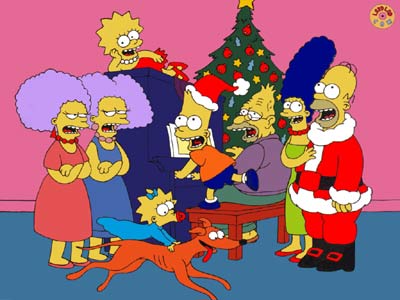
After yesterday’s post with a somewhat obscure holiday song, one of my good Texas friends and regular readers, Linda Leinen, reminded of a holiday song that she thought might not get much airplay outside of Texas, It was Merry Christmas from the Family from Robert Earl Keen, who has number of songs that I count among my favorites. This one has long been one of my favorites, one of those songs I sometimes break into unprompted at inappropriate times.
I was certain I had shared it here a number of times over the past 17 years. It turns out that the last time it showed up here was in 2009.
I guess it won’t be stale if I play it here today. Unless it is on your holiday playlist.
I shared the same image from The Simpsons in that 2009 post. Maybe that makes me appear to be lazy.
Lazy is as lazy does.
And that ain’t much this morning. I’m done here.
Here’s comes that song now. It is both funny and sweet. Perfectly imperfect. Just right for the season. This is a version that Linda shared with me:
Through long December nights we talk in words of rain or snow, while you, through chattering teeth, reply and curse us as you go. Why not spare a thought this day for those who have no flame to warm their bones at Christmas time? Say Jack Frost and the Hooded Crow.
–Jethro Tull, Jack Frost and the Hooded Crow
I haven’t listened to much holiday music this year. Haven’t fully invested myself into the holiday spirit thus far, plus the local radio channels that play only holiday music endlessly play the same songs over and over, to the point that you can almost predict the next song. I don’t know if I can bear hearing Mariah Carey sing All I Want for Christmas Is You again without tearing out my hair. I just don’t have enough hair to spare.
So, I went hunting for a holiday song this morning to share. one that might have eluded your ears. It did mine. It’s from Jethro Tull who have recorded quite a number of holiday songs over the years. This is from the late 80’s, I believe, and is titled Jack Frost and the Hooded Crow. It’s basically an admonition to spread your joy and lend a hand to those in need during the holiday season.
It just hot the spot for me this morning and I bet you haven’t heard this on any radio channel or holiday playlist.
Well, maybe you have. What the hell do I know?
Now get out of here before I lose my holiday spirit…
There’s a room out there somewhere with a woman in a chair With memories of childhood still lingering there How pretty the paper, the lights and the snow How precious those memories of long long ago
We held hands and stared at the lights on the tree As if Christmas was invented for you and for me When the angel on the treetop requested a song We sang, “Silent night all day long”
–John Prine, Silent Night All Day Long
Started the ADT (Androgen Deprivation Therapy) part of my treatment last Monday and it has gone pretty well thus far. However, I have had a creeping feeling of fatigue starting to show up in recent days, especially in the afternoon. It hit hard yesterday afternoon and this morning it was still with me, along with a sharp headache, which has eased a bit since I came into the studio, thankfully.
I can’t say definitively that any of this is related to the meds. I could just be tired this morning. Wouldn’t be the first time. But whatever the case, this is a going to be a quickie this morning, with a repeat of a favorite holiday song from John Prine that I shared a few years back. I really like the verses from the song at the top. They seem to capture Christmas from a kid’s perspective so well– as if Christmas was invented for you and for me. That’s probably why memories of Christmas past seem so vivid for many of us.
This is Silent Night All Day Long from John Prine.







 Redtree Times