Feeds:
Posts
Comments
Childe Hassam Rainy Day Fifth Ave

Childe Hassam- Rainy Day, Fifth Ave 1916


And I don’t know a soul who’s not been battered
I don’t have a friend who feels at ease
I don’t know a dream that’s not been shattered
Or driven to its knees
But it’s alright, it’s alright
For we lived so well so long
Still, when I think of the
Road we’re traveling on
I wonder what’s gone wrong
I can’t help it, I wonder what has gone wrong

–Paul Simon, American Tune


Not feeling particularly celebratory on this Fourth of July as we face a darker future that many of us never imagined might be possible in this country. It’s certainly not the promise and ideal of America that drew many of ancestors here. Since this is a workday for me and there is still much to be done for my impending show at the West End Gallery, I thought I would run the post from last year’s Fourth of July. 


Another Fourth of July. Independence Day, marking this day in 1776 when the Second Continental Congress adopted our Declaration of Independence. Since that day, for the last 247 years we have been in a constant struggle to live up to the promise that this country offers.

It seems it is always one step forward, one step back. We have always had to contend with the forces of hatred, bigotry, and greed as we try to achieve America’s promise of freedom, equality, and opportunity for all.

It’s a hard journey but worth the effort. For all of us.

Paul Simon wrote the song American Tune in 1973, at the height of the Watergate scandal, the continued war in Viet Nam and widespread social unrest. It felt like we were on the brink three years before our bicentennial.

50 years later, it feels much the same. Different scenarios, same reasons.

At this year’s Newport Folk Festival, Paul Simon performed American Tune with Rhiannon Giddens. The original song had the lines:

We come on the ship they call The Mayflower.
We come on the ship that sailed the moon.
We come in the age’s most uncertain hours
And sing an American tune.

For this occasion, Simon wanted to point out that many of our citizens did not come on the Mayflower or even by their own design. Many were here already. Simon changed those lines to:

We didn’t come here on the Mayflower.
We came on a ship on a blood red moon.
We come in the age’s most uncertain hour
And sing an American tune.

The blood red moon is an Old Testament reference to the book of Joel that prophesizes: The sun will become dark, the moon red as blood, before the overwhelming and terrible day of the Lord comes. It is a warning of the apocalypse that will occur when people lose their sense of love and justice.

We are certainly in the age’s most uncertain hour so this song seems appropriate to the day. 247 years later, the promise of America might be teetering but we are still standing. The experiment and the struggle continue.

And that’s reason to take a moment or day to celebrate before we get back to the fight.

Here’s Rhiannon Giddens and the revised version of American Tune.


Continuum: The Red Tree at 25 is in its final days at the Principle Gallery. It is a show that has a lot of meaning for me, one that I believe deserves to be seen. If you’re in the DC/Alexandria area, hope you can get into see the show before it comes down.

You can take a virtual walkthrough of the show by clicking the image below.

Matterport Page View 2024

Dust or Dream


GC Myers- Affirmation  2024

Affirmation— Now at Principle Gallery

It appears to me impossible that I should cease to exist, or that this active, restless spirit, equally alive to joy and sorrow, should only be organized dust — ready to fly abroad the moment the spring snaps, or the spark goes out which kept it together. Surely something resides in this heart that is not perishable, and life is more than a dream.

–Mary Wollstonecraft, Letters Written in Sweden (1796)


I came across the paragraph above recently and it really spoke to questions that often run through my mind. It’s from a letter from Mary Wollstonecraft, a renowned writer in the last half of the 18th century and the mother of Mary Wollstonecraft Shelley, author of Frankenstein. Her intellectual career as a writer and philosopher was a relatively rare thing in that era and her most significant writing, A Vindication of the Rights of Woman in 1792, was perhaps the first piece of feminist writing, paving the way for the much wider movement that was to come.

Are we but organized dust? Is there something that remains alive in some form after our current carcasses have run their course?

What is that thing, that force, that animates us?

The religious among us will say it is the holy spirit, the soul. Maybe it is some great natural electrical spark, something akin to the force used to animate the creature in the younger Wollstonecraft’s Frankenstein. Or maybe it is some form of energy that we just don’t have the ability to discern with our meager faculties.

Or maybe it is as she hoped against, that we are all just players in a far-flung dream, ready to disperse instantly on the wakening of whoever or whatever dreams us into being.

Who knows?

I certainly don’t. I guess the takeaway is that we’re still here, one way or the other. If we be dreams or dust, let us live our lives as though they are our one opportunity to experience this world.


The painting shown here is Affirmation and is 10″ by 25″ on canvas. It is included in my solo exhibit Continuum: The Red Tree at 25 which is hanging now at the Principle Gallery in Alexandria VA. Time to see it is limited as the show ends later this week.

Barefoot

GC Myers- Call of the Blue Moon  2024

Call of the Blue Moon–At Principle Gallery, Alexandria


When the sun goes down here and darkness falls
The blanket of winter leaves no light at all
You search for shelter to calm the storm
Shaking with an instinct just to stay warm

I’d walk through the snow barefoot
If you’d open up your door
I’d walk through the snow barefoot

–Barefoot, k.d. lang and Bob Telson


I hadn’t heard this song, Barefoot, from k.d. lang in years. Just one of those songs that gets lost in the shuffle over the decades. Even the songs you love (as well as other meaningful things) sometimes get misplaced and forgotten. So, when it came up on a streaming service the other day on a quick trip to Erie PA, it was both like hearing it again for the first time as well as remembering it as I knew it thirty or so years ago.

But more than that, it immediately made me think of this painting, Call of the Blue Moon. In a show dedicated to the Red Tree now in its last days at the Principle Gallery, this large painting stands out without assistance from the Red Tree. For me, it has a feel of being pulled toward that large blue moon.

About finding warmth or meaning in a cold and sometimes indifferent world.

I could see the voice of this song in this painting.

That’s all I have this morning. Please try to get in to see the show and this painting at the Principle Gallery before it comes down later this week. And, of course, for this week’s Sunday Morning Music, here’s Barefoot from the great k.d. lang.


GC Myers- On the Blue Side  2024

On the Blue Side— Included in Continuum: The Red Tree at 25


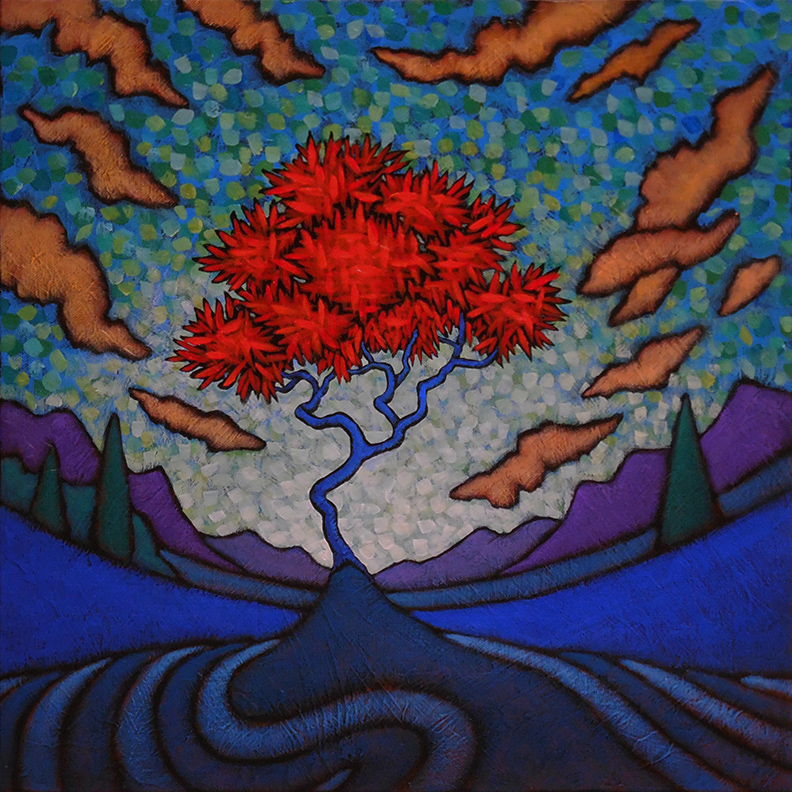
We’re in the last week of my annual exhibit at the Principle Gallery. This year’s edition marks my 25th solo show there and is aptly titled Continuum: The Red Tree at 25. Since the Red Tree has been a staple in my work for the past quarter century, you might assume a show celebrating it would have plenty of the Red Trees.

You’d be right in that assumption.

I have sometimes worried about a single element becoming so prevalent in my work. But when I examine the work of many other artists, including the greats, I find this same sort of repetition. In fact, this repetition is often what delineates the style for which they are known. I have mentioned here before that I believe that this repetition of form allows for greater emphasis on the actual expression contained in the painting.

Thinking about this repetition, I was reminded of the video below that I shared here about ten years ago. It’s a simple explanation of how we are affected by musical repetition based on the work and book, On Repeat: How Music Plays the Mind , of cognitive scientist Elizabeth Hellmuth Margulis, and it instantly made me wonder if the type of repetition employed in music played the same part in visual art. As I said, I believe that the personal style of an artist is a form of repetition, that the more familiar a viewer is with the work of an artist, the easier they find themselves able to engage with it. The repeating nature of their style and the body of work reinforces and reassures.

Of course, I am talking off the top of my head right now and I might read this later and ask myself what the hell I was talking about. It’s a grain of a thought at the moment.

Anyway, take a few minutes to watch the video and think about it on your own. And if you’re in Old Town Alexandria in the next several days, please stop in at the Principle Gallery to see the show. And if you can’t do that, click here to see the show as it is hung in virtual form.


GC Myers- Echoes of Time sm

Echoes of Time— At Principle Gallery

What an abyss of uncertainty, whenever the mind feels overtaken by itself; when it, the seeker, is at the same time the dark region through which it must go seeking and where all its equipment will avail it nothing. Seek? More than that: create. It is face to face with something which does not yet exist, which it alone can make actual, which it alone can bring into the light of day.

Marcel Proust, In Search of Lost Time: Swann’s Way


While the passage above from Proust refers to trying to recall a vague and distant memory brought on by a sip of tea, I felt that it described that feeling of standing before a blank canvas, not sure what might emerge.

An abyss of uncertainty … face to face with something which does not yet exist, which it alone can make actual, which it alone can bring into the light of day.

I don’t work from life nor do I use reference photos so I am dependent solely on my memory and perceptions of the world. Standing in front of that canvas sometimes becomes a daunting moment, uncertain what memory or tiny flash of imagery that I had seen ages before might push its way onto the surface.

You hope whatever comes out brings the same sort of sensory pleasure that Proust experienced in sipping his spoonful of tea with a morsel of a madeleine in it but you never know what you’ll get.

Not everything from the past is cookies and tea.

I chose the painting above, Echoes From Time from my current Principle Gallery show, for this post because, for me, it represents how we often live in time and memory. They are always with us, shaping how we see the present and the future. And ourselves.

Okay, that’s all the time I have this morning. There is a blank surface waiting for me and I must go stand before it to summon up something from that abyss of uncertainty.

Hopefully, it will taste of madeleines.

GC Myers- Shine

Shine– At Principle Gallery


Everyone sees the unseen in proportion to the clarity of his heart, and that depends upon how much he has polished it.
Whoever has polished it more sees more — more unseen forms become manifest to him.

–Rumi, 13th Century Persian Poet/Mystic


Take a commonplace, clean it and polish it, light it so that it produces the same effect of youth and freshness and originality and spontaneity as it did originally, and you have done a poet’s job. 

–Jean Cocteau, A Call to Order (1926)


Arts and sciences are not cast in a mould, but are formed and perfected by degrees, by often handling and polishing, as bears leisurely lick their cubs into form.

–Michel de Montaigne,  Essays (1595)


The ability to talk well is to a man what cutting and polishing are to the rough diamond. The grinding does not add anything to the diamond. It merely reveals its wealth.

-Orison Swett Marden, Selling Things (1916)


I wrote the other day about how I classify what I do. My work doesn’t necessarily fit in any particular pigeonhole of style or tradition. I do call myself an artist or a painter though it took a long time before I felt I had deserved the artist label. I think that’s something that has to be earned over time.

But yesterday while working on a new painting I realized that, more than anything, I am a polisher. The new piece started out well. The compositional underpainting fell into place, feeling balanced and rhythmic. Just what I wanted. But as the process wore on the painting the colors suddenly became flat and dull. its rhythm seems to evaporate and any zip or spark it had held was nowhere to be seen. It had lost all momentum.

I hated the damn thing.

I wanted to just set it aside or paint over it. Or jump up and down on it.

But I didn’t do any of those things. For one thing, I am racing against the clock right now and didn’t want to waste the days of work already invested. But more importantly, I have been at this point with many paintings countless times before. Despite the discouragement I felt and the utter disdain I held for that painting I knew there was still a wealth of beauty to be uncovered.

It was just a matter of persisting with my grinding and polishing. Which is exactly what I did. The transformation was amazing. There is always a tipping point where this change takes place and within an hour the painting went from a dull old gray rock to shining new gem.

It struck me that this might be my talent. I was like the person who picks up a rock from their driveway and knows that with some grinding and polishing, it will shine. It will reveal all the beauty it possesses.

And everything has some form of beauty that becomes apparent with some grinding and polishing.

The trick comes in knowing when to stop polishing. Too much and you take away the rawness and organic quality that is at the heart of all things. You can make a gem feel like a plastic replica with too much polish.

I have several quotes at the top about the effects of polishing from across the centuries. My favorite might be the last from one of the first self-help writers from the turn of the 20th century, Orison Swett Marden.

At the point I had reached with that painting yesterday, like a rough diamond, everything it would become was already there. It just took a little grinding and polishing to make it shine.


The painting at the top is not the painting of which I wrote. This painting is titled Shine and is a 9″ by 12″ canvas included in my current exhibit at the Principle Gallery, Continuum: The Red Tree at 25.


Niche


GC Myers- Niche  2024

Niche– At Principle Gallery, Alexandria

“As he was about to climb yet another dune, his heart whispered, “Be aware of the place where you are brought to tears. That’s where I am, and that’s where your treasure is.” 

― Paulo CoelhoThe Alchemist


When I am painting, especially in the runup to a solo show, I can often tell how effective I believe the work is by my emotional response to it. I often experience cathartic moments with many pieces where I see the meaning the painting holds for me, how it mirrors my emotional state and how I view myself and the world.

Sometimes tears flow in these moments. They are not sad nor are they happy tears.

They are tears of recognition and acknowledgment of the human condition. Tears of catharsis.

The painting shown here, Niche, had such an effect on me in the studio. I took it off the easel and set it down against a shelf then stepped back to take it in from a distance.

Within moments, my eyes were filled with tears.

I immediately saw the painting as a representation of my life as a painter. Maybe the closest I will ever come to doing a self-portrait. It is a modest painting, clear and colorful. The rolling field rows in the foreground generally represent work and labor for me and here I could only see them as representative the tens of thousands of hours spent alone in the studio working to create work that spoke some sort of truth.

But the part that hit me hardest was the narrowness of the canvas and how the Red Tree found its place to shine between two other trees. I could only see that as representative of my career as a painter. I live and work in a narrow niche, one that is simply stated and far apart from the art world in general. I don’t even know what to call my work or how others classify it. Neither highbrow nor lowbrow, it will never be swept up in movements or schools of art, never cited as part of some -ism in art history. It will never be the subject of big museum retrospectives or serious study from art critics. My life is too small and insular to warrant such things and I don’t have the will or energy to seek them.

It is, as I said, a narrow niche in art and in life. But that was not the part that brought the tears. No, it was the fact that I had this small, limited niche in the first place. It was the recognition that I had carved out such a niche with only my limited talents and mind that made me cry. I guess that I saw myself in this tree in that moment. And, even seeing all its limitations, it pleased me for having created something worthwhile from so little.

My niche might be small and narrow. But, good or bad, it is mine.

I am sure to many that seems like a small and simple thing. Maybe so. But even small and simple things sometimes make up the best part of a life.

Sometimes they make you cry.

Wasn’t planning on writing this this morning. Didn’t really want to share so much, to be honest. Certainly didn’t want to admit to crying. But I thought this painting deserved sharing my full reaction to it. It earned it.

Here’s a Ray LaMontagne song to go along with it. This is Such a Simple Thing. Seems about right.


GC Myers- Blaze  2014

Blaze— Now at Principle Gallery


Each minute bursts in the burning room,
The great globe reels in the solar fire,
Spinning the trivial and unique away.
(How all things flash! How all things flare!)
What am I now that I was then?
May memory restore again and again
The smallest color of the smallest day:
Time is the school in which we learn,
Time is the fire in which we burn.

Delmore Schwartz, Calmly We Walk Through This April’s Day (1937)


The last week has been a real test of my resolve. As noted here in the past, there is always a substantial letdown in the weeks after any opening. It feels like a bout of depression, deep and dark. Fortunately, I have come to recognize it as being short-lived which makes tolerating it much easier.

However, coupling this with the pressure of a looming deadline for my upcoming West End Gallery show and high temperatures and humidity that I don’t tolerate well leaves me feeling exhausted.

My get up and go has got up and gone.

Fortunately, I have been able to maintain focus in my work. It’s been a struggle. I sometimes feel like I have to bind myself to my easel like Odysseus lashing himself to his ship’s mast to resist the Sirens’ song and destroy his ship on the rocks of their island. There have been many days recently when I would love to follow the Sirens’ song anywhere but here. But I remain bound to my easel (interestingly, the main support on the easel is called a mast) and the enticement fades in the distance and the resulting work has been all I could ask for.

I thought I would share the one older piece from my current Principle Gallery show. It is a 2014 painting titled Blaze. From the very moment it came off my easel it has been a favorite of mine. It hits on every mark for me and still gives me a tremendous feeling of satisfaction when I look at it. It just feels right. Complete and alive. It reminds me that our energy and enthusiasm are a burning fire that constantly needs to be fueled. Once that flame has went out, rekindling it is a difficult thing.

The fact that it has never found a home has been vexing so I decided to show it once more in the new larger frame I introduced this year that has an architectural feel, as though you are viewing the work through columns or pillars. Like it was in a temple of some sort.

I am including this painting that is special to me along and the final verse of a 1937 poem from poet Delmore Schwarz (Lou Reed was his student at Syracuse University and was influenced by his work) that ends with a line–Time is the fire in which we burnthat serves as a refrain throughout the poem.

Because I am hoping that today’s triad of image, word and song serves to fuel my own flame, I am also including Whoop and Hollar from Ray Wylie Hubbard.  Hubbard wrote another favorite of mine, Up Against the Wall, Redneck Mother, for the late Jerry Jeff Walker (who is from Oneonta, by the way) in 1973. If this song doesn’t get your fire cooking you best look for the kerosene or something.

Your pilot light be out.

Now get the hell out of here. My flame is starting to rage and you might get burnt.


The Heart Warms

GC Myers- The Heart Warms  2024

The Heart Warms— Now at Principle Gallery, Alexandria


The whole course of human history may depend on a change of heart in one solitary and even humble individual – for it is in the solitary mind and soul of the individual that the battle between good and evil is waged and ultimately won or lost.

–M. Scott Peck, The People of the Lie (1983)


I thought since many of us are experiencing extreme heat, that the painting above from my current show at the Principle Gallery, The Heart Warms, would provide a cool respite. But the meaning behind this piece for me has little to do with air temperatures.

I see it as being about the difference one caring and empathetic person can make in a world that often seems uncaring and sometimes outright hostile.

A warm heart willing to stand apart in a cold world.

I used a passage from the late M. Scott Peck, who is best known for his book The Road Less Traveled. This is from his The People of the Lie which is an examination of evil based on his experiences as a clinical psychiatrist. Peck, who died in 2005, noted that a lack of empathy is among a list of prevalent traits among he observed in those who could be categorized as evil. It’s an interesting list (you can find it on Peck’s Wikipedia page under Theories) that seems to fit a certain narcissistic presidential candidate to a tee, even though it was written in 1983.

He also writes about how mass movements and crowds that arise behind leaders with these characteristics often cause their followers to lose or set aside their empathy and personal sense of personal responsibility. Sounds familiar, here in the moment and in every authoritarian regime throughout history.

That’s why the single caring person willing to stand against malignant ignorance (Peck’s term) of the crowd is vital in defeating all forms of evil. And that’s what I am seeing here, a reminder to stand against such evils. To be indifferent at such a time is to set aside any empathy one might possess, to deny the importance and power of one’s own singular voice.

Again, a lot to ask of a simple painting. You might not see it that way at all and like it for other reasons. Or not. That is the way of art.

Here’s a song to go with this all. It’s a lovely and moving performance of the classic Ben E. King song, Stand By Me, from Tracy Chapman. It was from a performance in 2015 during the last few months of the David Letterman show. Good stuff.