Call of the Blue Moon– Coming to Principle Gallery, June 2024
He who Doubts from what he sees Will neer Believe do what you Please If the Sun & Moon should Doubt They’d immediately Go out
—William Blake, Auguries of Innocence
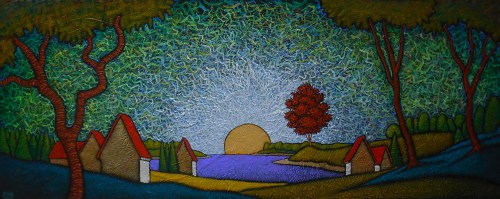
My annual solo exhibit at the Principle Gallery opens in 6 weeks, on June 14. One of the first pieces I completed for this exhibit, my 25th such show at the Alexandria, Virginia gallery, is this larger painting, a 36″ by 36″ canvas called Call of the Blue Moon.
It’s a piece that has been catching my eye for several months here in the studio, one that always seems to calm and center me when self-doubt seems overwhelming.
It possesses a coolness and clarity that is a balm for my doubts.
I’ve been needing to look at it quite often recently.
And an air of certainty. It seems to me like a place where there is no room for doubt. It depicts a cold and barren landscape where any doubt could be lethal. Yet it has a beauty and underlying warmth that transcends its harshness.
Maybe that is its simple message, that life is often harsh and dangerous yet still offers us beauty and tenderness. And hope.
Perhaps hope is that blue moon.
It just might be but you may well see it differently. As it should be.
Here’s a song to go along with this piece, though I am not sure it fully syncs with it. It’s a song I like that I was listening to this morning as I began writing this. I came across the music of the Yoshida Brothers a few years back. They are a duo playing the traditional Japanese shamisen, a three-stringed that sort of looks like a square banjo which is played by plucking or slamming the strings with a plectrum that looks kind a scraper. The Yoshida Brothers have a very eclectic sound that mixes traditional Japanese music and sounds many other musical influences. I sometimes hear Celtic or Bluegrass influences in some of their pieces and hard rock and electronica in others. This is Overland Blues.
String theory has the potential to show that all of the wondrous happenings in the universe – from the frantic dance of subatomic quarks to the stately waltz of orbiting binary stars; from the primordial fireball of the big bang to the majestic swirl of heavenly galaxies – are reflections of one, grand physical principle, one master equation.
—Brian Greene,The Elegant Universe
[From October 2014]
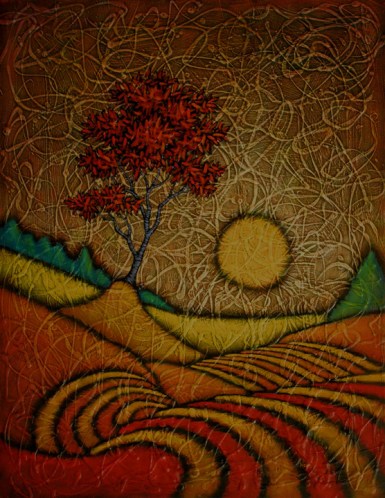
I’ve done several paintings through the years using textured surface that has bands or strings that twist and turn throughout. It’s an extreme texture, more pronounced on than my typical surfaces, and, as a result, takes center stage in these pieces. They become the driving force in the painting.
These bands that run through these paintings always spur something in me, some sense of wonder at the great unknowns of our world and universe. The painting shown here, Here There Everywhere, certainly does this for me. Looking at it, I am filled with questions about the world or worlds that lie just past our perceptions. Are there other dimensions, other pasts and futures swirling around us at any moment? And if so, are we connected in some way to this web of chaotic energy or are we merely physical beings, unwitting bystanders in the great dance of the universe?
In this painting, the Red Tree serves as the questioner, living in the moment but recognizing the forces that permeate everything and give that moment a discernible depth and meaning beyond the simple beauty it can physically observe. I know that I have had that feeling. I might be out driving and see a certain curve of a field, a bend of a tree or the filtering light from the sun and suddenly feel an intense emotional response that seems to have no basis of origin in my past, one so strong that I find myself asking why and where it came from.
Perhaps this indefinable emotional is a brush with these other worlds, these energy forces?
I certainly don’t know. Part of me wishes it to be so but part of me simply wants to savor that moment and emotion without questioning it. Something to ponder on a gray autumn morning.
Or something to ponder on a damp spring morning nearly ten years later. I was looking at this painting this morning in the studio for a few moments. It is one that made the gallery rounds and came back here years ago. I only used that sort of whirling texture in a handful of pieces around that time in 2014. They were all quite striking, as is this piece, but I never really employed that texture after those pieces.
This piece has a sort of elegant feel to me, almost regal. It certainly doesn’t feel like an orphan painting that never found a home. Maybe it’s more like exiled royalty than orphan.
But beyond its feel, it serves as a constant reminder of string theory which I roughly described in another post about another painting from around that time:
It reminded me of one of the supposed byproducts of the string theory which is a very speculative area of quantum physics. Without going into the scientific basis for the theory (which I couldn’t do very well anyway), string theory basically creates a platform where extra dimensions– it is speculated that there may actually be at least nine dimensions– could and may exist alongside the dimensions that we know and dwell within, without our knowledge of their existence. A simplified example of how this might work is the way we are surrounded by radio signals all the time without our knowledge but with the proper receptor, a radio, they become apparent. With string theory, perhaps there are also parallel dimensions around us without our knowledge, dimensions that contain others forms of energy, other forms of existence.
People have used this as theoretical basis for many things such as time travel, the existence of UFOs, and things supernatural such as ghosts and other spectral occurrences. The string theory has been a very fertile field for science fiction writers to work.
Perhaps it also provides a place where the soul, the source of energy that animates the body, ultimately dwells. Perhaps there is the energy of souls all around us in these alternative dimensions. Maybe the photons we see are also the part, a facet, of something unseen. That’s how I see the sky in this painting, as masses of disparate energies that we only see partially in the dimensions we can detect.
None of this has much to do with anything this morning. At least not here, in our meager world of limited dimensions. But it gives me something different to think about and that’s got to be worth something, right?
Here’s a lovely song whose title sort of inspired the title for the painting above. It’s the Beatles and Here, There and Everywhere.
Now, listen then leave quietly without disturbing my strings…
I said that the world is absurd, but I was too hasty. This world in itself is not reasonable, that is all that can be said. But what is absurd is the confrontation of this irrational and the wild longing for clarity whose call echoes in the human heart.
–Albert Camus, The Myth of Sisyphus: And Other Essays
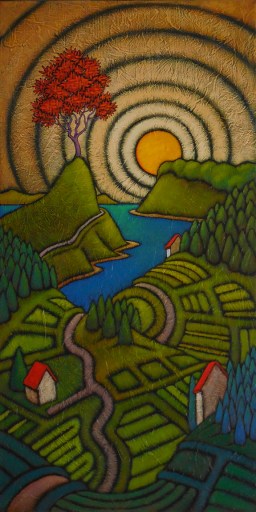
The new painting shown here is titled Echoes of Time and is 40″ tall by 20″ wide on canvas. It is included in Continuum: The RedTree at 25, my annual solo exhibit at the Principle Gallery which opens in June.
In recent years in my work, I have occasionally employed a sky comprised of a series of continually expanding concentric rings moving out from the sun/moon.
I don’t know what I would call it. I don’t really call it anything. It just is what it is, without a label. Maybe a spiral sky? Or perhaps an echo sky since that describing a reverberation from the past is what immediately comes to mind whenever I finally examine and try to interpret one of these pieces after they are completed.
But what is it an echo of? Is it a message from the past? If so, is it a warning of what is to come, something that has taken place once and seems ready to occur once more? Or is it something more encouraging, that humanity has endured the past and will continue to echo forward in time?
I surely don’t know. Maybe every echo has its own personal message, one that can only be recognized by only a few who are continually looking and listening for such things. Searchers, I guess you would call them though I don’t know that they even know what thing it they seek.
I often write of seeking something in my art so maybe I am looking for something from the past, my own and that of all mankind, that makes this world make sense. Maybe it that longing for clarity in an irrational world of like that in the passage above from Albert Camus?
That sounds right to me. Though I live and work in the gray areas of life, I do appreciate clarity.
But then again, maybe this sky of echoes is simply saying what goes around, comes around.
And there is a sense of clarity in that.
Here’s song that is titled Echofrom the British folk trio Talisk. It has a building intensity that feels like an expanding echo. Good stuff.
And the sky is black and still now On the hill where the angels sing Ain’t it funny how an old broken bottle Looks just like a diamond ring But it’s far, far from me
–John Prine, Far From Me
One of those mornings. Busy, with plenty to do, and everything seems out of rhythm. Everything, especially electronics, is acting glitchy this morning. Tried photographing some new work and the flap where the batteries and SD card are inserted broke. Had to hold it in place with masking tape.
Finally took a few images then tried editing them with Photoshop which acted glitchy, as well. Took much too long for a simple task.
Frustrating. Too frustrating for a Sunday morning.
Let’s just listen to this week’s Sunday Morning Music selection. It’s an old favorite from the late John Prine‘s 1971 self-titled first album. Here’s the bittersweet classic, Far From Me. This is a fine live version from a number of years back.
Feels right this morning. Now let me be. I have to get back in rhythm before it’s far, far from me…
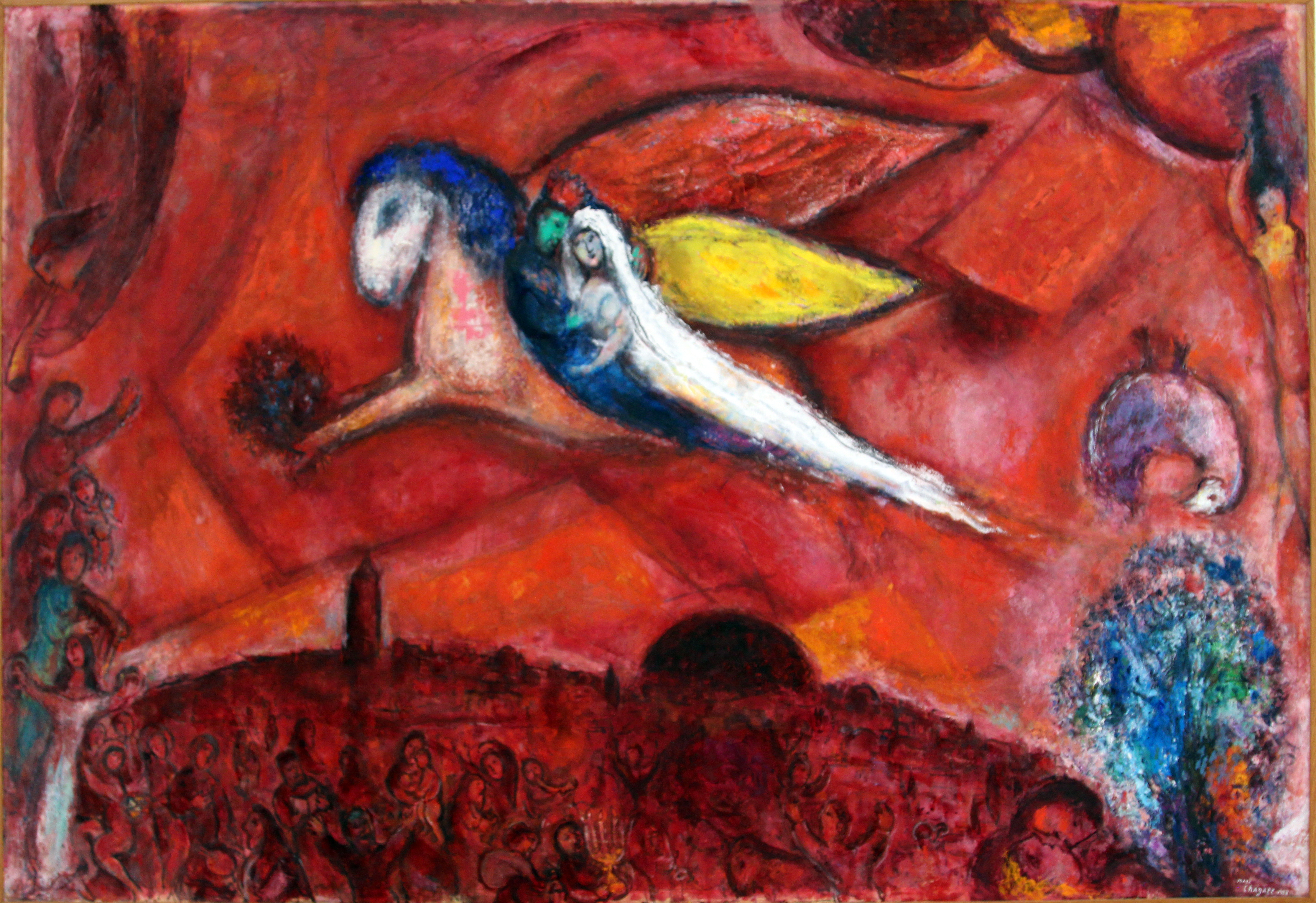
When I am finishing a picture I hold some God-made object up to it–a rock, a flower, the branch of a tree or my hand– as a kind of final test. If the painting stands up beside a thing man cannot make, the painting is authentic. If there’s a clash between the two, it is bad art.
–Marc Chagall
I have posted Marc Chagall a number of times since I have been doing this blog and I very seldom list him as one of my influences or even one of my favorite artists. But he somehow always seems to be sitting prominently there at the end of the day, both as a favorite and an influence.
One way in which his influence takes form is in the way in which he created a unique visual vocabulary of symbolism within his work. His soaring people, his goats and horses and angels all seem at once mythic yet vaguely reminiscent of our own dreams, part of each of us but hidden deeply within.
They are mysterious yet familiar.
And that’s a quality– mysterious yet familiar– that I sought for my own symbols: the Red Chair, the Red Tree and the anonymous houses, for examples. That need to paint familiar objects that could take on other aspects of meaning very much came from Chagall’s paintings.
He also exerted his influence in the way in which he painted, distinct and as free-flowing as a signature. It was very much what I would call his native voice. Not affected or trying to adhere to any standards or traditions, just coming off his brush freely and naturally.
An organic expression of himself. And that is something I have sought since I first began painting– my own native voice, one in which I painted as easily and without thought, much as I would write my signature.
To read how Chagall judged his work for authenticity makes me consider how I validate my own work. It’s not that different. I use the term a sense of rightness to describe what I am seeking in the work which is the same sense one gets when you pick up a stone and consider it. Worn through the ages, untouched for the most part by man, it is precisely what it is. It’s form and feel are natural and organic. There is just an inherent rightness to it. I hope for that same sense when I look at my work and I am sure that it is not far from the feeling Chagall sought when he compared his own work to a rock or a flower or his own hand.
This post has run a couple of times over the past decade. I read it when I need a lift, when I am less than confident about what I do. It always helps.
The day was when I did not keep myself in readiness for thee; and entering my heart unbidden even as one of the common crowd, unknown to me, my king, thou didst press the signet of eternity upon many a fleeting moment of my life. And today when by chance I light upon them and see thy signature, I find they have lain scattered in the dust mixed with the memory of joys and sorrows of my trivial days forgotten. Thou didst not turn in contempt from my childish play among dust, and the steps that I heard in my playroom are the same that are echoing from star to star. Where Shadow Chases Light This is my delight, thus to wait and watch at the wayside where shadow chases light and the rain comes in the wake of the summer. Messengers, with tidings from unknown skies, greet me and speed along the road. My heart is glad within, and the breath of the passing breeze is sweet. From dawn till dusk I sit here before my door, and I know that of a sudden the happy moment will arrive when I shall see. In the meanwhile I smile and I sing all alone. In the meanwhile the air is filling with the perfume of promise.
—Rabindranath Tagore, Gitanjali 43, 1916
Don’t have anything to say this morning. Well, anything worth putting down on paper or online. Nothing you want to hear or read.
Thought I’d share a triad of image, word and song anyway.
The song is Idle Moments from the late jazz guitarist/composer Grant Green, who died in 1979 at the age of 44. It’s a sauntering, easy tune that I think links well with the painting and the poem from Rabindranath Tagore, which is also known as Signet of Eternity.
Between two worlds life hovers like a star, ‘Twixt night and morn, upon the horizon’s verge. How little do we know that which we are! How less what we may be! The eternal surge Of time and tide rolls on, and bears afar Our bubbles; as the old burst, new emerge, Lash’d from the foam of ages; while the graves Of Empires heave but like some passing waves.
—Lord Byron, Don Juan
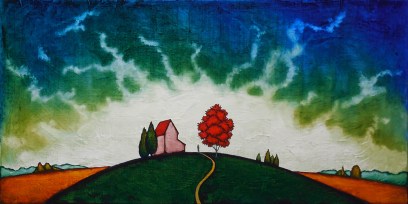
I chose the stanza above from Lord Byron’s Don Juan to kind of describe this painting because it seemed to fit so well what I was seeing in this piece.
When I look at it, the Red Tree seems to be an intermediary between differing worlds– between the solid ground of earth and the airiness of the heavens, between a life in civilization and the wide-open spaces of the fields and hills beyond, between the now and eternity, between the visible and the invisible.
Standing with one foot in either world, it becomes a moment of contemplation on the temporary nature of our existence. Standing there before the suddenly visible and unrelenting power of nature and the universe– the eternal surge of tide and time— the Red Tree recognizes its own smallness and insignificance–How less what we may be!
This idea of insignificant beings living but for a short time may seem like a dreary prospect to some. But I don’t see it that way. If anything, I see this as a celebration of just having the opportunity to bear witness to the grand spectacle of life set before us each day, to have a chance to play a part, albeit small, in the machinations of the universe.
Maybe this is too much for a simple painting such as this to bear. Maybe you will not see it in the same way, only seeing a tree, a lone figure and a house on a mound beneath an ominous sky. That’s fine because in its simplest terms that is what it is.
But even the simplest moments and images can have greater depth and meaning if we only choose to look more closely, to choose to perceive our place in the world in a different manner.
Well. that’s what I think anyway…
As I ready work for my annual solo show at the Principle Gallery in June, which is my 25th there as well as the 25th anniversary of the RedTree, I’ve been thinking about all the roles the RedTree had played in my work over the years. I often describe it as a greeter that invites the viewer into the painting or as a symbol for the individual. There are several other examples, but I like the role described in this post for a different painting, as an intermediary between differing worlds and dimensions, written back in 2016. The interesting thing is that it might well serves all these different roles at the same time.
Speaking of intermediaries between different dimensions, here’s Yo-Yo Ma playing the Prelude to Bach’s Cello Suite No. 1 in G Major. That’s a mouthful but you will most likely recognize this lovely piece.
RedTree: Stand Tall— Coming to Principle Gallery, June
Give me a place to stand, and I will move the Earth.
– Archimedes
This quote is actually a condensed and long accepted version of the words of Archimedes. It was originally about the power of lever in physics. He actually said: Give me a lever long enough and a place to stand and I will move the Earth. But the lever has been dropped over the 2200 or so years since he lived and has come to signify something more than a statement about physical mechanics. It is an almost existential statement about the power of the individual in changing the world.
The small somehow defeating the overwhelming forces set against them.
David versus Goliath.
The biblical David’s lever was his intelligence and the sling and stone that he used to offset the Philistine Goliath’s size and strength in order to take down the giant. Every underdog seeks to identify a strategic advantage that will enable them to triumph against all odds. Something that plays to their own strengths and magnifies their greater opponent’s weaknesses.
What is the lever you will use to move the Earth?
I’ve used the preceding paragraphs in a post many years ago but felt that it also applied to this new painting that is scheduled to be part of my June show, Continuum: The RedTree at 25, at the Principle Gallery. This is 40″ high by 20″ wide on canvas and is titled RedTree: Stand Tall.
It is a simple composition, but its size and colors give it a visual oomph that belies its quiet appearance. Though it is just a solitary tall tree set against the moon and sky with receding hills and a bit of water in the distance, it has a presence that demands to be heard. Around the base of the tree are a number of large stones. Perhaps a reference to the stones employed by that aforementioned underdog David?
It stands alone, without protection for all the world to see.
Yet it stands. Just standing where you are with stony resolve is sometimes a lever powerful enough to change the world.
Perseverance is often its own victory.
Persevere. That’s what underdogs do.
I’ve often felt the underdog. Maybe it was only a perception in my mind but, as a result, I have always rooted for underdogs., people who face long odds in taking on bigger, stronger opponents. People without privilege who are underestimated, overlooked, ridiculed, and pushed around. People who refuse to go with along with the crowd and are willing to stand on principle when the whole world seems against them.
And that’s what I see in this painting. Simple and strong.
Okay, here’s a song to fittingly fill out this post. It is a 1969 song, Stand, from the great Sly & The Family Stone. The lyrics fall right in place here.
So, give a listen then go figure out what your own lever might be that will move the Earth. Then stand tall.
He knows all about art, but he doesn’t know what he likes.
–James Thurber
I am fully immersed in work for my June show at the Principle Gallery right now. I need to get to a large piece on the easel that is waiting for its final touches which has me chomping at the bit to get to work this morning. In the name of expediency, I would like to share a post from a few years back about trusting yourself when looking at art. There are a lot of people who won’t go into galleries or museums or even comment on a painting because they think they don’t know anything about art and feel intimidated. That’s a shame because you don’t need to know anything about art except how you react to it. This was a Quote-of-the-Week post from back in 2015 when that was still a thing. Take a look:
This may not technically qualify as a quote but who cares? The message in this cartoon from the great James Thurber is simply put and true and that’s what I am looking for in a good quote.
And art.
That’s what I like.
In the past I’ve talked about how many people are intimidated by the idea of art, feeling that they don’t know anything about art. This leaves them not trusting their own eyes and their own reactions to any given piece of art. It often keeps them from even looking at art.
And that is a pity because art is mainly about the reaction to and interaction with art. Art is a reactive agent, reaching out and stirring something in the viewer. All the praise for or all the knowledge in the world about a piece of art cannot make you like that piece of work if it doesn’t first strike that chord that raises some sort of emotional response within you.
And I think most of us know within a few moments whether a work of art speaks to us or leaves us cold. The trick comes in recognizing this realization and trusting your own reaction. And feeling okay with that.
I’ll admit that there are many celebrated works of art out there that do absolutely nothing for me. They may have critical praise, historical importance, or great craftsmanship in them, but they simply don’t raise any emotional response within me.
I might be able to appreciate them, to understand why it has the respect or acclaim attached to it. But the bottom line is that I don’t like them, plain and simple. They just don’t speak to me. That doesn’t mean I’m right or wrong.
It just means I know what I like.
And I accept that criteria from anybody, even with my own work. While it would be nice to think that it speaks to everyone, I know this is an impossibility. Nobody’s work does that. I’ve had people tell me that they didn’t like my work– in polite and respectful terms, thankfully– and I can respect their honesty and the fact that they trust their own eyes and their own reaction.
And at least they are looking.
They know what they like. And that’s good enough for me.
I believe that the fundamental alternative for man is the choice between “life” and “death”; between creativity and destructive violence; between reality and illusions; between objectivity and intolerance; between brotherhood-independence and dominance-submission.
—Erich Fromm, Credo (1965)
The last couple of posts have dealt with personal creeds or statements of beliefs. I very much admire the work of Erich Fromm, the psychologist/philosopher who lived from 1900 until 1980. The passage above is from his 1965 Credo which was published posthumously. I find it to be a very insightful piece that concerns itself with helping the individual find a place and purpose in this world. You can read the document in whole (or download a PDF) at Erich Fromm Online.
The passage above from Fromm’s Credo seemed very relevant to this moment in history. We have historically, as a species, been in constant conflict between choosing between light and darkness, those polar oppositions that Fromm delineates here. It feels like we have to a point where there is little gray area between the two poles. There is little, if any, middle ground as darkness has distilled into a potent force that can no longer be shrugged off. We, in this nation and abroad, are facing stark choices between light and darkness, or creativity and violence.
Yesterday was a step in the right direction and it feels as though people are finally recognizing the darkness that has threatened to engulf us for too long.
Hopefully, light can overcome the darkness.
I realize this is short on specifics this morning. I just wanted to share Fromm’s words with the hope it will resonate with you as well. His credo ends with this summarizing point:
I believe in the possible realization of a world in which man can be much, even if he has little; a world in which the dominant motivation of existence is not consumption; a world in which “man” is the end, first and last; a world in which man can find the way of giving a purpose to his life as well as the strength to live free and without illusions.
Sounds good to me.
For this Sunday Morning Music, let’s go with a song that I played here a couple of years back. It’s Takuya Kuroda and his rendition of Roy Ayers’ Everybody Loves the Sunshine. This has been a favorite of mine since I stumbled across it a few years back and always sets me back on course when I feel out of rhythm.









 Redtree Times