Feeds:
Posts
Comments

Priceless Jewels

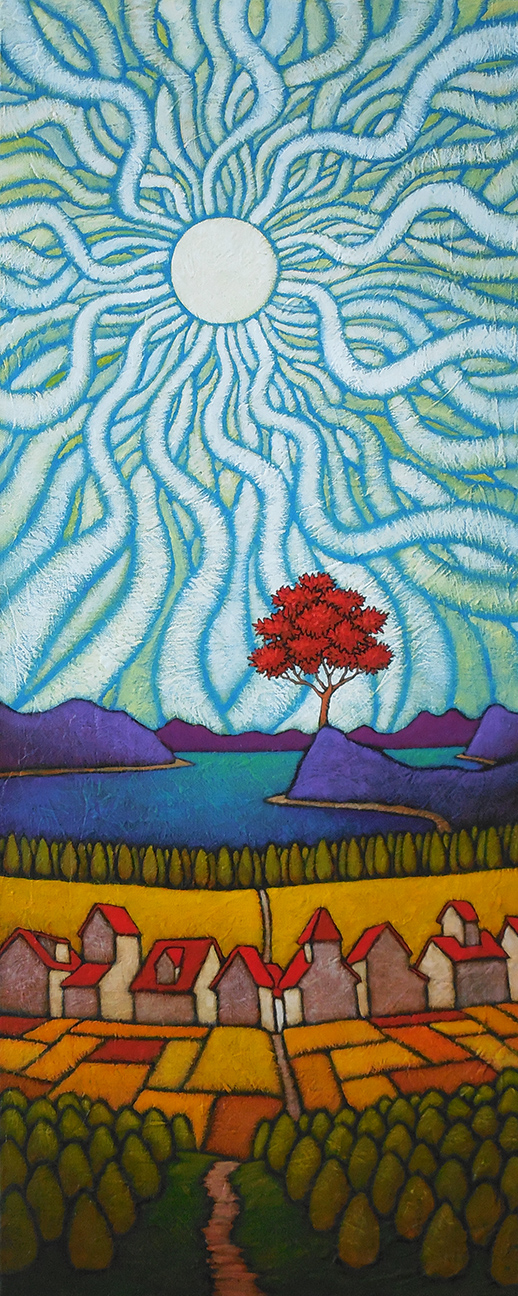
Pax Omnis– At Principle Gallery


We can only be said to be alive in those moments when our hearts are conscious of our treasures; for our hearts are not strong enough to love every moment.

― Thornton Wilder, The Woman of Andros (1930)


Hope you’re feeling alive today and fully conscious of the treasures that you possess that can’t be measured in dollars and cents. 

The sort of wealth that can’t be bought or sold. 

Love. Friendship. Belonging. Contentment. 

Those priceless jewels in our lives.

Have a Happy Thanksgiving.

Here’s a favorite song, the 70’s soul classic Be Thankful For What You Got, from William DeVaughn that I have shared a number of times here. Thought I’d play a cover of the song from the LA-based group Orgōne. It’s a faithful cover with the same vibe and just a few small additions to distinguish it.


Universal Symbol for Empathy


Resolve to be tender with the young, compassionate with the aged, sympathetic with the striving, and tolerant of the weak and the wrong. Sometime in life you will have been all of these.

― George Washington Carver


Let’s continue this Thanksgiving week’s stream of virtues with a biggie: empathy. The ability to put yourself in someone else’s shoes or see through their eyes. To feel their emotions, to try to perceive the circumstances of their life.

As Walt Whitman put it in the immortal Song of Myself, describing his time as a hospital aide during the Civil War when he nursed severely wounded Union soldiers:

I do not ask the wounded person how he feels, I myself become the wounded person.

It seems like a simple thing, a natural reaction for most decent people. But it is, unfortunately, becoming a more and more scarce entity. It sometimes feels like there is a total absence of empathy in this world with some folks. Or maybe it’s that they have managed to lop their empathy into smaller bits, reserving it only for people who look and speak and think like themselves.

Empathy is sometimes even mocked these days, derided as a symptom of weakness or softness, something to be exploited. My persona view on this is that empathy is actually a strength, something that allows you to feel compassion with those in need while at the same time giving you the ability to understand and perhaps predict how your adversaries might act.

In this case, a lack of empathy is actually a hinderance to those with less than honorable intentions.This thought takes me back to the words of Gustav Gilbert who was the psychologist at Spandau Prison where the Nazi war crimes defendants were held in 1945:

I told you once that I was searching for the nature of evil. I think I’ve come close to defining it: a lack of empathy. It’s the one characteristic that connects all the defendants. A genuine incapacity to feel with their fellow man. Evil, I think, is the absence of empathy.

Conversely, goodness would include the presence of empathy.

Most of you out there reading this are empathetic folks. If not, you most likely wouldn’t have read this far or be following this blog. So, this is just preaching to the choir. But can you make others feel empathy or, at least, more empathetic to a wider range of others?

I would guess that this can only occur through a willingness to display your own empathy with patience and grace. Much like the words of advice at the top from George Washington Carver.

Do I know this for sure?

No. But who or what can it hurt?

It can only help in some way or another. Try it…


I most likely start the first part of the treatment for my prostate cancer later this morning, so I am a little distracted this morning. But I thought this post from several years back fit nicely with this week devoted to giving thanks.

One benefit from the display of cruelty and hatred on display from the current administration is that their obvious lack of compassion and empathy is so egregious that even those of us who might not have had an awareness of our own empathy in the past are now paying a bit more attention to how they treat and interact with others.

I might be mistaken with that observation, but I hope not. For one thing, I would so love the irony that those who have waged a war on “woke” might have actually awakened that very reaction in the many folks who have allowed their native empathy to lag in recent years.

But more importantly, I would love to live in a world filled with empathy, compassion, and generosity. A world where greed, bigotry, and cruelty are driven back into the dark corners where they belong, not parading proudly down Main Street.

Give me beauty over ugliness any day of the week.

Maybe that’s asking too much but I don’t think it is.

I am adding a song that I have shared a few times over the years, Try a Little Tenderness. I have always shared the Otis Redding version which for me is the absolute gold standard. I have known and loved that version for almost sixty years but didn’t know that it was written in 1932 by Jimmy Campbell, Reg Connelly, and Harry Woods. Or that it has been recorded by a huge number of singers over the many years, many before and after Otis. Bing Crosby first recorded it in 1933 and Frank Sinatra in 1946. I thought I’d share the Sinatra version here this morning. This version is from 1960 with an arrangement from Nelson Riddle. Different than Otis but lovely.

Be kind out there, Try a little tenderness.


Etty’s Wisdom


As life becomes harder and more threatening, it also becomes richer, because the fewer expectations we have, the more good things of life become unexpected gifts that we accept with gratitude.

–Etty Hillesum, An Interrupted Life: The Diaries of Etty Hillesum, 1941-1943


The post below ran here last year at this time. I don’t like replaying a post so soon but felt that the wisdom in the words of Etty Hillesum warranted it, especially in a year like this one that seems to hold a variety of challenges for us all. I’ve added a few short passages from her diaries below that spoke to me. In this week of giving thanks, I am grateful to have come across the words expressing this young woman’s inner world.


I was looking for something to share about gratitude since this is the week of Thanksgiving. I came across the quote above from a name that I didn’t recognize, Etty Hillesum. I loved the sentiment she expressed but wondered who she was.

Turns out she was young Dutch Jewish woman born in 1914 who chronicled her spiritual growth in her diaries and letters until her murder at the hands of the Nazis in the Auschwitz concentration camp in late November of 1943. She was only 29 years old, a mere 81 years ago.

Her writings had been turned over to a friend before her internment so that they might someday be published. Though many attempts were made, it wasn’t until 1979 that they finally found their way into print as the book An Interrupted Life. In 2006, the Etty Hillesum Research Centre was founded in the Dutch city of Ghent to research and promote her writings.

As I pointed out, Etty Hillesum is new to me so I can’t speak with any authority on her writings. However, many of the passages I have read exhibit great depth. Some of my favorites thus far:

Suffering has always been with us, does it really matter in what form it comes? All that matters is how we bear it and how we fit it into our lives.


But I do believe it is possible to create, even without ever writing a word or painting a picture, by simply moulding one’s inner life. And that too is a deed.


Never give up, never escape, take everything in, and perhaps suffer, that’s not too awful either, but never, never give up.

Many of her observations, especially about how suffering plays a large role in one’s meaning of life, echo those of Viktor Frankl, a psychoanalyst and survivor of Auschwitz who wrote Man’s Search for Meaning. And that second one here, about the creation of an inner life adding to the meaning of one’s life, is something I believe all too many of us overlook in our own lives.

Inner creation is as important as any outward creation. Maybe more so. This inner creation is the core of the self and serves as an anchor which you can hold to when the outer world is spinning out of control.

Anyway, let’s kick off this week of being grateful with a nod of gratitude to Etty Hillesum for sharing the wisdom she uncovered in her brief stay here. Her life’s search for meaning adds to our own.

And that is indeed a great gift.


A few more passages from An Interrupted Life: The Diaries of Etty Hillesum, 1941-1943:


Ultimately, we have just one moral duty: to reclaim large areas of peace in ourselves, more and more peace, and to reflect it towards others. And the more peace there is in us, the more peace there will also be in our troubled world.


Life may be brimming over with experiences, but somewhere, deep inside, all of us carry a vast and fruitful loneliness wherever we go. And sometimes the most important thing in a whole day is the rest we take between two deep breaths, or the turning inwards in prayer for five short minutes.


Each of us must turn inward and destroy in himself all that he thinks he ought to destroy in others.


We human beings cause monstrous conditions, but precisely because we cause them we soon learn to adapt ourselves to them. Only if we become such that we can no longer adapt ourselves, only if, deep inside, we rebel against every kind of evil, will we be able to put a stop to it.


Most people write off their longing for friends and family as so many losses in their lives, when they should count the fact that their heart is able to long so hard and to love so much as among their greatest blessings.


I don’t want to be anything special. I only want to try to be true to that in me which seeks to fulfill its promise.


There are moments when I feel like giving up or giving in, but I soon rally again and do my duty as I see it: to keep the spark of life inside me ablaze.


A Grateful Leopard

Serene Gratitude— At West End Gallery


To Mercy, Pity, Peace, and Love
All pray in their distress;
And to these virtues of delight
Return their thankfulness.

–William Blake, The Divine Image in Songs of Innocence (1790)


It’s Thanksgiving Week. As in the past, I am going to focus on gratitude this week.

And why not? As the orator Cicero famously proclaimed that “Gratitude is not only the greatest of virtues, but the parent of all the others.

Who am I to argue with that?

I might be wrong here but one thing I have observed is the relativity of one’s gratitude to the hardships endured. It seems that it is ‘the greater the woes the greater the thanks.

It sure feels that way for me this particular year. This year has been one in which not a lot has gone the way I had hoped in so many ways. Even so, I feel extremely thankful for so many things and people.

Maybe more so than in those years when everything has gone my way.

I think in the better years, we tend to overlook the importance of the part that others play in our lives. It’s easier then to see ourselves as being solely self-reliant and independent entities.

But when times are a bit tougher and things seem to be going awry, we recognize how dependent we truly are on the assistance and support of others.

In seeing others reach out in hard times, willing to take on some of that hardship in order to give aid and comfort, it becomes clear that the triumphs that we once felt were ours alone were always the result of the aid from others.

In good times, we are lifted up by others. In bad times, we are pulled up by others.

And, man, am I grateful for both.

Now get the hell out of here before I change my mind.

Sorry– I couldn’t resist that exit line.

As they say: A leopard doesn’t change its spots.

Even a grateful leopard.

Nightflyer

the heart warms

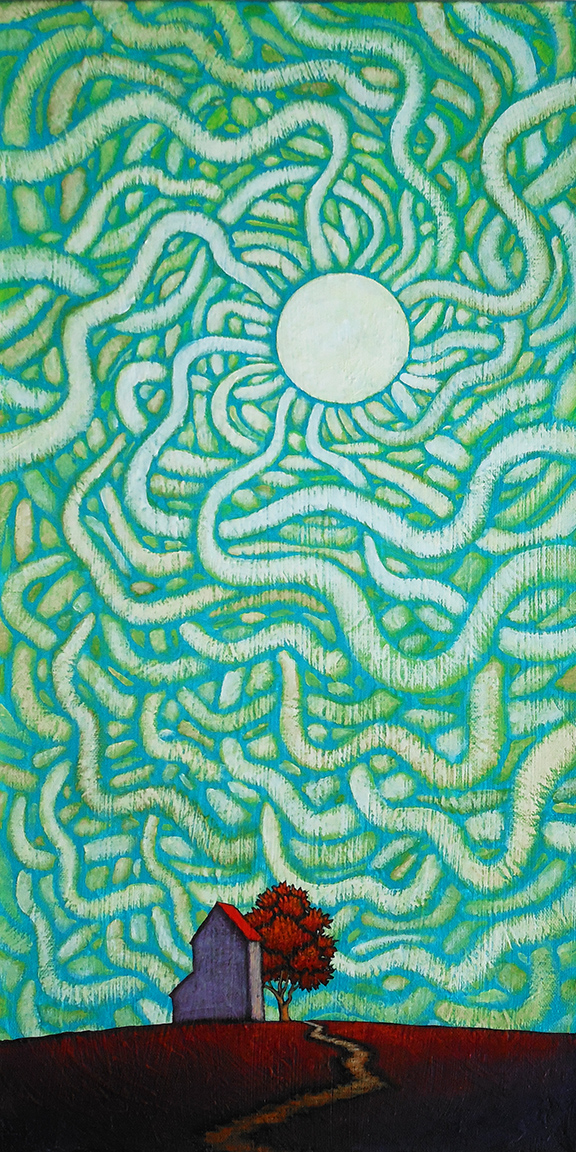
The Heart Warms— Now at Principle Gallery, Alexandria


I’m the wounded bird, I’m the screaming hawk
I’m the one who can’t be counted out
I’m the dove thrown into battle
I can roll and shake and rattle mm-hmm, hmm

I’m the moon’s dark side, I’m the solar flare
The child of the earth, the child of the air
I am the mother of the evening star
I am the love that conquers all

Yeah, I’m a midnight rider
Stone bonafide night flyer
I’m an angel of the morning too
The promise that the dawn will bring you

Nightflyer, Allison Russell (2021)


AS we come into the week of Thanksgiving, I thought I’d end this past week with a brief update. I had a consultation with a Medical Oncologist at Memorial Sloan Kettering in NYC on Tuesday and one with my local Radiologic Oncologist on Wednesday. Not much changed nor were there any great revelations with either consultation.

As I wrote in the past week or so, in the preceding several months it often felt as we had been dropped into forest wilderness without a compass or a guide, left to fend for ourselves in place with which we had no knowledge and little experience. We always felt like we were feeling our way through the trees of that wilderness, never sure if our steps were moving us closer or further from whatever path might take us out.

But after this past week, we now feel like we have a path that will lead us to a better place. Both consultations brought us a greater peace of mind and a feeling that we had some clarity in the way forward with my treatment. There is now great assurance for us that the cancer, though it can’t be cured, can be controlled. The cancer, along with its treatment, is most likely something I will be dealing with for the rest of my life.

Just the fact that I have a rest of my life, one that appears should not end as soon as we had once feared, is a good thing. I’ve come to like this place and had plans to be around for a while. I still believe some of my best work is yet to come.

I will have more clarity this coming Wednesday when I meet with the Medical Oncologist who will put forward the plan for my treatment. For my part, I am trying to up my fitness levels with intensified workouts every day that might both dampen the side effects of the drugs and the radiation as well as assist in fighting the cancer.  I think I may have mentioned that there is clinical evidence of more positive outcomes for patients who follow an intense interval training in the leadup and during their treatment. Plus, there’s just the upside in simply getting more fit in general as well as feeling, that by doing so, I am actively fighting the cancer.

Whatever it takes.

This peace of mind finally allowed me to get a couple of decent nights of sleep and has me thinking that the coming weeks will finally be productive in the studio. The paralysis that comes in not knowing seems to be easing and I am finally getting small things done. Not much but enough to spark me a bit and feel once more like myself.

And that’s a good thing.

Here’s song for this week’s Sunday Morning Music from singer/songwriter Allsion Russell. This song, Nightflyer, is from her acclaimed 2021 debut album. Ouside Child. Both the album and this song were nominated for Grammy Awards in the Americana category. Her work is autobiographical, reflecting the traumas she suffered in her childhood at the hands of an abusive stepfather as well as the triumph that came in overcoming it. I came across a quote from an interview with her that resonated with me:

‘I’ve come to understand that my path as an artist is to build empathy and to delve deeply into the truths, feelings and experiences that scare me the most in order to be a small part of leaving the world better than I found it. Silence is deadly.’

To use a doctor’s term, I concur.


Q & A, Again

The Answering Light-
At West End Gallery


“Why do you pray?” he asked me, after a moment.

Why did I pray? A strange question. Why did I live? Why did I breathe?

“I don’t know why,” I said, even more disturbed and ill at ease. “I don’t know why.”

After that day I saw him often. He explained to me with great insistence that every question possessed a power that did not lie in the answer. “Man raises himself toward God by the questions he asks Him,” he was fond of repeating. “That is the true dialogue. Man questions God and God answers. But we don’t understand His answers. We can’t understand them. Because they come from the depths of the soul, and they stay there until death. You will find the true answers, Eliezer, only within yourself!”

“And why do you pray, Moshe?” I asked him. “I pray to the God within me that He will give me the strength to ask Him the right questions.”

― Elie Wiesel, Night


The passage above from Night, the memoir of the Holocaust from the late Nobel Laureate and survivor Elie Wiesel, has stuck in my mind for a long time. Decades. It has informed my life and outlook as well as my work.

Life comes down to being a matter of not what we know but rather a matter of what we want to know.

A matter of the quality of our questions and how willing we are to accept the answers, even when the truth in them disappoints us. 

I think, as Moshe says above, that the true answers are only found within us. And while we can’t always understand the answers to our questions, we sometimes refuse to accept those answers we do comprehend because they reveal us to be less than we hope.

They are not the answers we wish to receive.

But these may be the most important answers we ever receive because to fully know yourself you have to be able to recognize and acknowledge every aspect of your being.

Both good and bad. Light and dark. Weakness and strength.

After all, each day contains about the same amount of darkness as it does light. You can’t know a day without knowing that there is both.

Hmm…


Things to do this morning so I am replaying a post that I like from a few years back, especially the passage from Night. What it said was a big part of some of my new work this year, such as the painting at the top, The Answering Light. So often the answers we seek are answered yet we are not able to recognize or understand them. It is only when we find them within ourselves that these answers become apparent. 

Sometimes we find those answers, sometimes we don’t. 

I’ve added a song from the Moody Blues that deals with the frustration that comes with seeking answers to difficult questions, answers that sometimes do not come. This was written and released in 1970 and primarily deals with the frustration of the younger generation and the anti-war movement of that time in getting real answers to their pleas. This is Question.


Running the Moons

Running the Moons— At Principle Gallery


As one studies these preconditions, one becomes saddened by the ease with which human potentiality can be destroyed or repressed, so that a fully-human person can seem like a miracle, so improbable a happening as to be awe-inspiring. And simultaneously one is heartened by the fact that self-actualizing persons do in fact exist, that they are therefore possible, that the gauntlet of dangers can be run, that the finish line can be crossed.

–Abraham Maslow, Motivation and Personality (1954)


I’ve been thinking in recent days about my recent paintings and the meaning I take from them. My perception of them has changed from the first time one of these paintings appeared. At first, it felt more like a simple design choice, added elements to provide balance and contrast. But as a few more showed up the moons took on different aspects, beyond mere design and deeper in meaning. I found that they were excellent reflectors (that is one purpose of a moon, after all) of my emotions and concerns at the time.

I’ve been thinking a lot about this small painting, Running the Moons, 6″ by 12″ on canvas at the Principle Gallery, in conjunction with the passage above from influential psychologist Abraham Maslow. Maslow, who died in 1970, is famous for his hierarchy of needs, which is presented as pyramid of basic human needs that must be met leading up to the pyramid’s topmost point, which is a state self-actualization.

This is basically a state of being a total human being once one has fulfilled their basic physical needs, has been made to feel safe and secure in their life and livelihood, has established loving and meaningful relationships, and has found respect for themself as well as for and from others. At this topmost point, they have reached their potential and can then live their most meaningful, creative, and productive life.

This is, of course, a gross and lacking simplification of Maslow’s theory but I think you get the idea. If you’re not familiar with his theories, it’s an interesting subject to explore on your own.

In this painting, I see the moons as being the different phases of ourselves as we maneuver a sometimes-turbulent sea on our hoped for destination of understanding, fulfillment, and, hopefully, self-actualization. These phases can correlate to our basic needs. One might represent our most basic needs– food and shelter. Another might represent our need to love and be loved. Another might represent our realization and acceptance of who and what we are.

And on and on. You get the picture.

As I said, it’s a simplified and most likely incomplete representation of Maslow’s thoughts. But a childlike naivete is sometimes an aspect of the self-actualized according to Maslow.

I’d like to think that’s true in this case, but it might just be that I’m naive and childlike sometimes. Often, actually.

Either way, it works for me this morning and gives me something to chew on for the rest of the day as I try to guide my boat through my own gauntlet of moons. I don’t know which moons are in my wake or exactly where I am in my journey.

The fact that I am still afloat and there is wind filling my sails is good enough this morning.

What more can you ask?

Here’s a song, Ship of Fools, from Robert Plant from 1988. While I hope my ship is not one of fools, this might kind of be about the same thing, Or not. Doesn’t matter.


Omen Clouds

Georgia O’Keeffe- Sky Above Clouds IV, 1965


I recall an August afternoon in Chicago in 1973 when I took my daughter, then seven, to see what Georgia O’Keeffe had done with where she had been. One of the vast O’Keeffe ‘Sky Above Clouds’ canvases floated over the back stairs in the Chicago Art Institute that day, dominating what seemed to be several stories of empty light, and my daughter looked at it once, ran to the landing, and kept on looking. “Who drew it,” she whispered after a while. I told her. “I need to talk to her,” she said finally.

My daughter was making, that day in Chicago, an entirely unconscious but quite basic assumption about people and the work they do. She was assuming that the glory she saw in the work reflected a glory in its maker, that the painting was the painter as the poem is the poet, that every choice one made alone– every word chosen or rejected, every brush stroke laid down or not laid down– betrayed one’s character. Style is character.

— Joan Didion, Georgia O’Keeffe


This anecdote opens the essay Georgia O’Keeffe that is included in author Joan Didion‘s 1979 book of essays, The White Album. I can only imagine the awe and wonder in the eyes of her daughter along with the many questions it inspired, on seeing O’Keeffe’s huge painting– it’s 8 feet high by 24 feet wide!– in a large open space.

It raises an interesting question: Is style character?

That’s a tough question. I am not positive it holds true for all artists across the spectrum of artistic disciplines but, for the most part, I would like to believe this is true if the style of the artist is genuine and true to their self.

Determining what is genuine and what is contrivance is another question.

I think the reaction of Didion’s daughter is one reliable indicator of authenticity. There is something about the reaction of a child to art that I trust implicitly. Their perception is still unclouded and intuitive and they usually don’t yet feel the need to categorize or rate everything that they come across. They have an ability to see things clearly that I sometimes think we lose in adulthood.

They just react on a gut level, quickly and decisively, to some inner intuitive cues.

In my experience, I generally am most pleased with my own work when it catches the eye or mind of a child. It’s perhaps the purest form of validation, letting me know that the work speaks on a visceral, emotional level.

But is this, the style that speaks to that child, character?

I can’t say for sure. I know a number of artists for which this holds true and I believe it is true in my own case.

Or at least I want to believe that. A person can’t attest to their own authenticity without some form of bias. That puts it out of my hands.

But I hope so. My intention for my work has always been to be transparent and open, for it to be an expression of my character, for better or worse. It is work that is meant to communicate. Or so I hope.

I don’t know that an artist’s work can ever fully mask the strengths or deficiencies contained in their character. Nor should they.

For myself, I am okay with that. I am willing to be judged because I know that few will be as critical of my work and my character as myself.

As Georgia O’Keeffe said:

To create one’s world in any of the arts takes courage.

And don’t we all aspire to have courage?


Heading across New Jersey yesterday on my way into NYC, there was a bank of clouds in the sky off to one side. They had a remarkable resemblance– from a ground level viewpoint– to the famed Georgia O’Keefe painting at the top which displays clouds from a higher perspective. I thought there must be some synchronicity at play since I had been looking at this painting in recent days as part of the post above which has been shared here a few times over the years. I took it as a good omen for my upcoming consultation. And though nothing was changed or resolved from the visit, I did feel more confident and assured in the path forward after my visit.

And that was good enough.

Maybe those clouds were indeed an omen. Neither good nor bad, just an omen telling me to trust that things will play out as they should and that I should relax a bit. Take things as they come.

And that is good enough.

Here’s a song that has absolutely nothing to do with either this post or those clouds. I just like its rhythm. It reminds me of the rhythm and pace of that ride across Jersey yesterday, under those clouds.

And that’s good enough for me this morning.

This is Dusty Boxcar Wall from Eilen Jewell.


Called to Flight

Learning to Fly–At the West End Gallery


You do not have to be good.
You do not have to walk on your knees
For a hundred miles through the desert, repenting.
You only have to let the soft animal of your body
love what it loves.
Tell me about your despair, yours, and I will tell you mine.
Meanwhile the world goes on.o 
Meanwhile the sun and the clear pebbles of the rain
are moving across the landscapes,
over the prairies and the deep trees,
the mountains and the rivers.
Meanwhile the wild geese, high in the clean blue air,
are heading home again.
Whoever you are, no matter how lonely,
the world offers itself to your imagination,
calls to you like the wild geese, harsh and exciting —
over and over announcing your place
in the family of things.

Mary Oliver, Wild Geese


Listening to a flock of Canadian geese fly over last week as they headed south brought this poem from the late Mary Oliver to mind. The honks and squawks of the flock were, indeed, harsh and exciting, as though they were giddy with delight at the prospect of being homeward bound.

It sometimes sounds to me as though they are calling out for everybody and everything to join their ranks, to grab a spot at the end of one of the legs of their long vee in the sky. To share their joy and excitement as they make their way home.

I sure wished that I could fly at that moment. If I could I ‘d have been up there trying to honk out a giddy initiation for others to join along and take their place, as Oliver writes, in the family of things.

To go home once more.

I am on my way this morning to Memorial Sloan Kettering Cancer Center in NYC for a consultation there. I’m going to try to keep those geese in mind today.

Maybe one day, I’ll learn to fly up there in the sky with them…

Here’s a song that I’ve shared here a number of times, I’ll Fly Away. It was written over three years between 1929 and 1932 by Albert E. Brumley, who is credited with writing over 600 gospel songs. This song has been recorded by innumerable artists and is considered one of the most recorded gospel songs of all time. Being a fan of both artists here, I am kind of partial to the Gillian Welch/ Allson Krauss version from O Brother, Where Art Thou?


Bang Your Drum– 1995


“In becoming forcibly and essentially aware of my mortality, and of what I wished and wanted for my life, however short it might be, priorities and omissions became strongly etched in a merciless light and what I most regretted were my silences. Of what had I ever been afraid? To question or to speak as I believed could have meant pain, or death. But we all hurt in so many different ways, all the time, and pain will either change, or end. Death, on the other hand, is the final silence. And that might be coming quickly, now, without regard for whether I had ever spoken what needed to be said, or had only betrayed myself into small silences, while I planned someday to speak, or waited for someone else’s words. And I began to recognize a source of power within myself that comes from the knowledge that while it is most desirable not to be afraid, learning to put fear into a perspective gave me great strength.

I was going to die, if not sooner then later, whether or not I had ever spoken myself. My silences had not protected me. Your silence will not protect you.”

― Audre Lorde, The Cancer Journals (1980)


I mentioned the Exiles series the other day when writing about my recent cancer diagnosis. It was a series that was my painted response to my mom’s short, painful battle with metastatic cancer that ended with death in November of 1995. It was a deeply personal series, obviously. It still creates an ache as I look at much of the work from the series.

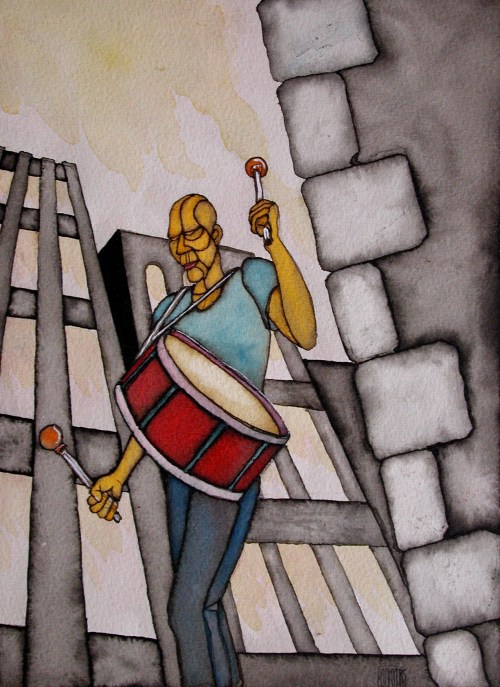
I thought I’d share the piece above from the series, Bang Your Drum, and an early blogpost from 2009 that discusses what it meant to me then. It was different than the other work in the series. At that point, I saw it about the need to speak up as an artist to both incorporate their personal experience into the work as well as in actively promoting their own work so that it doesn’t get overlooked or passed over.

An artist must often be their own best advocate.

In light of the past several months and my experiences in the healthcare system, I have come to see this piece as being about bringing that same sort of self-advocacy in the search for getting good and timely care. You have to bang your own drum, seeking the ears and eyes of those can best help you.

As it is with most artists, this is a task that is often not pleasant or satisfying. It sometimes goes against your nature and is sometimes humiliating.

But beating your own drum when it comes to the most important aspects of your life, you must bang away and make people hear you. This echoes the passage at the top from the late poet Audre Lorde.

Your silence will not protect you.

So, you might as well beat your drum. Words that are pertinent in many important ways these days.

Here’s that early post.


[From 2009]

I have discussed the Exiles series here in the past, about how it was important to me in coping with my mom’s suffering in the months leading up to her death in 1995. The series was also important to me as an artist, showing me that my work is forever derived from my personal experience.

This is a later piece in the series, Bang Your Drum, finished in early 1996. Initially, I was a bit more ambivalent about this painting compared to the feeling I had for the other pieces of the Exiles series. It exuded a different vibe. For me, the fact that the drummer is marching signifies a move away from the pain and loss of the other Exiles pieces. There is still solemnity, but he is moving ahead to the future, away from the past.

Over the years, this piece has grown on me, and I relate very strongly to the symbolism of the act of beating one’s own drum, something that is a very large part of promoting your work as an artist.

For me and most artists, it is a very difficult aspect of the job, one that is the polar opposite to the traits that led many of us to art. Many are introverted observers of the world, passively taking in the world as it races by as they quietly watch from a distance. To have to suddenly be the motor to propel your work outward is an awkward step for many, me included. Even this blog, which is a vehicle for informing the public about my ongoing work and remains very useful to me as a therapeutic tool for organizing my thoughts, is often a tortuous chore, one that I sometimes agonize and fret over. Even though my work is a public display of my personal feelings, this is different. More obvious and out in the open.

There’s always the fear that I will expose myself to be less than my work. The fear that people will suddenly discover the myriad weaknesses in my character that may not always show in my paintings, forever altering their view of it. The fear that I will be revealed to be, as I have said before, a river that is a mile wide and an inch deep.  

But here I stand with my drumstick in hand, hoping to overcome these fears and trusting that people will look beyond my obvious flaws when they view my work. Maybe they too have the same fears and that is the commonality they see and connect with in the work. Whatever the case, there is something in the work that makes me believe that I must fight past these fears and move it forward, out into the world.

What that is, as I’ve said before, I just don’t know. Can’t think about it now– I’ve got a drum to pound…