Feeds:
Posts
Comments

Nightbloom

GC Myers- Nightbloom 2024

Nightbloom— At Little Gems at West End Gallery


The whole history of science has been the gradual realization that events do not happen in an arbitrary manner, but that they reflect a certain underlying order, which may or may not be divinely inspired.

–Stephen Hawking, A Brief History of Time, 1988


I thought that Stephen Hawking writing about our recognition of the rhythms and patterns present in the universe would pair well with the new painting above, Nightbloom. It is part of the annual Little Gems exhibit that is hanging now at the West End Gallery in Corning.

For me, this piece is all about the central figure of the Red Tree observing the rhythms and patterns that surround it. There is the rising and falling of the sun and moon or the movement of the stars, varying slightly each day and night in a complex and unvarying pattern. Or the ebb and flow of the tides. Or the change of seasons each year and the activities that accompany each– planting, growing, and harvesting, for example.

And, of course, the life cycle of every living organism from birth to death.

And the interrelatedness of them all.

We sometimes have a moment of realization that our lives, while seeming often random and without purpose, play some part in a vast, complicated puzzle. We may never realize our role but just knowing we somehow belong to it must be enough. Leo Tolstoy wrote about just this in an entry from April of 1910 from his Last Diaries:

How good is it to remember one’s insignificance: that of a man among billions of men, of an animal amid billions of animals; and one’s abode, the earth, a little grain of sand in comparison with Sirius and others, and one’s life span in comparison with billions on billions of ages. There is only one significance, you are a worker. The assignment is inscribed in your reason and heart and expressed clearly and comprehensibly by the best among the beings similar to you. The reward for doing the assignment is immediately within you. But what the significance of the assignment is or of its completion, that you are not given to know, nor do you need to know it. It is good enough as it is. What else could you desire?

I see a form of this in this painting. We are what we are and we play that role in a play with a script that we will never see. The realization of this is as close as we may ever get to knowing the patterns which underlie our every move.

Let’s complete today’s triad of image, word and song with an old tune from Todd Rundgren from 1972. He’s one of those artists whose music was a staple of the FM channels of the 70’s and 80’s but who is a lot less known these days. This song is about a realization though maybe of a more personal nature than sensing the patterns of the universe. But it’s a good tune and the title fits. Here’s I Saw the Light.


Nightbloom is now hanging in the Little Gems show at the West End Gallery. There is an opening reception tomorrow evening, Friday, February 9, that runs from 5-7 PM. Hope to see you there.


A Great Bellow

GC Myers- A Great Bellow 2024

A Great Bellow— At Little Gems, West End Gallery


Storms, thunders, waves!
Howl, crash, and bellow till ye get your fill;
Ye sometimes rest; men never can be still
But in their graves.

–Oliver Wendell Holmes, Sr., Daily Trials, 1861


This is a new small painting included in the annual Little Gems show at the West End Gallery. The always popular show is now hanging in the gallery and opens officially on Friday, February 9. This piece is titled A Great Bellow and is 4″ by 8″ on paper, matted and framed at 8′ x 12″.

The idea of issuing a great bellow out over the landscape, of roaring out the eternal I Am to the universe, has been with me for a long time. It has origins, as many of you know, in the Walt Whitman verse from Song of Myself:

I too am not a bit tamed,
I too am untranslatable,
I sound my barbaric yawp
over the roofs of the world.

GC Myers- Barbaric Yawp carvingIt was a verse that spurred me on when I was at the lowest points in my life. In fact, before I began painting, I carved it on a piece of an old 2×12 board alongside a face that was later echoed in my Multitudes series. It’s crudely done and not something I relish displaying publicly but it still has deep meaning to me. It’s not particularly well done and might not be one of the best things I’ve done, but I find myself looking at this piece in the studio quite often.
Like myself, it is a bit rough and nicked up, having been banged around through the years. There is some symbolism there in that the desire to be heard, to issue one’s great bellow, doesn’t diminish with age, wear and tear, or whatever might stand before you and your expression of being.

In fact, it might be that the greater the barrier, the greater the bellow.

For me, this Little Gem speaks well to that idea which is why I chose the title, A Great Bellow. Because of its meaning to me, bellow is not a word I use lightly in my titling. I think this piece carries it well.


This year’s Little Gems exhibit marks 30 years at West End Gallery. The opening reception is this Friday, February 9, from 5-7 PM. Hope to see you there!

Coolway

GC Myers- Coolway 2024

Coolway— At Little Gems, West End Gallery


Returning to the source is stillness, which is the way of nature. The way of nature is unchanging. Knowing constancy is insight.

—-Lao Tzu


This coming Friday, February 9, is the opening date for this year’s edition of the Little Gems exhibit of small paintings at the West End Gallery. As noted here in the past, the Little Gems show was the first time I showed my work in public. That was in 1995 which makes this my 30th go-round with this show. I don’t know if it’s from the fact it was my first showing or just my affinity for small paintings, but this show has always been a favorite.

One of my new pieces from this year’s show is shown above. I call it Coolway. There’s a stillness in it that I find appealing along with a sense of coolness that plays off the warming colors beneath the snow. I have long been fascinated with extracting color from scenes where it isn’t expected or instantly perceived. My hope is that someone looking at this sees it as a snow scene and experiences it as such before they recognize the restrained underlying colors.

I would call them monochromatically colorful, if that’s a thing. I don’t really know. It just popped into my head a moment ago. Whatever the case, it’s a piece that appeals to that sense of rightness I often speak of.

It also has a sense of simplicity that appeals to me, with the forms and colors within those forms carrying the feel of the piece. Though some might not see it, I sometimes feel as though I get away from that simplicity and this feels like a return to finding pleasure in what is there as well as what is not there.

And that’s saying something.

We so often decry what we don’t have that we overlook the beauty of what we have.

And that’s what I see here. There’s not much there but there is a richness in what is there.

Here’s a favorite song and performance from the late great Nina Simone that speaks to the importance of seeing what we have. This song is from 1968 and is a combination of two separate songs from the musical Hair with original lyrics by James Rado and Gerome Ragni and music by Galt MacDermot. Simone rewrote and combined the two songs for her performance. Pretty strong stuff…


4 Artists Paint One Tree Disney

Disney Artists circa 1959


The best advice I have ever given students who have studied under
me has been this: “Educate yourself, do not let me educate you—use
me, do not be used by me.”

— Robert Henri, The Art Spirit


The passage above from The Art Spirit, a wonderful book from legendary painter/teacher Robert Henri is quoted by Walt Disney in the opening moments of an interesting short film I came across yesterday morning. I was happy to hear Walt quote that passage since it is basically the same advice I have offer when I have spoken to students over the years. The idea being that you can learn technique but an individual style created by fostering and employing your own unique set of experiences and perceptions.

On yesterday’s blog, I had written about Eyvind Earle, a great painter who was also a scenic artist for many Disney animated films of the 50’s and was looking for a video on his work when I came across 4 Artists Paint 1 Tree: A Walt Disney “Adventure in Art.” It was made around 1959, the time in which Disney’s Sleeping Beauty was being made.

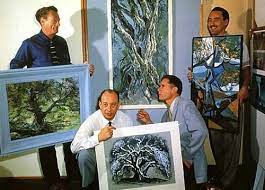
In order to show how diverse artists contribute their individual talents to a large project, Walt Disney had four of his main artists go out one day to be filmed painting their individual interpretations of a single subject. The subject was, as the title gives away, a tree.

I thought I would share the film here today. As you can see from the photo of the four artists at the top with their finished paintings, each artist has unique style and perception. It’s interesting to hear their thoughts on how they approach their subject and how they translate their vision into paint.

I was particularly interested in seeing Eyvind Earle’s technique and was pleased to hear him talk about initially painting the silhouette of the tree in black since I have always done that as well.

If you have about 15 minutes and are interested in the creative processes of four very accomplished artists, give a look at this film. Being a Disney film, it is well done.


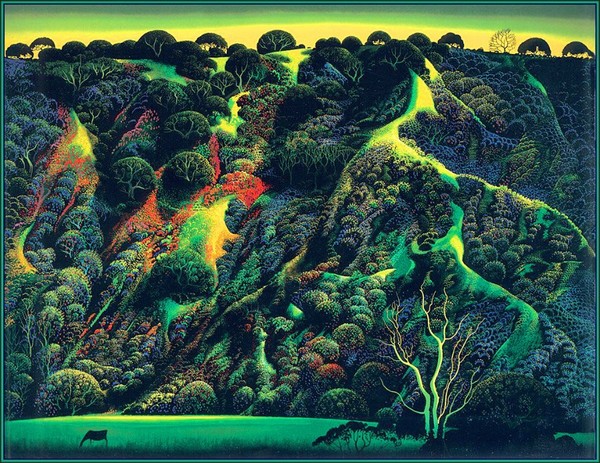
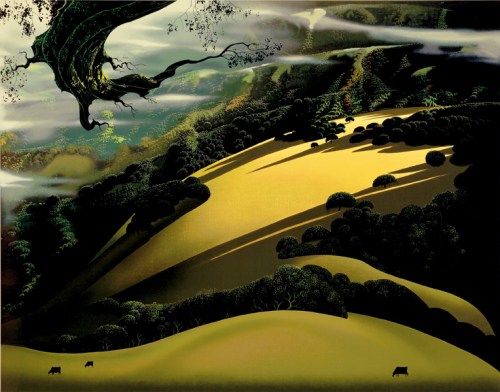
Eyvind Earle- Santa Ynez Memory

Eyvind Earle- Santa Ynez Memory


Then very slowly I go to slightly lighter colors until little by little, the forms begin to take shape and I start to see what is happening. Since I never plan in advance, I simply let myself be led by instinct, taste and intuition. And it is in this manner that I find myself creating visions that I have never before imagined. And little by little certain color effects develop that excite me and I find the painting itself leading me on and I become only an instrument of a greater, wiser force…or being…or intelligence than I myself am.

–Eyvind Earle


I have discussed my appreciation for Eyvind Earle on this blog in the past. Earle was a celebrated artist/illustrator who died in 2000 at age 84.  He was a child prodigy and had his first solo show ata gallery at the age of 14. He exhibited his work in gallery shows for many years but gained his ultimate fame with his popular stylized Christmas cards through the years and with his time spent working with Walt Disney in the 50’s and 60’s as a background artist. He was responsible for the look of many of the animated films of that time from Disney, including the classic Sleeping Beauty.

I have a massive two volume set of the works and writings of Earle’s work that I often pull from the shelf. There’s much I am drawn to in the graphic works from Earle– the colors and the rhythm of his landscapes, for example.

I am also attracted to the great clarity in his work. The compositions are often complex in design but come across as simple, a duality that I really find appealing. The color is bold and could be a little sharp in tone if it weren’t harmonized so masterfully within the picture plane. He is a pure genius at handling harmony and contrast– another duality that strikes me.

I also like the fact that Earle was an unabashed landscape artist, feeling no desire to express himself through figurative work. He found total expression in his handling of the landscape around him, often depicting the open spaces and coastlines of California. They are not mere scenes but have emotion and a depth that goes well beyond the surface, another aspect that appeals greatly to my desires for my own work.

The passage at the top briefly describing his process further links my attraction to Earle and his work. As he describes his process, I am struck by how similarly we describe how we work such as not planning anything in advance, working from light to dark colors and following the excitement of certain colors until the work seems to be taken out of our hands.

Until we become instruments.

I have often described the process and the final creation as being beyond me, the whole of the piece being more than the sum of all the parts I call myself. I have also described the sense of purpose I feel from these pieces, how I feel connected to something greater.

I can’t ever recollect using that term, instrument, before, maybe because it sounds a little presumptuous. But it does line up with what I have described in the past. And to read that Eyvind Earle felt much the same way about his work is comforting, especially on those mornings when I feel far removed from anything close to a greater force. Just knowing that the work might take me to that point where I transform into an instrument for something beyond myself makes the day seem easier to begin.


This post is edited from a combo of past blog entries. I came across the Earle passage at the top again early this morning and it really jumped out at me so I decided to combine a couple of posts since I haven’t featured Earle’s work here for several years. That leads to this week’s Sunday Morning Music which plays on the theme of being used as instruments for a greater force. The song is from Janis Joplin and is her rendition of Work Me Lord. There are some remarkable live versions of her performing this song out there, most notably from Woodstock in 1969. If you’ve ever watched her live performances you have seen someone channeling some greater force. Her studio work, like this track, is not far removed, bringing that same level of emotional commitment that made her such a compelling performer.

She was some kind of instrument.


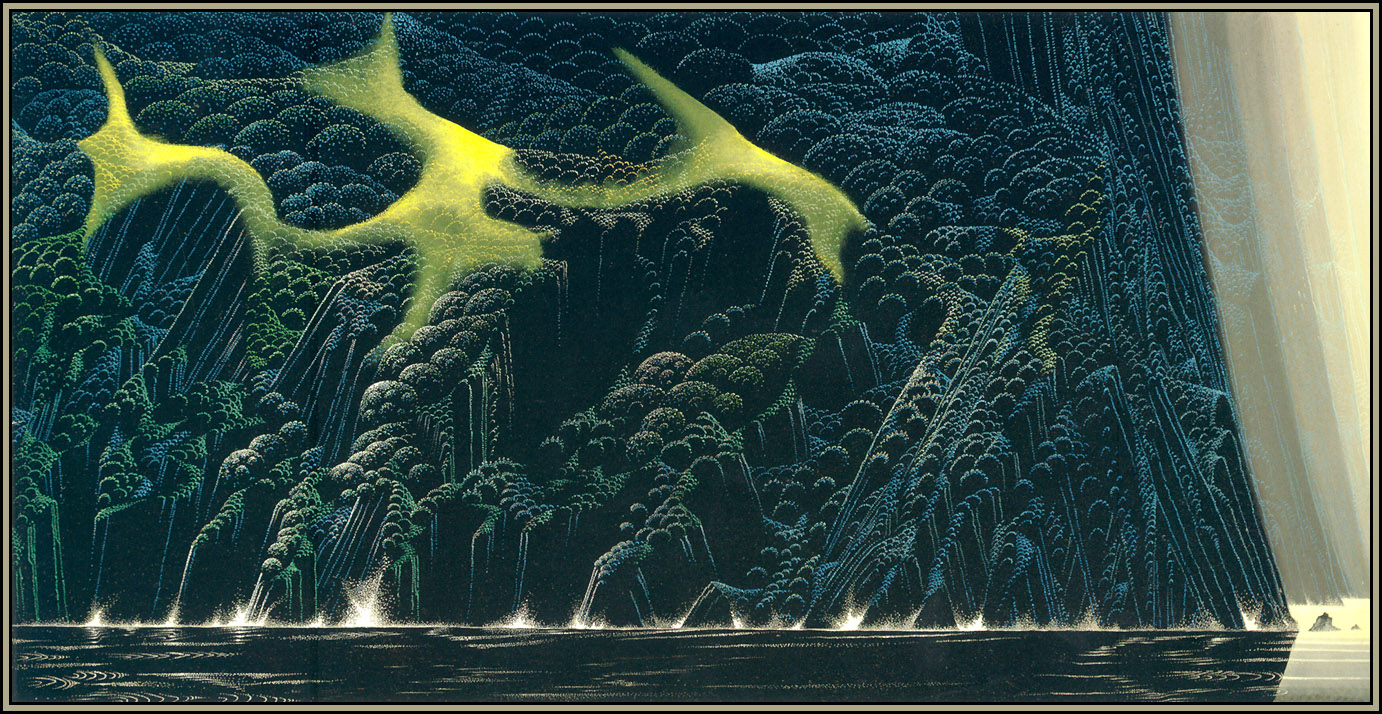
Eyvind Earle- YosemiteEyvind Earle Three OaksEyvind Earle-  Autumn EucalyptusEyvind Earle-A Sounding of Surf

Distraction


GC Myers-  BlueMoonWatch  2024

BlueMoonWatch– At Little Gems, West End Gallery

I wonder whether there will ever be enough tranquility under modern circum­stances to allow our contemporary Wordsworth to recollect anything. I feel that art has something to do with the achievement of stillness in the midst of chaos. A stillness which characterizes prayer, too, and the eye of the storm. I think that art has something to do with an arrest of attention in the midst of distraction.

— Saul Bellow, Paris Review interview, 1966


In yesterday’s post, I listed a number of ways in which I, like most of us, am limited. Looking over the list later, I realized that I had left off one very important limitation:

A finite span of attention.

Distraction comes much too easily to me. My mind often shoots from one shiny object to the next. It can be any number of things, some important and some trivial beyond belief.

It ends up often feeling like a chaotic whirlwind of distractions with bits of news, things to be done, worries, tidbits of trivia, old song lyrics, movie lines, passages from literature, reruns of old memories, details from favorite paintings, exterior sounds that nag at the edge of my consciousness, and on and on and on. Ad infinitum.

Except…

Except for those times when I am painting and everything closes off and my attention is, like Saul Bellow says above, arrested in the midst of distraction. Whatever is playing in the background is suddenly unheard and unseen. I become unaware whether it is sunny, cloudy, raining or snowing outside the large picture window just several feet away.

The whirlwind pauses and there is stillness. The only thing I see and respond to is what is in front of me. My next move. My next stroke. The constant weighing and balancing of the colors and forms which keep shifting until I feel at some point as though I am in among them.

It’s as close to a meditative state as I can imagine.

Unfortunately, it doesn’t happen every time I stand before the easel or at the table. My finite attention span and the endless world of distraction are worthy and tenacious opponents.

But when it does happen, for that brief instant there is all encompassing calmness. It might be the eye of the storm or even infinity or eternity for all I know.

But I can’t worry about what it is or isn’t.

I can just calmly accept it with gratitude.

Now get the heck out of here– you’re distracting me.

A Finite Being

GC Myers WIP February 2024

GC Myers/ Work-In-Progress, February 2024


Can a finite being ever attain infinity?

After all, isn’t that ultimately the goal of the artist, to seek that intangible state of infinity, that all-encompassing state of being beyond our knowledge and sight?

I don’t know the answer.

I do know that I am a finite being, limited in so many ways.

I have a finite amount of talent and ability.

Finite amount of intelligence.

Finite amounts of insight and experience.

Finite discipline.

Finite imagination.

Finite faith.

Finite certainty.

Finite courage.

Finite patience.

Finite energy.

Finite potential.

Finite time.

I am finite, limited in all ways.

The exception to that being seemingly unlimited amounts of fear and self-doubt.

And hope.

Hope that I can somehow exceed all my many limitations to attain that infinity I seek.

Is that enough?

Maybe. Maybe not.

And maybe one’s finiteness doesn’t matter.

Perhaps it is in the desire, the continual reaching for it, despite one’s human limitations.

I had these thoughts while working on the new painting at the top over the last few days. Thinking about it now, maybe infinity comes in the work itself.

I don’t know but, as a truly finite being, certainly hope so…

Songs We Carry


GC Myers- The Song That Brought Me Here

The Song That Brought Me Here– At Principle Gallery

What we have not had to decipher, to elucidate by our own efforts, what was clear before we looked at it, is not ours. From ourselves comes only that which we drag forth from the obscurity which lies within us, that which to others is unknown.

–Marcel Proust, Remembrance of Things Past


We all carry a lot of baggage with us on our journey through this life.  It’s a rare moment when we find ourselves free from all the traces from the past that we lug along– all the snippets of conversations, faces, song melodies and lyrics, pictures, smells, film clips and everything else we have input into the hard drive of our mind is always whirring around. I know that I will sometimes pull up some fragment from the past and wonder how I was still holding on to this piece of information. It might be the name of someone that I barely knew forty or fifty years before. Somehow it hangs on and occasionally pops out, confounding me with the idea that this seemingly useless bit of data is taking up space that could be occupied by truly meaningful information.

Like old Popeye cartoons. The one with Olive Oyl singing What We All Need is Brotherly Love runs on a loop in my head.

Or the year that Humphrey Bogart died–1957.

Or the name of the book that influenced the original Superman comic. (It was Philip Wylie‘s Gladiator— an interesting and fun read, by the way.)

Or the names of obscure musicians and their songs. Many times I have cursed Jay Ferguson and his one hit song, Thunder Island a song that I didn’t even really like– for taking up valuable space in my brain when I can’t retrieve something much more important from my memory.

Or the name and minute details of the life of someone I met once forty years ago. This becomes even more maddening now when I can’t remember the name of someone I have just met ten minutes before.

But somehow, despite and because of all this detritus, we emerge in some individual form.

A single distilled version of everything that we take in.

A single voice. One song.

Now here’s a little Popeye along with Wilco. It’s a video for Wilco’s Dawned on Me from last year [2012] and it features the first hand-drawn Popeye cartoon in over 30 years. I can’t remember if Olive Oyl danced like this in my memory but now I will.  The data has been entered.


This post is from 2013 with a few additions.


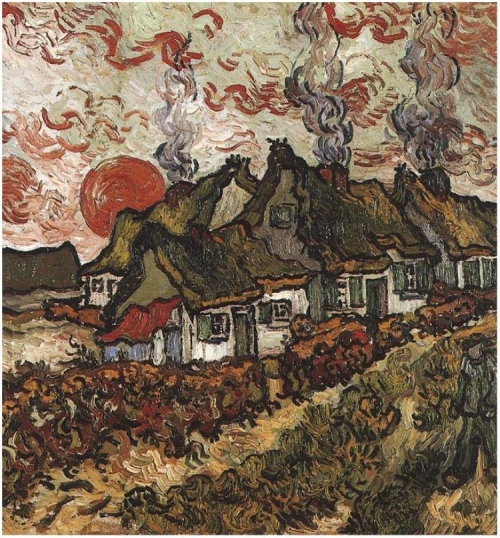
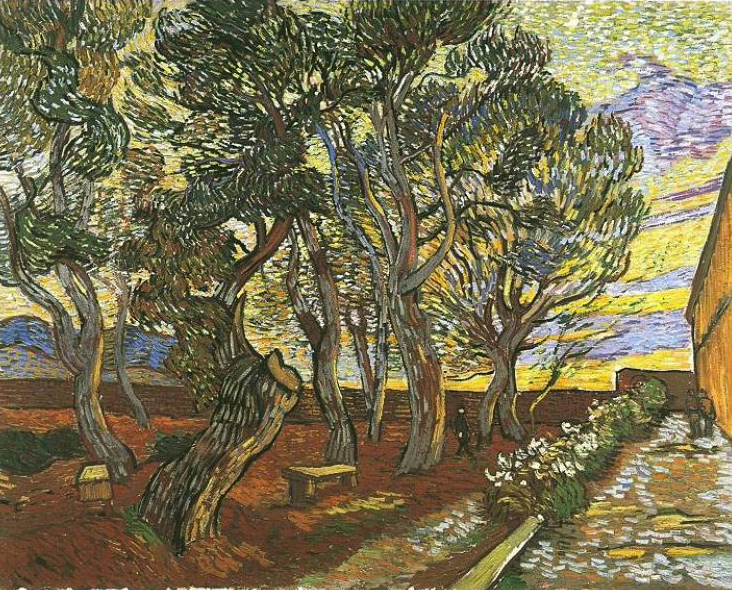
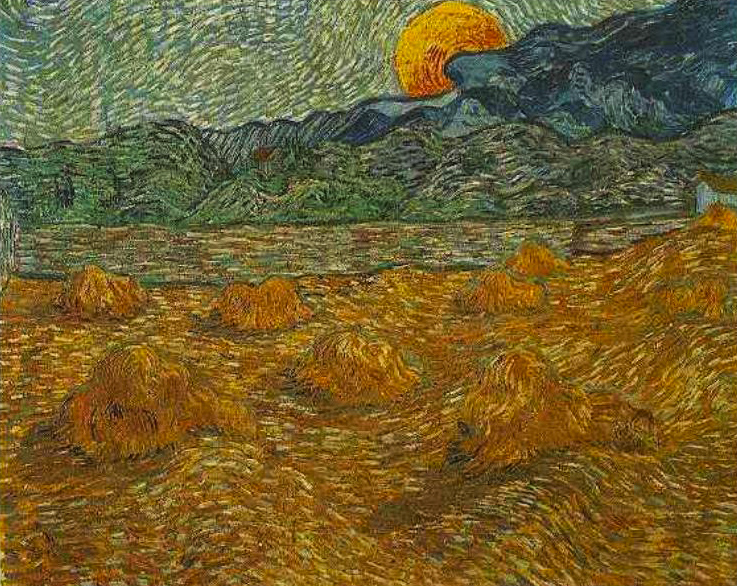
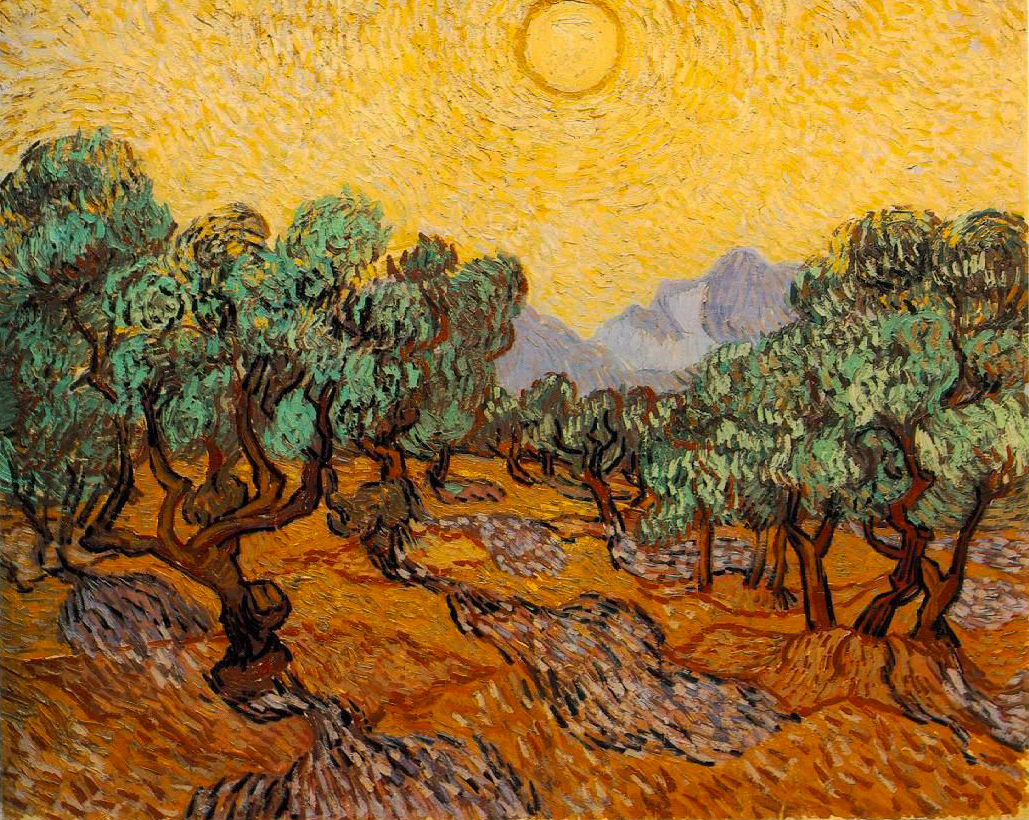
Van Gogh- Cottages--Reminiscence-of-the-North


“The world concerns me only in so far as I owe it a certain debt and duty, so to speak, because I have walked this earth for 30 years, and out of gratitude would like to leave some memento in the form of drawings and paintings—not made to please this school or that, but to express a genuine human feeling.”

― Vincent van Gogh, The Letters of Vincent van Gogh


I was wandering through the studio the other day looking at the paintings that are here. There are pieces that represent just about every year from the past 29 or 30 years. It’s been such a long time that even if it’s one or two pieces a year that end up back with me, it adds up.

But it wasn’t the number of pieces that struck me this time. It was more a question of what will become of them one day. Will they still exist long after I am gone? Will they find homes where they will spark some emotional response with their new owners or will they never be seen again as they rot in some mountainous landfill somewhere?

It was a sort of memento mori, a reminder of my death which made me somewhat sad. But it also made me hopeful that the work will somehow live beyond me and serve one day as a memento vivere, a reminder of my life. 

In the end, I realized that if even a few make it to the future, that would be alright with me. They would serve as expressions of my gratitude for my time here and hopefully help some future person recognize their life’s own uniqueness and express their own gratitude for it.

This reminded me of a post from back in 2018 that dealt with this using a passage from a Vincent van Gogh letter to his brother. I thought it was worth sharing again, if only to look at van Gogh’s wonderful works.


[From 2018]

Thought a good way to kick off this week might be to share a few paintings from Vincent van Gogh along with a quote from one of his letters that speaks very much to my own feelings about my own reasons for doing what I do. These are not his better known paintings, though some of you may well know these pieces. They’re pieces that speak to my own personal inclinations. You might notice that most of these paintings have his ball sun/moon.

The idea of feeling a need to leave a memento behind that expresses one’s gratitude and one’s expression of self is one that is not foreign to me. I often think about how my work will speak for me after I am gone. Actually, if it will speak into the future at all and if so, will it be an honest reflection, a true representation of my voice.

I know that an artist, for all of the ways they try to guide the narrative about their work and life, has little control over their work in the future.

What will be, will be.

Their voice might echo but it is always just that, an echo, a one-sided conversation from the past. Hopefully, what is said in that echo reverberates and speaks to someone of that future time so that they can fully understand and connect to the feeling behind it. And if so, with the hope that they might respond to that voice in some way that continues to give life to it.

As I said, an artist has little control over this outside of doing their work with honest efforts and emotions. It’s obvious this was the case in the work of van Gogh and we continue to have a conversation with his echoes from the past, his mementos of gratitude.


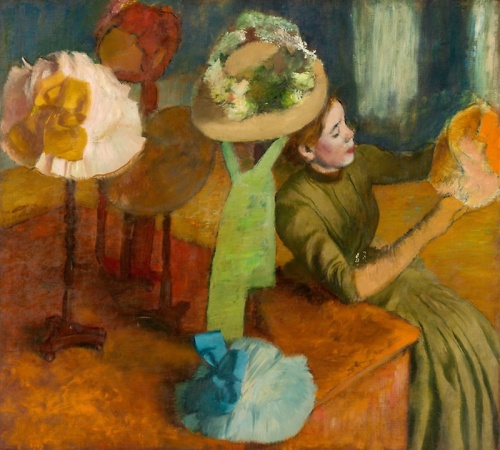
Edgar Degas The Millinery Shop

Edgar Degas– The Millinery Shop


Painting is easy when you don’t know how, but very difficult when you do.

—Edgar Degas


I have always loved this quote from the great Edgar Degas. It has meaning on a couple of different levels for me. First, it speaks to the sheer difficulty of the process of creating a painting. If you look at it as a purely mechanical process– step 1, step 2, step 3 and you’re done— it does seem exceedingly simple.

But art is not purely craft. There is an intangible element that gives it meaning for both the maker and those who take it in after it is made. Tapping into that intangible is the difficult part. Some days it is near impossible and makes the job very difficult, even though it might seem easy and effortless on its surface.

Been there, done that. In fact, sometimes having more skills and tools available sometimes hinders creativity as the artist begins to rely on the tried and true, which sets a limit on their further exploration.

The second meaning I get from Degas’ quote is how others view this job. I know folks who can only view art as a hobby and if you’re working as an artist, you’re just fooling around with doodles and such. They often don’t see it as work at all. They don’t understand that it is much more than having a particular ability. They don’t see the great effort that is required to have a career as an artist.

The long hours alone. The sacrifices you make to be able to have enough time.

The often sheer frustration that comes in creating work. The days and weeks and months spent feeling blocked and uninspired, times in which you question your own ability and value as an artist.

The many hours spent doing unseen and boring things like photographing, prepping, matting, framing and varnishing that are required to make the work presentable.

The agony of having to constantly self-promote in order to keep your name visible in the public eye. For most artists wanting to support themselves in the current business of art, they must serve as their own primary advocate.

The pain of having your work–- your creation and your voice— ignored, outright rejected or under-valued, not to mention the self-doubt that comes along with these things.

I am sure there are a bunch of other crappy things that are just slipping my mind at the moment.

This isn’t meant to be a whine fest. Every business has its own challenges, and I am sure anyone who has ever been self-employed can see their own situation in most of these things. For example, every restauranteur knows that great food is not enough to make a restaurant successful.

I understand and accept these pitfalls and they don’t detract from my view of this career at all. I just want people to understand that an artist’s life is not unlike their own with most of the same challenges and problems. It may sometimes seem easy, even romantic, but that is just the view from far outside.
.
That being said, I wouldn’t trade this job for any other. Thanks for allowing me to think that.


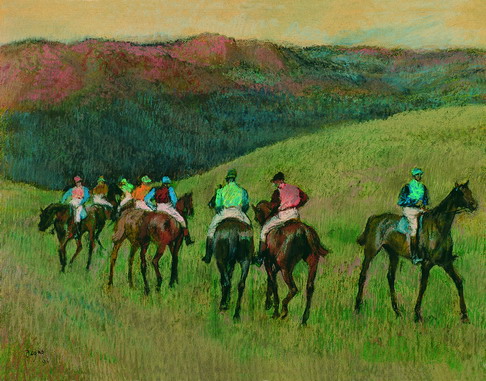
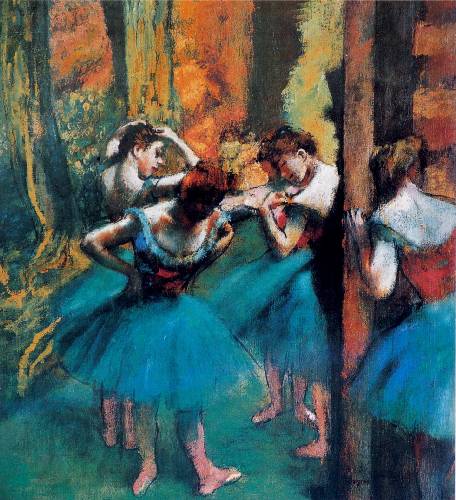
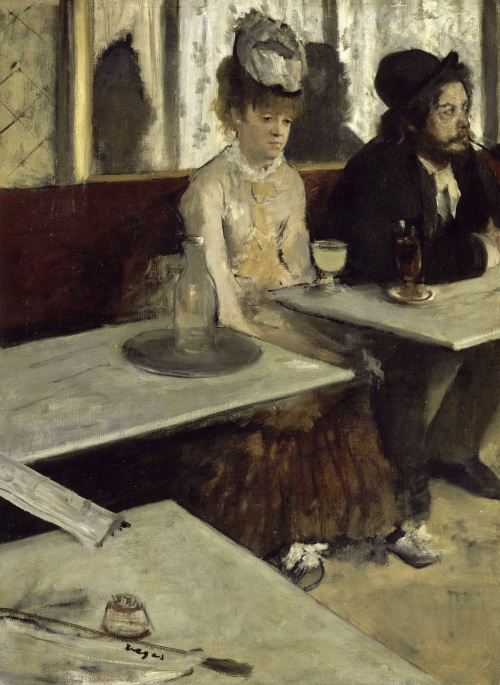
This post was from back in 2018. I apologize for it not being more about Degas’ work. I tried to make that clear in the title for the reposting. To make up for it, here are some more my favorites from Edgar Degas:


edgar degas- four-dancers-1900Edgar Degas- Horses in a LandscapeEdgar Degas Blue_DancersEdgar_Degas_-_In_a_Café_-_Google_Art_Project_2Waiting-pastel-paper-Edgar-Degas-1882