Feeds:
Posts
Comments

Man on the Moon

GC Myers- Cool Contemplation

Cool Contemplation— At Principle Gallery


The two ways of contemplation are not unlike the two ways of action commonly spoken of by the ancients: the one plain and smooth in the beginning, and in the end impassable; the other rough and troublesome in the entrance, but after a while fair and even. So it is in contemplation: If a man will begin with certainties, he shall end in doubts; but if he will be content to begin with doubts he shall end in certainties.

–Francis Bacon, The Advancement of Learning (1605)


I don’t know exactly why I chose the three parts of today’s triad. Maybe they don’t exactly line up up with one another. Maybe they do. Take them for what they’re worth.

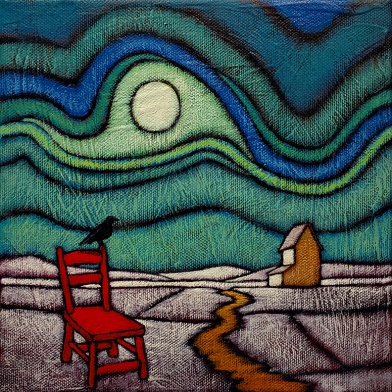
Being Sunday and needing a song to play, I chose the song first. It was R.E.M. and their Man on the Moon. Next, looking for an image, I came across the piece at the top, Cool Contemplation. The clarity of its light and the positioning of the moon made me feel as though the crow was contemplating some great thought, perhaps something to do with the moon, the house in the distance or the even more distant moon.

Maybe he was pondering whether he could fly to that moon? It seems so close.

The passage from Francis Bacon seemed to just fall into place. We often have a lot of certainty in our beliefs and opinions. These are sometimes unfounded and untested, simply based on what we want to believe. Plain and smooth as Bacon might have put it. It’s the easy way and the one chosen by most of us.

But it is best when our opinions and beliefs are grounded in long contemplation that involves challenging them, discarding the flaws of logic and fact that are uncovered, and then reevaluating and adjusting them.

As Bacon points out, it’s rough and troublesome. Not the easy way.

Reading bacon’s quote felt like it belonged in today’s triad. It is a celebration of real productive contemplation, the kind born of uncertainty and curiosity. It also reminded me of a certain political movement– a cult, if you will– who has very much embraced the easy way. There is no self-awareness nor self-reflection in this movement. They are adamant in their certainty, never challenging their first reactions or beliefs and never discarding flaws of fact or logic. And because they refuse to acknowledge the factual mistakes and problems in their logic, they never reevaluate or readjust.

It remains constant. Which means it is forever grounded in its errors and misunderstandings. According to Bacon, it will ultimately end in doubt and failure.

It will certainly never achieve the certainty of truth.

Okay, enough. You know I want to write more on this and be much more explicit and maybe drop a few f-bombs here and there. I am trying to keep this space free of the craziness out there. I have enough in here for all of us.

So, take what’s here for what it’s worth.

Here’s R.E.M. with Man on the Moon.


GC Myers- Lit Candles sm

Lit Candles, 2006


We were so close, there was no room
We bled inside each other’s wounds
We all had caught the same disease
And we all sang the songs of peace
Some came to sing, some came to pray
Some came to keep the dark away

— Melanie, Lay Down (Candles in the Rain)


Wasn’t going to write this morning. Looking for the Muse, you know. That kind of thing. But I thought it should be noted that singer/songwriter Melanie died this week at the age of 76. Most of you who remember Melanie most likely immediately think of a couple of her hits from the early 1970’s, most notably, Look What They’ve Done to My Song, Ma and Brand New Key. The latter was almost a novelty hit with lyrics that may be familiar to you if you are of a certain age: I’ve got a brand new pair of rollerskates/ You got a brand new key.

But she had chops, being one of only three solo women to perform at Woodstock. In fact, this song, Lay Down (Candles in the Rain), was written about her experience at that festival. It’s a song that dropped off my radar for many years until I found it again a few years back. I always get a thrill out of this version with the Edwin Hawkins Singers.

Great and memorable stuff. G’bye, Melanie. Thanks.

Now, where’s that Muse?


Hard-Earned Joy

GC Myers- Breaking Joy  2023

Breaking Joy–At Principle Gallery


Joy lies in the fight, in the attempt, in the suffering involved, not in the victory itself.

— Mahatma Gandhi


How do you define joy? Is there such a thing as joy that is the same for every person or is finding joy strictly a personal preference? Are there people who live without any joy at all in their lives or are there moments in everyone’s lives where they experience something close to joy? Maybe it’s not a giddy kind of joy. Maybe joy for some is a feeling of contentment, an absence of fear, an absence of pain.

Maybe that’s it. Maybe joy is finding that which takes away our fears and pains.

I don’t know. I know that it doesn’t have to be sought. It’s just there or it’s not. For me, it might be as simple as laying in the grass and having my dog come over and lay against my chest. It might be in sipping a cup of tea or watching the deer graze laconically in the yard. It might be in laughing out loud at something I’ve seen a hundred times yet still find funny or in making my wife laugh, something which gives me the greatest joy.

It can seem so simple. Yet I see people who seem joyless and I wonder where the joy might be in their life.

Certainly, they must have something which brings them something akin to joy. At least contentment. But maybe it’s not for me to see or maybe they live a joyless existence. Who knows? Just something I wonder about on a sunny morning when the sun filtering through the trees, scattering patches of light on the thick grass beneath them, brings me joy.


The above was posted here back in 2009. Some things have changed. It’s not a sunny morning for one thing. And our good girl, Jemma, our rescue Corgi, passed away years ago so the joy of her resting against my chest is no more. But there is still joy in the contented purrs of our cats, especially the feral family that currently occupies my garage. There is something so satisfyingly joyful in having a near-wild creature choose to let you love them. To trust you.

The mother cat disappeared for several days last week. We feared she was dead. I was heartbroken since she had transformed from what was originally a snarling, swatting wildcat into a creature that openly showed her affection for me with loud grinding purrs and soulful, contented gazes up at me as I petted her.

Thankfully, she returned a few days ago and we were joyful. But she was obviously injured and kept her distance. We believe she had an encounter with a raccoon in the garage.

But in the last day or so, she has progressed and returned to the garage which I seal up at night so that no other creatures can enter. She is on the mend, moving much better, and has allowed me to once again stroke her.

She is back once more with her purrs and stares. It’s a small thing but it makes me happy.

Gives me joy.

And maybe that is the sort of victory that Gandhi described at the top, the kind that remains after persevering and enduring all the hardships this world sometimes bestows upon us.

Maybe hard-earned joy is the ultimate victory.

Pilgrim Rock


GC Myers- Pilgrim Rock 2024

Pilgrim Rock– At West End Gallery

And thus ever by day and night, under the sun and under the stars, climbing the dusty hills and toiling along the weary plains, journeying by land and journeying by sea, coming and going so strangely, to meet and to act and react on one another, move all we restless travellers through the pilgrimage of life.

-Charles Dickens, Little Dorrit


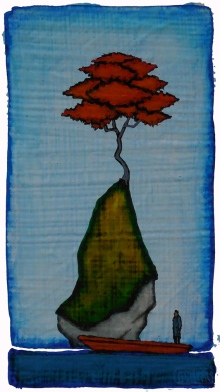
This is a new small painting, 4″ by 2″ on paper, included in this year’s edition of Little Gems at the West End Gallery.  The title that came to be attached to it is Pilgrim Rock. I am not exactly sure what it was in this piece, what mental connection was made, that brought that title.

I did see this odd, perilous little island as an enticement, a thing of strangeness and beauty that creates a longing in one who sees it from afar. The island with its Red Tree atop it draws these pilgrims but even as the pilgrim comes near to reaching this longed for place, its steep rocky walls keep them at a distance.

I don’t know exactly what that means in psychological terms, or if it has meaning at all. Or if what I see in it will be the same or similar to what anyone else sees. I could certainly imagine a number of other interpretations of it that tell much different stories.

I find this interesting that such a small and simple image could have multiple meanings and narratives attached to it. I think it’s that, even though it is limited in size and detail, it has space in it for the viewer to add their own feelings and experiences, to perhaps see themselves as the Pilgrim or the Red Tree.

Pieces like this with multiple possibilities create an enigma that always intrigues me.

Here’s a song to fill out today’s triad of image, word and song. It’s Pilgrimage from R.E.M. in 1983. It’s a song whose lyrics also offer multiple possibilities and interpretations, much like Pilgrim Rock. I sometimes find this song brightly positive and sometimes darkly cynical. My interpretation is as much about my feelings at the time as the song itself.

Like I said, an intriguing enigma.


I want everything we do to be beautiful. I don’t give a damn whether the client understands that that’s worth anything, or that the client thinks it’s worth anything, or whether it is worth anything. It’s worth it to me. It’s the way I want to live my life. I want to make beautiful things, even if nobody cares.

–Saul Bass


Saul Bass is not a name that probably jumps to the mind of many people. It’s a name that was employed in a Seinfeld episode but that’s not the Saul Bass and his work that I’m sharing here today. No, the Saul Bass I’m talking about lived from 1920 until 1996 and is considered a groundbreaking graphic designer, best known for his work in the movies. The three movie posters at the top feature Bass’ signature work. If you watched many movies over the years, you no doubt have seen his work in the opening credits or in movie posters.

He was also served as a visual consultant on many well-known films (Spartacus, for example) and was an acclaimed filmmaker. He made a short film called Why Man Creates which won the Academy Award for Documentary Short Subject in 1968. The film featured a series of vignettes on creativity. You can watch the entire film on YouTube. It is about 22 minutes long so today I am sharing the opening segment, called The Edifice, which basically summarizes the entire history of man’s creative endeavors in the form of a rising building. I thought I’d share it because it’s a fun piece and you might recognize Bass’ signature style. But I also wanted to share it because creates a rising continuum in which our own creative endeavors have a place and purpose.

That’s important to remember.

Take a few minutes to enjoy this then check out the photo below of Bass and another designer laying out the animation artwork alongside a segment of it.


In Full Regalia

GC Myers-  In Full Regalia sm

In Full Regalia— Coming to West End Gallery


He alone is great and happy who fills his own station of independence and has neither to command nor to obey.

-Johann Wolfgang von Goethe, Götz von Berlichingen


The new painting above is a small one, coming in at a mere 5″ by 5″ on panel. It is headed to the West End Gallery later this week for their annual Little Gems show that opens in early February.

I call this painting In Full Regalia. I tend to view pieces such as this as much portraits as they are landscapes. The crown and trunk of the tree represent the head and neck of the portrait’s subject while the mound on which the tree grows serves as the shoulders and body.

For this piece, the multicolored plots of land that make up the mound reminded me of a rich robe, something that might have been worn by royalty.

It made me think that this might be a royal portrait.

And in a way, it is and was meant to be such.

The idea of self-sovereignty is a recurring theme in my work. And in my life.

It’s a concept where the individual maintains sole authority over their body and mind, action and thought. They alone determine the direction of their life and the choices they make.

They are, in effect, rulers over the realm that is their life.

It’s a way of looking at one’s life that is very much focused on personal independence and the power of the individual. I think that is why the Red Tree most often stands alone in my work, way from the other gathered trees that make up the forest. Maybe it’s a need for elbow room or the desire to be seen as an individual rather than part of a group.

Whatever the reason, we often notice the tree that stands alone in the landscape. Much as we often notice the individual who lives their life in the way they choose. Those who march to the beat of a different drum.

That’s seems like a perfect segue into a song to complete today’s triad. The song is Different Drum which, as many might know, was a hit record for Linda Ronstadt with the Stone Poneys in 1967. However, the song was written by Michael Nesmith in 1964, a few years before he became best known as the droll, stocking-capped guitarist for The Monkees. It was originally recorded by a bluegrass group, The Greenbriar Boys, in 1964 though the song was performed much in the same way as the later Ronstadt/Stone Poneys version. Nesmith recorded it in 1972 and it has a more folkie, bluegrassy sound. I like it a lot.

It’s its own thing. Like the Red Tree, it stands apart from the forest.


Evercool

Evercool - GC Myers 2024

Evercool— Coming to Little Gems, West End Gallery


One of the many suppressed longings of creation which cry after fulfilment is for neglected joys within reach; while we are busy pursuing chimerical impossibilities we famish our lives… The emptiness left by easy joys, untasted, is ever growing in my life. And the day may come when I shall feel that, could I but have the past back, I would strive no more after the unattainable, but drain to the full these little, unsought, everyday joys which life offers.

–Rabindranath Tagore, Glimpses of Bengal (1921)


The painting at the top is new, an 8″ by 8″ piece on wood panel that is headed to the West End Gallery in the next week for inclusion in the annual Little Gems exhibit. The title for this painting is Evercool.

I think the strength in this piece comes in its contrasts. It feels cool yet there is considerable underlying warmth. It has motion yet it also possesses great stillness. It feels dark yet has much light.

Just little joys.

Appropriate for a Little Gems show. This year marks my 30th Little Gems exhibit at the West End Gallery. My first, in 1995, was my first experience showing my work in public. At that point, I had no idea that I could possibly do this as a way of life and that decades later my life would center around this work. But that’s the way things turned out and now I can’t imagine doing anything but this.

Another little joy.

For this week’s Sunday Morning Music, I chose a song that may not completely mesh with this painting and the always wise words of Rabindranath Tagore. It’s an acoustic version of the old Procul Harum song, A Whiter Shade of Pale, from Dave Matthews while on an appearance on the Howard Stern show. It’s a lovely version.

You know, now that I think about it, maybe this performance does fit in. It has a very bittersweet feel– much like that produced by the contrasts in Evercool.

Another little joy on a bleak, cold winter Sunday morning. All we can hope for.


Getting to Know Klimt

Gustav Klimt-Beech Grove I

Gustav Klimt- Beech Grove I


Whoever wants to know something about me – as an artist which alone is significant – they should look attentively at my pictures and there seek to recognise what I am and what I want.

—Gustav Klimt


I shared this quote from the artist Gustav Klimt several years ago. The post it was in didn’t have any commentary, only the quote and several of Klimt’s lesser-known paintings, not the famous pieces like The Kiss. I love his landscape paintings, especially his trees, and would surmise, adhering to his own words, that he had a high regard for the landscape and trees around him.

That’s a pretty simple observation. Maybe that’s one of the things he would expect a viewer learn about him from his work. Maybe not. Perhaps he was thinking about how he valued organic forms, the beauty of color or the intimacy of the embrace.

It made me wonder how much any artist really reveals of themselves in their work and what viewers might take from my own work. Does the impression of the artist that viewer has from looking at the work jibe with the reality of the artist or even the artist’s desired perception of themself?

I don’t know that there is an answer for those questions that applies to every artist. I suppose if an artist paints freely without contrivance, they might well reveal much of who and what they are. I can think of many artists whose work I admire who I feel have done just that.

Maybe it doesn’t really matter. Maybe so long as someone sees something they can connect with in any one work, the whole of the artist doesn’t play any part. There are certainly works that I admire that reveal little to me of who the artist is as a person. That makes sense since you seldom know who a person is from a single encounter.

I would certainly hate to have anyone base their impression of me on one encounter. After all, how many people have I come across on days when I am not at my best?

Yikes.

I guess knowing the artist comes with a number of encounters, after an artist has established a recognizable voice in their work. Then the viewer can pull out the subtle, unconscious elements that hint at who the artist is in reality.

Okay, that’s enough. This was meant to focus on Klimt’s paintings. Here are some of my favorite from his landscapes along with a video featuring a larger body of better-known work from Gustav Klimt put together by a Brazilian musician, Juliano Cesar Lopes, who creates musical scores for films under the name JCSL Studio Recording. He has produced a number of short films like this one as a showcase for his skills.

Maybe you will now Klimt a bit better after watching? Who knows?


Gustav_Klimt_068Gustav Klimt_-_Bauerngarten_mit_Sonnenblumen_-_ca1907

Gustav Klimt The-Sunflower 1907

Gustav Klimt The-Sunflower, 1907

Gustav KlimtFarm Garden with Crucifix Gustav Klimt

Church in Cassone Gustav Klimt

Gustav Klimt- Church in Cassone

Gustav Klimt--Mountain-slope-at-Unterach

Gustav Klimt The Big Poplar 1902

Gustav Klimt, The Big Poplar, 1902

Maybe…

GC Myers- Point of Contact 2016

Point of Contact, 2016


The world is full of magical things patiently waiting for our wits to grow sharper.

Bertrand Russell


These handful of words from the great British thinker Bertrand Russell succinctly sums up the idea behind much of my work. And that is that there is a world of wonder within our grasp if only we make the effort to recognize the patterns and forces of which they are comprised.

I have said before that we are part of a greater pattern. I believe that it can be found in two simple ways– either looking inward or looking outward. Since we are formed from and dwell within this pattern, we can find parts of by examining our own inner world, our thoughts and dreams. Or we can examine the world immediately around us for the hints of the pattern that are everywhere if only we can recognize them.

Unfortunately, in this busy modern world we too often find ourselves doing neither. We live in a sort of limbo where we are mesmerized by the glossy lure of technologies that occupy our every moment. It keeps us in a state of limbo where we are neither looking inward or outward, as our eyes and thoughts are transfixed by the screen in our hands.

Don’t get me wrong, I’m no technology-resisting Luddite. I embrace and depend on the wonders of this technology as much as anyone. And laud it when it serves a real purpose, when it expands our knowledge and transmits it to the far corners of the world. The possibilities for the good benefits from technology are seemingly endless.

But none of it matters if we lose contact with the greater powers and wonders that surround us every day, forces and patterns that patiently wait for us to unravel the magic that makes them invisible to us.

I know to some that this sounds like a bunch of mumbo jumbo. Maybe the idea of great forces and patterns surrounding us seems a bit loony to some. I get that. But set that aside, if you must, and simply consider the benefits of looking away from your smartphone or laptop for a short time each day to examine the inner and outer world outside of that screen. Maybe if we do this on a regular basis our wits will sharpen to the point that we will better see that world of magical things as Bertrand Russell pointed out.

And if we can achieve that maybe we can one day achieve one of Russell’s great hopes, taken from his 1954 book, Human Society in Ethics and Politics:

I allow myself to hope that the world will emerge from its present troubles, that it will one day learn to give the direction of its affairs, not to cruel swindlers and scoundrels, but to men possessed of wisdom and courage. I see before me a shining vision: a world where none are hungry, where few are ill, where work is pleasant and not excessive, where kindly feeling is common, and where minds released from fear create delight for eye, ear and heart. Do not say this is impossible. It is not impossible. I do not say it can be done tomorrow, but I do say that it could be done within a thousand years, if only men would bend their minds to the achievement of the kind of happiness that should be distinctive of man.

It’s one of my great hopes as well. On some days I sense that we are closer to achieving this than it seems while on other days it feels as though we are doomed by our own greed and selfishness.

But the hope remains and perhaps one day, maybe a thousand years from now, if we have endured the damage done to ourselves by our greediness and have sharpened our wits, we will realize that hoped for state of being.

Maybe…


This is a post from 2016 that I have edited, including the addition of the last Russell passage. The painting at the top, Point of Contact, is from that time and is one of those paintings that has returned to me. Probably because I associate it so closely with the sentiments in this blog post, it remains a favorite of mine.

Court and Spark at 50

Joni Mitchell- The Mountain Loves the Sea- watercolor 1971

Joni Mitchell- The Mountain Loves the Sea- watercolor 1971


Everything comes and goesMarked by lovers and styles of clothesThings that you held highAnd told yourself were trueLost or changing as the days come down to youDown to youConstant strangerYou’re a kind personYou’re a cold person tooIt’s down to you

— Joni Mitchell, Down to You


Yesterday marked the 50th anniversary of the 1974 release of the album Court and Spark from Joni Mitchell. It has been a favorite of mine for those many years, though sometimes it fades from my playlist for a short while. But it always breaks back onto it and each time it does it feels like hearing it anew for me. The same of thrill and appreciation in hearing each song. It has aged well, at least to these ears.

Thought it would be a good morning to replay a post from back in early 2020 about the influence I found in it along with a song from it I haven’t played here before, Down to You.


Over the years, I have often been asked about influences on my work and I often list several artists that I feel pushed me in certain directions. Then I also point out that there have been influences that fall outside of the painter mode. For example, literature, poetry and film come immediately to mind. Then there’s pop culture such as cartoons and comics, television and so much more. I’ve mentioned that there was a Coca Cola tv ad back in the 80’s that featured saturated colors– reds and golds– that stuck in my mind for years before I began painting.

There are so many contributing sources of inspiration.

I mention this today because as I was looking for a piece of music to play this morning, I came across the old Joni Mitchell album from 1974, Court and Spark. It was a great album, one that I loved even as a teenage boy. I had not listened to it in several years but each of the songs was imprinted in me by this time.

I also hadn’t looked closely at its album cover for many, many years though it was a beautiful cover, cream colored with a small watercolor painting, The Mountain Loves the Sea, that Joni Mitchell had painted a few years before, tastefully in its center. It had a simple elegance that I recognized, again even as a teenage boy. But it was just one of those things that, because I had seen it so many times before, I didn’t look with any attention at all.

But I looked closer today at the painting in the cover’s center and was surprised at how much my own work sometimes held echoes of this little painting. I would never thought of Joni Mitchell as an influence beyond her music but looking at this little image made me rethink that.

Maybe it was just one of those little things that push you, without your knowledge, in one direction or another. Influences that you internalize and can’t recognize or name until you come face to face with them. We all have them, those small things we take in and blend together to make us who we are.

I am glad this album was one of those things for me.