If you’re doing nonsense it has to be rather awful, because there’d be no point. I’m trying to think if there’s sunny nonsense. Sunny, funny nonsense for children — oh, how boring, boring, boring. As Schubert said, there is no happy music. And that’s true, there really isn’t. And there’s probably no happy nonsense, either.
–Edward Gorey, Ascending Peculiarity: Edward Gorey on Edward Gorey
Going to keep it short on this Sunday Christmas Eve morning. Always been a fan of Edward Gorey and his darkly skewed perspective on things. I think his words above echo my own feelings on things, that anything that really reaches across to people on an emotional level, be it children’s books, music, literature, painting or any other medium, is seldom totally happy.
That probably applies to holidays, as well. I imagine that mixed in with all our happy memories of past holidays there are more than a few instances of sadness and disappointment.
And that might be the beauty of it.
Who knows?
So, for this Sunday Christmas Eve morning let me share the images and prose from the collaboration of Edward Gorey and John Updike that is The Twelve Terrors of Christmas. It is darkly droll, the perfect counterbalance to seasonal saccharinity of Hallmark movies and wooden Christmas songs from popstars.
It makes me smile and that’s all I need today.
At the bottom is the full instrumental version of Christmas Time is Here from the Vince Guaraldi Trio. Somewhat like the work of Gorey, it is bittersweet. Beautiful yet not fully happy.
From early in November to the last week of December I got money matters weighing me down Oh the music may be merry, but it’s only temporary I know Santa Claus is coming to town
–Paul Simon, Getting Ready For Christmas Day
On an episode of The Colbert Report back in December of 2010, Paul Simon appeared and played a new Christmas song called Getting Ready For Christmas. It was a song that dealt with the pressure to celebrate the holiday while dealing with real life problems.
Before singing, Simon explained that his song was based on a sermon from December of 1941, in the weeks after Pearl Harbor. The preacher was the Reverend J.M. Gates, a fire-and-brimstone Baptist from Atlanta who was famous for recordings of his sermons in the years before his death in 1945. I didn’t know much about him and had never heard the name before writing this post in 2010 but discovered that he was a superstar of the era, one of the most prolific recording artists, if that’s what he might be considered, with over 200 sermons recorded and sold at the time.
I liked the Simon song and there were samples of Gates’ recordings in the background at certain points in the performance that intrigued me. I don’t know exactly which sermon Simon sampled but there are numerous examples of Gates’ work online. One, Death’s Black Train Is Coming, from 1926, was his bestseller and is a great example. My favorite however is Hitler and Hell which is a rhythmic sermon that plays very well in the video off the sound of the footsteps of the jackbooted figure moving through the darkness in it.
Another of Gates’ most popular sermons, Will Your Coffin Be Your Santa Claus! (Or a variation of it, Death Might Be Your Santa Claus) sounds like it might be the one. Funny, that with such a catchy title it never caught on like Jingle Bell Rock or Grandma Got Ran Over By a Reindeer.
Anyway, gives a listen to the Rev. Gates, if you are so inclined. If not, here’s the Paul Simon take on Gates’ sermon, Getting Ready For Christmas. Not a song you hear on the radio stations that play Christmas music this time of year. But it is a good tune with a very watchable video.
Practice giving things away, not just things you don’t care about, but things you do like. Remember, it is not the size of a gift, it is its quality and the amount of mental attachment you overcome that count. So don’t bankrupt yourself on a momentary positive impulse, only to regret it later. Give thought to giving. Give small things, carefully, and observe the mental processes going along with the act of releasing the little thing you liked.
–Robert A.F. Thurman, American Buddhist author/professor
I like this bit of advice.
Give away things that mean something to yourself, something to which, as Thurman points out, you have a mental attachment that must be overcome. That’s always been the yardstick I use when giving away work at my talks or simply as a gift. It has to be something that hurts a bit to give away, something that you just want to hold onto a bit longer.
But giving away the valued things of self brings on a feeling of magnanimity in myself, a feeling that seems so much larger and grander than that which usually comes along with clinging onto something. The feeling of generosity is warm and encompassing, like a field of fully opened sunflowers reaching toward the sun. On the other hand, miserly stinginess feels cold and all balled up, like a hard raisin sitting on a frigid garage floor.
And you most likely will find that the more that you give away, your desire to cling on to these things will fade away.
Let me clarify– I am not saying that you should give away everything you have. Again, as Thurman also points out, don’t bankrupt yourself on a momentary positive impulse. First of all, a large or expensive gift doesn’t necessarily have any emotional attachment. Sometimes a small but thoughtful thing, even something that might appear trivial to someone from the outside, can hold the most lasting meaning.
So, don’t equate price with meaning. But give when you can or when it is needed and don’t be afraid to give of yourself, even if it’s only a few sincere words on a piece of paper. Those always ends up being the gifts that hold the most meaning for both the giver and the receiver.
But you probably knew this, right? So, let’s listen to a song with a similar message from JD McPherson and his fun holiday album, Socks, from a few years ago. This is All the Gifts I Need.
This post ran a few years back, in 2020. I was reminded of it when a longtime reader of the blog recently reminded me of the enjoyable Christmas album, Socks, from JD McPherson. Doing a search to see when I last shared a song from the album, I saw that it was attached to this post. Reading it again reminded me that it is the same guiding principle I use when choosing paintings that I sometimes give away at gallery talks. I want the choice to mean something to me, to have a small pang of regret or feeling of having sacrificed something when it leaves my hands. I believe– or at least, hope– that the recipient senses this feeling and perhaps values it a bit more knowing it was given with real consideration.
I have also added the album’s title song, Socks, at the bottom. It’s a live version and captures the feeling of a kid getting a gift without much meaning, one that is just given just to be a gift.
At this the fathers shook their heads, being themselves unable to understand how Claus had gained admittance to their homes; but the mothers, watching the glad faces of their dear ones, whispered that the good Claus was no mortal man but assuredly a Saint, and they piously blessed his name for the happiness he had bestowed upon their children.
“A Saint,” said one, with bowed head, “has no need to unlock doors if it pleases him to enter our homes.”
And, afterward, when a child was naughty or disobedient, its mother would say:
“You must pray to the good Santa Claus for forgiveness. He does not like naughty children, and, unless you repent, he will bring you no more pretty toys.”
But Santa Claus himself would not have approved this speech. He brought toys to the children because they were little and helpless, and because he loved them. He knew that the best of children were sometimes naughty, and that the naughty ones were often good. It is the way with children, the world over, and he would not have changed their natures had he possessed the power to do so.
And that is how our Claus became Santa Claus. It is possible for any man, by good deeds, to enshrine himself as a Saint in the hearts of the people.
–L. Frank Baum, The Life and Adventures of Santa Claus, 1902
I have shared a shorter version the passage above from the 1902 book, The Life and Adventures of Santa Claus, from L. Frank Baum here in recent years. I thought that a bit fuller version would be more appropriate, especially with that final line.
I also liked the explanation of how Santa could enter a home without anyone knowing. It also reminded me of a poem from the late Shel Silverstein, called Christmas Dog which gave a dog’s viewpoint on Christmas. This pup was definitely aware of Santa’s entrance.
Tonight’s my first night as a watchdog, And here it is Christmas Eve. The children are sleepin’ all cozy upstairs, While I’m guardin’ the stockin’s and tree.
What’s that now–footsteps on the rooftop? Could it be a cat or a mouse? Who’s this down the chimney? A thief with a beard– And a big sack for robbin’ the house?
I’m barkin’ I’m growlin’ I’m bittin’ his butt. He howls and jumps back in his sleigh. I scare his strange horses, they leap in the air. I’ve frightened the whole bunch away.
Now the house is all peaceful and quiet again, The stockin’s are safe as can be. Won’t the kiddies be glad when they wake up tomorrow And see how I’ve guarded the tree.
Let’s finish this off today with a holiday song. I’ve played this song, Must Be Santa from Bob Dylan, a few times over the past decade. It’s a great song, a rollicking polka with a klezmer feel that takes Dylan back his Jewish roots. Plus, in the entertaining video you get the bonus of seeing Dylan dance. Good fun.
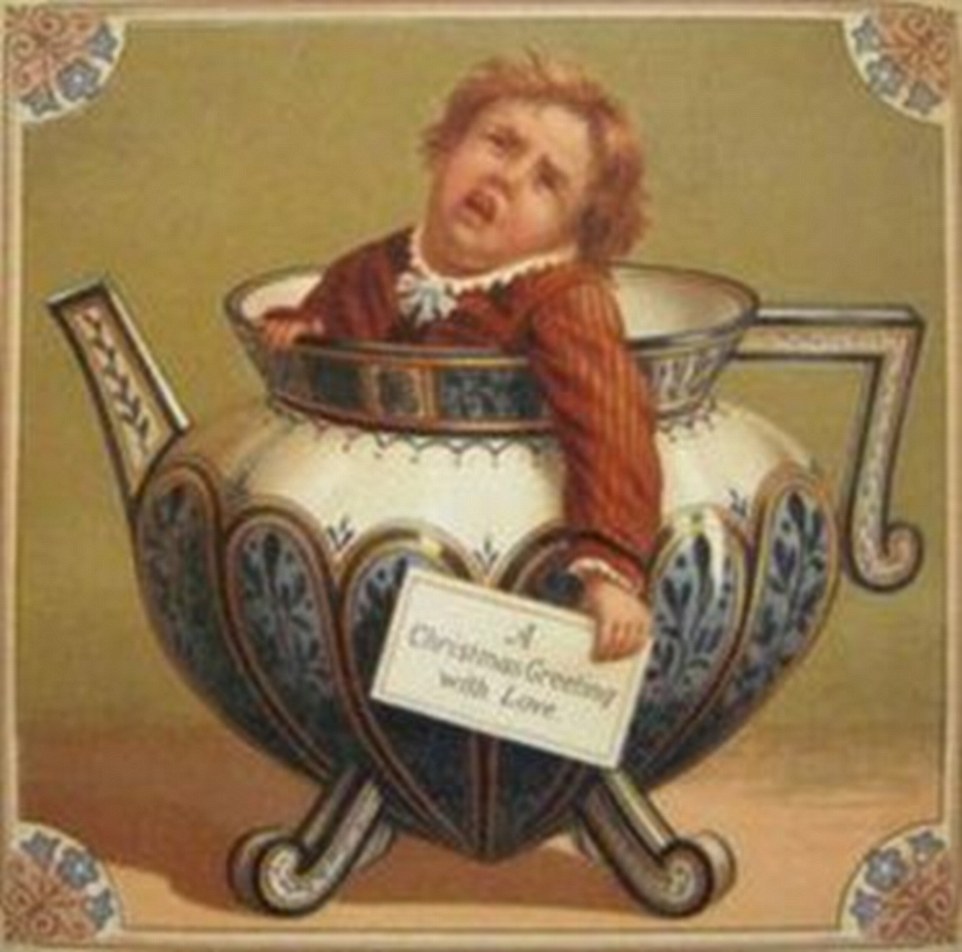
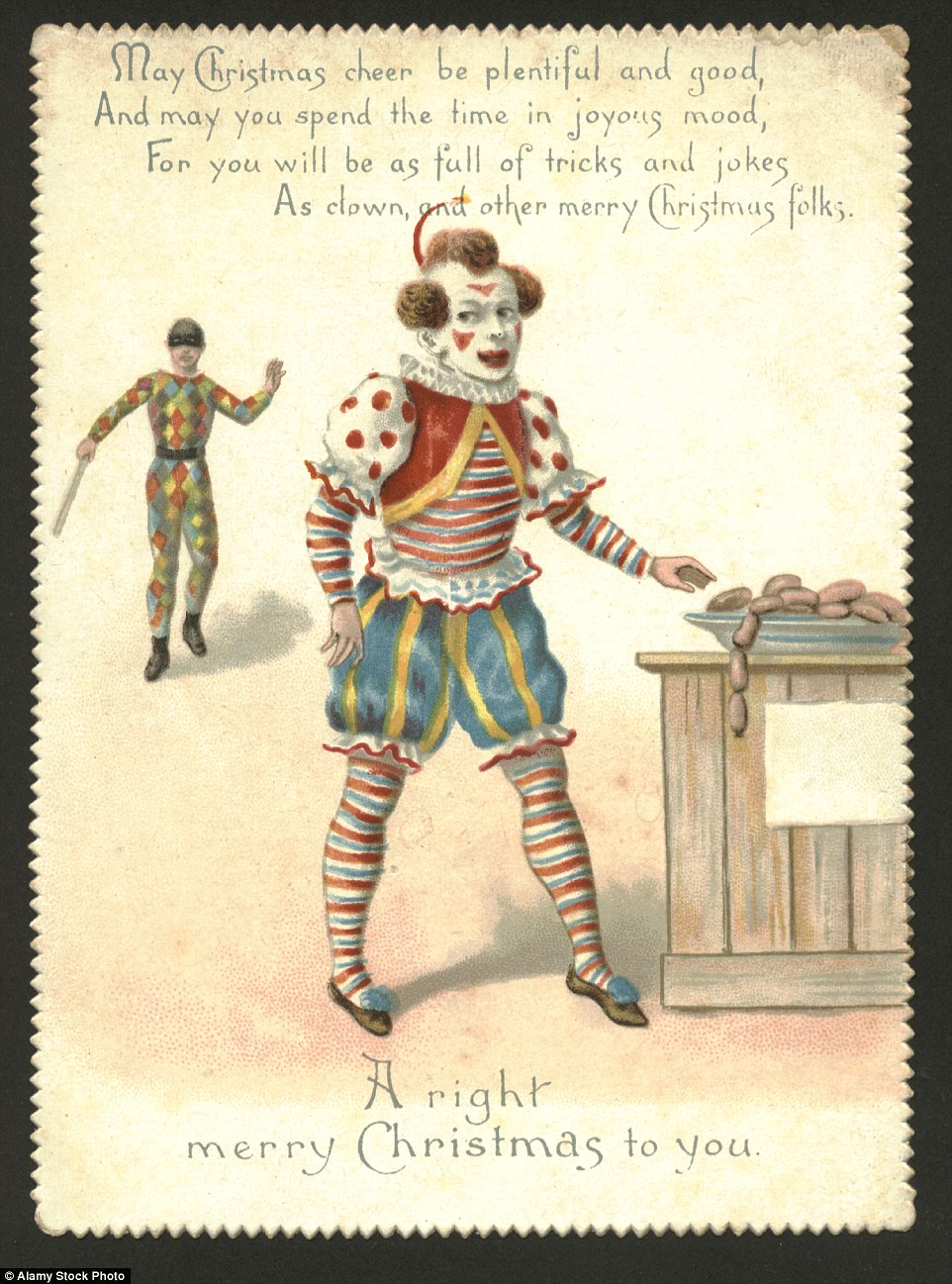
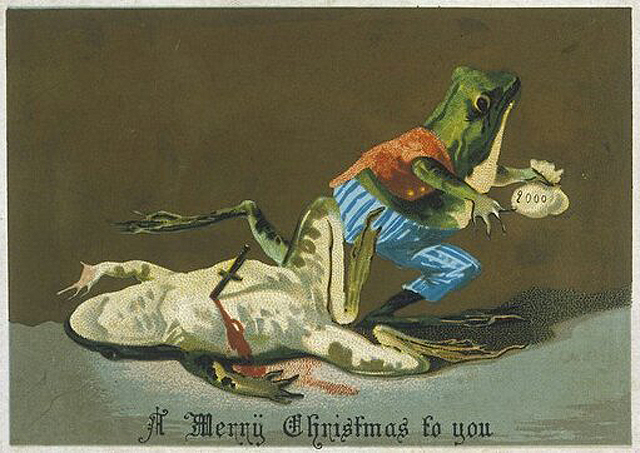
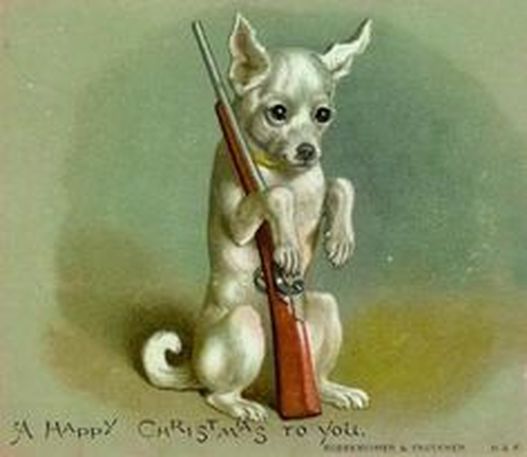
I shared some vintage ads a few weeks back that showed Santa enjoying a smoke and an adult beverage or two. It reminded me f a post from a number of years back that shared a group of odd Victorian Christmas images. Those Victorians had a darker and weirder sense of humor than we give them credit for. At least, I think it was a sense of humor. It was often definitely weird, with creepy clowns, distraught children in china teapots, walking root vegetables and roasted rats.
I won’t even try to explain the murderous, thieving frog or the gun-toting Chihuahua.
I think my favorite is the first one below with the polar bear mauling a skater under the heading ” A Happy Christmas ” with ” A Hearty Welcome” under it. I get that way about the holidays sometimes myself.
So, if you think we’re living in a strange time, take comfort in knowing that it was equally weird 125 years ago. Now get out of here or I’ll let my polar bear out of the shed.
Git!
Children attacking a large pudding on a Christmas card. Date: circa 1890s
Happiness is not a matter of intensity but of balance and order and rhythm and harmony.
–Thomas Merton, No Man is an Island (1955)
Some mornings I need to be electrified or kick-started into motion. I guess that would qualify as a sort of intensity as referred to in the words above from the estimable Thomas Merton. And as he points out, those mornings seldom bring any more satisfaction than those when I find myself in a state of calm and harmony.
So, for this morning, I am going to keep it simple. Minimalist, as it were. Just Merton’s observation, a painting from the current Small Works exhibit at the Principle Gallery and a song selection for this week’s Sunday Morning Music.
The song is Music For a Found Harmonium from the Penguin Cafe Orchestra, who are considered an avant-pop group whose music is often called minimalist which fits today’s theme. This song was composed in the early 1980’s when guitarist/band leader Simon Jeffes was staying in Kyoto after the band’s tour of Japan in 1982. He came across an abandoned harmonium (a pump organ where air produced either by a foot or hand bellows moves over the reeds of the organ) on the street and moved it into the apartment in which he was staying. He often experimented with it during his time there and this piece resulted, reflecting his enchantment with his time in Kyoto. This tune has been used in a number of films, most notably in Napoleon Dynamite.
Man, if he compare himself with all that he can see, is at the zenith of power; but if he compare himself with all that he can conceive, he is at the nadir of weakness.
–Charles Caleb Colton, Remarks on the Talents of Lord Byron and the Tendencies of Don Juan, 1823
I came across aphorism above from Chares Caleb Colton and it got me thinking. Not that it is pertinent to my thoughts here, but Colton (17801832) was one of those interesting British eccentrics of the 19th century. He was a cleric, a writer, an art gallerist, a high-stakes gambler, and a wine collector.
His words at the top made me think about how we perceive our own strengths and weaknesses. How much power do we really have? Is our strength as mighty as we sometimes perceive it, especially when we often only see as far as the wall of the bubble in which we exist?
Probably not.
If we extend our realm beyond our bubble of familiarity, we often discover our true significance. Or should I say, insignificance.
I guess it’s just another way of putting the big fish in a little pond versus a small fish in a big pond thing. Except I believe we need to have the experience of both. We need to feel strong and powerful in some way just to know that we are necessary. But at the same time, we need to recognize our limitations and smallness in the greater scheme of things.
It’s that balancing of these two worlds, our little and big ponds, that we really need. We need to feel big and small at once. Proud and humble in equal amounts.
Whoa, Nellie! Have to pull on the reins and bring this old horse to a stop. I started this without any real thought as to where it was going and now I am afraid my original riff is at peril of running wild.
I want to get off right here before I get too far from where I’d hoped I’d end up which was in pointing out that our power and weakness is at the mercy of the amount of love we produce, give, and receive in our worlds, be they little or big ponds. Love is the zenith of all power.
I guess I should have just written that.
Oh, well. That’s what you get when you read someone else’s journals– ramblings, half-baked thoughts and half-witticisms.
Let’s end today with a favorite song, Love Reign O’er Me, from Quadrophenia from The Who. I thought I had played this video here before but I guess I was mistaken. It is a rendition from tenor Alfie Boe with Royal Philharmonica Orchestra and the London Oriana Choir. Pretty powerful stuff. Zenith-level.
Pieter Brueghel the Elder- Hunters in the Snow (Winter) 1565
Darkness stalks the hunters, Slowly sliding down, Falling in beating rings and soft diagonals. Lodged in the vague vast valley the village sleeps.
–Joseph Langland, Hunters in the Snow: Brueghel
I was looking for a medieval image of a scene in snow that would fit a piece of medieval seasonal music. In this instance, or most any other for that matter, you can’t go wrong with a painting from Pieter Bruegel the Elder. The Flemish painter, who lived from around 1525 until 1569, has long been a favorite of mine with the gorgeous colors of his peasant scenes as well as their elaborate and harmonious composition.
This is one of the more famous of the 45 or so known remaining paintings from Bruegel, titled The Hunters in the Snow from 1565. The contrasting darkness of the trees and the hunting party against the lightness of the snow and the atmosphere just make this piece memorable for me. It is of its time but it feels as though you could step into it, be part of it. It’s a feast for the eyes.
The piece of music I wanted this to accompany is Gaudete, a well-known piece that comes from the 16th century which means that it, like the Bruegel painting, are not really medieval since that period ended with the 15th century. But both feel as though they have that medieval feel and, besides, Gaudete is based on truly medieval Latin lyrics. The song is a Christmas carol that opens with the line Gaudete, gaudete! Christus est natuswhich translates to Rejoice, rejoice! Christ is born. Gaudete is Latin for rejoice. While I do not practice any particular religion, this is a beautiful piece of music and a wonderful expression of the meaning of the season.
There are all sorts of performances of this song out there. Steeleye Span, the British folk/rock group, had a minor hit in the UK with this song in the 1970’s, and it has been performed by many choral groups. I like the version below from Choir of Clare College Cambridge and London Cello Orchestra. It’s probably the drum backing that does it for me but regardless, it’s still a wonderful recording.
This post has run here a couple of times over the past decade. For this posting, I have added the last verse of the poem Huntersin the Snow: Brueghel from the late American poet Joseph Langland.
You have discovered the spiritual universe. Many others have discovered this same world, but each must make the discovery for himself. You are going to have a lot of joy sailing around this world of yours. Don’t fight the opinions of others, or waste your time arguing over these things. Follow the inward gleam of your consciousness and you will arrive.
–Ernest Holmes, This Thing Called You, 1948
This is one of those posts where one leg of my desired triad of image, word and music appears first, inspiring a search for the other two.
For today it was a piece of music that I came across yesterday. It was piece of music called Dance With Waves performed by Tunisian composer/ oud player Anouar Brahem. It came on a station I was listening to yesterday and captivated me with its buoyant pulse. Made me feel like I was bobbing on waves, lightly riding the rhythm of a much greater force.
Not sure that the other two legs hold up today’s triad but it doesn’t really matter. They work on their own, I guess. For your information, Ernest Holmes was a writer of the American New Thought movement, a pseudo-religious/metaphysical movement that goes back to the early 19th century. I don’t know much about it but from my brief look it seems to have many of the same Deist beliefs espoused by some of the Founding Fathers or of the Transcendentalist movement that inspired Ralph Waldo Emerson. It doesn’t have a real doctrine or dogma and encompasses much of the philosophy and wisdom that has come down from ancient cultures around the world.
Interesting to consider. And for the purpose of today’s post, it works for me, as does the painting at the top, Navigating Chaos.
Give a listen and find out for yourself. Here’s Anouar Brahem.
Miracles in mysticism don’t occupy such an important place. It’s metaphor, for the peasants, for the crowds, to impress people. What does mysticism really mean? It means the way to attain knowledge. It’s close to philosophy, except in philosophy you go horizontally while in mysticism you go vertically. You plunge into it. Philosophy is a slow process of logic and logical discourse: A bringing B bringing C and so forth. In mysticism you can jump from A to Z. But the ultimate objective is the same. It’s knowledge. It’s truth.
–Elie Wiesel, Elie Wiesel: Conversations, 2002
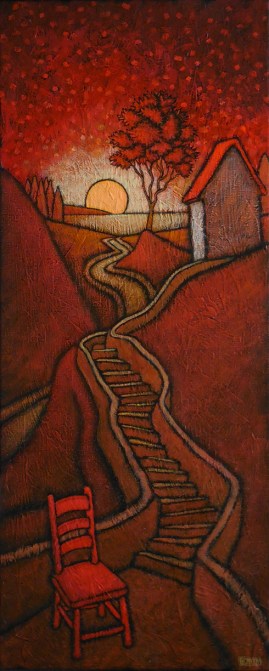
I showed this new painting several weeks ago as a work in progress. It has hung around here for that time and I would periodically put it back on the easel to make a few adjustments. Nothing drastic, just a little more light inserted here and a bit more red there. Small and subtle changes but changes nonetheless.
The one aspect that didn’t change for me was the feeling of the painting. I originally called it Mystic’s Way early into its progress. There was something in the tone and color of it that spoke to me of some mystic pondering or longing. Maybe it was the Red Chair and its placement. I can’t quite put my finger on what it is about this piece that inspired the title. But it stuck and still feels right for me.
After the piece was finished, I came across a passage from a 1984 interview from the Paris Review with author Elie Wiesel. I immediately saw how this painting visually articulated his words for me.
The Red Chair can be viewed as the starting point, the spot where the mystic or philosopher begins their search for knowledge or truth, symbolized here by the rising sun on the distant horizon. The philosopher follows a path that takes him up the steps, past the Red Roofed house and the ever-vigilant Red Tree, alongside the stream and across the water. A logical and direct path. A to B to C and so on.
The mystic transcends those steps of logic and jumps, as Wiesel says, from A to Z. It is as though the mystic sees the destination and moves through the air in an ethereal manner, unhindered by the need for absolute logic, to get to that destination.
I think I can see Wiesel’s definition in this painting. Even its orientation replicates the vertical path that Wiesel describes for mysticism.
Neither manner of getting there is right or wrong, better or worse. They are simply different ways of attaining truth and knowledge.
I guess either is better than just staying in that Red Chair with your back to everything…
Here’s a song that feels right for this post. It’s River Man from British singer/songwriter Nick Drake. Drake died in 1974 from an overdose of antidepressants at the age of 26. His work never achieved widespread acclaim in his lifetime but in the years since he has been a major influence on a generation of musical artists incuding R.E.M., the Black Crowes and many others. The song Life in a Northern Town from Dream Academy is written about and dedicated to Drake. The river his River Man may have been watching over may well be the body of water in this painting.
Who knows?
PS- This painting, Mystic’s Way, 10″ by 25″ on canvas, will be making its mystical journey to the West End Gallery in the next day or two.








 Redtree Times