Feeds:
Posts
Comments

I Felt…

GC Myers- The Enlightenment sm

The Enlightenment— At the Principle Gallery


I felt before I thought…

–Jean-Jacques Rousseau, Confessions, 1782


I came across the short line above today from one of the leading lights and philosopher of the Enlightenment, Jean-Jacques Rousseau, and it immediately stopped me. I first thought of something I sometimes speak about in my gallery talks, about how I try to not think when paint, how I want my reactions that take place on the canvas to be emotionally based.

I have always felt that thinking turns to cleverness in art. And while that is not a bad thing in itself, cleverness is a poor substitute for emotion. Cleverness is a contrivance while emotion is unadulteratedly real.

You feel what you feel.

It is the state in which a child lives. They purely react only to how and what they feel. But at a certain point, a change occurs and thinking enters the equation. We think about how we should react, about fitting in with those around us. We think about how our reaction will be perceived by others. We think of what is socially acceptable and what is not. The world becomes different in many ways. More self-conscious and less spontaneous.

Not a good formula for art.

When does that change occur? When do we go from that childlike state of first feeling things emotionally to one where we think about what we feel before allowing ourselves to react?

I don’t know exactly. It most likely differs for each of us. Some of us remain children throughout our lives. I wish I could say if that was a good or bad thing, but I can’t. I can think of examples where remaining a child is bad (the pure selfishness of children, for example) and others where it is a good thing. The sense of wonder and the feeling of newness one senses in most everything.

I guess what I am saying is that I am, in my work, hoping for that feeling of pure emotional reaction. Free of thought and all subjective criteria.

Sounds kind of lofty, doesn’t it? Kind of sounds like bullshit, right?

And maybe it is. After all, part of being a child is their pure belief in myths– Santa, the Easter Bunny, The Tooth Fairy, etc. Maybe we need to believe a little BS if it gets us to where we need to be.

Okay, enough for now. Wasn’t planning on writing this at all. It just fell out so I better read this before I click it into existence as I have a feeling there are all sorts of contradictions and failures of logic within it. But then again, maybe I won’t read it. Maybe it’s better to just let it fly without thinking it over too much.

Yeah, that’s the ticket.

Below is the rest of Rousseau’s thought from his posthumously published autobiography. It says a lot about how reading as a child impacts our ability to feel emotionally. I think a lot of us can relate to that:

 I felt before I thought: this is the common lot of humanity. I experienced it more than others. I do not know what I did until I was five or six years old. I do not know how I learned to read; I only remember my earliest reading, and the effect it had upon me; from that time I date my uninterrupted self-consciousness. My mother had left some romances behind her, which my father and I began to read after supper. At first it was only a question of practising me in reading by the aid of amusing books; but soon the interest became so lively, that we used to read in turns without stopping, and spent whole nights in this occupation. We were unable to leave off until the volume was finished. Sometimes, my father, hearing the swallows begin to twitter in the early morning, would say, quite ashamed, ‘Let us go to bed; I am more of a child than yourself.’ In a short time I acquired, by this dangerous method, not only extreme facility in reading and understanding what I read, but a knowledge of the passions that was unique in a child of my age. I had no idea of things in themselves, although all the feelings of actual life were already known to me. I had conceived nothing, but felt everything. These confused emotions, which I felt one after the other, certainly did not warp the reasoning powers which I did not as yet possess; but they shaped them in me of a peculiar stamp, and gave me odd and romantic notions of human life, of which experience and reflection have never been able wholly to cure me.

Rouault, Revisited

Georges Rouault -Christ in the Suburbs 1920-24

Georges Rouault -Christ in the Suburbs


Anyone can revolt. It is more difficult silently to obey our own inner promptings, and to spend our lives finding sincere and fitting means of expression for our temperament and our gifts.

Georges Rouault


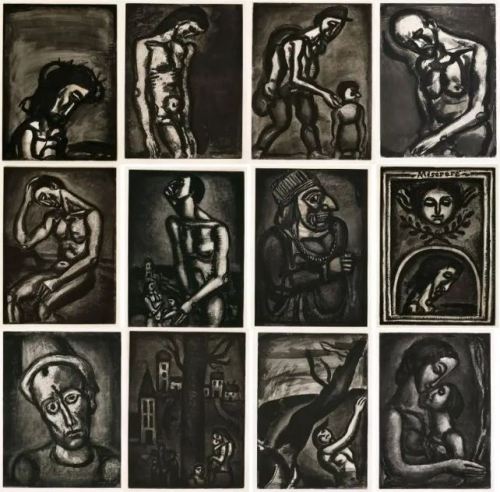
I’ve been a big fan of French painter/printmaker Georges Rouault  (1871-1958) from the moment many years ago when I stumbled across a copy of Miserere, a book of his deeply expressionistic etchings. The title translates as Mercy and it contained raw and expressive work that dealt with deeply personal and religious themes along with those inner promptingsas he calls them in the quote above. It was a work that was very influential on my early Exiles series.

His entrance into the world of art was serving, at the age of fourteen, as an apprentice glass painter and restorer which shows itself in his mature work which resembles leaded glass windows with its dark dividing lines and glowing colors that feel sometimes as though they are lit from behind with the light shining through. Both are qualities that excited me and made me want to emulate in my own work. Not to mention the purity a of the emotional feeling throughout.

Now, if only I can obey my own inner promptings…


The section above is a replay of a blog entry that ran back in 2017. In the interim, I came across some of Rouault’s other writings. He wrote of being an artist in a way with which I easily identified. For example, in his 1947 album of work, Stella Vespertina, he wrote:

The painter who loves his art is ruler in his own kingdom, even if he be in Lilliput and a Lilliputian himself. He transforms a kitchen maid into a fairy, and a great lady into a brothel matron, if he wants to and sees them so, for he is a seer. His vision includes everything that is alive in the past.

This idea of being ruler over one’s own kingdom as an artist has always been a huge attraction to this profession for me. To be able to set the rules, to discard convention, to put the world in order as I see it and answer to only my vision– these were all things that drew me in. And it didn’t matter that it might be a tiny, insignificant kingdom ruled by a tiny, insignificant king– it was mine.

Rouault also wrote in Stella Vespertina:

The conscience of an artist worthy of the name is like an incurable disease which causes him endless torment but occasionally fills him with silent joy…

Like the passage about the artist’s Lilliputian kingdom, it rang true. Though I love what I do, it is often frustrating and tormenting and certainly never as easy as it might seem. But it is in those moments of silent joy, as he puts it, that there is the ultimate reward. A sense of completion.

And also in Stella Vespertina:

The old masters are perfect and admirable examples, on condition that we remember that the spirit gives life and the letter kills, and that even the best pastiche is inferior to the harmonious stammering or incoherence of a child trying to speak.

He is basically saying that even the most perfectly crafted piece of art can sometimes lack the life and spirit found in those imperfect aspects of our world, those things and moments that give our lives depth and meaning.

I don’t think I can add to that except to say that I am glad to have stumbled across Rouault those many years ago in an old book store.


Georges Rouault Sunset 1937

Georges Rouault- Sunset, 1937


Georges Roualt Automne ou Nazareth

Georges Roualt – Automne ou Nazareth

georges rouault- landscape with large trees

Georges Rouault — Landscape with Large Trees

georges rouault- landscape with large trees

Georges Rouault — Landscape with Large Trees

Georges Rouault Misere Images

Georges Rouault – Miserere Images


Georges Rouault Three Clowns

Georges Rouault -Three Clowns


Georges Rouault The Old King

Georges Rouault- The Old King, 1936


Bluefire

GC Myers- Bluefire sm

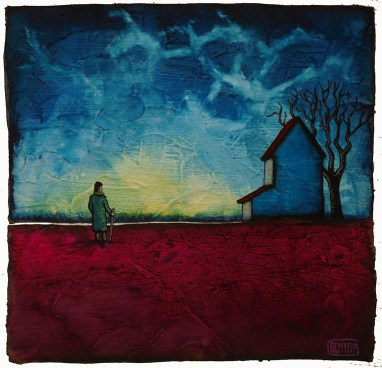
Bluefire— Small Works show at Principle Gallery


Where rose the mountains, there to him were friends;
Where rolled the ocean, thereon was his home;
Where a blue sky, and glowing clime, extends,
He had the passion and the power to roam.

–Lord Byron, Childe Harold’s Pilgrimage


Have some things that I need to get done so I am just going to share this week’s Sunday Morning Music. I wanted something to fill out the triad of the new painting at the top, Bluefire, and the verse from Lord Byron and his Childe Harold’s Pilgrimage.

I was going to use the old Bob Dylan song, It’s All Over Now Baby Blue. I have shared the Them/Van Morrison version here in the past which I consider the best of all the many covers of the song. I came across a version from The Byrds that I liked very much and planned on sharing it. However, it also made me think that their song Eight Miles High from 1966 might better suit this triad. Actually, I hadn’t heard it in quite a while and wanted to hear that intro again and the harmonies within it.

I have to run so I leave it to you. Listen, if you want, and when you leave please don’t slam the door. I am working, after all. So, without further ado, here it is.


GC Myers-The Fulfillment

The Fulfillment– Soon at West End Gallery


I slept and dreamt
that life was joy.
I awoke and saw
that life was duty.
I worked — and behold,
duty was joy.

–Rabindranath Tagore


When I first read the short poem above from the great poet and philosopher Rabindranath Tagore some time ago, it struck a chord with me. It so simply put across, in just a few lines, an observation that takes most of us a lifetime to realize. That is, if we ever do realize it.

Duty was joy.

But what is duty? Is it in being a good parent? A faithful spouse and a loyal friend? Is it in what we do to make a living? Or is it in being decent and caring human being?

Perhaps, it is how our lives touch the lives of others? Could that be a duty?

I don’t know for sure. Most likely, duty and joy is not a one size fits all proposition.

My own feeling is that duty is much like having a purpose, a reason for living. I remember reading Holocaust survivor Viktor Frankl‘s transcendent book, Man’s Search For Meaning, which described his time in the Auschwitz death camp. He observed that those who were able to survive the horror of that place were those who somehow had a purpose for their life, who saw a future that they needed to reach ahead for. This purpose, even a modest one, often gave them the drive needed for survival, creating a path forward for them.

In the year after being liberated from Auschwitz, Frankl gave a series of lectures that were the basis for his book. In one, Frankl spoke of Tagore’s poem and that final line: Duty was joy:

So, life is somehow duty, a single, huge obligation. And there is certainly joy in life too, but it cannot be pursued, cannot be “willed into being” as joy; rather, it must arise spontaneously, and in fact, it does arise spontaneously, just as an outcome may arise: Happiness should not, must not, and can never be a goal, but only an outcome; the outcome of the fulfillment of that which in Tagore’s poem is called duty… All human striving for happiness, in this sense, is doomed to failure as luck can only fall into one’s lap but can never be hunted down.

In short, lasting joy and happiness cannot be pursued as a goal on their own, without a responsibility to some higher purpose.

I am writing this because sometimes I need to be reminded of this. I have been struggling at times recently in the studio, seemingly fighting with myself to find something that just doesn’t seem to be there. The harder I tried to find it, the further away it seemed. It was like I was looking for something to quell my anxieties and bring me some form of easy happiness. To bring me effortless joy.

I should have known better. Yesterday, I just put down my head and worked without thinking about the end result. I focused solely on my purpose in each moment, the task at hand. Concentrating on doing small and simple things with thought and care was my duty, as it were. As the day went on, my burden felt lessened and I began to feel joy in the work, joy in small aspects that I had been overlooking in prior days.

It was a satisfying day, one that left me feeling that I had moved in some way toward fulfilling a purpose. It may not be a grand, earth-shaking purpose but it doesn’t need to be. It is mine. My purpose. My duty.

And that is enough to bring me a bit of joy.


The post above ran here three years ago, in early 2020. It has become one of my most popular posts, getting quite a few views every day. I often go back and read it again just for the reminder it offers. In doing so recently, the words of Viktor Frankl stating that happiness and joy are the outcomes of the fulfillment of one’s duty stuck in my mind and turned into the title for the new small painting at the top, The Fulfillment, which will be at the West End Gallery later this coming week. 


Don QuixoteThe mass of mankind is divided into two classes, the Sancho Panza’s who have a sense for reality, but no ideals, and the Don Quixote’s with a sense for ideals, but mad.
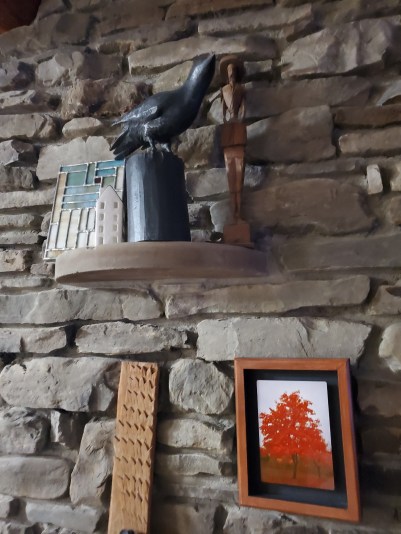
–George Santayana, Little Essays


Now that we’re in the Christmas season, I’ve been thinking about some of my favorite gifts I’ve received over my life. There have been many that have had special meaning such as the typewriter, that I wrote of earlier, that was a gift from my parents in order to foster my writing ambitions as a teen. Most are gone now but some still live with me. This is one that does.

My sister, Linda, gave this to me many, many moons ago when I was 12 or 13 years old. It’s a simple carving of what is probably meant to be Don Quixote. It doesn’t matter- it’s always been Don Quixote to me.

It’s not finely carved, probably made by a guy in some tropical foreign land where he knocks out 20 of these a day to earn a meager living. Doesn’t matter. To me, it’s a Rodin. I’ve carried it with me all my life, through ups and downs, and the wear shows on it. There’s a nick from his hat and a scratch here and there. It even broke in two at his ankles and needed mending just to continue standing.

And he does.

I view him as an inspirational icon, a constant reminder to dream beyond what is in front of you, to believe that you can exceed what others think is possible for you. That you can be whatever you dream yourself to be.

To tilt at your own windmills.

And to remember that others believe in you.

Simple things and small gestures can have great effect.

Many belated thanks, Linda…


santa vintage-christmas-cigarette-lucky strike


Cigarettes is a blot on the whole human race.
A man is a monkey with one in his face.
That’s my definition, believe me dear brother,
A fire on one end and a fool on the t’other.

— Tim Spencer, Cigareets, Whuskey, and Wild, Wild Women, 1947


Don’t know how this popped into my mind this morning but I suddenly thought about how Santa Claus was once a shill for cigarettes in mainstream advertising. Growing up, it wasn’t that unusual to see Saint Nick extolling the virtues of a fine smooth smoke. This thought made me look up some old print ads to share.

Some, like the Murad ads, I had not seen before nor was I even aware of the Murad brand. This surprised me because as a kid I knew all the brands that my family members smoked. My parents smoked Camels. One aunt smoked Raleighs, another Salems. My uncles smoked Pall Malls, Lucky Strikes and Marlboros. Somebody in there smoked Winstons but I can’t remember who it was exactly. Doesn’t matter, of course. Just a memory check.

It turns out that Murads were a brand made in NY using pure Turkish tobacco. As the American tobacco industry grew in the aftermath of World War I, Turkish tobacco use waned and with it, the Murad brand. Their ads with Santa are among the more lurid, with Santa slumped against a chimney as he takes a smoke break from his Christmas deliveries. 

Thought I’d share some of them below. A favorite is the Pall Mall ad that promotes cigarette smoking as a preventative against a scratchy throat. Times certainly have changed. This reminded me of an old song that was written in 1947 by Tim Spencer of the Sons of the Pioneers. The song was Cigareets, Whusky, and Wild, Wild Women. While I like their original version, I prefer the one from Red Ingle and the Natural Seven who had a hit with it in 1948.

Don’t know if Santa went along with the whiskey and women part. Wait a second. Of course, he did.  A quick search found plenty of whiskey ads with Santa along with some for women’s lingerie, including ne where Santa appears to be taking an upskirt view. The one Dewars ad with Santa without pants is a bit disturbing, as well.

Oh, Santa, I hope you’re clean and sober for this coming holiday season…


santa-smoking pall mall throat scratch 2Santa-selling-cigs CamelSanta-Claus-for-Murad-Ad-wm-826x1030Santa-Claus-for-Murad-santa-smoking pall mall throat scratchSanta-selling-cigs Murad


santa-mojudSanta-with-mojud lingerie 1953

santa dewars.jpg 2santa whiskey

santa dewars

Dawn’s Return

GC Myers- Dawn's Return  2023

Dawn’s Return— Now at West End Gallery


A dreamer is one who can only find his way by moonlight, and his punishment is that he sees the dawn before the rest of the world.

–Oscar Wilde, The Critic as Artist (1891)


Sitting here in the studio at 5:15 AM waiting for the sun to come up. Still a ways to go before it cracks the horizon this morning. Nestled in the woods as I am, I don’t get to see many spectacular sunrises. Just the light filtering through the trees.

But it’s enough just to see the darkness recede.

Is it punishment though, as Wilde’s character, Gilbert, states in The Critic as Artist?

I guess it could be viewed that way. The dreamer tends to sense and see things before others. They can often spot patterns and trends that portend future events. Unfortunately, that isn’t limited to only good or inconsequential things.

Sometimes the dawn ‘s light reveals troubling news to the dreamer long before others even notice that it is on the way. They have to live with it and try to alert the others, many who refuse to believe such things.

I suppose it is a punishment in that way– to see indications of danger and travails ahead but having your warnings ignored or minimized.

Hmm. Something to think about this morning, once dawn breaks.

Here’s an old song written in the years immediately after World War I, at a time when the world was just emerging from the dark. It is The World is Waiting For the Sunrise. It was originally a hit for bandleader Isham Jones in 1922 and became a big hit for Les Paul and Mary Ford in the early 1950’s and it has been recorded by all sorts of artists over the years, including the Beatles. I really like this version from Willie Nelson along with a group of old time Texas musicians such as Paul Buskirk on the mandolin.

Give a listen, if you feel like it. I’m going to listen to it again as I sit here still waiting in the dark for the dawn to break.


Jean Arp- Torso of a Giant 1964

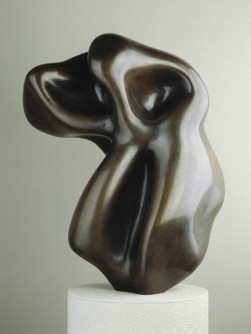
Jean Arp- Torso of a Giant 1964

Soon silence will have passed into legend. Man has turned his back on silence. Day after day he invents machines and devices that increase noise and distract humanity from the essence of life, contemplation, meditation… tooting, howling, screeching, booming, crashing, whistling, grinding, and trilling bolster his ego. His anxiety subsides. His inhuman void spreads monstrously like a gray vegetation.

Jean Arp


I came across this quote above from sculptor Jean Arp that I shared here back in 2013. At the time, a friend pointed out that she somewhat disagreed, that our anxiety doesn’t subside when silence goes away and passes into legend, as Arp suggested. 

At the time, I agreed with her disagreement. I certainly didn’t lose my anxiety in the face of constant sound. But after reading it again after the past ten years, I believe I just wasn’t reading enough into his intended meaning.

I believe– and I might be wrong here– that he meant that as silence leaves us and is replaced by a constant cacophony of sounds, we become desensitized to the noise. It no longer has an effect on us.

Where once it created anxiety, there was now just a void of reaction. 

An inhuman void, as Arp put it. 

Some of us may have lost our anxiety but they may have also lost something more in the form of basic human feelings such as empathy and kindness and caring. I think this Arp’s supposition has become more evident in the past ten years as our society has been infected with noise and distraction of a bullhorn that carries a constant blast in the form of disinformation, misinformation, unending conspiracy theories, and absolute falsehoods.

The void caused by anxiety’s departure is replaced by anger, distrust, and hatred.

And even more noise.

And as Arp points out, this spreads monstrously like a gray vegetation.

In the ten years since I first ran the words from Arp, I believe I now better understand the meaning of Arp’s words now as a result of what we have seen happening here. It makes the ideas of contemplation and meditation in order to not succumb to the void, seem even more vital to our survival.

I wasn’t intending to write anything this morning but reading Arp’s quote again just sparked something. Now, I have to find some silence for a while.

To ease my anxiety– not lose it entirely.

Here’s a piece of music in that spirit. It is a longtime favorite of mine that I have played here a number of times in the past. It played a large part in how I came to view my own work early in my career, establishing what I wanted to take from it for myself. It’s from composer Arvo Pärt and his composition Tabula Rasa. This is the second movement, fittingly titled Silentium


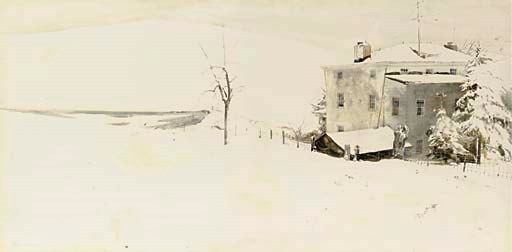
Wintry Wyeth

Andrew Wyeth Fence Line 1967

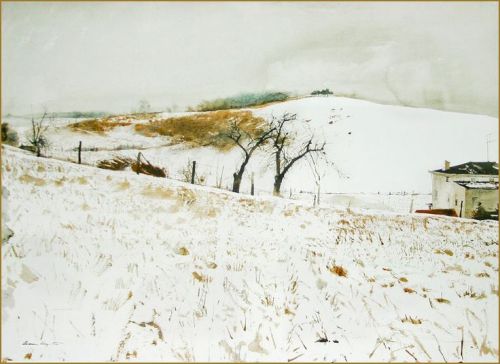
Andrew Wyeth – Fence Line 1967


I prefer winter and fall, when you feel the bone structure of the landscape – the loneliness of it, the dead feeling of winter. Something waits beneath it, the whole story doesn’t show.

Andrew Wyeth


This post ran several years ago. We have yet to feel the true blast of winter here which is fine. However, my feelings on the winter landscape are very much in line with those of Andrew Wyeth. I like that the cold of winter drives most others inside, taking their noise and busyness with them. The stillness and the dark exposed bones of the trees creates that dead feeling as Wyeth puts it.

It reminds me of why I like walking in cemeteries, especially empty ones. As in winter, there’s a peaceful hush over everything. It feels unhurried. And why not? Nobody there is going anywhere. Nor do they have appointments or deadlines.

But the mystery remains. Who were these people? What gave them joy? What stories are buried with them, never to be told again?

It adds a bit of a melancholic edge to the stones and trees.

That feeling certainly permeates Wyeth’s winter scenes. I thought it was worth looking at them again until the snow finally comes to my part of the world.


Andrew Wyeth – Over the Hill 1953

Andrew Wyeth- Heavy Snow

Andrew Wyeth- Not Plowed 1985

Andrew Wyeth- Farm Pond Study

Vivaldi’s Winter

GC Myers- Moonlight Quartet, 2023

Moonlight Quartet–At West End Gallery


Winter

Allegro non molto

To tremble from cold in the icy snow,
In the harsh breath of a horrid wind;
To run, stamping one’s feet every moment,
Our teeth chattering in the extreme cold

Largo

Before the fire to pass peaceful,
Contented days while the rain outside pours down.

Allegro

We tread the icy path slowly and cautiously,
for fear of tripping and falling.
Then turn abruptly, slip, crash on the ground and,
rising, hasten on across the ice lest it cracks up.
We feel the chill north winds course through the home
despite the locked and bolted doors…
this is winter, which nonetheless
brings its own delights.

— Antonio Vivaldi


Just want to share a little Vivaldi today. Here’s the Winter segment from his best-known work, the Four Seasons. Vivaldi also composed four separate sonnets for this work to give the listener a better idea of the feeling he was trying to evoke in each of the seasons. The sonnet for Winter is shown above.

This performance of the Winter portion is on instruments of the period in Vivaldi composed the piece. It is performed by renowned violinist Cynthia Miller Freivogel and the Baroque music group, Voices of Music. I played this piece here several years back but it felt right this morning.