Feeds:
Posts
Comments
GC Myers- A Matter of Perspective sm

A Matter of Perspective— Now at the Principle Gallery


I have never started a poem yet whose end I knew. Writing a poem is discovering.

–Robert Frost, The New York Times (Nov. 7, 1955)


I often write about the parallels between different artistic forms. For example, how the rhythm of music runs through painting. Another is in the quote above from poet Robert Frost, which mirrors how I view the development of my paintings. Creative expression is formed in much the same way across the spectrum of artistic pursuits.

Below is a post from a number of years back that is consistently one of my most popular blogposts. Hardly a day goes by when it doesn’t get at least a handful of views. It is about a well-known essay from Robert Frost that describes in a poetic way how his work emerges and the parallels to painting that I see in it. 


The poet Robert Frost wrote a wonderful preface to the 1939 edition of his collected poems. It was titled The Figure a Poem Makes and it described how he viewed his process of unveiling the true nature of his work. Reading it, I was struck by the similarities between his development of a poem and how I view my process for a painting.

For example, the following paragraph-I have highlighted individual lines that jumped out at me. I probably could have highlighted them all:

It should be of the pleasure of a poem itself to tell how it can. The figure a poem makes. It begins in delight and ends in wisdom. The figure is the same as for love. No one can really hold that the ecstasy should be static and stand still in one place. It begins in delight, it inclines to the impulse, it assumes direction with the first line laid down, it runs a course of lucky events, and ends in a clarification of life–not necessarily a great clarification, such as sects and cults are founded on, but in a momentary stay against confusion. It has denouement. It has an outcome that though unforeseen was predestined from the first image of the original mood-and indeed from the very mood. It is but a trick poem and no poem at all if the best of it was thought of first and saved for the last. It finds its own name as it goes and discovers the best waiting for it in some final phrase at once wise and sad-the happy-sad blend of the drinking song.

A painting often begins in delight, assuming direction, as Frost put it, with the first line laid down. A certain tone of color, the shape of a form, the way a line bends, the manner in which a brushstroke reveals the paint or in how the contrast of light and dark excites the eye. The delights pull you in and keep you engaged and it is not until you have finished that you are able to understand the sum of these elements, to detect the wisdom, the meaning, behind it all. It is only then that you know what you have uncovered and how it should be named.

The work itself, if left to its own means, knows what it is and will tell you.

Then there is this gem of a paragraph:

No tears in the writer, no tears in the reader. No surprise for the writer, no surprise for the reader. For me the initial delight is in the surprise of remembering something I didn’t know I knew. I am in a place, in a situation, as if I had materialized from cloud or risen out of the ground. There is a glad recognition of the long lost and the rest follows. Step by step the wonder of unexpected supply keeps growing. The impressions most useful to my purpose seem always those I was unaware of and so made no note of at the time when taken, and the conclusion is come to that like giants we are always hurling experience ahead of us to pave the future with against the day when we may want to strike a line of purpose across it for somewhere. The line will have the more charm for not being mechanically straight. We enjoy the straight crookedness of a good walking stick.

I have often spoke of the need to have my emotions near the surface when I work, to always need to feel excited and surprised by what I am working on. To recognize new things I never knew as being part of me. If I am not moved by the thing I am working on at any given time, how can I expect others to be moved by it? This paragraph speaks clearly to my experience as an artist.

Then there is the final sentences of the essay:

Like a piece of ice on a hot stove the poem must ride on its own melting. A poem may be worked over once it is in being, but may not be worried into being. Its most precious quality will remain its having run itself and carried away the poet with it. Read it a hundred times: it will forever keep its freshness as a petal keeps its fragrance. It can never lose its sense of a meaning that once unfolded by surprise as it went.

My translation of this, as a painter, is that the work must be free to move and grow of its own volition. It tells you where it wants to go and, if you don’t constrain it and try to push it to a place to which it was not intended, will reveal its truth to you. If you can do that, it remains always fresh, always in the present and always filled the excitement and surprise that it contained in that burst when it was created.

And that, to feel always fresh and in the present, is the goal of all art, be it painting, poetry, music, or dance.

I don’t want to bore you too much. It’s a great essay and is a valuable read for anyone who makes art in any form. You can see the whole book, The Collected Poems of Robert Frost, and read this essay in full by clicking here. The link takes you to one of my favorite sites on the whole interwebs, the Internet Archive, which has a huge library of available books that you can view in book form online. With its great search engine, it is a super reference tool.

To Learn…

GC Myers- Maestro  2023

Maestro— Now at West End Gallery, Corning, NY


“The best thing for being sad,” replied Merlin, beginning to puff and blow, “is to learn something. That’s the only thing that never fails. You may grow old and trembling in your anatomies, you may lie awake at night listening to the disorder of your veins, you may miss your only love, you may see the world about you devastated by evil lunatics, or know your honour trampled in the sewers of baser minds. There is only one thing for it then — to learn. Learn why the world wags and what wags it. That is the only thing which the mind can never exhaust, never alienate, never be tortured by, never fear or distrust, and never dream of regretting. Learning is the only thing for you. Look what a lot of things there are to learn.”

–T. H. White, The Once and Future King


Not sure what I want to say this morning. Not sure I want to say anything at all. Kind of a glum feeling this morning. I know the feeling well, having felt it countless times over the years. I’ve learned how to deal with it.

One way is pretty well defined in the advice Merlin gave to the young squire Wart (destined to later be King Arthur) in The Once and Future King from T.H. White. The book was written as a series of novels during the early years f World War II and was loosely based on the Sir Thomas Mallory‘s 15th century classic, Le Morte d’Arthur, which gave us the legend of Arthur as we know it. White saw Mallory’s book and his own as ultimately being about the quest to end war. Both books advocate for knowledge and wisdom as the path to this end.

Turns out it also helps take the edge off a dark mood. And maybe it is this same sort of darkness that ultimately drives wars and violence?

And on cue, here’s my constant refrain: I don’t know.

But I find that on these dark mornings, asking such questions and trying to find some sort of answer, or even a hint of one, acts as a kind of antidote to my glumness. It gives me a chance to change my arc of thought. And hopefully that will carry me out of darkness and into a better day.

Thankfully, it often works. Not always. But enough that it is a dependable part of my toolkit, the first tool I reach for on those glum days. It’s probably the reason I have persevered in maintaining this blog for over 15 years now.

It must work– I haven’t started a war in the past 15 years.

That brings us to a song to tie up this triad. It’s a new song from another favorite of mine, Glen Hansard, called Bearing Witness. It is from his new album All That Was East Is West Of Me Now. It might not be a perfect fit today but I love the chorus:

‘Cause it’s not what you’re given
But what you do with it
And it’s not the road less travelled
But how you choose to live

That kind of feels like a summary of my artistic career and maybe my life.

You make the most of what you got, as they say. Whatever it takes to get to the next day.

See? It works. I started this post glum and with nothing to say. I’m not saying that I said a lot here but I do feel better. Now, on to this day.


In Distrust of Merits

GC Myers- Bruised Orange  2022

Uncertain Times— At the West End Gallery


The world’s an orphans’ home. Shall we never have peace without sorrow? without pleas of the dying for help that won’t come. O quiet form upon the dust, I cannot look and yet I must.

–Marianne Moore, In Distrust of Merits, 1941


The longer one lives, the more one sees firsthand how easily we fail to heed the lessons of history. We continue to repeat our pasts as though we are on a turning wheel of fate where everything eventually comes around once more. Issues that had been thought to be long settled emerge once more and are battled over again and again. The same hatred, the same ignorance, the same rationalizations and manipulations.

All the same, just in a different time with fresh faces.

And the wheel keeps turning.

I came across a recording of the late Modernist poet Marianne Moore (1887-1972) reading her poem In Distrust of Merits. I found it captivating as I read along to her voice. It seemed to speak to this moment in time, as it has to the many other uncertain times in world history. I have placed the whole poem below the recording below. If you have four or five minutes to spare, I urge you to read along as she reads. I think it’s worth the time.


In Distrust of Merits

Strengthened to live, strengthened to die for
medals and positioned victories?
They’re fighting, fighting, fighting the blind
man who thinks he sees, —
who cannot see that the enslaver is
enslaved; the hater, harmed. O shining O
firm star, O tumultuous
ocean lashed till small things go
as they will, the mountainous
wave makes us who look, know

depth. Lost at sea before they fought! O
star of David, star of Bethlehem,
O black imperial lion
of the Lord — emblem
of a risen world — be joined at last, be
joined. There is hate’s crown beneath which all is
death; there’s love’s without which none
is king; the blessed deeds bless
the halo. As contagion
of sickness makes sickness,

contagion of trust can make trust. They’re
fighting in deserts and caves, one by
one, in battalions and squadrons;
they’re fighting that I
may yet recover from the disease, my
self ; some have it lightly, some will die. ” Man’s
wolf to man? ” And we devour
ourselves? The enemy could not
have made a greater breach in our
defenses. One pilot-

ing a blind man can escape him, but
Job disheartened by false comfort knew,
that nothing is so defeating
as a blind man who
can see. O alive who are dead, who are
proud not to see, O small dust of the earth
that walks so arrogantly,
trust begets power and faith is
an affectionate thing. We
vow, we make this promise

to the fighting — it’s a promise — ” We’ll
never hate black, white, red, yellow, Jew,
Gentile, Untouchable. ” We are
not competent to
make our vows. With set jaw they are fighting,
fighting, fighting, — some we love whom we know,
some we love but know not — that
hearts may feel and not be numb.
It cures me; or am I what
I can’t believe in? Some

in snow, some on crags, some in quicksands,
little by little, much by much, they
are fighting fighting fighting that where
there was death there may
be life. ” When a man is prey to anger,
he is moved by outside things; when he holds
his ground in patience patience
patience, that is action or
beauty, ” the soldier’s defense
and hardest armor for

the fight. The world’s an orphan’s home. Shall
we never have peace without sorrow?
without pleas of the dying for
help that won’t come? O
quiet form upon the dust, I cannot
look and yet I must. If these great patient
dyings — all these agonies
and wound bearings and blood shed —
can teach us how to live, these
dyings were not wasted.

Hate-hardened heart, O heart of iron,
iron is iron till it is rust.
There never was a war that was
not inward; I must
fight till I have conquered in myself what
causes war, but I would not believe it.
I inwardly did nothing,
O Iscariotlike crime!
Beauty is everlasting
and dust is for a time.

–Marianne Moore, 1941


Autumn People


GC Myers- The Color of Night  2023

The Color of Night- At Principle Gallery, Alexandria VA

“…that country where it is always turning late in the year. That country where the hills are fog and the rivers are mist; where noons go quickly, dusks and twilights linger, and midnights stay. That country composed in the main of cellars, sub-cellars, coal-bins, closets, attics, and pantries faced away from the sun. That country whose people are autumn people, thinking only autumn thoughts. Whose people passing at night on the empty walks sound like rain.”

–Ray Bradbury, The October Country


Every so often you come across something from your distant past that has long passed from memory.  It could be a book, a song, a photo or some small insignificant memento, something once cherished but now tucked away in the piling up of time. Coming across such a thing after so many years illuminates how much that thing meant to you. In some cases, being able to look back at the years allows  you to see that it actually influenced your way of thinking and, therefore, your life.

That’s how I felt this morning when I came across the short prologue, shown here at the top, to the 1955 book of short stories from Ray BradburyThe October Country. I probably read this book last in the late 1970’s at a time when I devoured most of Bradbury’s books. His short stories were all great and interesting reads and Bradbury had a poetic nature to go with his active imagination, one that sometime revealed those feelings of isolation and fear that lingered at the edges of the mundane.

I don’t remember how I reacted when I read the words above forty years ago but reading them now, I felt like he was describing me. Or at least, describing the occupants of the world I depict in my paintings, those folks who, by extension, are built from parts of myself.

They are definitely the autumn people, thinking only autumn thoughts.

Lingering in twilight, tucked in dark niches inside, facing away from the sun.

I went through a stack of old paperbacks in a closet and dug out my dog-eared copy of the The October Country. Leafing through it, I saw a few titles in the list of contents that I had circled eons ago. I don’t remember doing this, of course, but I obviously saw something in it that made me do this.

One was titled The Wind and turning the pages to that story I was greeted by a black and white illustration for the story from artist Joe Mugnaini, who often worked on the Bradbury books of that time.

I didn’t recognize or remember it but even so, it had a familiarity that made me smile. My own wind-blown trees often resemble the manner in which Mugnaini shaped this tree.

I found an image of it online and am sharing it here. Maybe it was not only Bradbury’s words that influenced me forty some years back?

The mind works in weird and wonderful ways, eh?


The post above is from four years back. Felt right this morning. It goes well with this week’s Sunday Morning Music selection, which is October Skies from Mumford & Sons.

Good song for the autumn people among us.


Kilroy Was Here

kilroy-was-here-at-wwii-museum


LEGACY, n.  A gift from one who is legging it out of this vale of tears.

-Ambrose Bierce, The Devil’s Dictionary


While doing some background work for yesterday’s post on Wassily Kandinsky, I was reminded of one of my favorite passages from the artist:

In the final analysis, every serious work is tranquil….Every serious work resembles in poise the quiet phrase, ” I am here.” Like or dislike for the work evaporates; but the sound of that phrase is eternal.

This concept of the I am here has been a big motivating force for me throughout my career. Actually, probably back to my earliest remembered days. Even then, there was always a desire to be heard, to have my existence acknowledged in some tangible way. It was a powerful inducement to me that a book, a poem, or a piece of art might be left behind so that someone in the future who might stumble across it and recognize something of themselves in it. Maybe even inspiring them to do something to make their own voice heard.

I think this idea of leaving something behind that tells the world you exist must be a universal urge. The many examples of ancient graffiti in Greece and Egypt and even those first prehistoric handprints in caves around the globe attest to this. The image at the top, Kilroy Was Here, was a ubiquitous image from WW II. Though it was attributed to US troops, it was a symbol of all the allied soldiers. The simple-to-draw Kilroy, derived from a British cartoon character from the late 30’s, appeared everywhere the allies fought in all sorts of places from the sides of fighter planes and tanks to barracks, bombed out buildings, torpedoes, missiles, and on and on.

Bugs Bunny Kilroy Was HereIt is said that Stalin encountered the drawing on a bathroom wall at the Potsdam Conference and was upset by it. It is also reported that even Hitler was made aware of it as so much of the ordinance was hitting German positions carried the slogan.
It is now even part of the World War II Memorial in Washington. Even Bugs Bunny encountered it on a trip to Mars.

Those cavemen, those ancient Greeks, those troops — they all understood the I am here. The idea of some small evidence of themselves left behind. It’s a powerful driving motivation.

Believe me, I know.

Here’s a song on that subject from Sean Rowe that I played several years back. This is To Leave Something Behind. His strong, deep voice really adds a dimension to this song. Good stuff to leave behind…


Kandinsky/ Music

Wassily-Kandinsky-Composition-8-1923

Wassily Kandinsky– Composition 8, 1923


With few exceptions music has been for some centuries the art which has devoted itself not to the reproduction of natural phenomena, but rather to the expression of the artist’s soul, in musical sound.

A painter, who finds no satisfaction in mere representation, however artistic, in his longing to express his inner life, cannot but envy the ease with which music, the most non-material of the arts today, achieves this end. He naturally seeks to apply the methods of music to his own art. And from this results that modern desire for rhythm in painting, for mathematical, abstract construction, for repeated notes of colour, for setting colour in motion.

–Wassily Kandinsky, Concerning the Spiritual in Art


Much like the artist indicated in the words above from Wassily Kandinsky, I have always envied the way in which music elicits deep emotion in a non-material, almost abstract manner. To attempt to draw similar emotions forward as an artist who deals in the visual without losing their impact to the weight the subject matter creates is a difficult task.

As a result, somewhat like Kandinsky, I have over the years looked at my painting as a form of music. Using the flow of lines as rhythm, the arrangement of forms as melody, and colors as notes. The repetition of elements are choruses and themes in the body of my work.

I believe this equating with music is the reason I often think of a painting as a performance of a composition that is unique to its time of creation, with new improvisations and changes in tempo and tone.

Though the subject matter is often repetitive– Red Tree, Red Roofed House, Red Chair, etc. — they ultimately are the mere armature on which the music surrounding them is composed. They are important, yes, but they serve the emotion of the music of the colors, textures, lines and forms around them.

It’s a difficult thing to describe and I don’t really think much about it except at times like this when I am trying to give some insight to others. Most of the time, it is an ingrained part of the process.

I do what I do and hope for music.

Sometimes it comes and it is good. Sometimes it doesn’t and the result feels more like noise than music.

And sometimes it is a music that approaches silence. And that, ultimately, is what I am seeking.

Here’s a fine video that intersperses music and the work of Kandinsky. Might be worth a moment of your time. He is another of those artists whose both work and words strike chords in me.


Honor’s Value

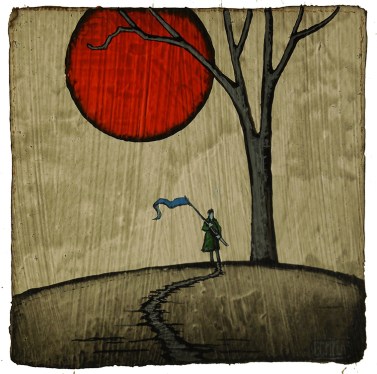
GC Myers- Carry the Blue Flag

Carry the Blue Flag— At the Principle Gallery


Men must be able to engage in business and go to war, but leisure and peace are better; they must do what is necessary and indeed what is useful, but what is honorable is better. On such principles children and persons of every age which requires education should be trained.

–Aristotle, Politics and Poetics


How do you define honor for yourself?

A sense of fairness, truthfulness, loyalty, compassion, empathy, tolerance, and generosity of spirit — are these defining elements of honor the same for others as they are for me?

What are the principles that guide your sense of honor? Is honor a universal and singularly defined concept or does it vary from person to person or nation to nation?

Are your guiding principles carved in stone or written in the sand on the shore? Would you be willing to carve your guiding principles in stone and then live by them?

I know this might sound a little moralistic or judgmental. Or that I am preaching as to how anyone else should live. It’s not meant in that way. I just have real questions given the number of prominent people who seem to live lives with little or no honor.

Besides, I have little moral ground on which to stand. My principles were pretty shaky for the first half of my life.

However, at a certain point you realize that your true wealth in measured not in dollars and possessions but in your honor and the principles you uphold.

How much do you value your honor? Do you ever think about what principles make up your own sense of honor?

Aristotle probably had it right. The world might be much better off if children were educated on matters of honor, on principles and ethics. Maybe throw some civics lessons into the mix, as well. We’re seeing way too much evidence of the harm that people without honor or shame can do in this world.

We might all sleep better at night in a world that held honor in higher esteem than money or power.

Here’s song that deals with honor. It is from Jeremy Dutcher, a classically trained Canadian Indigenous tenor, composer, and activist. An interesting person. This song is Honor Song and Dutcher performs it in his native Wolastoq language with accompaniment from the great cellist Yo-Yo Ma.

It’s a powerful song, as it should be for something as valuable as one’s honor.

If you made it this far, thanks for hearing me…


FYI— I used the small painting at the top, Wave the Blue Flag, because the blue flag in it always reminds me of the phrase True Blue. It means honest and loyal and devoted to a sense of rightness. Honorable things all.


Mystic’s Dusk


GC Myers- Mystic's Dusk

Mystic’s Dusk

Ye realms, yet unreveal’d to human sight,
Ye gods who rule the regions of the night,
Ye gliding ghosts, permit me to relate
The mystic wonders of your silent state!

–Virgil, Aeneid


On Monday, I showed the painting to the right as a Work-In-Progress in the stage where it began fully showing itself. I liked where it was at that point and didn’t want to venture far from the feeling I was getting from it. I determined that I wanted to stay within the red tones and hold back on moving out into other colors.

Felt something very moody, almost mystic, in those tones. As though the dusk represented something more than the sun descending behind the horizon.

I can’t say exactly what it might mean or symbolize. Sometimes there is something satisfying in simply bathing in a mood without knowing the meaning behind it, in just accepting the mystery of the moment and resting within it.

This might be one of those pieces that does that for me. Only time will tell. I need to sit myself in that chair for a bit longer to take it all in.

Then I’ll know. Well, maybe. Who ever really knows?

Here’s a favorite Van Morrison song that I believe goes well with this painting which I am calling Mystic’s Dusk. The song is Into the Mystic and this version is from a 2007 performance from Jason Isbell & The 400 Unit. It’s hard to live up to the original but this is a fine rendition.


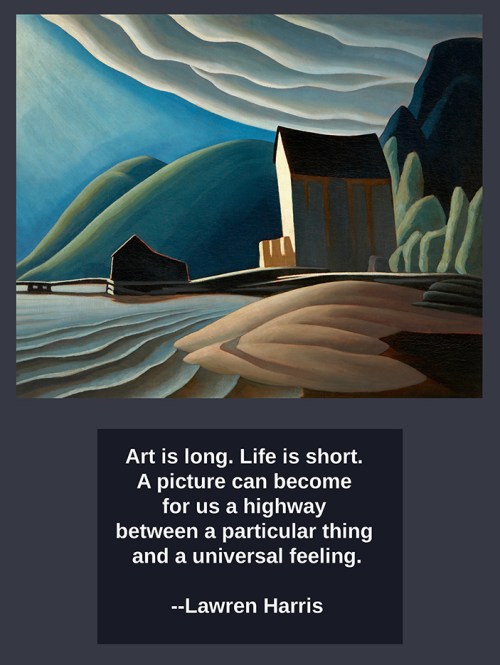
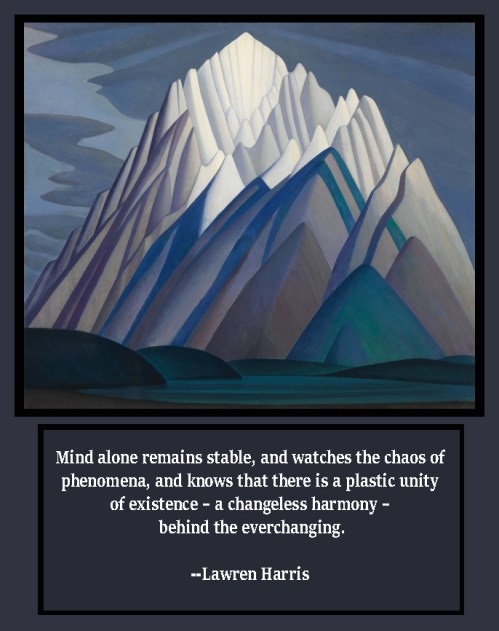
Lawren Harris From the North Shore Lake Superior 1927

Lawren Harris, From the North Shore Lake Superior, 1927


Art is not an amusement, nor a distraction, nor is it, as many men maintain, an escape from life. On the contrary, it is a high training of the soul, essential to the soul’s growth, to its unfoldment.

–Lawren Harris


Whenever I need a lift or a reminder that what I am doing is more than a mere triviality, it’s always good to revisit the work and words of the late painter Lawren Harris.

Harris, who died in 1970 in his native Canada at the age of 85, had a way of capturing of grand spaces and forms and imbuing in them a sense of absolute stillness. It’s a created atmosphere that is conducive to the unfolding and growth of one’s soul.

Some might say that this in itself is an escape from life and, in the simplest terms, they would be correct. But art transcends the mere act of escape in that while doing so, it provides the space and nourishment for the growth of the soul.

I know that I have often looked to art as a safe haven, an escape from the cruelty and often illogical nature of the outside world.

But it was never just that single thing. This separation between the outer and inner world created an environment, a time and place, where lessons could be learned and insights could be formed. These lessons and insights become part of who we are and then undoubtedly travel with us back into that outer world.

No, art is not an amusement or an escape. It changes us in fundamental ways and by that, we are always made better.

I needed to write that this morning, if only for myself. Thanks, Mr. Harris, I feel a little better now.


The Revealing


GC Myers WIP 2023 Oct sm

Work-In-Progress 2023

I aim here only at revealing myself, who will perhaps be different tomorrow, if I learn something new which changes me.

–Michel de Montaigne (1533-1592)


This is a Work-In-Progress that is currently on the easel here in the studio. Thought I’d show it this morning because it’s at that point where it begins to reveal its true self in its evolution from the nothingness of a bare canvas to whatever it turns out to be.

It’s my favorite point in the process because the tones of the red oxide underpainting and the first few touches of color coalesce into a wholeness that begins emitting an emotional radiance.

Yeah, that sounds kind of pretentious, I know. But you have to give me a break– if I had better words I most likely would be a writer and not a painter. Or maybe a plumber. Who knows?

But the point I am trying to make is that it’s at a point where it begins to tell its story with feeling. My struggle is to keep this first burst of feeling intact or increase it as the painting progresses from here. Actually, it’s to try to figure out now to not obscure that feeling that I am getting from it at this point.

And that sometimes happens. I have had pieces where they feel very strong at this juncture but end up losing a bit of their emotional impact under the layers of paint that will follow. I toy with the idea of going just a touch further than this before leaving the painting alone but am blocked in doing from some compulsion to see it go as far as I can take it.

It’s a kind of metaphor for our personal evolution, much like the words at the top from the 16th century French philosopher Michel de Montaigne. We are like the painting in that we find ourselves revealed to be who we are at certain points in our lives. But we do not have to remain at that point. With knowledge, new revelations about ourselves and the world around us, we change. We have that same underpainting in place but we are now somehow different.

Hopefully, for the better.

I am eager to see where this piece goes. I will be sure to share it at some point.

Here’s a song in that same vein. It’s a live version Changes from David Bowie. Good way to kick off the new week that is facing a difficult world.

Now, get the heck out of here. I got work to do.