Feeds:
Posts
Comments
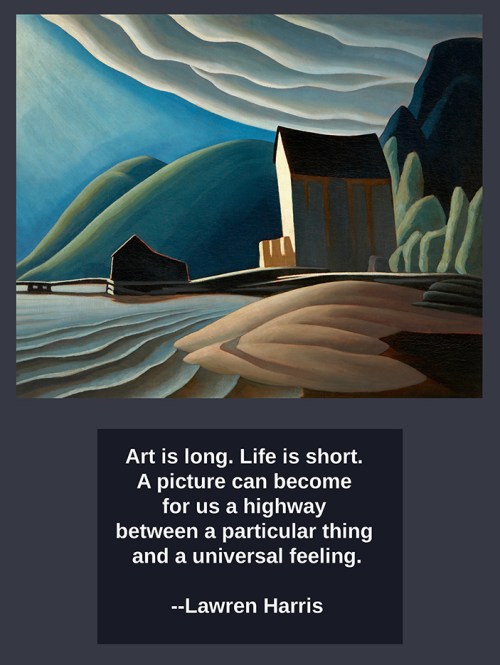
Lawren Harris From the North Shore Lake Superior 1927

Lawren Harris, From the North Shore Lake Superior, 1927


Art is not an amusement, nor a distraction, nor is it, as many men maintain, an escape from life. On the contrary, it is a high training of the soul, essential to the soul’s growth, to its unfoldment.

–Lawren Harris


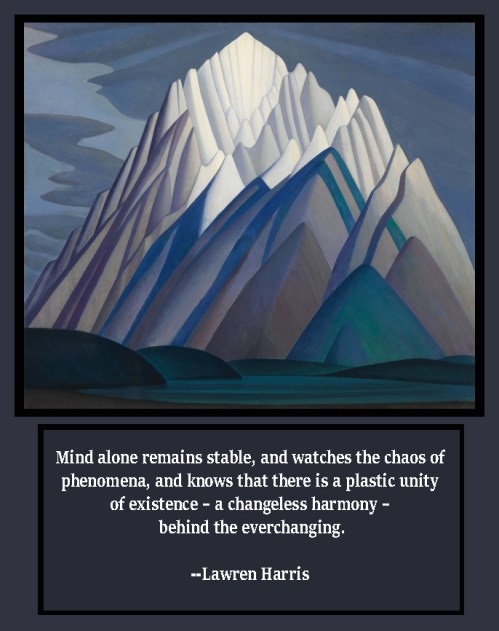
Whenever I need a lift or a reminder that what I am doing is more than a mere triviality, it’s always good to revisit the work and words of the late painter Lawren Harris.

Harris, who died in 1970 in his native Canada at the age of 85, had a way of capturing of grand spaces and forms and imbuing in them a sense of absolute stillness. It’s a created atmosphere that is conducive to the unfolding and growth of one’s soul.

Some might say that this in itself is an escape from life and, in the simplest terms, they would be correct. But art transcends the mere act of escape in that while doing so, it provides the space and nourishment for the growth of the soul.

I know that I have often looked to art as a safe haven, an escape from the cruelty and often illogical nature of the outside world.

But it was never just that single thing. This separation between the outer and inner world created an environment, a time and place, where lessons could be learned and insights could be formed. These lessons and insights become part of who we are and then undoubtedly travel with us back into that outer world.

No, art is not an amusement or an escape. It changes us in fundamental ways and by that, we are always made better.

I needed to write that this morning, if only for myself. Thanks, Mr. Harris, I feel a little better now.


The Revealing


GC Myers WIP 2023 Oct sm

Work-In-Progress 2023

I aim here only at revealing myself, who will perhaps be different tomorrow, if I learn something new which changes me.

–Michel de Montaigne (1533-1592)


This is a Work-In-Progress that is currently on the easel here in the studio. Thought I’d show it this morning because it’s at that point where it begins to reveal its true self in its evolution from the nothingness of a bare canvas to whatever it turns out to be.

It’s my favorite point in the process because the tones of the red oxide underpainting and the first few touches of color coalesce into a wholeness that begins emitting an emotional radiance.

Yeah, that sounds kind of pretentious, I know. But you have to give me a break– if I had better words I most likely would be a writer and not a painter. Or maybe a plumber. Who knows?

But the point I am trying to make is that it’s at a point where it begins to tell its story with feeling. My struggle is to keep this first burst of feeling intact or increase it as the painting progresses from here. Actually, it’s to try to figure out now to not obscure that feeling that I am getting from it at this point.

And that sometimes happens. I have had pieces where they feel very strong at this juncture but end up losing a bit of their emotional impact under the layers of paint that will follow. I toy with the idea of going just a touch further than this before leaving the painting alone but am blocked in doing from some compulsion to see it go as far as I can take it.

It’s a kind of metaphor for our personal evolution, much like the words at the top from the 16th century French philosopher Michel de Montaigne. We are like the painting in that we find ourselves revealed to be who we are at certain points in our lives. But we do not have to remain at that point. With knowledge, new revelations about ourselves and the world around us, we change. We have that same underpainting in place but we are now somehow different.

Hopefully, for the better.

I am eager to see where this piece goes. I will be sure to share it at some point.

Here’s a song in that same vein. It’s a live version Changes from David Bowie. Good way to kick off the new week that is facing a difficult world.

Now, get the heck out of here. I got work to do.


In the Maze

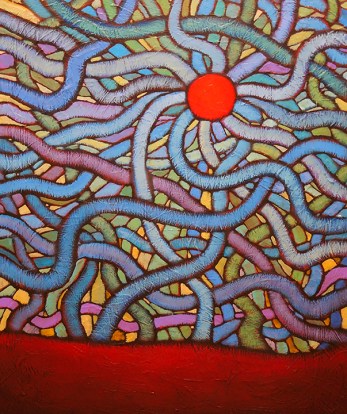
GC Myers- Tangled Light sm

Tangled Light, 2015


Our final results appear almost self-evident, but the years of searching in the dark for a truth that one feels but cannot express; the intense desire, and the alternations of confidence and misgiving, until one breaks through to clarity and understanding, are only known to him who has himself experienced it.

–Albert Einstein, University of Glasgow Lecture, 1933


To paraphrase: The answers we seek are almost certainly before us. We just don’t recognize them as such, grasping as we do at threads that only serve to overcomplicate the situation. It twists our thinking to the point that the simplest and most logical answer seems nonsensical.

We become like the conspiracy theorists who see intricate plots with complicated and illogical twists and turns in places where the easiest and most evident answer contradicts their every assertion. We wander in the vast mazes we create only to discover that a simple straight line, in the end, leads to the answer.

It’s only when we finally come to that answer that we see that simplest way was the right and only way to get to the answer.

But everyone who travels that straight line afterward can plainly see that it was the right way. But they will never know the confusion, consternation, and doubt of those who were lost in the maze before finally stumbling across that direct path.

Okay, I’m done. That’s too much whatever-this-is before 6 AM on a Sunday morning. Here’s a song from the Postmodern Jukebox for this week’s Sunday Morning Music. Featuring the vocals of Rogelio Douglas, Jr., this is their version of the U2 classic I Still Haven’t Found What I’m Looking For.


FYI: The painting at the top is a companion piece to the one shown yesterday. It also lives with me in my studio now. I am looking at it as I write this, and it reminds me that I still have a maze to contend with. If you know how to get out of here, let me know. I just can’t see it yet…


GC Myers-  October Sky sm

October Sky, 2015


Human lives… are composed like music. Guided by his sense of beauty, an individual transforms a fortuitous occurrence… into a motif, which then assumes a permanent place in the composition of the individual’s life… Without realizing it, the individual composes his life according to the laws of beauty even in times of great distress.

–Milan Kundera, The Unbearable Lightness of Being


I was reading an article this morning about the role serendipity plays in shaping our lives and our perceptions of it. How we shape our being by the meaning we find in coincidences and the parallels we recognize in art– those books, music, and films we take in– and our own lives. I can certainly point to such instances in my own life. This somehow reminded me of the painting above and the blog entry below from a few years back. The blog post featured little close-up chunks of the painting and that reminded me in a way of how we put together the composition that is our life. Little bits that by themselves often go by unnoticed but ultimately interweave and coalesce into something more than themselves.

Felt like it was good morning to replay this post, especially given that the title of the painting is a timely one, October Sky.


I was looking for something to play this morning and put on this album, Blues Twilight, from jazz trumpet player Richard Boulger. I’ve played a couple of tracks from this album here over the years.

While the title track was playing, I went over to over to a painting that hangs in my studio, the one shown above. It’s an experiment titled October Sky from a few years back that is a real favorite of mine. I showed it for only a short time before deciding that I wanted it hanging in the studio. I never really worked any further in the direction this piece was taking me. Part of that decision to not go further was purely selfish, wanting to keep something solely for myself, something that wasn’t subject to other people’s opinions.

A strictly personal piece. A part of the prism that doesn’t show.

I look at it every day but generally it is from a distance, taking it in as a whole. But his morning, while the album’s title track played I went and really looked hard at it, up close so that every bump and smear was obvious. And I liked what I was seeing, so much so that I grabbed my phone and began snapping little up-close chunks of it.

It all very much felt like the music, like captured phrases or verses. Each had their own nuance, color and texture and they somehow blended into a harmonic coherence that made the piece feel complete.

It’s funny but sometimes when I am working hard and in a groove that takes over from conscious thought, I almost forget about those things that I myself like in my work because I don’t have to think about them in the process of creating the work. Looking at this painting this close made me appreciate the painting even more, made me think about it in a different way than the manner in which I now used to seeing it.

Guess it’s a good thing to stop every now and then and look at what you’ve done, up close and personal.

Here’s Blues Twilight from Richard Boulger. Enjoy the music and take a look at the snips below the song, if you so wish.


GC Myers- October Sky detailGC Myers- October Sky detail20180415_07492420180415_07490820180415_07485920180415_072615


At the age of six I wanted to be a cook. At seven I wanted to be Napoleon. And my ambition has been growing steadily ever since.

–Salvador Dali, The Secret Life of Salvador Dali (1948)


From 2008:

At the opening for my show at the Haen Gallery in Asheville, NC, a young woman approached me, telling me first that she had a piece of mine which she loved. She said she felt the same about all my work. We talked for a bit then she came out with the inevitable.

You’re not what I had expected. I thought you might be wearing a beret or a cape or something like that.

Strangely, I get that a lot.

People expect me to be something much different than I appear to be. More flamboyant, I guess. Maybe more boorish. Maybe like this guy, Salvador Dali, who exemplified that stereotype of the crazy artist.

But they’re faced with me– a thick-waisted, middle-aged guy with a sloppy gray beard. I used to kid with the folks at the Principle Gallery that one day I would show up at a show in a Dali-like manner, swooping in to hold court in my flowing black cape, waving my arms about in dramatic flourishes. Maybe wearing a monocle and spats like Mr. Peanut. Maybe with a waxed rat-tail moustache a la Dali?

I sometimes wonder if people would look at my work differently then.  Would they find different attributes in the paintings? Would they find a different meaning in each piece?

I don’t know. I hope not.

But I do know there is an illusion behind each person’s impression of a piece of art, that it is a delicate web that supports how they value a piece and that can be affected by my words or actions or even appearance. I have had collectors who did not want to meet me at openings for that very reason, fearful that I might end up being a total dope and that the paintings on their walls were now worthless in their eyes.

Probably a wise move on their part.

That is one of the reasons I’m a little reticent to do this blog. I could write something off the cuff, something that I might soon realize was a product of flawed logic, and quickly destroy someone’s whole perception of my work.

Perhaps that is not giving the work enough credit for its own strength and life. Perhaps this is the flawed logic I mentioned. Whatever the case, it’s something I bear in mind. But for the time being, I will keep the cape and moustache wax in storage and stick with the credo of my childhood hero, Popeye: “I yam what I yam.”

And that’s all that I am…


Followup from 2012:

In the comments from the original 2008 post, someone made the point that the work should stand on its own regardless of the mannerisms or perception of the artist. Of course, I agree completely with that in theory. 

However, I point out that sometimes the artist can affect, both positively and negatively, how their work is viewed with their words and actions. I cite a story I’ve told innumerable times of going to a local college to hear a famous author speak. I was seventeen years old and aspiring to be a writer at the time, armed with a legal pad filled with questions that I hoped to ask this author so that his words of wisdom might guide me along. At the reception afterwards when I finally got a chance to speak with him, he was half in the bag drunk– and a smug prick as well. He rudely dismissed me, moving on without taking a second to consider my question to him. I was crushed and left promising myself that I would never read another word that fool would write.  I have kept that promise to this day.

I also vowed to myself that if I was in that position, I would never treat anyone so dismissively. Hopefully, I have kept that promise.

This was written in the first few months of writing this blog so some things have obviously changed. I was still up in the air about writing this blog, something which I have obviously reconciled with myself. But I am still the same middle-aged guy with a thick waist and a sloppy gray beard.


Followup from 2023:

Since it’s been fifteen years now, must be I have gotten over my hesitancy in writing this blog. Still the same thick-waisted middle-aged guy with what is now a white sloppy beard. The cape and moustache wax have, like Elvis, left the building long ago. Still worry about inadvertently coming off as rude or dismissive of folks at openings and talks. 

And still strong to the finish ’cause I eats me spinach…


GC Myers- Sharing Heart sm

Sharing Heart– At Kada Gallery, Erie PA

Illness is the doctor to whom we pay most heed; to kindness, to knowledge, we make promises only; pain we obey.

–Marcel Proust, Remembrance of Things Past


There is always some sort of conflict and atrocity taking place somewhere on this Earth of ours. History tells us that. It’s so prevalent that many of us are able to tune it out altogether, barely noticing it.

We become inured to the pain and suffering of so many others.

But there are moments when it feels like the hurt and horror of the world reaches some sort of peak. Like a psychic string has been plucked that reverberates around the globe, pealing out a tone that anyone with an iota of empathy can feel.

It feels like such a moment. Maybe it’s just me.

And even if it is something that is felt by others as well, I am left wondering what one can do in response to that vibrating tone. Is it a call to action or a warning to be prepared when whatever evil is taking place heads your way? Maybe a warning that it can come your way?

I don’t know. It certainly has me on edge but, then again, maybe it’s just me.

For the moment, let’s act on the words from Proust at the top of this page. Let’s fulfill our promises to kindness and knowledge. Maybe that is the thing that will dampen that plucked string.

What can it hurt?

Here’s one of my all-time favorites, Try a Little Tenderness, from the immortal Otis Redding. This is a performance in Cleveland that took place the day before he died in a plane crash back in 1967. I am still in awe of all that he left in his 26 years on this planet. Let’s listen to his advice.


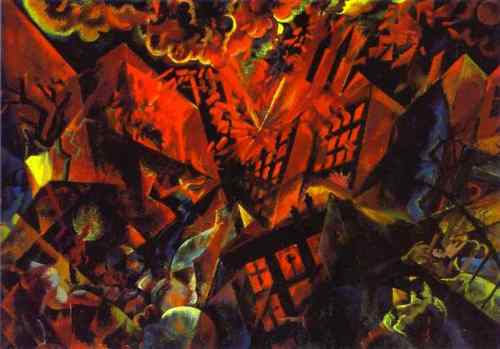
Grosz Explosion

George Grosz- Explosion, 1917


The war was a mirror; it reflected man’s every virtue and every vice, and if you looked closely, like an artist at his drawings, it showed up both with unusual clarity.

–George Grosz, Autobiography (1893-1959)


I was watching and listening to the reports from Israel yesterday. There were anecdotal stories that were filled with horrific details of death along with amazing stories of survival. As artist George Grosz wrote above, the best and worst of man.

This conflict feels like a massive expansion from the same motivating forces that have created similar death and destruction in Ukraine for the last 18 months.  The news reports are often accompanied by videos of huge explosions in the night sky that color the atmosphere in the colors of war and apocalypse– black and red and deep yellows and orange. After a while, it feels overwhelming. I am reminded by these images of artist George Grosz whose powerful work filled with those same colors of war reflected his WW I experience as a German soldier.

Below is a post from back in 2011 about the effect of this work.


From 2011:

I woke up in the dark this morning after a fitful night of sleep filled with horrible dreams.  I don’t want to go into the details but they were awful and constant, each sweeping from desperate scene into yet another. Dark and tinged in deep colors of black and red. Hopeless in the scope of their finality and, though I am hesitant to use the word, there was a sense of apocalypse.

I was shaken. I’ve had many horrifying dreams over the years but they seldom felt so vast and desperately final.

As I trudged down to pick up my newspaper, I tried to sort out these dreams in order to find an equivalence in imagery that I know that captured in some way the feel of these dreams. As I neared the studio the dark paintings of George Grosz done in Germany in the years before World War I came to mind. They were forebodingly dark and angry and just the overall look of them made me think of the darkest corners of man’s mind. The red tones and the way they filled the picture plane along with the chaotic nature of the compositions brought to mind the nightmarish feel of my dreams.

Grosz’s work changed over the years, especially after fleeing Hitler’s Germany, moving to the New York in the 1930’s where he lived until the late 1950’s when he returned to Berlin, dying there in 1959. His American work is often considered the weakest of his career, less biting and more esoteric. There were exceptions during the war such as 1944’s Cain, Or Hitler in Hell, shown here, which reverts back to the colors and nightmare feel of his early work.  Very powerful work that may not sooth one’s soul but rather documents the darker aspects of human existence.

I don’t know if my own nightmares have an effect on my work. Perhaps they come out in work that seems the antithesis of them, work that seeks to calm and assure. Even so, I believe they are there in the background somewhere.

I don’t really know to be honest. I do know that I want to put last night’s visions behind me. To that end, I think I should get to work and let my nightmares only dwell in the work of Grosz for now.

Below is more of the work of George Grosz along with a video of his work set to violinist Andre Rieu playing a selection from The Merry Widow, which gives the whole thing a lighter tone than one would expect.


America

Centre of equal daughters, equal sons,
All, all alike endear’d, grown, ungrown, young or old,
Strong, ample, fair, enduring, capable, rich,
Perennial with the Earth, with Freedom, Law and Love,
A grand, sane, towering, seated Mother,
Chair’d in the adamant of Time.

— Walt Whitman, 1888


Not that it matters, but the photo of poet Walt Whitman at the top was taken by the famous painter Thomas Eakins in 1891 while his painting of Whitman on the right was completed in 1887. Just wanted to get that info out of the way.

Whitman and his belief in the power of democracy and equality has played a role in my life for a long time. Thought I’d share the only known recording of his voice, from a wax recording of his reading of his poem America. The recording only contains the first four lines of the short six-line poem leaving off one of my favorite of his phrases, the last line: Chair’d in the adamant of Time. He is basically declaring that so long as America remains a country of Freedom, Fairness and Justice for all, it shall remain as the grand, sane, towering, seated Mother as it has often been perceived by the rest of the world. I like that he portrays the country in the matriarchal sense.

It takes less than a minute to listen to Whitman’s reading. It’s interesting to hear his voice, especially the emphasis he places on some words, such as ample. To my ear, it reminds me of the voice of actor Lionel Barrymore, also a longtime favorite of mine.

Now, for the sake of transparency, I have to let you know that there is a lot of controversy as to whether this is indeed Whitman’s voice. I share this link to the Library of Congress Blog and an article that makes a strong case for it being a recording by an actor from a later date

So, maybe it is Uncle Walt and maybe it isn’t. Maybe the reading itself doesn’t matter so long as we understand the message in his words, be it Whitman or an actor, especially at this point in time.

To those who pay attention, the question of whether we can remain that country of Equality, Fairness and Justice for All remains up in the air at the moment. We struggle against powerful forces that seek to define equality, freedom, and fairness in terms that they define that benefit the few, not the many. Hopefully, enough of us can recognize the motives moving these forces and take a stand to defend an America that would make Uncle Walt proud.


Truth Spoken Here

GC Myers-  The Durable Will sm

The Durable Will– GC Myers


It is the glory and good of Art
That Art remains the one way possible
Of speaking truth,—to mouths like mine, at least.

–Robert Browning, The Ring and the Book (1868-69)


The events of recent times, here and abroad, have me questioning the meaning and value of truth. It seems like we have entered an era in which every word and action is dissected, parsed, decontextualized, twisted in all directions, and ran through a gauntlet of algorithms that leave one wondering if any truth can endure and overcome such strain.

Are there still universal truths and, if so, will we be able to continue to recognize these truths going forward?

That’s a big question with most likely no concrete answers and probably an unfair question to ask in this early Monday morning.

Unfortunately, it’s the kind of question that sometimes wakes me up at 4:30 AM, making my mind immediately begin racing.

I have spent the last 25 or so years trying to make some sort of sense of this world through my work, to reveal even the smallest bit of truth that speaks to a universal audience. These questions about what truth now means make me wonder whether the truths that I have known are still real, are still durable enough to persist.

One may never know. I guess the best we can do is to keep speaking the truth as we know it and hope that its reality will allow it to survive the tests it will surely face.

Man, this week feels like a bear already and it’s not even 7 AM!

Let’s listen to the great and underappreciated jazz harpist Dorothy Ashby with a tune that lines up with today’s thoughts. It’s called Truth Spoken Here from her 1969 album, Dorothy’s Harp.

It’s good stuff and that’s the truth…


Little Blue


GC Myers- Moonlight Quartet, 2023

Moonlight Quartet–At West End Gallery

Little blue, be my shelter
Be my cradle, be my womb
Be my boat, be my river
Be the stillness of the moon
If I could, I’d go with you
To a place I never knew
In your eyes, so dark and open
There’s a light that leads me back to you

Jacob Collier, Little Blue


What a time.

What a world.

It all seems out of rhythm, in vast disharmony. The hatred, anger, and inhumanity that is taking place– how can one make sense of such things? How can one maintain balance in a world so out of balance?

We can put our heads in the sand to ignore it or try to rationalize it away by saying that it’s been this way for thousands of years, that it’s simply part of our nature. But that doesn’t make it right. Doesn’t bring even the slightest reassurance or comfort, even to someone who is far removed and insulated from the horrors of the moment.

I wish I had answers for you. Or for myself. Of course, I don’t have any.

Probably the best we can do is not to accept it, to not let the hatred and disregard for life seep into our own lives. To be kind and tolerant of others we come across. To do no harm.

Maybe we can create tiny ripples of humanity in a vast and turbulent ocean of inhumanity. Maybe we can still the waters.

Hmm…

For this Sunday Morning Music break, here’s a song from Jacob Collier with a performance that is all about harmony. Lovely tune in an unlovely moment. A tiny ripple.