Feeds:
Posts
Comments

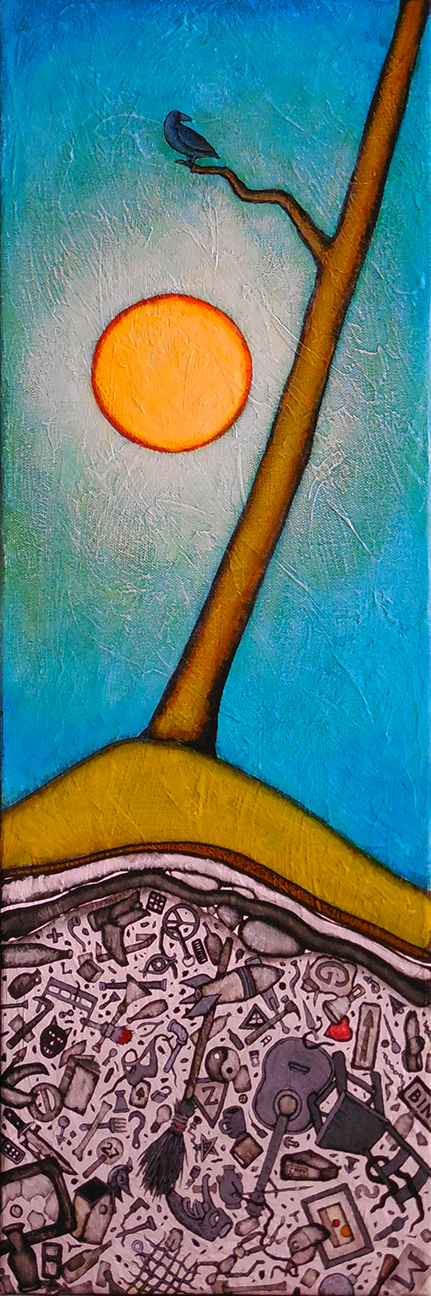
Crescendo

GC Myers-Crescendo sm

Crescendo– Coming to Principle Gallery, Alexandria, VA


Sometimes I sit, sometimes I stareSometimes they look and I don’t careRarely I weep, sometimes I mustI’m wounded by dust

–Laura Marling, Sophia


My annual solo exhibit at the Principle Gallery opens four weeks from today on June 9th.  This means I have about three weeks to finish and prepare the remaining paintings for the show. As the experience of doing this show for the past 24 years have shown me, the coming weeks is filled with a wide variety of emotions for me.

There is the excitement of the work itself as it builds toward the show. Inevitably, it is in these final weeks and the final pieces that the direction of the work hones itself to a fine point. A rhythm (there’s that word again) develops in the months leading up to now and in the final weeks, it is racing fully forward. Everything comes easily and the momentum of one piece carries into the next with full force.

The work seems self-propelling at these times, and I just need to make myself available as the tool which creates the work. It is the excitement of a performer who has rehearsed for months and months and at some point, the work they are rehearsing becomes built-in and natural. It becomes part of them in that moment.

I think that’s what you hope for whatever creative field you might be in.

It might also be like an athlete training for many months for an event. Ideally, their training builds and builds so that at the moment of the event every motion, every stride, is at full effort and in full rhythm.

But there are also moments of despair and doubt, as I have pointed out here before. You worry if you’ve done enough or made the right creative choices when they have appeared. You wonder if you are good enough or if this will be the time when your inadequacies are fully revealed.

Do I have what it takes to finish this race, to reach the crescendo?

Sounds neurotic, I know. And that might be correct. It might also be integral to the process. I don’t know.

It makes for a roller coaster ride of emotions each day.

It’s the best and it’s the worst. 

I’ve had quite a few jobs that were far too imbalanced with worst moments so this is a relative picnic, neurotic as it might seem. At least it has those best moments to counter the worst ones.

Thanks for listening to me babble for a few minutes. It serves a purpose for me–I think. Here’s a favorite song that I haven’t heard in a while. I chose it because of the manner in which it builds to a crescendo. Seems fitting. This is Sophia from Laura Marling.



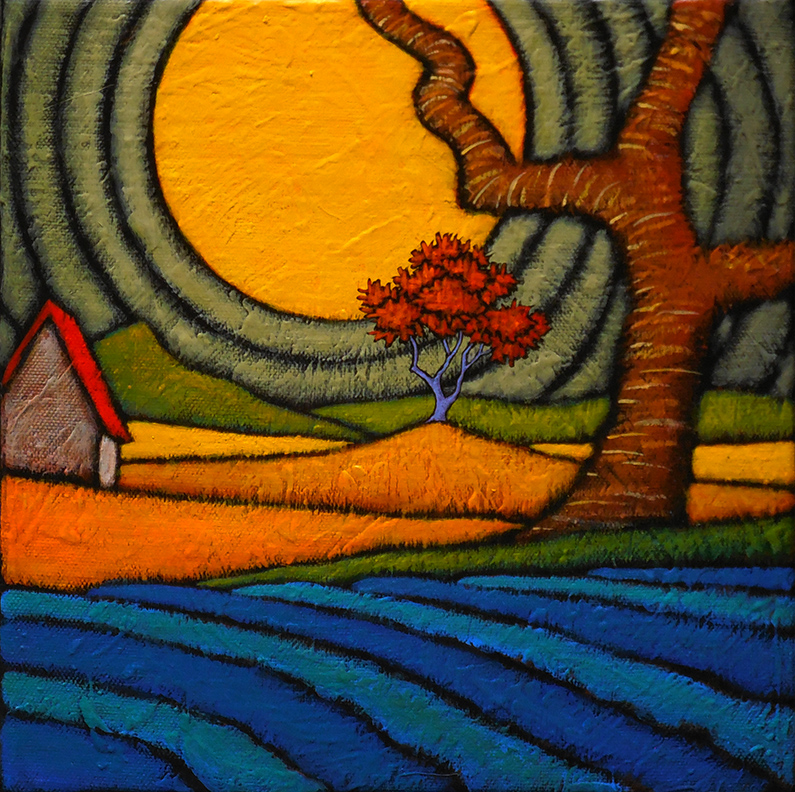
GC Myers- Force Natural 2022

Force Natural— Coming to the Principle Gallery, June 2023

My father was very sure about certain matters pertaining to the universe. To him all good things — trout as well as eternal salvation — come by grace and grace comes by art and art does not come easy.

–Norman Maclean, A River Runs Through It and Other Stories (1976)


“grace comes by art and art does not come easy”

I think about this line from Norman MacLean’s A River Run Through It quite often, especially in the weeks before a show. It’s a period of time filled with the elation and excitement of new work brimming with new life. But with that there are also intense feelings of doubt and smallness.

I look around and see the familiar singular Red Trees and Red Roofs and round balls of suns and moons and wonder if I have reached my limit. It’s not unusual to find myself asking if I have wrung out the dishrag of whatever little talent or potential I possess.

It’s a maddening time that has me questioning why I continue doing it. Starting work on the next piece becomes harder and harder but I force myself to it. Maybe it’s from force of habit or maybe I see it as my one last attempt.

And I wonder to myself what exactly I am attempting.

It’s at this point that I think of the words above from MacLean.

Maybe it is that grace of which he writes. An action repeated again and again in an attempt to reach a degree of the ultimate rightness. Not perfection because we are, as humans, imperfect and each attempt begins already carrying a measure of our imperfection.

Perfection, no. But perfecting, yes. Perhaps an ultimate rightness, something refined from repetition and persistence, might be attainable. What that ultimate rightness might be varies for each of us. It takes into consideration our inherent and unique imperfections and flaws– those things that differentiate works of art.

Thinking of things in this manner makes this period of time before a show more tolerable. I begin to see each piece as a distinct attempt to reach my ultimate sense of rightness and starting a new piece no longer feels like a great chore but more like the beginning of a journey that might take to me a that hard-fought form of grace I seek.

Maybe this time…

GC Myers- Blaze  2014

GC Myers- Blaze, 2014


When men sow the wind it is rational to expect that they will reap the whirlwind.

–Frederick Douglass


Amplified consequence.

In his 1892 essay, Lynch Law in the SouthFrederick Douglass used the proverb from biblical book Hosea, to illustrate how man often sets things in motion that have results that extend far beyond– and often in stark opposition to– their intended goals. Douglass wrote that the deadly violence being shown against the black citizens of the south at that time would eventually come back to haunt those that perpetrated the deed or stood idly by, complicit in their silence.

The biblical proverb in Hosea was about how the the citizens of Israel of that time (ca 725 BC, I believe) took to idolatry, the worship of false idols, and how their actions brought down upon them the wrath of God. In that book the author uses the concept of farming to make his point, that a  a single seed of grain sowed by a farmer returns to him many times over.

An amplified consequence.

Of course, the farmer can usually tell what the result of his sowing will be. Planting X amount of seed will allow him to reap Y amount of grain at harvest under normal circumstances. Predictable.

But that same degree of predictability doesn’t apply to all other actions man sometimes sets in motion. While we might initially think we control the outcome, we sometimes put actions into motion — sow our seed– that we cannot control, that return to us with such amplification and intensity that we are overcome and sometimes decimated by the result.

One small, seemingly insignificant action, such as not paying attention to a rising dangerous wind, can sometimes turn into a maelstrom of destruction that we never saw coming.


The entry above ran several years back. I wanted to say something today about yesterday’s verdict in the civil case against the former president*** and today’s coming indictment of a sitting congressman along with what no doubt will be many more serious legal actions in the coming months. I believe that anybody that watched closely over the past six or seven years has been anticipating this action for much of that time.

It was an act of faith, this believing that dire consequences would finally come to those characters who twisted and broke laws for their own gains, who lied without end in betraying the public trust. Thise who gained power not to serve the people but to serve themselves.

Justice, however, has been slow in coming and the faith in karmic justice of many has been strained. One was left to wonder why anyone would follow the rule of law when those entrusted to serve us were exempt from doing so. It felt as though unless justice was meted out to those usurpers of the power of our government, everything would come apart.

The center could not hold.

After all, when one has lost all beliefs and trust, what holds their world together?

Maybe yesterday was hopefully a beginning to a coming whirlwind. A righteous and justified whirlwind that will cleanse the landscape and restore the faith of many in that which is right.

Using lines from a couple of other earlier blogposts, Robert Louis Stevenson claimed: Everybody, sooner or later, sits down to a banquet of consequences.

Or to put it in even more direct terms, from the song from Rival Sons:

When it comes back around you’re gonna get what’s coming.
You sit on your fence and you scream about justice.
Between the have and have-not’s only one feels the difference.
And when it comes back around you’re gonna get what’s coming.
When it comes back around you’re gonna get what’s coming.

I’ve played this song a couple of times in the past several years in the anticipation of a coming whirlwind of justice. Let’s hope yesterday’s first breeze foretells of a mighty storm.


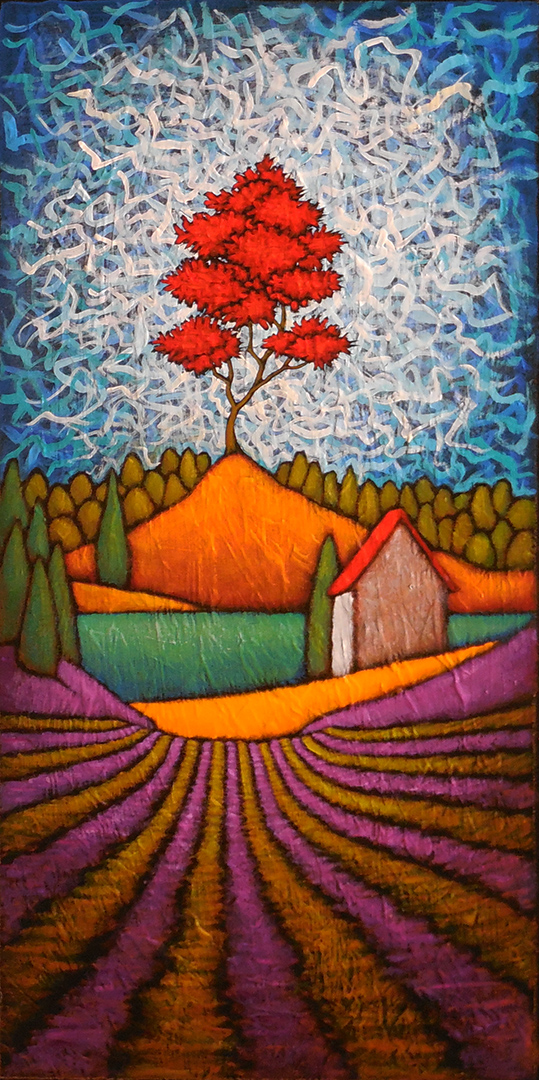
GC Myers-  Endless Possibility

Endless Possibility– Coming to Principle Gallery in June


George Gray

I have studied many times
The marble which was chiseled for me–
A boat with a furled sail at rest in a harbor.
In truth it pictures not my destination
But my life.
For love was offered me and I shrank from its disillusionment;
Sorrow knocked at my door, but I was afraid;
Ambition called to me, but I dreaded the chances.
Yet all the while I hungered for meaning in my life.
And now I know that we must lift the sail
And catch the winds of destiny
Wherever they drive the boat.
To put meaning in one’s life may end in madness,
But life without meaning is the torture
Of restlessness and vague desire–
It is a boat longing for the sea and yet afraid.

–Edgar Lee Masters, Spoon River Anthology, 1915


The painting at the top probably represents how George Gray, studying his gravestone in the poem above from Edgar Lee Masters, wished he had lived his life instead of being a boat at rest in the harbor, longing for the sea and yet afraid.

There’s something to think about there, how we let our fears and inner demons squash our greatest desires and rule our lives. 

Maybe we should take a bit of advice from this song, Shake It Out, from Florence and the Machine. As she sings: It’s hard to dance with a devil, on your back, So shake him off…

I bet old George Gray wish he had taken that advice.


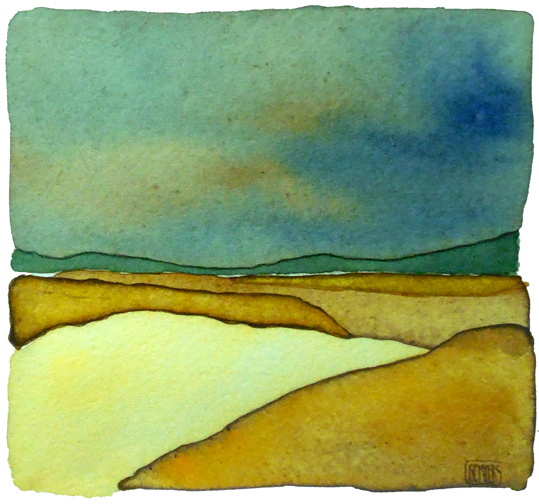
gc-myers-the-sky-doesnt-pity-1995sm

GC Myers- The Sky Doesn’t Pity, 1995

Competitions are for horses, not artists.

–Bela Bartok


The quote above from Hungarian composer Bela Bartok pretty much sums up my feelings about entering my work in competitions. Don’t get me wrong– I have been a highly competitive person in most things through most of my life. But I never liked the idea of judging one painting against another as though there was some objective scale on which to judge them. Art is always subjective, in the eye of the beholder. Plus, the idea of a judge or group of judges trying to get a grasp of your work with 10 seconds exposure to it seemed kind of unfair in some way.

That being said, I did enter my work in competitions early in my career and have also served as a judge in several others. I had a pretty decent level of success competing, taking a third place in a national competition and a couple of Best in Shows along with a couple of other awards in regional events. But it never felt good to me and when I felt like it no longer served my needs I stopped entering them. 

It was pretty much the same with judging. As much as I tried to be objective, my selections in these competitions always ended up subject to my own likes and dislikes, on whether they moved me in some way. They were honest choices but it always bothered me that these artists were judged on a scale that most likely was unknown to them.

As it was with entering my work in competitions, I no longer judge competitions.

But I do have to add that those competitions did wonders for me early on in my development and I may not be writing this today if not for them. Here’s what I wrote ten years back about the painting above which was the first painting I ever entered in a competition:

I was looking around my studio, taking in some of the work hanging on the walls throughout the house. There are pieces from other artists, including some talented artist friends and young fans along with some notables such as David Levine and Ogden Pleissner. But most of it is older work of my own. There are a few orphans, paintings that showed extensively but never found a home. I see flaws in some of these that probably kept potential collectors from taking it home but most just didn’t find that right person with which to connect. Most of the other hanging work is work that I won’t part with, work that somehow has deeper meaning for me. Work that I just keep close.

One of these paintings is the one shown here, The Sky Doesn’t Pity, a smallish watercolor that’s a little over 4″ square. It was painted in 1995 after I had started publicly showing my work for the first time at the West End Gallery in Corning, NY, not too far from my home.  The gallery has been what I consider my home gallery for 18 years [28 years now], hosting an annual solo show of my work for the last eleven [ 21 now] years.

But when this piece was painted, I was still new there, still trying to find a voice and a style that I could call my own. I had sold a few paintings and had received a lot of encouragement from showing the work at the gallery but was still not sure that this would lead anywhere.  I entered this painting in a regional competition at the Gmeiner Art Center in Wellsboro, a lovely rural village in northern Pennsylvania with beautiful Victorian homes and gas lamps running down its Main Street.

It was the first competition I had ever entered and, having no expectations, was amazed when I was notified that this piece had taken one of the top prizes. I believe it was a third but that didn’t matter to me. Just the fact that the judges had seen something in it, had recognized the life in it, meant so much to me. It gave me a tremendous sense of validation and confidence in moving ahead.

Just a fantastic boost that opened new avenues of possibility in my mind.

I still get that same sense even when I look at this little piece today, a feeling that keeps me from even contemplating getting rid of this little guy. I can’t tell you how many times I have glimpsed over at this painting and smiled a bit, knowing what it had given me all those years ago.

And it keeps giving, encouraging me even now.

GC Myers- White in the Moon 2023

White in the Moon— At the Principle Gallery, June 2023


White in the moon the long road lies,
The moon stands blank above;
White in the moon the long road lies
That leads me from my love.

Still hangs the hedge without a gust,
Still, still the shadows stay:
My feet upon the moonlit dust
Pursue the ceaseless way.

The world is round, so travellers tell,
And straight though reach the track,
Trudge on, trudge on, ’twill all be well,
The way will guide one back.

But ere the circle homeward hies
Far, far must it remove:
White in the moon the long road lies
That leads me from my love.

–A.E. Housman, A Shropshire Lad, XXXVI


When I was finishing up this new painting that is headed to the Principle Gallery for my June show, I thought of it only in terms of the color blue. But the more I lived with it, the more I realized that the blue, though it seems to dominate the space, held a secondary position in this piece. The white of the moon and the light it sheds on the middle landscape and road carries the emotional weight, at least to my eyes.

And that subtle change in perception makes a significant difference in how I see this piece now. Seeing it in blue made me think of a somewhat sad, perhaps regretful, recollection of the past whereas when viewed with the white light of the moon, it felt more like a clarified remembrance. It is as though the onlooker here is looking back not with remorse or sorrow but with a new understanding of the past.

Maybe a wistful clarity.

Well, that’s how I see this piece which I am calling White in the Moon, after the lines above from A.E. Housman’s A Shropshire Lad. You might see it differently. You may very well see it bathed in blue with all the feeling and meaning that the color carries. In a way, I hope you do because that indicates you’ve engaged with it in even a fleeting way.

And that is a start.

My annual solo exhibit, this year titled Passages, at the Principle Gallery in Alexandria, VA opens Friday, June 9, 2023.

For this week’s Sunday Morning Music I am going with a theme of white light. There are a couple of classical pieces with male voices written for this particular verse– white in the light the long road lies— but they didn’t move me in any way so I decided to go another route. It’s not necessarily a song that you might normally pair with this painting or the verse of Housman. It’s a version of the old Lou Reed/Velvet Underground song White Light/White Heat which has long been a favorite of mine. This is a version from a casually gathered group (for a film, I believe) called The Bootleggers which consists of Nick Cave (who has been a regular on this blog) and Warren Ellis with the late Mark Lanegan on vocals. It has a bluegrassy feel to it that appeals to me on this fine-looking Sunday morning. Enjoy.


Georges Rouault The Old King

Georges Rouault- The Old King, 1936


I don’t know in the world why anyone would consent to be a king, and never to be left to himself, but to be worried and wearied and interfered with from dark to daybreak and from morning to the fall of night.

–Augusta, Lady Gregory,  The Dragon: A Wonder Play in Three Acts, 1920


I somehow found myself awake and watching the coronation of King Charles III early this morning. Not planned, of course. I am not a royal watcher nor a fan of monarchies in general. I did admire Queen Elizabeth II for a number of reasons but that is an exception. The idea of someone believing that they are born to a divine right to rule over anyone kind of ruffles my feathers as I sit here– unkempt, unwashed, unshaven.

I think the idea of kings and crowns speaks more to a need and desire by the majority of people to be ruled over than any divine right that any monarch truly possesses.

But I do appreciate the history of the moment as well as the rituals that go along with the ceremonies of the day. The Brits certainly know how to put on a show. 

Watching the ceremony and trying to write this post took me to the passage above from Isabella Augusta, Lady Gregory, the Irish playwright and co-founder of the Abbey Theatre with W.B. Yeats. While I don’t know the context in which it was written, the sentiment certainly matches up with my thoughts. For the life of me, I could never understand the desire to rule over others. If you are a good and caring person, the responsibility would be a giant and endless task

And if you go the other way, if you are an evil tyrant, you might not have the burden of caring weighing on your mind. You would instead be worrying day and night about who was trying to assassinate you or remove you from power. 

Either way sounds like a drag and who needs that? 

I don’t want to be ruled over nor do I want to rule over anything but my own little space in the world.

My own little kingdom.

Here’s my national anthem, You Can Have the Crown, from Sir Sturgill of Simpson.

Now get the hell out of here before I call out the palace guards. And stay off my royal lawn!


GC Myers-- Archaeology: Executor

Archaeology: Executor— Coming to Principle Gallery

Archaeology is rather like a vast, fiendish jigsaw puzzle invented by the devil as an instrument of tantalizing torment, since: (a) it will never be finished (b) you don’t know how many pieces are missing (c) most of them are lost forever (d) you can’t cheat by looking at the picture.

–Paul Bahn, Bluff Your Way in Archaeology, 1989


This is a new Archaeology painting that is headed to the Principle Gallery for my upcoming solo exhibit there next month. Titled Archaeology: Executor, it is 24″ by 8″ on canvas.

The Archaeology series has been one of the most popular since it was first introduced back in 2008. In the past decade I have only painted a few of these pieces for a variety of reasons. But I decided late last year that I would create a small number of new pieces from this series for this show.

One of the reasons these pieces have been in short supply is that they are difficult to paint. I don’t mean that in the technical sense, except in that they are time consuming with all their little details and such.

No, they are difficult because they present a challenge to my own curiosity. In the earliest examples from the series, I could easily fill the layers of artifacts with little thought as to what was there or how one artifact related to another or what tale they might tell in their jigsaw manner of storytelling.

But as I painted more of these pieces, I began to think about the artifacts and how they related to each other and what story they might be telling. As a result, painting these pieces became even more time consuming because I pondered and weighed each artifact a little more.

And all this additional thinking was off putting.

I know that sounds odd. You would think an artist would want to claim that everything that appears in their work is of their design, a product of their thought process. But early on in this series, I found that the appeal of it for me was the fact that I could just start painting with a minimum of thought, in a kind of stream of consciousness, and that it would produce a pile of jigsaw pieces waiting for someone else to put them all together. Some future archaeologists of art, maybe a kid in a gallery seeing a story come together in their imagination from the disparate pieces.

And that process of just allowing the subconscious to do its thing worked well.

But in trying to work on newer Archaeology pieces over the years, I found that I was trying to make out the story as I was painting. I was putting myself in the place of an archaeologist thinking of what they should find rather than just accepting and reading what they did find.  It was frustrating and often kept me from starting or finishing new pieces.

However, I might be past that now. With the this and a few other recent Archaeology pieces, I seem to have adapted the process. I find that they begin slowly– too much thinking!– but if I can get past a certain point and let my mind wander off on its own somewhere else, it all begins to fall into place.

Well, into whatever place puzzle pieces fall when thrown into a pile.

Do they tell a story? Sure, as much a story as the imaginative mind can glean from found odd bits and pieces. And since each imagination is unique each story will most likely be different in most every way.

And this open-ended way storytelling, that every viewer can see something completely different in them, is one attraction of these pieces for me.

I am still reading the artifacts from this piece. Obviously a primitive culture…

Here’s one of those rare songs about archaeology. This is The Archaeologist from Heather Nova.


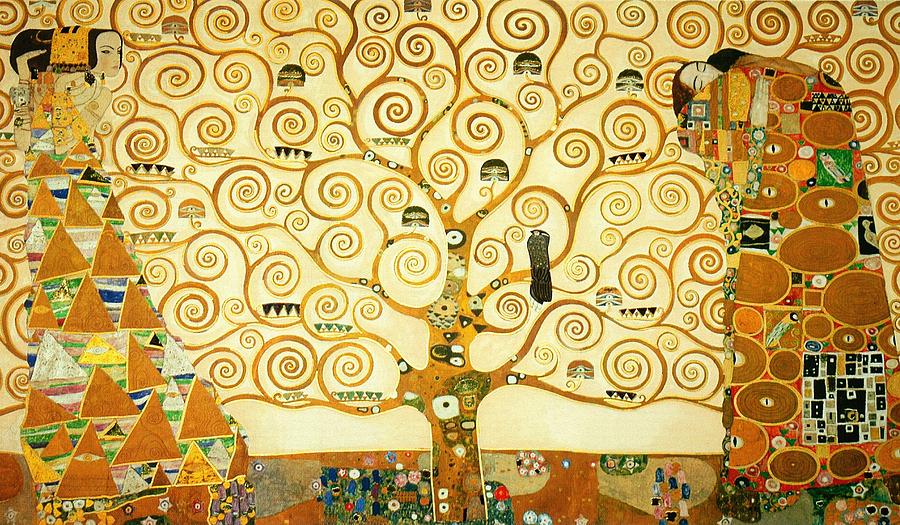
Gustav Klimt the-tree-of-life 1905
Gustav Klimt- The Tree of Life, 1905


There is always hope, as long as the canvasses are empty.

–Gustav Klimt


This quote from Gustav Klimt made me smile this morning, a little knowing smile. When I am getting ready for a show, such as I am now, the studio is initially filled with prepared empty canvasses of a wide variety of sizes, coated with layers of gesso and topped with a thick layer of black paint. They are everywhere, all propped up against any available surface that will support them.

Having them around is comforting, representing possibility. It is the hope of which Klimt speaks. Each blank canvas has the possibility of being a whole new world, a new experience, a new revelation. There is almost a hum of potential life coming from them.

But as the weeks and months pass and many of the canvasses are painted, taking on their new lives and identities, the supply of blank surfaces dwindles down to the point where there is now only a smattering of blank canvasses scattered around the studio. It is at this point when I get anxious, most likely from no longer being surrounded by those empty surfaces that have come to symbolize hope and potential for me.

It is at this point that I can begin to see the end of this painting session, that soon I will have to stop for a bit to ready the work, to photograph, to stain frames and varnish paintings to make them presentable for the show. This makes me a little glum because I am usually very hyped up from the momentum that has been building as the work for the show progressed. This makes me want to paint and push even more, to further explore all the new avenues that are opening up before me in the paintings in which I am working.

Looking around now and seeing just a few empty canvasses is a reminder of that coming point. It makes me pause in for a moment, anticipating that coming shift of gears, and for that moment I am a bit down. But reading Klimt’s words makes me smile, knowing that I just received a new shipment of canvas the other day which is waiting patiently downstairs to be prepped so that it soon can carry all my hopes and possibilities.

And the glumness fades.


This post originally ran back around this time in 2019. Some things are constants. I have added a few other Klimt paintings that didn’t appear in the earlier post.


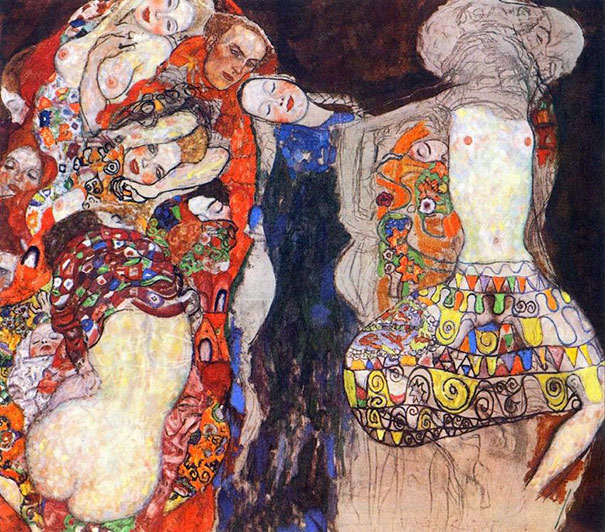
adorn the bride with veil and wreath by Klimt.jpg

Gustav Klimt- The Bride, 1918

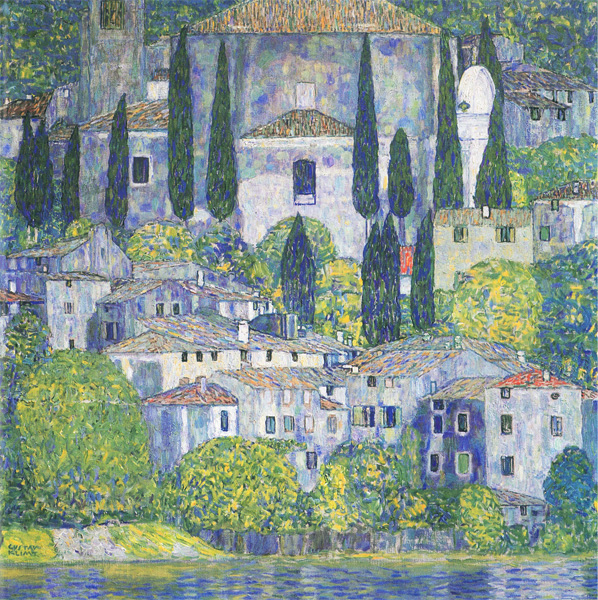
Church in Cassone Gustav Klimt

Gustav Klimt- Church in Cassone

Gustav Klimt The-Sunflower 1907

Gustav Klimt The-Sunflower, 1907

Gustav Klimt-Beech Grove I

Gustav Klimt- Beech Grove I

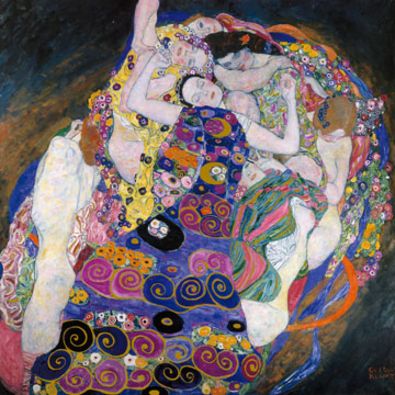
klimt-gustav-la-vergini

Gustav Klimt- La Vergini

klimt-portrait-of-adele-bloch-bauer

Gustav Klimt- Portrait of Adele Bloch Bauer

Persisting…

GC Myers- 2023 Work in Process


If the fool would persist in his folly he would become wise.

–William Blake, The Marriage of Heaven and Hell, 1790 


I have just a few weeks of painting time remaining before I have to do final prep and delivery of my annual show at the Principle Gallery. This year’s exhibit, Passages, opens on Friday, June 9th, at the Alexandria, VA gallery that has hosted my shows since 2000, making this my 24th show there.

That creates a lot of history and experience to pull from, which has proved invaluable as I go through this always stressful process. The process itself is very much like the actual painting process for me. At least, much like one of the two processes I employ.

Let me explain for those of you who don’t know much about my work.

I paint with two very different processes. I began my career painting mainly with watercolor or ink. It was wet work and the process I developed for myself had me applying lots of wet paint then pulling off pigment until I reached the level of color and transparency that suited my needs. I call this my reductive process.

The reductive  process uses the whiteness of the surface as a light source and allows color to immediately shine brightly on that surface. It is a great process for the part of me that desires instant gratification. Once in the process, my job consists of maintaining that original brightness, to not allow any additions to dull the painting’s surface.

It requires a lighter hand than the other process which is a more traditional manner of painting. I call it my additive process because it consists of beginning with a blackened surface and adding layers of color until I reach my desired levels of saturation and tone. use those terms– saturation and tone– but it is not that easily defined. I should say I keep adding paint until some little inner voice tells me to stop, that there is a sense of rightness on the surface. 

This year’s show is almost equally divided between the two processes. Usually, it skews one way or the other, in recent years much heavier towards the darker based additive process. But this year I am finding it easier to transition between the two. Maybe it has to do with simplifying and comparing the processes in my mind.

The wet reductive process takes me to its peak quickly and I have to totally concentrate on keeping the painting at that peak. I have several unfinished pieces from this process waiting for me to return to them but they still have so much of that peak glow and shine that I am hesitating until I can fully devote my mind to them. It is a matter of preservation from the get-go.

The additive is more about persistence. It is a process that takes me through a kingdom of dullness at many points. The detail at the top is from a painting I am currently working on and is good example of this. Yesterday, I worked on this section for many hours and most of the time I absolutely hated it. Layer after freaking layer, my frustration continued to grow. There were several times when I truly felt like bringing out the black paint to cover the whole of it and restart. 

This is where the year’s of experience and knowing how each process progresses comes into play. I knew I had been through this part many times before. It is actually a part of the additive process. I know going in that it is going to be frustrating, that this is a matter of tolerating the dullness until the desired glow finally appears. I kept telling myself to go on, that I can make it right, that I can fix it.

And like most of the times in the past, I moved past the dullness and found the peak. 

Persistence.

Having these two processes — one of preservation and the other of persistence — is kind of like being bi-polar. One is high, one is low. One is about the initial thrill of color on the surface, about finding myself on a high peak and trying to not fall off. The other is about making your way to and clawing your way up to that peak.

Each has its own difficulties and challenges. I guess each matches up to the highs and lows that abound in my own psyche. I’m probably pretty fortunate to have developed the two together. I don’t know if one alone would have sufficed.

Who knows? Just rattling on this morning. Thanks to those of you who endured in reading this far. For those that didn’t– they can take a hike.

Better yet, let’s all take a hike. You guys go on ahead. I got work to do.

The show must go on, you know.