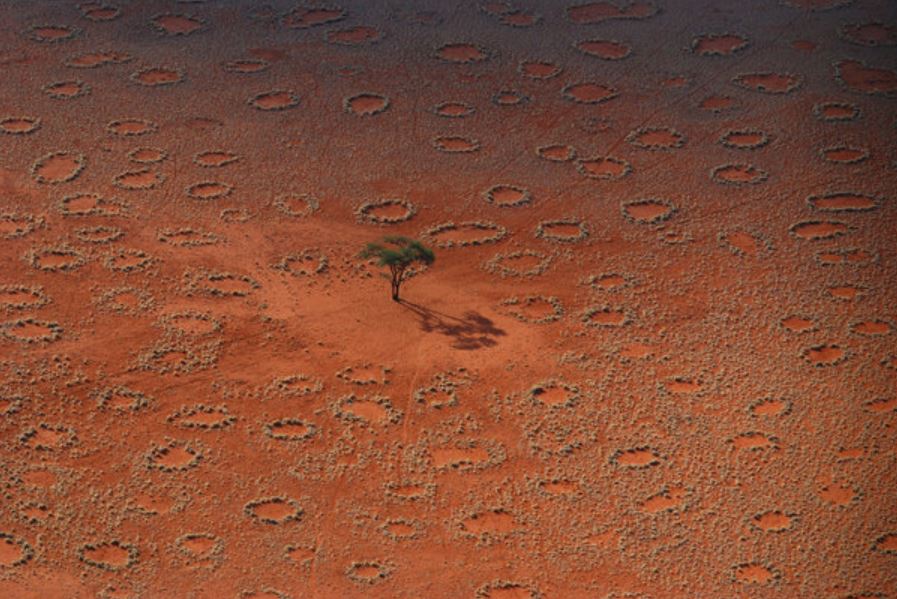
 A friend sent me this photo that was attached to an article from the NY Times from a few days ago, writing that it reminded her of me and my work. It’s a high overhead view of a tree standing alone on a barren plain in southwestern Africa surrounded by small circles that dot the terrain, looking like tiny craters on the surface of the moon. It’s a great image, simple and strong, and I am honored that she saw my work in it.
The article called the rings growing around the tree fairy circles. This, at first, brought to mind the fairy circles that we sometimes see around us that are formed by mushrooms growing along the forest floor in rings that are usually three or four feet in diameter. They are called fairy, pixie or elf rings or circles. The Gaelic legend behind the name says that these are these rings are the gateways to elfin kingdoms, places where the little creatures sometimes appear to sing and dance. Pixie dance floors. I don’t know about that but we have found some old beer cans in the woods. But I don’t think these came from elves or pixies. I just think the previous owners of the forest around us were slobs. But if some new cans show up I may have to rethink this whole thing.
The fairy circles shown in the photo are not formed from mushrooms but are made a dense grass. Their has been some controversy about how they are formed and the article states that the current and best theory, as stated in the Times article, is that they are made by a particular type of sand termite that has engineered these rings to better capture the rare rainfall, allowing the soil inside the rings to remain relatively moist for a longer period of time compared to the arid conditions outside of them.
The article downplays the elfin kingdom theory altogether. And they call themselves scientists…

 Redtree Times