
Paul Henry- The Fairy Thorn (1936)
I will arise and go now, and go to Innisfree,
And a small cabin build there, of clay and wattles made;
Nine bean rows will I have there, a hive for the honey bee,
And live alone in the bee-loud glade.
And I shall have some peace there, for peace comes dropping slow,
Dropping from the veils of the morning to where the cricket sings;
There midnight’s all a glimmer, and noon a purple glow,
And evening full of the linnet’s wings.
I will arise and go now, for always night and day
I hear lake water lapping with low sounds by the shore;
While I stand on the roadway, or on the pavements grey,
I hear it in the deep heart’s core.
— William Butler Yeats, The Lake Isle of Innisfree (1888)
St. Patrick’s Day 2025. No commentary today, just a simple triad of Irish imagery, song and verse.
The painting at the top is from Paul Henry, who spent his life painting his native Ireland from 1877 until his death in 1958. He was perhaps the best-known painter in Ireland through the first half of the 20th century though many of us here in the States may not recognize the name. I didn’t know his work until a decade or so ago, but had an affinity for it instantly, seeing a familiarity between his work and my own, in the stark manner in which the landscape and tree was portrayed.
Most of Henry’s landscapes were set in the west of Ireland, in the Connemara district, an area described by Oscar Wilde as “a savage beauty.” For many, Henry’s landscapes represent the idealized image of the Irish countryside with simple white cottages set among stark, barren hills and rolling green fields. But his greens are not that bright Kelly green so often used in depicting Ireland. No, Henry often chose blue and brown tints in his work. He used a very distinct and deceptively cool palette in his painting which enhances the earthy coolness and solitary nature of the landscapes.
The poem, The Lake Isle of Innisfree, is from the great W.B. Yeats and may well be the most famous piece of Irish verse. It has been set to music by numerous artists, referenced in film and television, and is even printed on the Irish passport. I find it’s transcendent tone captivating, a mood much like that which I try to find in my work.
For the song, I am going with Carrickfergus from the collaborative effort between the Chieftains and Van Morrison. This may be my favorite version of this folk tune that feels like it is much older than its actual age, coming as it does from the 1960’s. That old feel may come from the fact that musical scholars have deduced that its melody is a combination of two much older Celtic folk tunes.
Whatever the case, I think it is a lovely fit this morning with the words of Yeats and the painting from Henry.
And I shall have some peace there, for peace comes dropping slow…
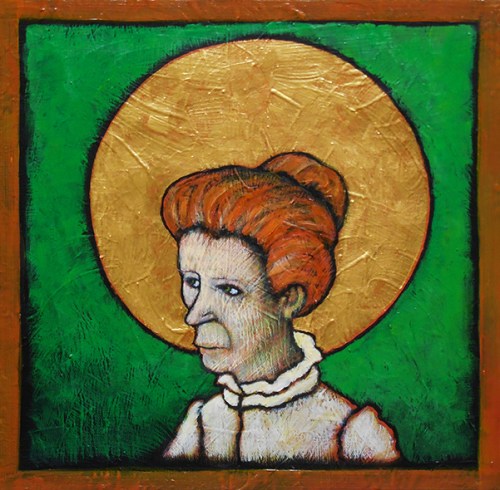 One of the things I am trying to emphasize with this current Icon series is the fact that we are all flawed in some way, that we all have deficiencies and stumbles along the way. Yet, uncovering these faults in my research, I find myself holding affection for many of these ancestors that dot my family tree. Perhaps it is the simple fact that without them I would not be here or perhaps I see some of my own flaws in them.


 Redtree Times