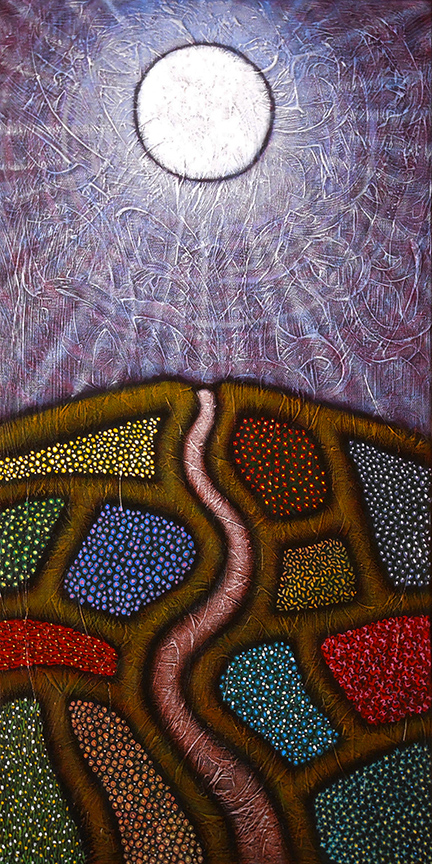
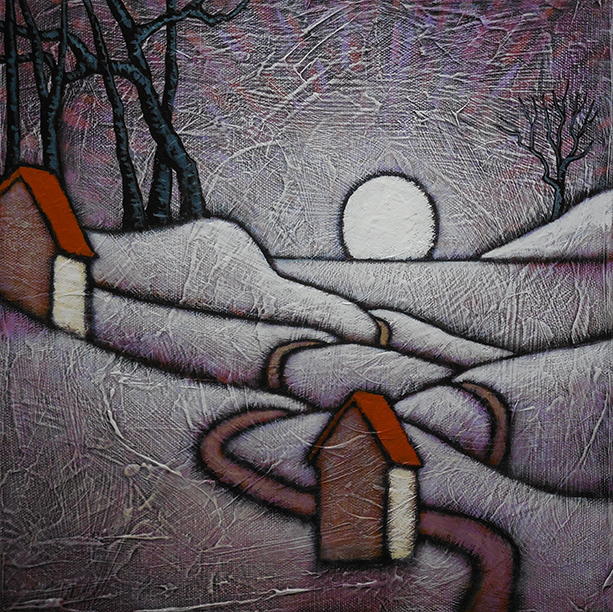
Finished this new painting just the other day. It’s a very quiet, almost meditative piece that I am calling Moon Flowers.
It’s a piece that I find myself looking at a lot these past couple of days. While it is simply constructed, there are some there things taking place in it that keep my eye occupied. The relationships between the beds of flowers, for example, with their individual color vibrations and shapes. Or the relationship between the moon and the path below. There seems to be a connection between the two.
These relationships and the organic quality of the lines within it give it an abstract quality that I like very much. If I just let my mind go where it desires, it allows me to move beyond what seems to be represented and see something quite different.
Or rather, feel something quite different.
And ultimately, that is what I hope for in my work– to move the viewer beyond the representation of the image presented. How that’s done, I do not know. Maybe the answer is somewhere on that path under that moon. Maybe that is what I am seeing in this picture that is pulling me in.
Only time will tell.
So, for this Sunday morning music let’s go with a piece with an apt title, Moonflower, the title track of a 1977 album from the great Carlos Santana. Hard to believe this piece is over forty years old now. Time!
Came across a blogpost from back in 2009 had a piece of music that I couldn’t remember. Playing it this morning fascinated me and I listened to it a few times. It’s a big loud choral piece with ominous sounding Latin lyrics and a thumping percussion rhythm that drives it forward in a way that makes it feel as though it is absolutely unstoppable.
It’s a piece called Dies Irae from a 2005 work, Requiem, from the contemporary Welsh classical composer Karl Jenkins. Dies Irae translates as Day of Wrath and the tone of this piece has that feel, without a doubt. Powerful stuff.
It certainly woke me up this morning. I found myself wanting to be able to paint with that kind of feel. It’s something I can;t explain fully. I see big slashes of color and full sweeps of the arm across the surface with my feet set wide apart in front of the easel as though I was delivering body blows to the canvas. Primal. No delicacy here, no up close touches of paint. Every stroke a deep mark, a bruise, on the surface.
Like I said, I can’t really explain it.
But here it is along a video comprised of apocalyptic imagery, most from the artist Alfred Kubin who I have featured here in the past. The piece at the top, Into the Unknown, is from Kubin. It may startle you awake or, at least, stir something deep within you.
For this Sunday morning music, it would be hard to not feature a bit of the Irish. It is St. Patrick’s Day, after all. So I thought I’d share a beautiful version of old Irish chestnut, Raglan Road, performed by actress Cristin Milioti. Hardly an Irish name but this is a lovely version of a beautiful tune. (You can click here to see the poetry of these lyrics.) You might recognize her from her work on the second season of Fargo where she played Betsy Solverson, the cancer stricken police chief’s wife.
I thought I’d also replay a post from a few years back about one of my Irish ancestors. As I say in the post, it’s story of many immigrant families. Have a great day. You, too, St. Patrick.
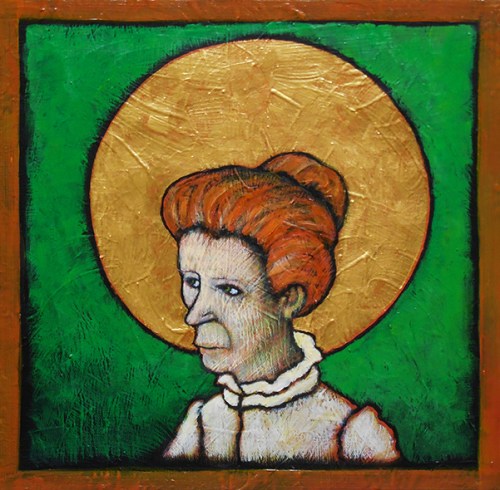
One of the things I am trying to emphasize with this current Iconseries is the fact that we are all flawed in some way, that we all have deficiencies and stumbles along the way. Yet, uncovering these faults in my research, I find myself holding affection for many of these ancestors that dot my family tree. Perhaps it is the simple fact that without them I would not be here or perhaps I see some of my own flaws in them.
I’m still working on that bit of psychology.
The 12″ by 12″ canvas shown here is titled Icon: Mary T. She is my great-great grandmother. Born Mary Anne Ryan of, I believe, Irish immigrant parents in the Utica area (though some records list her as being born in Ireland) she married Michael Tobin, an Irishman ( it is thought that he was from County Kerry but the research is still up in the air on this) who came to the States around 1850, right in the midst of the Great Irish Immigration.
Michael worked on the railroads being built throughout central New York in the late 1800’s. Following the progress of the railroads, the couple and their growing family worked their way down through the state towards Binghamton, NY where they eventually settled. Mary Anne eventually ended up as a housekeeper in a prominent home in the area. Michael died around 1890 although records are sketchy on this and Mary died at my great-grandmother’s home in Elmira in 1914.
All told, they had seven daughters and three sons. Most worked in the then booming tobacco industry of that time and place. Most of her daughters worked as tobacco strippers and some worked as cigar rollers, as did her sons.
That’s the simple telling of the story. Looking into the back stories provide a little more depth which can sometimes change all perceptions.
None of her sons ever married and all had desperate problems with alcohol. One son was listed in a newspaper report from some years later as having been arrested for public drunkenness around 40 times over the years, seven times in one year. He was also arrested for running a still more than once during the prohibition years. Two of her sons died in institutions where they had been placed for their alcoholism.
A Silk Spencer
I came across a story in the local Binghamton newspapers about Mary and two of her daughters, who were also working as domestics with here in the prominent Binghamton home owned by a local attorney and nephew of the founder of Binghamton. In 1874, the story reports that a number of items came up missing, including a “forty dollar silk spencer,” which is a sort of short garment like the one shown here at the right. Neighbors informed the owner of the spencer that Mary had a number of the stolen items in her possession and a search warrant was sworn out.
Detectives came to the Tobin home and made a thorough search but turned up nothing. They then, acting on a hunch, tore up the carpets which revealed a trap door that led to a small hidden basement. There they found many of the stolen items but no spencer. But they did find a silk collar that had been attached to it. Mary and her two daughters were arrested.
Mary did finally claim to be the sole thief and her daughters were released. I have yet to find how this particular story ends and how Mary was punished but based on the futures of some of her children I can’t see it being a happy ending.
Doing this painting, I was tempted to make my Mary a bit harsher, a lit more worn. But as I said, there’s some sort of strange ancestral affection at play even though I know she was obviously a flawed human. She’s smaller and more delicate looking in the painting than I imagine she was in reality. But maybe that’s little payback for the information her story reveals about the future of my family.
This is a simple painting because, as I pointed out, this is a simple story at its surface. It’s the story of many, many immigrant families.
Daylight Savings Time! Woke up late this morning so I am hustling around trying to get to a piece on the easel that has been gnawing at me overnight. I just realized yesterday that in all the time I’ve been doing his blog and sharing some of my favorite music I hadn’t played any Jimmy Reed, the late great bluesman. Going to rectify that today. I came across his albums when I was teen and some of his songs from the 50’s and early 60’s remain among my faves including Big Boss Man (You ain’t so big/ You just tall That’s all), Baby What You Want Me to Do ( You got me runnin’/ You got me hidin’), Ain’t That Lovin’ You Baby, and the song I’m sharing below, Bright Lights Big City.
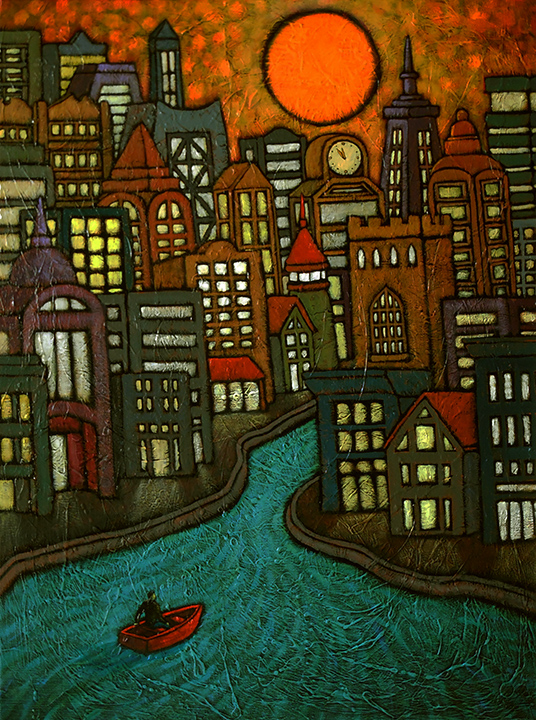
Thought the painting above might fit. It’s fairly new and is one that I am still taking in mentally. There’s a lot going on and I thought the idea of being taken in by the movement and bright lights of the big city as one approaches it was a nice complement to the song.
The switch to Daylight Saving Time really cuts into my prep time this morning. So I am going to share my musical selection for this Sunday along with a rerun of a post that originally ran ten years back. I reran it once four years back but I think it’s worth sharing again. Plus the painting fits the song. So here it is along with The Beat Is Rhythmfrom Club Des Belugas. As is the case with much of their music, it’s heavy on the beat which is as good a way as anything to give a kick to a dragging Sunday morning.
This is another piece from my early Exiles series, titled Bang Your Drum. This is a later piece, finished in late 1996.
Initially, I was a bit more ambivalent about this painting compared to the feeling I had for the other pieces of the Exiles series. It exuded a different vibe. For me, the fact that the drummer is marching signifies a move away from the pain and loss of the other Exiles pieces. There is still solemnity but he is moving ahead to the future, away from the past.
Over the years, this piece has grown on me and I relate very strongly to the symbolism of the act of beating one’s own drum, something that is a very large part of promoting your work as an artist.
For me and most artists, it is a very difficult aspect of the job, one that is the polar opposite to the traits that led many of us to art. Many are introverted observers of the world, passively taking in the world as it races by as they quietly watch from a distance. To have to suddenly be the the motor to propel your work outward is an awkward step for many, myself included. Even this blog, which is a vehicle for informing the public about my ongoing work and remains very useful to me as a therapeutic tool for organizing my thoughts, is often a tortuous chore, one that I sometimes agonize and fret over. Even though my work is a public display of my personal feelings, this is different. More obvious and out in the open.
There’s always the fear that I will expose myself to be less than my work. The fear that people will suddenly discover the myriad weaknesses in my character that may not show in my paintings, forever altering their view of it. The fear that I will be revealed to be, as they say, a mile wide and an inch deep.
But here I stand with my drumstick in hand, hoping to overcome these fears and trusting that people will look beyond my obvious flaws when they view my work. Maybe they too have the same fears and that is the commonality they see and connect with in the work. Whatever the case, there is something in the work that makes me believe that I must fight past these fears and move it forward, out into the world.
What that is, as I’ve said before, I just don’t know. Can’t think about it now– I’ve got a drum to pound…
Finisterre is a peninsula at the westernmost point of Spain. In Roman times, it was thought to be the end of the known world.
Thus the name: finis/end + terre/land.
Finisterre.
It is also the title of a lovely song from English folk singer June Tabor that I am featuring for this week’s Sunday music. Very atmospheric.
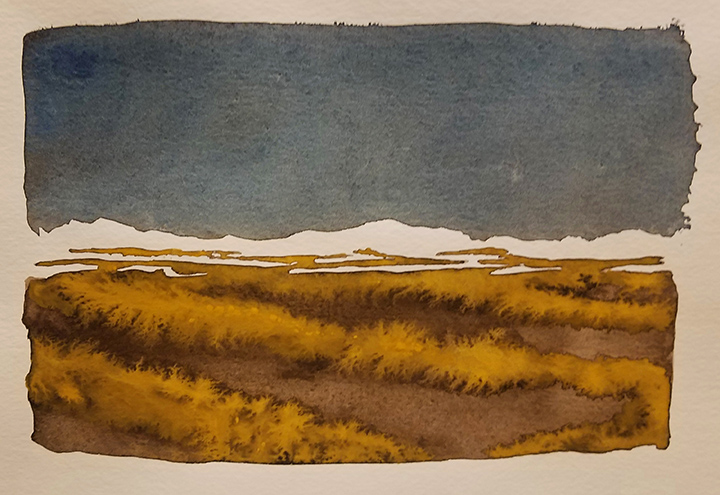
The accompanying painting at the top is a piece I came across this past week in an old sketchbook from back in 1994, when I was just starting to paint. I hadn’t seen it in some time and was pleased that it had aged well, that it had a completeness that was not the norm for the work I was doing at that time. The rest of the sketchbook, for example, is filled with landscapes that are cringeworthy enough that this piece seems out of place.
I chose it to accompany this song because it also has an atmospheric quality, one that speaks of open space and emptiness. Pauses and the quiet rush of the wind through the grass. It might not be Finisterre but it feels like it might be the end of the world for someone.
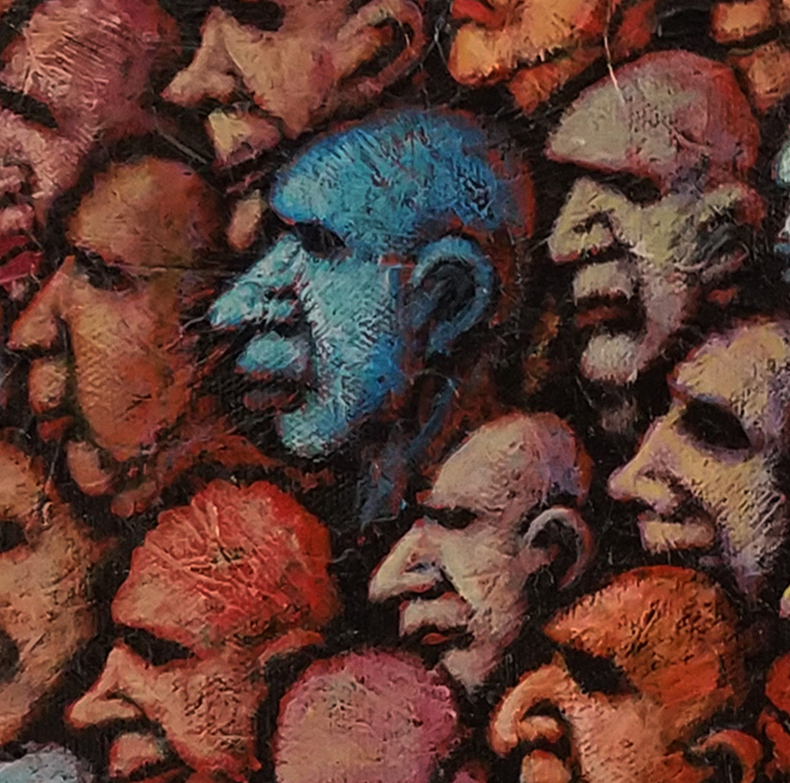
This Sunday morning’s musical selection is tied somewhat to a group of new work that has been rekindling my fire here in the studio. I’ve shown a couple of images of new paintings here and on social media of what I might call my Mask pieces.
Each has been a group of faces that is done in quick strokes from a single brush, starting from one point and filling the canvas. It is unplanned in almost every way. No color plan. No theme. Just intuitively and roughly formed faces that stem from a lifelong collection of faces that have been stacked in my head, culled from looking intently at clouds, woodgrains and patterns of all sorts through the many decades. Seeing them spill out in this way has been energizing in a way that I know from experience will spill over into the rest of my work even if this particular work remains for me privately.
I haven’t been thrilled with how the camera is catching the images thus far. They have been quick photos that don’t fully capture much of the subtlety in the closer parts of the painting. So when the musical selection came up this morning, this section of one of the paintings jumped out at me. I thought showing it in detail would better show how I am seeing the work.
The song selection is the jazz standard Born to Be Blue, written by Mel Torme in 1946. It’s been performed by scores of singers over the years but it became a signature piece for the late Chet Baker.which is the version I am sharing below. In fact, a 2015 film biography of his life starring Ethan Hawke as Baker uses the song title as the film’s title. This version highlights his vocals rather than his horn work and features great piano playing from Bobby Scott.
Hearing it made me think of a blue face that I consider a central character in one of these pieces. At least my eye always lands on him first before roaming across the rest of the picture. The image at the top is a detail featuring him and shows better some of the surface and textures that compose the painting.
That being said, I am eager to get back to work on a new piece in this same style. Enjoy the song and have a great Sunday.
Not much to say today, feeling a little rundown. Looking for a spark in some way, something to get the engines running at higher rpm’s, but can’t find anything in the music I’ve been listening to this morning that does the job. So I’ll resign myself to just holding on until that livelier spirit comes again.
The song that seems to jibe best with that feeling is the old Creedence song, Long As I Can See the Light. Here’s a nice version from the late Ted Hawkins, a name most likely unknown to most of us. He was one of those incredibly gifted artists who was always just short of meeting Lady Luck. Oh, he saw her a few times but it was just in passing as she gave him a flirting glance.
Here in the States, he was primarily a street performer who was “found” a number of times by record producers who could never quite put it all together for him. He gained much more recognition headlining shows in Europe, moving at one point to the UK. He was deported back to USA and reverted to being simply a street busker. He finally achieved a bit of a breakthrough when Geffen Records signed him and produced what might have been his breakthrough record, The Next Hundred Years. I say might have been because Hawkins died from a stroke at the age of 58 in 1995, only months after the release of the album.
Lady Luck is a fickle flirt, indeed.
But here’s his powerful version of the CCR classic. Enjoy.
The painting above is a new piece, Prodigal, that is included in the Little Gems show at the West End Gallery that opens this coming Friday, February 8.
We live in a time of chaos and confusion, amidst a constant bombardment of information and misinformation, an indecipherable babble of yelled opinions and enough stupidity to fill all the oceans and flood every coastline of this planet.
And that’s on a good day.
This morning I found myself longing for something, some music or reading, that would take me away from this maelstrom of madness. I came to the music of the Estonian composer Arvo Pärt whose piece Tabula Rasa was a big influence on my early work.
His work is the antidote to the turbulence of our time. It is what I would call slow music. It is the sort of music that requires you to pause to hear it fully. Doing so slows down the elevated heartbeat, syncs it to a pace that seems to be a meditative drone that has long resided in us though we have long forgotten our ability to find it within ourselves.
For quite some time I have enjoyed Pärt’s adaptation of My Heart’s in the Highlands, which is a 1789 poem/song from the Scottish poet Robert Burns. Listening to it reminds me of the time spent alone wandering in the woods and fields in the hills around our home as a youth. Those times had that same pace, that same heartbeat and silence that made it so memorable in my mind.
Many times I have found my mind wandering back to those times and the spaces and silences that created a sense of home within me. Burns’ words speak a truth for me especially in these times so filled with sound and fury.
Allow yourself to pause for a moment and give a listen. Perhaps you will find your own heart in the highlands…
My heart’s in the Highlands, my heart is not here,
My heart’s in the Highlands a-chasing the deer –
A-chasing the wild deer, and following the roe;
My heart’s in the Highlands, wherever I go.
Farewell to the Highlands, farewell to the North
The birth place of Valour, the country of Worth;
Wherever I wander, wherever I rove,
The hills of the Highlands forever I love.
Farewell to the mountains high cover’d with snow;
Farewell to the straths and green valleys below;
Farewell to the forrests and wild-hanging woods;
Farwell to the torrents and loud-pouring floods.
My heart’s in the Highlands, my heart is not here,
Snowing like made still. Been out plowing for a couple of hours already this morning, just trying to keep the driveway open, and there is definitely a few more hours of plowing ahead. But I thought I’d take a break, drink some coffee and try to throw out some music for a snowy Sunday morning.
Came up with an old song, Valley of Tears, written and performed originally in 1957 by Fats Domino and covered by a number of other artists over the years. Buddy Holly did a version that charted in 1961 that had a skating rink/ magic organ quality to it but I really like this version from the late great Solomon Burke accompanied by one of my favorites, Gillian Welch, and her husband David Rawlings.
Solomon Burke was one of the early greats in the transition period between R&B and Soul. He was a real preacher and blended the spiritual and the physical aspects of soul– the sex and the salvation– into his music. He never got the acclaim as some of the other big names of 60’s Soul but he is is revered.
This is a great, heartfelt performance of the song. Give a listen while I get back to my own valley of tears. If you consider the falling snow tears, that is. Have a good day.
 *************************
 One of the things I am trying to emphasize with this current Icon series is the fact that we are all flawed in some way, that we all have deficiencies and stumbles along the way. Yet, uncovering these faults in my research, I find myself holding affection for many of these ancestors that dot my family tree. Perhaps it is the simple fact that without them I would not be here or perhaps I see some of my own flaws in them.


 Redtree Times