Feeds:
Posts
Comments

Posts Tagged ‘New Paintings’

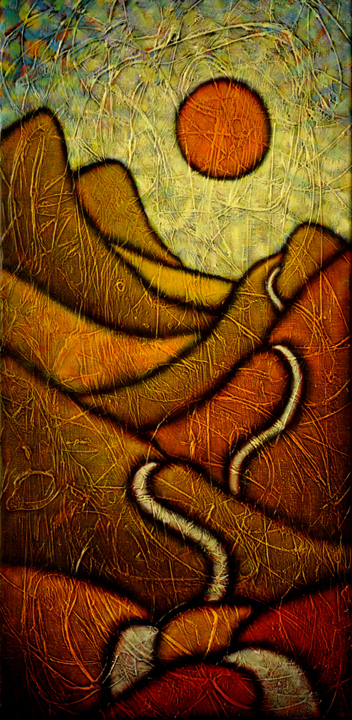
I see this new piece, a 12″ by 24″ canvas, more as a meditation than a scene.  There is rhythm in the motion of the path’s ascent as well as a rhythm in the chaotic nature of the underlying texture that gives this painting its name, Rhythm of the Mountain.  As I first started painting I had every intention of inserting a tree to act as the focal point of the piece but as I progressed it became evident that it would actually pull away from the meditative simplicity of the barren landscape.  The sun/moon becomes the central figure here and the mountain pass leads the eye upward to it.

I am drawn to the simplicity of this piece.  It has a dramatic calmness to it, like the actor delivering a soliloquy who takes a dramatic pause and in that moment there hangs all that has come before alongside the potential of what is to come, held up for the audience to ponder in the silence of that pause.  Empty yet full.

I mentioned the texture of this piece and it plays a central role here.  It has ribbons of gesso that spin  across the canvas which in the sky actually dictated how I was to paint it.  It gives this piece a greater depth and this would be a much different painting without it.

I can’t say if this will appeal to everyone but that’s something I can’t worry about.  The important thing is in satisfying something inside myself and hoping that others recognize that same thing within themselves and identify with it.  Hopefully, this piece will strike an inner chord with others.

Read Full Post »

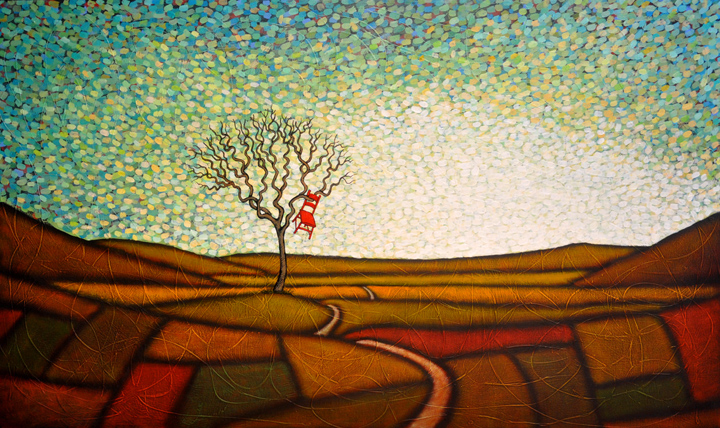
This painting called Dissolve is another in the series I’ve been working in for the past few months.  This 24″ by 36″ piece is based very much on the same format as Like Sugar In Water, which I displayed here several days back.  Both paintings grow from the bottom where they begin in structured blocks of color.  The path cuts through, rising from the geometry of the fields up to a plain that flattens out.  The path continues by the red-roofed house and is not seen again as it enters the broad yellow field that runs to the horizon.  The path’s upward movement is continued in  the spreading bare limbs of the distant tree which merges into the broken mosaic of the sky.

It’s a simple concept and a simple composition, dependent on the complexity of the color and the placement of the elements in order to transmit feeling and emotion.  These simpler compositions, when done so that they work well, are often very potent purveyors of feeling and are among my persoanl favorites.  The stripped down nature of the scene takes away all distractions and centers the essence of the work in the willing viewer’s eyes, making it very accessible to those who connect with it.  And that is much of what I hope for my work- to create work that stirs strong emotion within a seeming;ly simple context.

Maybe there’s more to it than this.  I can’t be sure if my thoughts and interpretations are any more valid than those of a first-time viewer.  That’s the great thing about art– there are no absolutes.  It’s also the thing about art that scares a lot of people.  Many people fear the gray areas of this world, of which there are many,  and desire absolute belief and knowledge in all aspects of their lives.   But art most often  lives in the ambiguity, the uncertainty,  of those gray areas and that can be unsettling to some. 

 Dissolve seems absolute and certain at first glance but is all about the gray areas of our world and our belief.  At least as I see it…

Read Full Post »

Like Sugar In Water

I call this painting Like Sugar In Water.  It is a continuation of the group of paintings that I have been working on over the past few months and is by far the largest of the series at 36″ by 60″.   The larger scale gives the piece a real sense of  space and depth that I think carries the work.

This painting evolved in a much different way than I originally thought it might.  As I started, I first saw this as being a piece about movement and saw a large tree bowing in the  gusting wind with leaves being released out into the large space created by the sky, which had its own sense of motion in the brushwork.  But as the sky came into being it changed and I found myself sensing a much different feel for this piece.  It became quieter and the sky didn’t feel frantic but rather had a sense of light breaking into particles and quietly dissolving into a multitude of colors.   Because of this change, the central figure in the painting, the tree, changed for me.  It had to have a calmness but it had to have a different function than my typical red tree.  Here I saw it as a connection between the landscape and the sky, like a conduit of energy from the earth upward.  It would have to be less dominate than my typical red tree.

At this point I set this piece aside so that I could fully consider it.  I really felt that the landscape and the sky were strong and could stand on their own but I wanted to make sure in my own mind.  So I went to work on other work and kept an eye on this piece, continually looking at it and pondering what lay in store for it.  Finally, after a couple of weeks, I decided it was time to let this painting complete its metamorphosis.  I had come to see the tree as being bare of leaves with the branches stretching up into the sky, almost dissolving into the particles of the sky. This feeling of dissolving is carried through in this piece by the landscape as well.  I see it in the road that runs through the structured geometric pattern of the field of the foreground, moving up through the spreading branches of the tree and into the breaking sky. 

I see the red chair here, not as I often do as a symbol of memory or of the dead, but as a symbol of the temporary nature of our existence here, living as we do between the solidness of the earth beneath our feet and the particulate nature of the heavens above our heads.  This is reflected in the title as well.  Perhaps the universe is like a large body of water and we are but a bit of sugar.

I don’t know about that.  But I do that I think that there is a lot to be found in this piece and I find myself pondering over it quite often,  taking in whatever message there is in it.

Read Full Post »

Regal Bearing

I call this new piece Regal Bearing.  It’s 30″ square and is a continuation of the style and color of much of my recent work.

I find myself viewing this not as a landscape but as a piece of portraiture.  There’s a seense of orderliness and formality in the composition that brings this sense of a head and shoulders pose to mind.  When I look at this I see the red tree as the head atop the neck formed by the mound which is emerging from shoulders formed by the fields.  I see this as a portrait of a monarch from the 19th century dressed in grand military regalia, the field comprised of alternating rows creating a sense of a sash or epaulets.  It’s this visualization that forms the title.

There is often a personification of the red tree in my work but this is perhaps as overt an example as I have done.  I’m sure there are other ways of seeing this painting but for me I only see that  image of a ruler who has the bearing that puts forth the belief that it is both his right and his responsibility to lord over a people and a land.  Here, the landscape that extends beyond the tree is its realm.

I don’t see this as a glorification of a system based on monarchies.  I am certainly no fan of ruling classes.  Rather, I think it is about the belief in oneself and the certainty of ones own place in the world that I see in this piece.  It is something that I  see in some folks who are far from being royalty.  Call it what you will, confidence or pride or something else.

Whatever the case, I see strength and resolve in this painting that appeals to me…

Read Full Post »

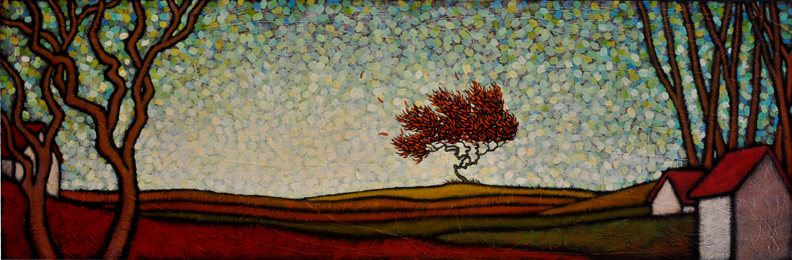
This is a painting that I started in December and on which I finally put the finishing touches just a week or so ago.  It’s a large piece, a 20″ tall by 60″ wide canvas, that really accentuates the panoramic aspect, one that I enjoy working in.  I really was at a standstill on this piece at one point, really savoring the composition and the sky but not knowing how to bring it to completion that fit with where it was at that point.

But it came.

I’ve really been enjoying this sort of groove I’ve fallen in over tha last month or so, feeling the tedium of painting the skies growing, with the thousands of small strokes slowly building to a sort of crescendo.  There’s been a common thread of color running through this work, including a very large 36″ by 60″ painting that I am working on now.  The sky is comprised of dozens of different shades of blue and green and yellow all over deeper violets and reds that peek through  in tiny almost unseen glimpses.  To me, these pieces are really about the light of the sky pulling out the dark colors of the ground below, creating a tension between the light and dark that gives the piece the emotion it emits. 

For me, this emotion goes back and forth between joyous, almost triumphantly defiant, and a bit sad, as though the leaves are moments slipping away, opportunites lost.  Perhaps it is both.  Whatever the case, I find myself liking this piece a lot, looking at it quite often as it sits over the fireplace in the studio.  Now to find a title…

Read Full Post »

This is a new piece that I’ve been working on for the last week.  It’s fairly large at 30″ by 40″ and carries the size well, drawing my eye back to it on a regular basis from across the studio.  I am drawn to the rhythm of the landscape and the quiet of the central red tree against the action of the confetti-like sky.  It has a calming effect for me, one that centers my anxieties and slows me down a bit.  Applied patience in a turbulent world.

I’ve talked about this here before.  The purpose my work holds for me is to act as a  sort of pacifier, to create a world and landscape that takes me just a bit further from the reality of the world in which we actually live.  I consider this alternate landscape  a world based on reason.  At least, that’s how I see it.

I documented this piece in a series of photos as I was painting, snapping shots after small bits were done.  I am in the process of putting them together in a video similar to the one I posted last week, Growing a Painting.  This video would be more in depth and detail as far as the way the piece comes together.  I’ll post it when it is done. Hopefully, it will turn out well.  We’ll see…

Read Full Post »

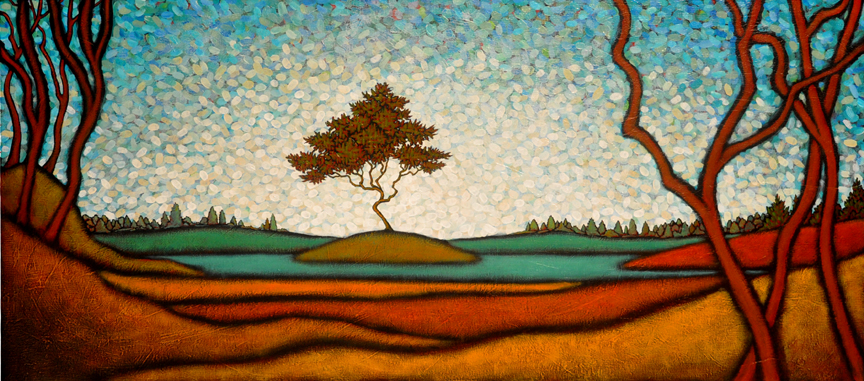
I recently finished a commissioned piece for a couple in NYC.  It was a little different and offered more challenges than many of my requested pieces. 

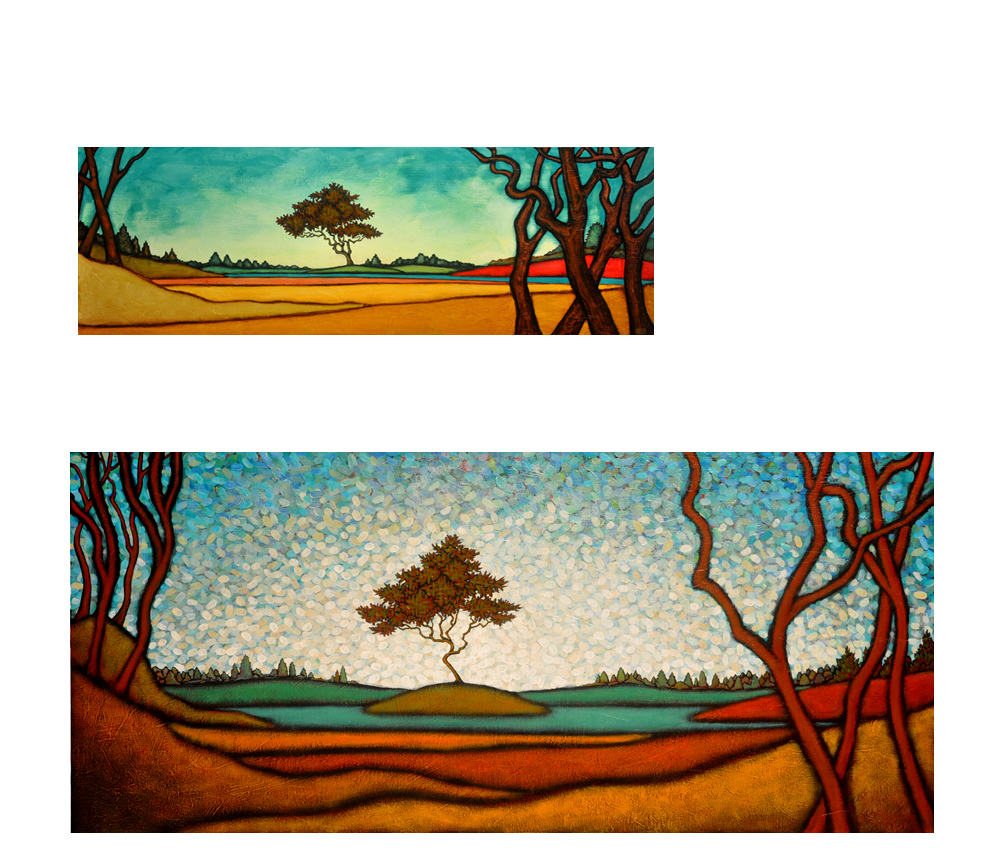
First,  it was a larger version of a smaller existing painting, Destination, which was a 12″ by 36″ canvas.  The requested piece is a 24″ by 54″ canvas.  So, while it is larger, it also has has a different ratio of height to width than the smaller painting, meaning it is less panoramic and changes the relationships of  all the elements in the painting to one another.

The second problem was that the original piece was painted in what I have referred to here as my reductive style.  It is a process that I use that places a lot of wet, liquid paint on a horizontal canvas (or paper) and takes away paint with brushes or rags until I have achieved the color and intensity I’m seeking.  I use transparent paints which allows the gessoed surface underneath to glow through.  

The other way I paint is an additive process.  By that I mean that paint is simply built up from the surface by adding stroke after stroke of paint, usually going from darker tones on the surface to lighter tones.  It is a more traditional method of painting.  My work tends to have a bit less refined appearance when I paint in this way as a result of generally using larger brushes and allowing the skies in my landscapes to be unblended color comprised of individual brushstrokes.  I also usually start these paintings with a layer of black paint over my normal gessoed surface.  This was the method that was requested for this new piece.

So, the request was for this smaller, more panoramic painting to be translated into a larger, somewhat boxier piece painted in a different method.  At first, I was skeptical that it could be achieved to either my satisfaction or their’s.  After a short bit of consternation, I decided to simply jump in and keep some of the elements the same and try to carry the tone of the colors through but let the painting take its own course.   I changed other elements and colors as I felt were needed in the context of the new painting.  For instance, the trees in the foreground are thinner and more expressive, as well as lighter in color.   I ended up with a piece that carries the influence of the original yet has become something of its own, complete with a different feel and attitude.  Just what I had hoped for when I started.  I was very pleased and, fortunately,  the folks who requested the painting were very happy as well. 

Here are how the two compare, when placed together in relative size.

Read Full Post »

I don’t normally show my paintings here with the framing, instead focusing on the image only.  But framing and presenting the work properly is a big deal.  A poor presentation can lessen the impact of a good piece, create a barrier that the viewer can’t get past.  A good presentation allows the work  to be seen in its best light, holding the piece  as though it were a gem and the frame was a fine setting.  You may notice it but the painting itself remains the focus.

I’ve had a certain look for many years now.  It’s a simple profile with a distinctive color that is built for me by a friend, Stephen.  For about the last 13 or so, he has provided me with sturdy raw frames built to my specs and I stain them to attain the color I desire which is normally a  warm yellowish tint with red undertones.  The edges are normally black. 

I tend to use the same frame for almost all my work.   It is simple and is immediately recognizable as my framing.  It also allows work from different years to hang easily together, giving them a sense of continuity and unity.  Plus, it allows me more time to paint by taking away the decision making process in choosing frames for individual pieces.  Early in my career, I learned that this process of choosing was very time consuming and wanted to come up with a way that took it away yet still gave me a distinctive and complementary frame.  Hence, the frame I’ve used for well over a decade came about.

But I still want to change things up periodically, if only to see my work in a different setting.  The piece above is a new one that I call Into the Mix which is a 10″ by 22″ image on paper.  It has a very distinct texture with raised ribs of gesso running chaotically through the background beneath the paint.  All in all, a very strong and individual piece. 

I really wanted to try something different with the presentation of this piece so I went with a frame that I’ve been experimenting with on a very limited basis.  This is only the third one of these I’ve produced.  It is a very simple flat frame with layers of gesso built up on top of it in the form of thin ribs, echoing those in the painting, then painted black.  The black gives the ribs visual depth and the gessoed ribs effectively cover the mitred corners, giving the frame a feel of unity and strength.  I like the look very much for certain pieces such as this, but don’t know if I will adapt it any way for wider use.  It’s just something I need to try to periodically see how the work looks in different settings.  Here, I think the new look works pretty well.

I’ll have to think on this…

Read Full Post »

This time of the year I often do a series of  small paintings to show in the galleries that represent my work.  It allows me to start moving towards new ideas that I may be working on in the upcoming year, as well as  revisiting themes from the past years in a smaller form. This gives me a chance to work on a small scale which allows for quicker alterations to the work while working out concepts as well as providing a lower priced entry point to those who might want to obtain a piece.  These are as close as I come to sketches or studies.  The difference is that unlike many studies, these are complete pieces  done in the same manner as all my paintings no matter the size. This is one such piece from this year, a small 3″ by 5″ canvas that I call Eyes on Time.

The idea of the tree piercing the large sun/moon behind it is one that I ‘ve played with in the past although having the strata beneath is new.  This has a great profile and would translate really well as a larger painting although sometimes it is hard to move a piece to a larger size without losing some of that feeling that makes it seem vital and alive.  The color relationships sometime change  over larger spaces, requiring alterations to the intensities that fundamentally change the way it is perceived. 

 Plus, committing in large scale to some of the elements that work well in a very small painting is sometimes difficult.  For instance, moving this painting to a larger scale might make the sun/moon seem too big as I hover over the canvas or paper.  I have to be fully committed to this idea, have to see it in my mind, or I might be tempted to scale it back in size which changes the whole composition.

It sounds like all of this is well thought out but actually this is a longer explanation of something that occurs in seconds, on the fly as the brush is in motion.  There are many, many decisions in the painting of a piece that are made like this, each one fundamentally changing the painting and sending it in a new direction that calls for more decsions. 

It’s a bit like driving a car.  Blind. There is constant adjustment to the steering wheel as you move forward, feeling the road and reading what it’s telling you as to how to next move.  Or not.  Whatever the case, this feeling along process produces a piece like Eyes on Time, which may be small but is very strong.

Read Full Post »

« Newer Posts