 Once again, I came across a painter from the past of which I knew absolutely nothing. That is nothing new but when I first saw these paintings I was shocked he was unknown to not only me but to most other people as well. Actually, his biography is pretty thin in content but the sheer power of his work makes up for it.
His name was Thomas Chambers and he was born in England in 1808, probably training there as a decorative painter for the theatres of London. He popped up in the States, in New Orleans, in 1832, filing for American citizenship. Over the next few decades he moved along the Atlantic Coast and New England working as a landscape and marine painter as well as a fancy painter, meaning that he also painted objects such as mirrors and furniture in a decorative fashion. After the death of his wife in 1866, he returned to England, where he died in 1869. He never really prospered as an artist, just scraping by for most of his life. He died in an English poorhouse.
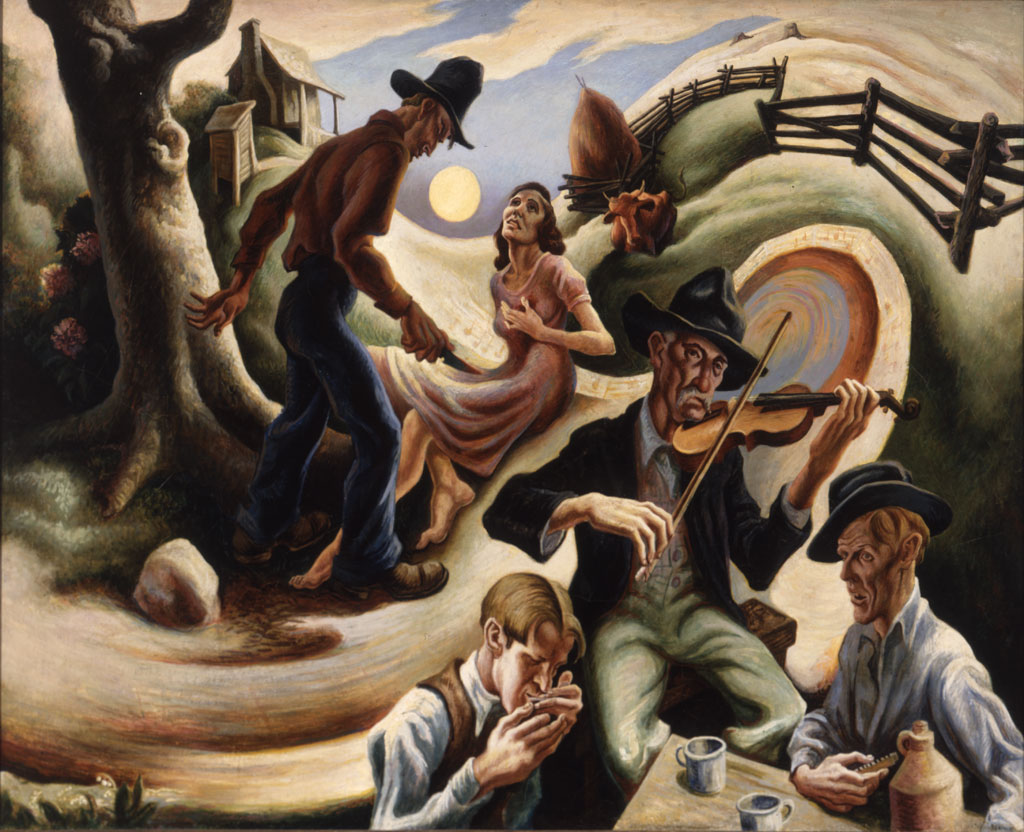
 All of that seemed impossible to believe when I first saw his work. It was unlike anything I had seen from that era. They felt like folk art but with a stylized sophistication that displayed a distinct and fresh voice. They seemed so modern, feeling to me as though they were perhaps 75 years before their time. The colors were powerful. The forms were stylized and rhythmic, the skies often having wonderful whirls of clouds and light. Looking at some of these landscapes, I could believe that they were influenced by some of my heroes such as Thomas Hart Benton and Grant Wood even though I know that this is impossible because of their age. I wondered if some of the more modern painters had come across his work or if his work was merely a similar artistic evolution, just earlier, isolated in time.
 It’s hard to believe that this work was practically unknown until around 1940 when a group of his paintings were found in upstate NY. How something this dynamic and modern in feel could slide by unnoticed is a mystery. The first major museum exhibit of Chambers’ paintings was only held in late 2009/early 2010 at the American Folk Art Museum in NYC.
 There’s a good article from the NY Times that offers a good overview of Chambers’ life as well as a review of this museum show that I found very interesting, particularly when the author, Roberta Smith, writes about the works included in this exhibition of other painters who were better known contemporaries of Chambers, such as Thomas Cole and William Matthew Prior. She writes: This exhibition includes landscapes by other artists, including Cole, Thomas Doughty and William Matthew Prior, but don’t be surprised if you pass them by. Chambers’s work may lack the historic pedigree and national symbolism, say, of Cole’s paintings, but on the wall, it’s no contest.
As I said, potent stuff. I’m hoping to find out more about Chambers but for now I am basking in these rich images. 



 Redtree Times