Feeds:
Posts
Comments

Posts Tagged ‘West End Gallery’

GC Myers -Proclaim the Day  2024

Proclaim the Day— At the West End Gallery


By health I mean the power to live a full, adult, living, breathing life in close contact with what I love — the earth and the wonders thereof — the sea — the sun. All that we mean when we speak of the external world. A want to enter into it, to be part of it, to live in it, to learn from it, to lose all that is superficial and acquired in me and to become a conscious direct human being. I want, by understanding myself, to understand others. I want to be all that I am capable of becoming so that I may be (and here I have stopped and waited and waited and it’s no good — there’s only one phrase that will do) a child of the sun. About helping others, about carrying a light and so on, it seems false to say a single word. Let it be at that. A child of the sun.

Katherine Mansfield (1888- 9 January 1923)

October, 1922, Her final journal entry


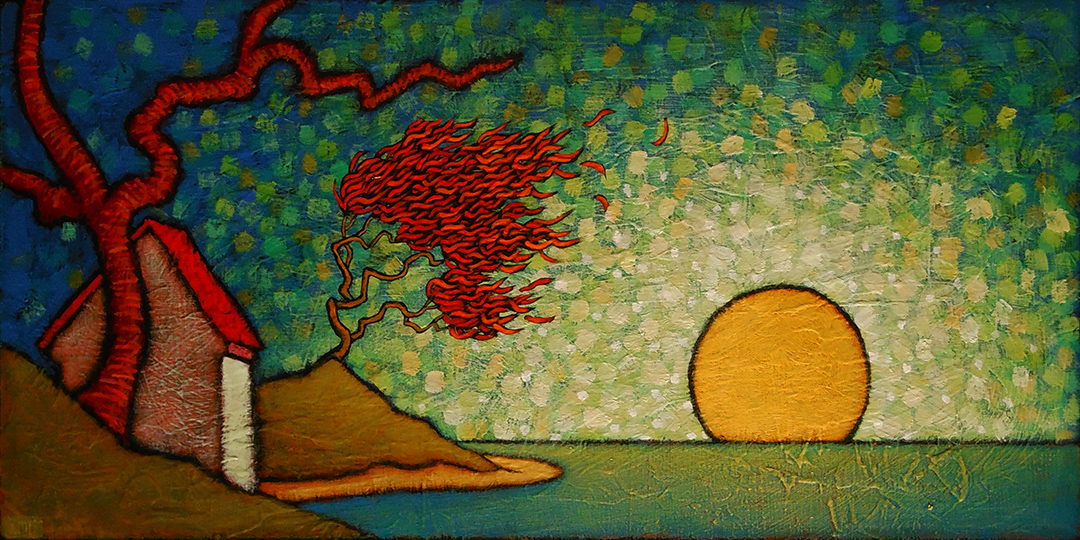
About ten years back, I came across this final journal entry from the Modernist writer Katherine Mansfield, who died much too early from tuberculosis at age 35, and employed it for a painting called Proclamation. The feel of that painting very much mirrors that of the painting above, Proclaim the Day, which is at the West End Gallery as part of their Deck the Walls show which opened yesterday. The sense I get from both paintings remind me very much of the emotions expressed by Mansfield.

This is a painting that speaks to me of having come to an understanding of oneself, to be willing to stand strong against the prevailing winds in order to show that true identity. It is at once strong yet fragile, flawed yet beautiful. A strength derived from the challenges it had overcome and a fragility in that it recognizes its limits and mortality. Flawed by the scars of attained wisdom and change. Beautiful because it is honest and authentic, open to the elements and all who look upon it.

In these ways, it has become a source of light in its own right or, to use Mansfield’s term, a child of the sun.

 A child of the sun.

If only we could all see ourselves in that way.

Here’s a song I shared a couple of years back. It often comes back to me in a haunting kind of way. It’s a remake from horn player Takuya Kuroda of the 1976 song, Everybody Loves the Sunshine, from jazz artist Roy Ayers. The original is great, but I personally prefer Kuroda’s remake.  Has more of that child of the sun feel in my opinion. But, hey, that’s just me…


Read Full Post »

GC Myers- Someway Somehow

Someway Somehow — At West End Gallery


…Perhaps
The truth depends on a walk around a lake, A composing as the body tires, a stop
To see hepatica, a stop to watch
A definition growing certain and A wait within that certainty, a rest
In the swags of pine-trees bordering the lake.
Perhaps there are times of inherent excellence

–Wallace Stevens, Notes Toward a Supreme Fiction (1942)


This new small painting, Someway Somehow, now showing at the West End Gallery as part of their Deck the Walls holiday exhibit, might well represent finding beauty and color amidst the ashes of the everyday. Much like the lines from Wallace Stevens above.

For me, it has the feel of dreaming for me. Maybe it would be better to say dreams set against reality.

Maybe that’s the same thing as what I derived from Stevens’ lines. Not sure this morning.

The lower part of the image is in tones of gray that symbolize the sometimes grayness and monotony of our everyday existence, that workaday part of our lives when we set aside our hopes and dreams to focus on tasks and responsibilities. The upper part is set in colors that represent for me the rare times we find in order to return to those hopes and dreams.

We often find ourselves living in that area that straddles both gray and color, with the hope that we can find a way to live in the color of our dreams. Getting to that place is sometimes a hard road to follow and too many people give up early on. But those who continue do so withe thought echoing in their mind that someday somehow they will reach that place.

The dream of the dream.

Here’s a tune to go along with it. It’s Follow That Dream from Bruce Springsteen. It’s often referred to as a cover of the Elvis Presley song from his 1962 movie of the same name. Springsteen has often referred to the Elvis song as a favorite and covered it a number of times in early concerts.  I had a bootleg version of his cover that I can’t locate much to my dismay as it was a wonderful performance. The version of Follow My Dream from Springsteen that people might know is a reinvention of the song with altered melody, pace, and lyrics that he began performing in the early 1980’s. Not really the same song except for a few lines and its message.

But still effective. I think it fits well with this painting.

As I noted above, Someway Somehow is at the Deck the Walls show at the West End Gallery that opens today, Friday, November 22, with an opening reception that runs from 5-7 PM.


Read Full Post »

GC Myers-- Moment of Pride 2023

Moment of Pride— At West End Gallery


Pictures must be miraculous: the instant one is completed, the intimacy between the creation and the creator is ended.

Mark Rothko


I came across the words above from the late painter Mark Rothko and found myself relating very much to their meaning. The process of creating a picture is ideally a period of intimacy, one where the maker ideally opens their inner self and exposes their totality to the surface. There is a transference of energy and thought in that moment that forms the new life taking place on that surface.

Each move, each change to the surface pulls bits from the inner stores of the creator and alters the new reality being formed. For a rare moment, the two entities– the maker and the surface–are locked together.

They are one.

But as the picture takes shape and form, beginning to express its own life force, it moves away from the maker. At completion, the painting takes on its own being and at that point is beyond the reach and influence of the maker.

As a maker of pictures, I can say that this moment is both wistfully sad and exhilarating. When that moment of completion is at hand, I immediately miss that time of transference when the air is still filled with excitement and possibility. But seeing the new picture, self-contained and speaking for itself, brings a kind of parental pride. I know that I will never be as close to that picture as I was in that moment. But that moment binds us forever, even if it will be always as a faint memory when I glimpse its image in the future.

I chose the piece at the top for this post- fittingly titled Moment of Pride because it sums up the feeling felt when that transference has taken place and the piece stands apart, living and breathing on its own. I certainly felt the feeling depicted when completing this piece.

There was a definite moment of transference when this painting made the leap from being me to being it. It had its own story to tell that was then beyond me, speaking with its own voice, its own meaning that it will someday make known to someone other than me.

And they will hopefully experience their own rare moment….


This is a reworked post from 2016. It seemed to perfectly fit the painting at the top, Moment of Pride, which is now at the West End Gallery as part of their Deck the Walls exhibit, opening tomorrow. I’ve been adding songs to most every post lately and I’ll keep that going today.

Don’t think this song fits the painting here but it has a wistful feel much like that feeling felt when you realize that you’ve lost a closeness with someone or something that you will never be able to recapture, so it might. Whether it does or not, it’s a song that like a lot from an album that I like a lot and that’s good enough for me. It’s the title track from the Anodyne 1993 album, the last album from Uncle Tupelo before splitting up the next year as its members moved on separately to form the bands Son Volt and Wilco.

The tune and lyrics have a weary, disenchanted feel that seems to fit my own lately and probably a lot of others out there:

You threw out the past
When you threw out what was mine
Throughout the years
It was hard to make it last

Anodyne, anodyne

No sign of reconciliation
It’s a quarter past the end
Full moon from on high
Across the board, we lose again

Give a listen if you are so inclined. And don’t slam the door when you leave, okay?


Read Full Post »

GC Myers- Biding Time 2007

Biding Time, 2007


Waiting for the end, boys, waiting for the end.
What is there to be or do?
What’s become of me or you?
Are we kind or are we true?
Sitting two and two, boys, waiting for the end.

–William Empson, Just a Smack at Auden


I feel like we are in a period of waiting right now. I don’t know what exactly, but it feels like we are kind of frozen in place as we wait for something to happen that will put everything into motion, for better or worse. Like we are waiting for someone to push over that first teetering domino.

Maybe it’s just me in feeling this way. Maybe it’s just the time of the year as we enter the holiday season and I am reminded of the intolerable waiting for Christmas’ arrival when I was a kid.  I am not quite so eager for whatever surprise is in store for us to arrive as I was then.

But whatever it is or isn’t, we– or maybe just me– remain somewhat frozen in place, biding our time. Finding a way to get through this waiting period is all we– or I– can do.

That brings me to the painting at the top, an older piece from 2007 that is titled Biding Time. I used to periodically paint pieces like this that were extremely simple and quiet. I viewed them then and now as meditations, as a means to finding stillness amidst the surrounding chaos. I haven’t painted one in quite some time for reasons I can’t determine which is odd because I always found most of them quietly effective., remaining in my mind for long periods of time.

This particular piece has not been shown publicly in many years and I thought it was time for it to make an appearance once again. The time seems right. It is headed to the West End Gallery tomorrow, in time for their annual Deck the Walls holiday show.

FYI– The verse at the top is from William Empson, a friend and colleague of poet W.H. Auden. In the poem Empson both pays homage and pokes a bit of fun at Auden while capturing the anxiety of post-WW II Europe that was struggling to gain its bearings amidst the nuclear threat that had risen.

Let’s have a song to go with such waiting.  Here’s a favorite, Waitin’ Around to Die from the late Townes Van Zandt.  This is from the 1976 documentary Heartworn Highways, a film that captured the beginnings of the alt-country movement of that time.  This clip features Townes singing to his girlfriend and his neighbor Uncle Seymour Washington, a retired blacksmith born to ex-slaves.


Read Full Post »


Sharing Heart– At West End Gallery

“Hello babies. Welcome to Earth. It’s hot in the summer and cold in the winter. It’s round and wet and crowded. On the outside, babies, you’ve got a hundred years here. There’s only one rule that I know of, babies- “God damn it, you’ve got to be kind.

― Kurt Vonnegut


The words above are from the book God Bless You, Mr. Rosewater from the late Kurt Vonnegut. They are spoken to the infant twins of a neighbor as part of a baptismal speech from Eliot Rosewater, the book’s protagonist.

It seems like a ridiculous bit of advice to speak over infants at a religious ceremony, but the sentiment is striking in its simplicity and practical application.

In nearly every instance, kindness will make the situation better.

I don’t know why I am writing this today. Maybe it’s the shrill ugliness of our society at the moment, marked by naked tribalism and selfish greed.

Or maybe it’s our attack mentality that has become the norm, one where reason and logic are thrown aside and replaced with insults and slurs.

These negative aspects, the hatred and selfishness we are so often displaying, are not sustainable for us as a society. They are the signs of an undisciplined and unprincipled people.

On the other hand, kindness is a sustainable and enduring principle of guidance. It builds up, not tears down. A hand up, not a push down.

Like I said, I don’t why I am writing this. Maybe the thought was that we– maybe just I– needed a reminder that a little kindness does more for the world that all the ugly words spoken with hatred by one person toward another.

So, this is your reminder. We have a short time on this world. Don’t waste your time here being mean-spirited and vengeful.

Be kind to others. Be kind to yourself.

This made me want to hear a little Otis Redding this morning. Try a Little Tenderness. Doesn’t get much better than that.

Have a good and kind day.


I shared this post back at the beginning of 2020 and it has been one of my more popular posts in the intervening years. Even more so when we seem to be in a period of crisis or hardship. Its popularity has really spiked in the past week so I thought it might be worth rerunning as its message is evergreen. But I want to add a word or two to its message of kindness: Be kind but be strong. Kindness is not weakness– it is strength. Hold tight to those values you know are right. Kindness does not include accepting the intolerance and hatred of others.

Kindness in word and action is the bully’s kryptonite.

Welcome to Earth, babies…


Read Full Post »

GC Myers- Island Getaway sm

Island Getaway— At West End Gallery


If you ever meet someone who cannot understand why solitary confinement is considered punishment, you have met a misanthrope.

If we define a misanthrope as ‘someone who does not suffer fools and likes to see fools suffer,’ we have described a person with something to look forward to.

Florence King, With Charity Toward None (1992)


Since I no longer expect anything from mankind except madness, meanness, and mendacity; egotism, cowardice, and self-delusion, I have stopped being a misanthrope.

Irving Layton, The Whole Bloody Bird


I have to admit that I am not too fond of humans in recent days. I used to kid around, saying that I was a misanthrope, but I never really believed it. I felt that there was some redeeming quality, some goodness, in everyone, and that when push comes to shove that they would ultimately do the right thing.

I should have known better. To do so meant ignoring everything I had read about the history of mankind. It’s a virtual laundry list of atrocity and cruelty.

So, maybe I was only kidding myself. Maybe I was–and am–a misanthrope. Or, like the quote above points out, is it even misanthropy when the horrible behavior of humans fails to even live up to your lowest expectations?

Honestly, while I am not thrilled with people in general at the moment, I still hold out hope for them.

Don’t know why.

This reminds me of a post from several years back, Misanthropy in the Morning. I thought it was worth another look this morning:


I wish I loved the Human Race;
I wish I loved its silly face;
I wish I liked the way it walks;
I wish I liked the way it talks;
And when I’m introduced to one,
I wish I thought “What Jolly Fun!

― Sir Walter Alexander Raleigh


On a morning when I am feeling more than a bit misanthropic, I thought I’d express it in the lightest manner I could muster. I guess the verse above from English poet Sir Walter Alexander Raleigh (1861-1922) might do the trick.

I don’t know much about this particular Raleigh and, feeling as I do this morning, don’t really care. Don’t know if he was descended from the more famous Walter Raleigh, the one I best knew from seeing his face on my one aunt’s cigarette packs as a kid. I would imagine so but what does it really matter?

For those of you more interested, this particular Walter Raleigh was a professor of literature at Oxford and that bit of light verse was titled Wishes of an Elderly Man, Wished at a Garden Party, June 1914.

It might be titled Wishes of a Near Elderly Man, Wished in an Art Studio, August 2021. [or November, 2024]

I thought of going with a different piece of verse this morning, like this short bit from Ape and Essence, the lesser-known dystopian novel from Aldous Huxley:

The leech’s kiss, the squid’s embrace,
The prurient ape’s defiling touch:
And do you like the human race?
No, not much.

Or I guess I could have gone with this simple quote from the great German painter Caspar David Friedrich (1774-1840):

You call me a misanthrope because I avoid society. You err; I love society. Yet in order not to hate people, I must avoid their company.

It’s not verse but maybe it gets closer to the bone. Perhaps even closer is this passage from Sinclair Lewis, as laid out it in his It Can’t Happen Here:

… he loved the people just as much as he feared and detested persons…

That might best describe my misanthropic urge this morning. And every other morning.

I like and love people individually but, on the whole, very much dislike persons in the collective sense.

I am not talking about you guys. No, you’re okay.

Really.

I hope you will excuse my curmudgeonly behavior this morning. Now get out of here.

And stay off my lawn…

Read Full Post »

GC Myers- Offered to the Wind 2022

Offered to the Wind— At West End Gallery


What is wild cannot be bought or sold, borrowed or copied. It is. Unmistakeable, unforgettable, unshamable, elemental as earth and ice, water, fire and air, a quintessence, pure spirit, resolving into no constituents.
Don’t waste your wildness: it is precious and necessary.

–Jay Griffiths, Savage Grace: A Journey in Wildness


I had a procedure at a doctor’s office this past week. As I sat there waiting for him to come in, there was music playing. It was modern country music. There wasn’t much to focus on, so I listened more intently than I might have done otherwise. The doctor was running behind schedule and I ended up listening to four songs. I am not saying it was bad or anything like that. It was just nothing. The sound was pleasing but bland. Unmemorable. The lyrics said little if anything. The first two I heard could have been the same song in many ways. It all reminded me of some awful AI concoction.

I was still a bit prickly from the events of last week and the music began to grind on my nerves. I could feel my blood pressure rising. After the fourth song, his assistant came in to let me know he was behind schedule and asked if I wanted to listen to something different.

I said that I did. When she asked what, I said immediately Nina Simone. She instructed the Alexa there to play Nina Simone and when the first notes from her piano slowly began asked if that was right. I assured that it was correct and she left me alone to listen.

The song was Wild is the Wind. I couldn’t have asked for a better song in that moment in that sterile doctor’s office at the end of a perfectly awful week. It captured my mood perfectly. I could feel an easing within me as I sat there. A heavy sigh came forth.

The contrast between that song and the stuff I had heard before was stark. This song had a rawness of emotion and a uniqueness and human touch that the other songs seemed to be lacking. As I said, the others felt to me as though they were created by AI.

Contrasted against the dullness of their conformity, Nina’s song felt like a rebellion of the spirit. Though it is not upbeat and has a sense of loss to it, it did feel wild and free in that moment. The other music, on the other hand, felt boxed in and constrained. No wildness, no freedom.

There seemed to be an analogy there to what I sensed has been happening here in this country. The sense of loss is for that wildness of spirit that seems to be leaking away, being rejected and replaced by uniformity of belief, thought, and action.

Maybe there is no analogy to be had. But for a moment I felt inspired at a moment that was uninspiring in every other way.

Maybe that is the purpose of art — if there is any at all.

Something to think about this morning. Here’s Nina Simone and her version of Wild is the Wind.


Read Full Post »

1995-V1 The Day of Great Confusion sm

The Day of Great Confusion–1995, At West End Gallery


It was a murky confusion — here and there blotted with a color like the color of the smoke from damp fuel — of flying clouds tossed up into most remarkable heaps, suggesting greater heights in the clouds than there were depths below them to the bottom of the deepest hollows in the earth, through which the wild moon seemed to plunge headlong, as if, in a dread disturbance of the laws of nature, she had lost her way and were frightened.

–Charles Dickens, David Copperfield


I was looking at some older work for the West End Gallery, pieces that had been with me for decades and had never been shown for a variety of reasons. Some just were never meant to be shared with the public, work not complete in one way or another. Some were drab and dull.

And some just didn’t completely click with me at the time. They didn’t hit whatever mark I had established for my work at the time they were painted. I don’t know if the criteria on which I was basing my judgement was that much different from what it is now or if it has shifted subtly over time due to time and circumstance. Whatever the reason, my appreciation for some of these unshown early pieces grew over the intervening years. 

Such is the case for the painting at the top of this page. It was painted in 1995 and, for reasons I can’t determine now, never made a journey outside my studio. Maybe it was that its colors were a bit different than my normal range of color in that time. Maybe I felt that the spew lines from where the watercolors broke free from the body of painting were too sloppy and distracting. Maybe it was the title I had jotted at the bottom of the sheet on which it was painted back in 1995, The Day of Great Confusion. Trying to determine why I applied that title always taxes my memory. 

I still don’t know why it didn’t quite hit the mark for me in 1995. 

However, looking at it at various times over the years, this painting greatly grew on me, showing me qualities I hadn’t recognized earlier. Those things I thought might have caused me to withhold now seemed like strengths. And in the past decade the title took on great significance as our country undertook an unnerving political transformation that still causes confusion and bewilderment within me.

Maybe that was the reason? I don’t know for sure, but I think there are other factors at play, as well. I think, even though it slightly differs from other pieces of that time, that it is a fine example of my early work in most every way. It’s one of those pieces that made me always pause in appreciation when coming across it in past years.

You might not see it that way and that’s okay. I just felt that if there was ever a time for a painting with that title to be shared, this was that time. It has put in its time with me and deserves to be seen.

Here’s song that kind of sums up the moment. Well, at least for me. It’s I Don’t Get It from the Cowboy Junkies. It’s from their fine 1988 album, The Trinity Session. It has bluesy vibe and lyrics that bite into the here and now.


Read Full Post »


GC Myers- To the Main Road

To the Main Road– At West End Gallery

Benteen: “I remember the Earth. I remember it as a place, a place of color. I remember, Jo-Jo, that in the autumn … the leaves changed, turned different colors: red, orange, gold. I remember streams of water that flowed down hillsides, and the water was sparkling and clear. I remember clouds in the sky: white, billowy things that floated like ships, like sails. You see, in ancient times that’s the way men moved their ships across the water. They unfurled large sections of canvas against the wind, and the wind moved them. And I remember night skies. Night skies. Like endless black velvet, with stars, sometimes a moon, hung as if suspended by wires, lit from inside.”

Jo-Jo: “What’s night, Captain?”

Benteen: “Night? Night is a quiet time, Jo-Jo, when the Earth went to sleep. Kind of like a cover that it pulled over itself. Not like here, where we have the two suns always shining, always burning. It was darkness, Jo-Jo, darkness that felt like … like a cool hand just brushed past tired eyes. And there was snow on the winter nights. Gossamer stuff. It floated down and covered the Earth, made it all white, cool. And in the mornings we could go out and build a snowman, see our breath in the air. And it was good then. It was right.”

Jo-Jo: “Captain, why did you leave there?”

Benteen: “Well, we thought we could find another place like Earth, but with different beauties, Jo-Jo. And we found this place. We thought we could escape war, we thought we could — well, we thought that we could build an even better place. And it took us thirty years to find out that we left our home a billion miles away to be only visitors here, transients, ’cause you can’t put down roots in this ground. But it was too late. So we spent thirty years watching a clock and a calendar.”

— Rod Serling, Twilight Zone episode, On Thursday We Leave for Home


This is a scene from a Twilight Zone episode about a group of people who have left the Earth and settled on a distant planet, V-9 Gamma. It is a harsh and barren place with two suns giving it an unending day on which the group has struggled to survive for thirty years. Some have only vague memories of Earth while children who have been born on the alien planet have no memory at all. James Whitmore plays the leader, Benteen, of the group who also tries to keep up their spirit.

I don’t know why I am sharing this today. Maybe it’s just a wonderful example of the lyricism of Rod Serling‘s writing. That would be enough in itself.

But maybe it has to do with the episode’s theme of opting for a radically different existence and leaving all that you know behind. We often don’t recognize the actual ramifications of such a decision until it is too late. We learn in that moment what has been lost. The absence of those lost things we all too often overlooked and took for granted weighs heavily on us.

What we may lose may never be regained. Those things lost turn out to be the things that enrich and define us as humans. What we think would be a better life ends up feeling like an alien existence with us longing for a way of being we have forever lost.

Hmm…

Read Full Post »

GC Myers- Elbow Room sm

Elbow Room“- Currently at the West End Gallery


Alone he trod the shadowed trails;
But he was lord of a thousand vales
As he roved Kentucky, far and near,
Hunting the buffalo, elk, and deer.
What joy to see, what joy to win
So fair a land for his kith and kin,
Of streams unstained and woods unhewn!
” Elbow room! ” laughed Daniel Boone.

–Arthur Guiterman, Daniel Boone


“Elbow room!” cried Daniel Boone. 

This phrase always comes to my mind whenever the name of Daniel Boone or the phrase elbow room comes up.

This doesn’t come about often but it happens.

I think I must have read or heard the poem from Arthur Guiterman, whose verse is shown above, as kid. Guiterman (1871-1943) was an American poet who wrote mainly humorous verse that often dealt with those things that are lost in the rush of modern progress.

Things like elbow room.

For example, here’s his On the Vanity of Earthly Greatness:

The tusks that clashed in mighty brawls
Of mastodons, are billiard balls.

The sword of Charlemagne the Just
Is ferric oxide, known as rust.

The grizzly bear whose potent hug
Was feared by all, is now a rug.

Great Caesar’s bust is on my shelf,
And I don’t feel so well myself.

I think knowing the Daniel Boone poem from an early age ingrained the idea of elbow room in me, that desire for wide open spaces or forests free from the encroachment of people. It certainly shows up in my work, even in the title of piece at the top. I know when I was considering a title for this painting after it was completed, that line “Elbow room!” cried Daniel Boone immediately entered my thoughts.

I don’t want to get into the reality or the myth of Daniel Boone this morning. I don’t know or care if he killed a b’ar (that’s bear, for those of you who didn’t know the old TV series and song) when he was just three though I kind of think that this particular claim might be bordering on myth. I just bring him up for his place in this poem and the idea of elbow room.

He and I share an affinity for that.

I will end with the last lines of the final verse of Guiterman’s poem on the man. In the afterlife, this poem has him frolicking among the heavens in what feels like a weird sci-fi scenario, one that made me laugh out loud when I read this poem again for the first time in probably 50 years:

He makes his camp on heights untrod,
The steps of the shrine, alone with God.
Through the woods of the vast, on the plains of space
He hunts the pride of the mammoth race
And the dinosaur of the triple horn,
The manticore and the unicorn,
As once by the broad Missouri’s flow
He followed the elk and the buffalo.
East of the sun and west of the moon,
” Elbow room! ” laughs Daniel Boone.

Old Dan Boone out hunting unicorn on the plains of outer space.

Strange and a little politically incorrect? Yeah. But that’s what you get when you mix together myth, reality and a little elbow room.

” Elbow room! ” laughs Daniel Boone.

Read Full Post »

« Newer Posts - Older Posts »