Feeds:
Posts
Comments

Posts Tagged ‘West End Gallery’

In the Weave of Time– Coming to West End Gallery


Each minute bursts in the burning room,
The great globe reels in the solar fire,
Spinning the trivial and unique away.
(How all things flash! How all things flare!)
What am I now that I was then?
May memory restore again and again
The smallest color of the smallest day:
Time is the school in which we learn,
Time is the fire in which we burn.

–Delmore Schwartz, Calmly We Walk Through This April’s Day (1938)


Sometimes I begin to write about a new painting fully intending to describe what it means to me. But there are times when those intentions go out the window. Then I find myself just staring blankly at the piece.

I should say staring blankly into rather than at the painting because it’s not one of those cases where you stare straight ahead without focusing on or even knowing what is in front of your eyes. The mind is so preoccupied with something else that it commandeers your eyes.

No, this is the opposite, more like having what is front of my eyes push away all thought and empty my mind.

The eye commandeers the mind. I suppose that would be a form of involuntary meditation. Maybe that’s the best kind, one that comes without trying.

That’s kind of what happened first thing this morning. I was intending to write a bit about the new painting at the top. It’s an 18″ by 18″ canvas titled In the Weave of Time and is included in my October solo exhibit, Guiding Light, at the West End Gallery.

I pulled up the image and before I knew it, I was staring into it with an empty mind. I say empty but it was not a pure void. It had a harmony, a tone of great calmness. It had a space as well, one that placeless and timeless.

It’s hard to explain. Placeless and timeless things often are.

But frustrating as it was to find my mind empty at a time when I was desiring words and thought, I was pleased by the effect. It gave me some much-needed stillness at a moment when time and deadlines plague my thoughts.

It felt like a gift in the dark of morning.

This not what I intended to write about this painting but maybe it should have been. It certainly says more about it than the meager words I probably would have spewed.

Unfortunately, I have to return to a world filled with time and place and deadlines right now. But first, I am going to spend a few more minutes in this painting. I need it.

Here’s a favorite song, The Stable Song, from Gregory Alan Isakov. It came on while I was writing what I hadn’t intended writing and it felt right in the moment. I often have music playing while I work and much of it plays without me noticing the song or artist due my focus on the work in front of me. But whenever this song comes on, I stop and listen for a few minutes.

There’s a familiarity in it that rhymes with some memory of in the weave of time. And that’s all I could ask for this morning.


Read Full Post »

Dusk of Time– Coming to West End Gallery


When philosophy paints its grey on grey, then has a shape of life grown old. By philosophy’s grey on grey it cannot be rejuvenated but only understood. The owl of Minerva spreads its wings only with the falling of the dusk.

–Georg Wilhelm Friedrich Hegel, Philosophy of Right (1821)


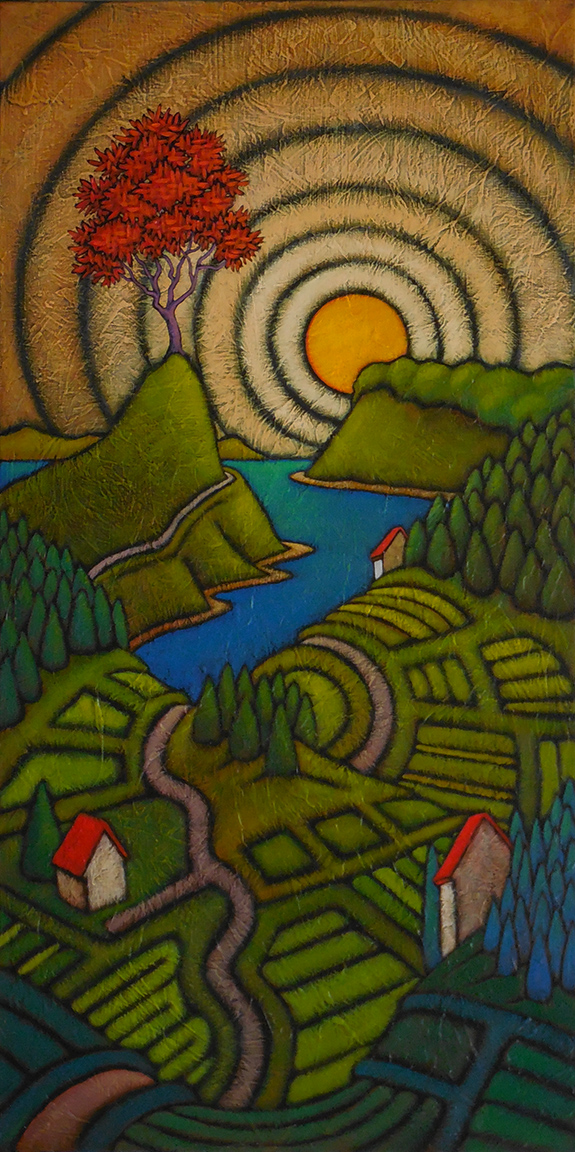
This is the first new painting from my October solo show at the West End Gallery that I am sharing here. I didn’t think it would be the first painting from the show to be shown, mainly since it is relatively small at 6 inches wide and 18 inches tall. There are much bigger pieces from the show, including the title painting, Guiding Light, that I could have shared here first. But it stood out to me this morning and it still does somewhat represent the title of the show with its prominent dropping sun.

You might see it as a rising sun and that’s fine. Art is subjective to our own personal interpretation. While I might see it one way and I am its creator, that doesn’t mean it must have only that meaning. Once I put it out in the open air it is on its own and it becomes what the viewer thinks it is.

But I am sharing my thoughts today, so we’ll call it a dropping sun at dusk. I felt that the passage at the top from the German philosopher Hegel truly fit what I was seeing in this painting. I saw it as being about the passage of time, the ending of a period of time, and the retrospection that comes after that time is gone. 

He is basically saying that we can only truly know and understand anything until it has fully run its course and is well beyond our efforts to bring it back to life. The Owl of Minerva that he employs here is an ancient symbol of wisdom. The owl flies when we gain the wisdom from any time or event only after it has completed the course of its existence. 

That makes sense to me. So often we lose understanding and insight when we are in the midst of the happenings of our time. We see and hear only bits and pieces of the truth along with a multitude of falsehoods, biased opinions, and myriad distractions. We are unable to see the full scope and perspective of events (or lives) while they are happening.

We can’t see them in their fullness until the arc of their being has been completed. Only then does there come clarity as time washes away the debris that obscured the truth while it existed.

Of course, sometimes this clarity is only gained after years, decades, and centuries. Sometimes eons and ages. 

In this painting, Dusk of Time, I see that clarity on a smaller scale in the reflection that sometimes comes at the end of the day, especially when that day has been an eventful one. Ideally, you can see the arc of the day and understand how it took shape and where it led you. Perhaps how you will go forward.

That’s a thumbnail explanation. There’s a lot of feeling in this smaller painting, much more that I can put down right now.

It just feels like it knows a story that it needs to share. I have a sense of the story and the truth it is telling me. But what that story is and what truth it reveals is up to whoever engages with it. 


Read Full Post »

In the Rhythm of the World– At West End Gallery


I recently came across a book of graduation speeches given by Kurt Vonnegut over the years. The speeches are witty, insightful, and bitingly to the point, much like his writing. I thought I would share one of these commencement speeches, one that includes the story behind the title of his book of speeches, If This Isn’t Nice, What Is? 

This speech from 1999 was given at Agnes Scott College, a private women’s liberal arts college in Decatur, Georgia. 26 years later, Vonnegut’s words ring true as we see ourselves vying to survive in a world that proclaims that we should adhere to Jesus’ words from the Sermon on the Mount while simultaneously prodding us to follow the Code of Hammurabi.  

Below is that speech. It’s worth a few minutes of your time. It covers a lot of ground in a short time.


Kurt Vonnegut Commencement Speech, Agnes Scott College, 1999–

I am so smart I know what is wrong with the world. Everybody asks during and after our wars, and the continuing terrorist attacks all over the globe, “What’s gone wrong?” What has gone wrong is that too many people, including high school kids and heads of state, are obeying the Code of Hammurabi, a King of Babylonia who lived nearly four thousand years ago. And you can find his code echoed in the Old Testament, too. Are you ready for this?

“An eye for an eye and a tooth for a tooth.”

A categorical imperative for all who live in obedience to the Code of Hammurabi, which includes heroes of every cowboy show and gangster show you ever saw, is this: Every injury, real or imagined, shall be avenged. Somebody’s going to be really sorry.

When Jesus Christ was nailed to a cross, he said, “Forgive them, Father, they know not what they do.” What kind of a man was that? Any real man, obeying the Code of Hammurabi, would have said, “Kill them, Dad, and all their friends and relatives, and make their deaths slow and painful.”

His greatest legacy to us, in my humble opinion, consists of only twelve words. They are the antidote to the poison of the Code of Hammurabi, a formula almost as compact as Albert Einstein’s “E = mc2.

I am a Humanist, or Freethinker, as were my parents and grandparents and great grandparents — and so not a Christian. By being a Humanist, I am honoring my mother and father, which the Bible tells us is a good thing to do.

But I say with all my American ancestors, “If what Jesus said was good, and so much of it was absolutely beautiful, what does it matter if he was God or not?”

If Christ hadn’t delivered the Sermon on the Mount, with its message of mercy and pity, I wouldn’t want to be a human being.

I would just as soon be a rattlesnake.

Revenge provokes revenge which provokes revenge which provokes revenge — forming an unbroken chain of death and destruction linking nations of today to barbarous tribes of thousands and thousands of years ago.

We may never dissuade leaders of our nation or any other nation from responding vengefully, violently, to every insult or injury. In this, the Age of Television, they will continue to find irresistible the temptation to become entertainers, to compete with movies by blowing up bridges and police stations and factories and so on…

But in our personal lives, our inner lives, at least, we can learn to live without the sick excitement, without the kick of having scores to settle with this particular person, or that bunch of people, or that particular institution or race or nation. And we can then reasonably ask forgiveness for our trespasses, since we forgive those who trespass against us. And we can teach our children and then our grandchildren to do the same — so that they, too, can never be a threat to anyone.

A woman’s reach should exceed her grasp, or what’s a heaven for?

You should know that when a husband and wife fight, it may seem to be about money or sex or power.

But what they’re really yelling at each other about is loneliness. What they’re really saying is, “You’re not enough people.”

If you determine that that really is what they’ve been yelling at each other about, tell them to become more people for each other by joining a synthetic extended family — like the Hell’s Angels, perhaps, or the American Humanist Association, with headquarters in Amherst, New York — or the nearest church.

Computers are no more your friends, and no more increasers of your brainpower, than slot machines…

Only well-informed, warm-hearted people can teach others things they’ll always remember and love. Computers and TV don’t do that.

A computer teaches a child what a computer can become.

An educated human being teaches a child what a child can become. Bad men just want your bodies. TVs and computers want your money, which is even more disgusting. It’s so much more dehumanizing!

By working so hard at becoming wise and reasonable and well-informed, you have made our little planet, our precious little moist, blue-green ball, a saner place than it was before you got here.

Most of you are preparing to enter fields unattractive to greedy persons, such as education and the healing arts. Teaching, may I say, is the noblest profession of all in a democracy.

One of the things [Uncle Alex] found objectionable about human beings was that they so rarely noticed it when they were happy. He himself did his best to acknowledge it when times were sweet. We could be drinking lemonade in the shade of an apple tree in the summertime, and Uncle Alex would interrupt the conversation to say, “If this isn’t nice, what is?”

So I hope that you will do the same for the rest of your lives. When things are going sweetly and peacefully, please pause a moment, and then say out loud, “If this isn’t nice, what is?”

That’s one favor I’ve asked of you. Now I ask for another one. I ask it not only of the graduates, but of everyone here, parents and teachers as well. I’ll want a show of hands after I ask this question.

How many of you have had a teacher at any level of your education who made you more excited to be alive, prouder to be alive, than you had previously believed possible?

Hold up your hands, please.

Now take down your hands and say the name of that teacher to someone else and tell them what that teacher did for you.

All done?

If this isn’t nice, what is?

Read Full Post »

First Peace


Well, the night is still
And I have not yet lost my will
Oh and I will keep on moving ’till
‘Till I find my way home

When I need to get home
You’re my guiding light

Guiding Light, Foy Vance


I am still building up strength and energy after being sick. I feel like I am running at about 70% or so, still getting really fatigued after much exertion or just a busy day in the studio. But my work continues, and I feel like it’s building in a way that will be at full capacity for my autumn schedule, which this year features a solo show and two Gallery Talks.

Fortunately, we switched my annual solo show at West End Gallery from July to October this year. In the shape I was in at the time, there would have been no way in which I could have mounted a July show. But we did switch and I am looking forward to that show at a different time with the added time to prepare. I especially need that additional time as my strength rebuilds.

My solo show at the West End Gallery opens Friday, October 17 and runs to November 13. This year’s show is titled Guiding Light. I was recently mulling over what to call the show and a song came on the channel I often listen to early in the morning and the song struck a chord. And its title, Guiding Light, instantly felt right. That song, which is shared below, was from singer/songwriter Foy Vance, who hails from Northern Ireland-– or Norn Iron as my good friend from Portadown, Tom, would say.

I will write more about the title and theme of the show in the coming month or so.

There will also be a Gallery Talk in the weeks following the opening. A date has not been nailed down, but it will most likely be on one of the Saturdays after the opening, either October 25, November 1 or the 8th. I am leaning toward October 25 myself, but we want to make sure it’s a clear date before announcing it. I will let you know when we make that final decision.

Before that, on Saturday, September 27, I will be returning to Alexandria to give my annual Gallery Talk at the Principle Gallery. The talk begins at 1 PM. It is usually a pretty good time and I have no doubt that this year’s edition will not be as well.

And to spice things up, I will be doing the whole talk while standing on my hands.

Well, we’ll see about that. But if anyone in attendance feels like doing handstand while we have our Gallery Talk, I will not discourage it.

That is this fall’s schedule thus far. Hope to see you somewhere down the road.

Here’s that Foy Vance song, Guiding Light. This is from a live performance in 2023 from Belfast accompanied by the Ulster Orchestra. It makes for a great way to end his show, if you watch through the end.


Read Full Post »

Soloist– At West End Gallery


We’re creators by permission, by grace as it were. No one creates alone, of and by himself. An artist is an instrument that registers something already existent, something which belongs to the whole world, and which, if he is an artist, he is compelled to give back to the world.

Henry Miller, The Rosy Crucifixion Book I: Sexus (1949)


The words above from Henry Miller very much echo in several things I have written here in the past. An artist recreates in their own manner that which already exists, the seen and the unseen. It is created from a multitude of influences, experiences, and observations from this world.

As he says, this creation, being comprised of this world, belongs to the whole world. Art, though its message often feels targeted to us as individuals, is at its heart communal, meant to be shared.

I am not going anywhere with this statement this morning. I simply like the thought and thought it needed to be shared.

Now, here’s a song from a favorite of mine, guitarist Martin Simpson. It fits well with the painting at the top but most likely has nothing to do with Miller’s words. As it was with the Miller passage, I simply like it and wanted to share it. This is Granuaile from his 1991 album When I Was on Horseback. I believe it refers to Grace O’Malley, the head of the Irish O’Malley dynasty in the 16th century. She is often referred to as the Pirate Queen. and is known for a meeting she had late in her life with Queen Elizabeth to ask for the release of her sons who were being held captive by the English governor of Connacht.


Read Full Post »

In the Light of Stillness— At West End Gallery


it was the kind of moon
that I would want to
send back to my ancestors
and gift to my descendants

so they know that I too,
have been bruised…by beauty.

― Sanober KhanTonight’s Moon


I have things to do this morning– work things for a change, not doctor appointments or tests — so I am reposting a post from about 8 years back that has been heavily reedited.


The poem above was taken from the book Turquoise Silence from contemporary Indian poet, Sanober Khan. I like the thought that beauty makes such a deep impression that it bruises us in a way. And that effect by the moon seems the perfect example as its beauty has been our most dependable companion since we first came to be here, whenever that might have been.

We often pay little attention to the moon as it rises and falls through all our nights. We fail to notice the path it traces across the sky and the light it reflects down on to our world as we remained focused on our earthly matters, always looking downward.

Yet, every so often, it refuses to be taken for granted and demands that we stop and take it in, to admire its cool and distant majesty. To make us consider that it has looked down on all that man has done in our relatively short time here, at least when compared the time that the Moon has looked down on our planet. To think that it has witnessed the building of the Great Pyramids, the conquests of Alexander the Great, the birth of Jesus, the explorations and sailors that circled the globe, and the rise and fall of empires, and so much more. It was even kind enough to welcome us as we came to visit it in the distant space it occupies.

It has witnessed us at our best and at our worst, stoically withholding judgement. It remains forever a true companion to the most and least among us. There is a raw element of beauty in the moon to those who appreciate it that almost leaves a mark behind, its memory serving as a bruise’s touch to remind you of the sensation.

It makes me wonder if that person who does not see the beauty in the moon even has the ability to see beauty in anything. It’s a thought that makes me sad because I can’t imagine what kind of person I would have to be to not feel the emotion that comes with witnessing the eternal and ageless beauty that the Moon brings us without fail.

Here’s a favorite song from Neko Case that I play here every few years. I think it’s been about four years now, so I guess it’s okay to share it again. This is I Wish I Was the Moon.


Read Full Post »

Echoes of Time— At West End Gallery


The lonesome friends of science say
“This world will end most any day”
Well, if it does, then that’s okay
‘Cause I don’t live here anyway
I live down deep inside my head
Well, long ago I made my bed
I get my mail in Tennessee
My wife, my dog and my family

John Prine, Lonesome Friends of Science (2018)


Another short post this morning. Not even the normal triad of word, image and song since the chorus from the song is serving as the word leg of the three-legged stool I am building here.

So, it’s a two-legged stool. Hope, it stands up.

At least for today.

The same goes for me.

Here’s the song, Lonesome Friends of Science, from John Prine‘s last album, The Tree of Forgiveness, from 2018. As you might know, John Prine passed away in 2020 from covid. II am using the painting above, Echoes of Time, because this morning I am seeing it as that tree of forgiveness as John Prine put it.


Read Full Post »

The Welcome Tree–At the West End Gallery


There is one thing one has to have: either a soul that is cheerful by nature, or a soul made cheerful by work, love, art, and knowledge.

—Friedrich Nietzsche, Genealogy of Morals (1887)


Nietzsche wrote a lot more about cheerfulness than one might expect. Not that I suspect that he himself was a cheerful soul. Maybe he was one of those, as the quote above implies, was made cheerful through work, love, art and nature.

I don’t know and I’m not interested enough right now to explore it any further at the moment. This quote seems to be one that is not verbatim from its source but was instead a compilation of thought.

That, too, doesn’t matter to me at the moment. I just like the quote as it stands, without full context.

It makes me wonder about my own nature and that of many others I know. Do I consider myself one who is cheerful by nature? I don’t believe I am though I have certain aspirations of being naturally cheerful, to not feel the weight of periodic depression or be eternally optimistic. I am not to that point yet and seriously doubt I will ever be there.

Actually, I know I won’t ever be that person. Whatever cheerfulness I possess comes from those potential sources that Nietzsche mentions. I think that holds true for most people, but I can’t say for sure. We all wear masks that sometimes cover our true natures.

I am sure we could go into a whole psychological examination of one another here but let’s save that for our diaries this time. 

Instead let us enjoy another song from Chicago that plays into the theme today, as does the painting at the top. This is Make Me Smile. I wasn’t a big Chicago fan when I was younger and they were in their heyday. But we change with time– hopefully and thankfully– and I have become quite a fan over the years.


Read Full Post »

Serene Gratitude— At West End Gallery


If you have built castles in the air, your work need not be lost; that is where they should be. Now put the foundations under them.

–Henry David Thoreau, Walden (1854)


I was going to write something else this morning but am feeling a bit foggy and tired. Instead, I thought I would share a post from a few years back and add the Don McLean song, Castles in the Air, at the bottom.


This is a well-known quote from Walden. Maybe the most well-known. It basically states, in my opinion, that we are meant to dream, to imagine better things and circumstances for ourselves. But there comes a time when we have to put the necessary work if these dreams are ever to become a reality.

Pretty sound stuff. The value of work and dreams is not lost on me. My life as it currently is, relatively simple and humble, was once a castle in the air. I was leafing through an old journal from when I was 16 or 17 years old and came across a list of goals for my future.

I had forgotten that I had made such a list and was surprised at how closely it matched the life I now live. Apparently, though I stumbled and fumbled around for too long a time, I somehow subconsciously made my way back to those castles I had built in the air with that list as a teenager.

I was pleased at first for it validated this idea that you somehow eventually reach destinations for which you set a course. Then I began to wonder what might have happened had I built my castles even further up in the sky.

Were the goals of an unexceptional and naive 16-year-old too restrained and self-limiting? Or did that 16-year-old know itself better than I currently think it did, that it already recognized its own core strengths and deficiencies? 

I don’t know the answer to that question. But I can say that I don’t regret placing the foundation under the castle that I first built in the air when I was young. It suits me.

My one wish is to have time enough to put other foundations under a few other castles that float in the air above me. We shall see.

As it is with most of the quotes I use here, I like to seek out the context in which they appear in their original form. I felt that the paragraphs that end with these words from Thoreau should be shared in full.

There’s still a lot of meat on this old bone from Mr. Thoreau:

I left the woods for as good a reason as I went there. Perhaps it seemed to me that I had several more lives to live and could not spare any more time for that one. It is remarkable how easily and insensibly we fall into a particular route and make a beaten track for ourselves. I had not lived there a week before my feet wore a path from my door to the pond-side; and though it is five or six years since I trod it, it is still quite distinct. It is true, I fear, that others may have fallen into it, and so helped to keep it open. The surface of the earth is soft and impressible by the feet of men; and so with the paths which the mind travels. How worn and dusty, then, must be the highways of the world, how deep the ruts of tradition and conformity! I did not wish to take a cabin passage, but rather to go before the mast and on the deck of the world, for there I could best see the moonlight amid the mountains. I do not wish to go below now.

I learned this, at least, by my experiment: that if one advances confidently in the direction of his dreams, and endeavors to live the life which he has imagined, he will meet with a success unexpected in common hours. He will put some things behind, will pass an invisible boundary; new, universal, and more liberal laws will begin to establish themselves around and within him; or the old laws be expanded, and interpreted in his favor in a more liberal sense, and he will live with the license of a higher order of beings. In proportion as he simplifies his life, the laws of the universe will appear less complex, and solitude will not be solitude, nor poverty poverty, nor weakness weakness. If you have built castles in the air, your work need not be lost; that is where they should be. Now put the foundations under them.


Read Full Post »

New Day Rising– Now at West End Gallery


Art is not a plaything, but a necessity, and its essence, form, is not a decorative adjustment, but a cup into which life can be poured and lifted to the lips and be tasted.

–Rebecca West, Black Lamb and Grey Falcon (1941)


In what is considered her masterpiece describing the history and culture of Yugoslavia, author Rebecca West wrote in Black Lamb and Grey Falcon that art and culture, especially in the form of myths and storytelling, provide both countries and individuals with a revitalizing well from which they can drink in order to survive the difficulties of life and history. Art and culture connects us with symbols, stories, and myths that changes our mere existence into one brimming with purpose and meaning. 

I know that West is writing primarily about storytelling and the myths of nations, which is evident in the passage from which the lines above are taken, which I am sharing below. But I feel that the purpose they serve, as West sees it, is very much the same for art in general. Art moves us beyond our own day-to-day existence, connecting us with our known and unknown pasts and futures. It allows us to feel as though we are part of some greater vehicle, serving both as a function of memory and desire.

Indeed, art is not a plaything. It is an elixir that invigorates the spirit and soul.

Below is the expanded passage from Rebecca West. I think there may be relevance in it for this country at this juncture in history.


Art is not a plaything, but a necessity, and its essence, form, is not a decorative adjustment, but a cup into which life can be poured and lifted to the lips and be tasted. If one’s own existence has no form, if its events do not come handily to mind and disclose their significance, we feel about ourselves as if we were reading a bad book. We can all of us judge the truth of this, for hardly any of us manage to avoid some periods when the main theme of our lives is obscured by details, when we involve ourselves with persons who are insufficiently characterized; and it is possibly true not only of individuals, but of nations. What would England be like if it had not its immense Valhalla of kings and heroes, if it had not its Elizabethan and its Victorian ages, its thousands of incidents which come up in the mind, simple as icons and as miraculous in their suggestion that what England has been it can be again, now and for ever? What would the United States be like if it had not those reservoirs of triumphant will-power, the historical facts of the War of Independence, of the giant American statesmen, and of the pioneering progress into the West, which every American citizen has at his mental command and into which he can plunge for revivification at any minute? To have a difficult history makes, perhaps, a people who are bound to be difficult in any conditions, lacking these means of refreshment.

Read Full Post »

« Newer Posts - Older Posts »