Feeds:
Posts
Comments

Posts Tagged ‘West End Gallery’

Poole Early MeltI am currently in the process of getting ready for my annual show at the West End Gallery in Corning, NY.  This exhibit, titled Dispatches, is my ninth solo show at the gallery which was the first gallery to exhibit my work, starting back in 1995.  

For the past several years at the West End, the show that is hanging in the month or so before my show is from one of my favorite artists,  Martin Poole, who also lives in this area.  Marty’s work is always beautiful, with wonderful handling of the paint and luminosity in his colors.  There is little he can’t do with a brush and it shows in all the genres he paints.

Poole CassandraHis landscapes are filled with light and space, often immense, complex  skies that fill the picture plane.  His portraiture goes beyond traditional portrait painting.  For Marty, it’s not enough to paint a superb representation of the subject- it’s more important to have them be mere components in a beautiful composition, which makes for a more interesting viewing experience for all.  Marty’s unique eye comes through in everything he paints and other painters usually just sigh resignedly when they look at his stuff.Poole Long Talk

I know I have on more than one occasion.

It’s always a daunting task to follow Marty’s show at the West End.  His shows are always filled with beautiful, strong work that draws raves and oohs and aahs.  You never want to be the one who comes in with a lackluster show after Marty sets the bar a little higher each year.  So, I work a little harder after I see his show each year and hope I can match his consistency and his obvious commitment to his work.  It’s the sort of pressure that some artists don’t enjoy, having to follow the show of a highly skilled and well known artist.  I can’t say I enjoy it but I know it provides an impetus to continue striving, to continue to grow my work.  For that alone, it’s a pleasure to follow the Martin Poole show.

You can see the work of Martin Poole in a number galleries throughout the country including the West End in Corning and the the Principle Gallery in Alexandria, VA.  His current show at the West End hangs until July 18.

Read Full Post »

AswirlIt’s Monday morning, back in the studio.  After a show, there’s always a period of settling back into my routine which is something that is really important for me as I’m a real creature of habit.  It takes a couple of days to digest the events of the past few days so these first days are kind of sluggish, just tying up loose ends to little projects and straightening up the studio.  Start focusing on the next goal which is my annual show at the West End Gallery in Corning at the end of July.  

There’s also always a slight melancholy, something I may have mentioned before.  I’ve heard about this from other artists as well.  I think there’s always a letdown after you finish a project, such as a show, that you’ve been so focused on for a period of time.  During the preparation the goal drives you on but suddenly the day arrives and the goal is no longer there.  So you float a bit, tread a little water, until you determine what the next goal will be.  Luckily, I have my next show so I can swing into that with only a slight case of funk.

So today is spent with errands and such but tomorrow I’m back in full swing.  But until then I will enjoy my quiet time and that small bit of melancholy.  Here’s a song in that spirit from Steve Earle (in his heavy phase) with a song written to his friend, Townes Van Zandt,  on his passing.  Enjoy Fort Worth Blues

Read Full Post »


1998In January of 1998, I was still working as a waiter in a Perkins Restaurant, at the same time painting and showing  my work in three galleries.  I was still unsure as to whether I should make the jump to going full-time as a painter.  Oh, the work was well received and nearly everything I was painting sold but I was never convinced that it was anything more than a temporary whim of the public.  Something that would soon fade.  

So I delayed going full-time.

One day while waiting, a single man sat in my station.  I recognized him as someone who I had waited on a number of times with his family.  It was lunch rush and my station was full so I was dashing around.  I stopped and quickly asked if I could get him something to drink.

“I didn’t come here to eat.  I came to buy paintings.”

I looked at him and my mind was blank.  I wasn’t excited.  Actually, I was a little irked.  I was busy as hell and this guy wanted to talk.  I always sort of prided myself in giving 100% to whatever job I had at the moment, even something that might be considered menial.  Hastily, I told him that this was not the time or place for such a conversation and we agreed to meet later that day at the West End Gallery in Corning.

We met and it turned out that he was a designer/ project manager for Corning, Inc.  He knew me from my waiting on his  family and was always impressed by my service as a waiter.  He said I reminded him of waiters he knew in  Venice who treated waiting as an honored profession and would wait their entire lives.  Because of this favorable impression, when he learned a couple of years before that I was showing my work at the West End, he started to follow the work.  He said he loved the way I worked with color and the personal style of my work.

With this in mind, he was now in the middle of a project, building a new photonics research facility in New Jersey for Corning.  The project was nearing completion and he stunned me when he said he had used my work as the basis for the color scheme of the building.  Now he needed some paintings for some key spots and he thought that my work would only be fitting.  Five or six larger pieces.  And he needed them in about six weeks.  Could I help him?

Instantly my head was reeling with questions on how I could do this.  You see, my work up to that point was very small, generally little things in the 4″ X 6″ or 9″ X 12″ range with a few going up to the 18″ x 24″ range.  I had taught myself a technique that worked really well in small blocks but wasn’t sure if I could translate it to a much larger piece.  And where would I paint?  I had started building my studio but it was nowhere near ready.  I was painting on a folding table in our kitchen/dining area.  How could I do this in the time frame he was giving me?  Was I ready for this?

“Sure,” I said.  “No problem.”  Inside, I wasn’t so positive.1998

I took time off from my job at Perkins and set up on my little folding table.  Since I was only adept at painting small blocks of color, I devised my paintings to be larger paintings comprised of smaller building blocks.  It allowed me to maintain my technique.  I struggled for a few weeks but somehow the pieces came around.  I used acrylic inks, acrylic paint, oil paints, chalk and pastels- whatever fit the need of the moment.  As the deadline approached I finally began to believe that I could do this.

At the end, I delivered five paintings.  Two large single pieces and a large triptych for the boardroom.  They were happy and I was very pleased and exhilarated by the whole experience.  It had given me an opportunity to paint on a much larger scale, to expand my work.  My confidence grew in my ability to create work that was beyond the temporary whim I mentioned earlier.  I could do this.

Within a few months I was painting full-time.  All the fears I had allowed to keep me from doing this were swept aside.  That was eleven years ago and seems like a hundred.

Read Full Post »

991-855We went to the opening of the Little Gems show at the West End Gallery in Corning last night.  It’s an annual show of very small paintings by the gallery artists and is always one of my favorite shows to attend.  There was a great turnout and I talked with folks I hadn’t seen in quite some time, some of them the earliest buyers of my work.

The Little Gems show was the first show where I ever exhibited my work, back in 1995.  It was an interesting experience, as I mentioned in an earlier post on this blog, to sit back and see how people react to the work.  It ran the whole spectrum of emotions, from exhilaration as some stopped and talked with friends about how they liked the small pieces by this new artist, to despondency as some brusquely walked by without a second glance.

I remember a local, well-known businessman approaching me and seeing my name tag, said,”You’re GC Myers?  I love your work!  It’s just great!  But…”

Uh-oh.  There’s a but.  That is never a good thing…

“But I only buy paintings of places I know.  Y’know, a local landscape or landmark.”

What?  At the time, it was an odd sensation.  It was one of the most exuberant expressions of approval for my work I had yet heard followed within a breath by a backhanded slap.  It took a long time before I processed this comment but in the long run it helped me.  It sparked my natural contrarian nature and gave me some resolve to not to kowtow to such little minds, to paint what I wished to paint in whatever manner I so chose.  This has served me well over the years and whenever I feel I am steering my work to someone else’s criteria of validity, I pull out that incident and stay on my own course.

I’ve had other incidents like this.  For instance, there is a well-known collector from our area with a vast collection who I’ve known for many years.  He knew me before I was a painter.  Whenever we meet he is highly complimentary but has never added one of my pieces to his collection.  Several years ago I learned the reason.

At an opening he said, “I really should have one of your pieces but…”

Uh-oh.

“But I only buy oil paintings.”

Now I’ve known of this bias for a long time but hearing it from a savvy collector was a kick in  the head.  All I could ask myself was if this guy would not want a Wyeth watercolor or a Klee work on paper?  He was cutting out a broad swath of the art world with this somewhat arbitrary qualifier.  It seemed to me that it was his loss.

Again, I have used that as incentive over the years.  The “don’t tell me what I can or can’t do” factor is a big motivator for me, even now.

Hey, that makes me want to paint.  See ya’…….

Read Full Post »

And The Future ComesThis a new smaller painting with the title  And The Future Comes, an 8″ by 16″ canvas.  It is a continuation of my Red Roof series and is, what I think, a very strong piece.

There’s a great deal of warmth in this piece and the mosaic-like quality of the sky adds depth and vibration.  There is a quiet, contemplative feel throughout the piece and while the coming light of the future seems ominous, it is also hopeful. 

This painting will be at the West End Gallery in Corning, NY  for their upcoming Little Gems show which opens February 6.  There is also a group of very small paintings that I call Redtree Thumbnails .  They are 2″ by 4″ canvasses which give them a real gem-like quality and are a great way for the beginning collector to obtain a first piece.

 If interested call Linda or Hedy at the West End at 607-936-2011. 

9909-102-redtree-thumbnail-29909-105-redtree-thumbnail-5Redtree Thumbnail #4

Read Full Post »

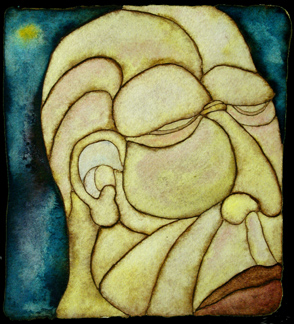
A Prayer For Light  This past week I mentioned a series of paintings that I had finished in the mid 90’s called Exiles.  This series was the basis for my first solo show and remains a very prominent and personal group of work for me.  I had started showing my work publicly for the first time at the West End Gallery in Corning in February.  It was a huge first step for me.  A few months later, my mom, who lived in Florida, was diagnosed with lung cancer.  

This, in itself, was not unexpected. She had been a smoker since she 13 or 14 years old, often smoking 2-3 packs a day.  She smoked Camels.  No filters here.  Many of my childhood memories are tinged with white clouds of cigarette smoke, something that seems horrible and unthinkable now but those were different times with different sensibilities.  

A Prayer For ReliefHer struggle with her cancer was fairly short and tortuous, lasting about five months.  Her cancer had moved into her lymph system and became systemic, invading her breasts and bones.  It ended in early November of 1995.  She was 63 years old.

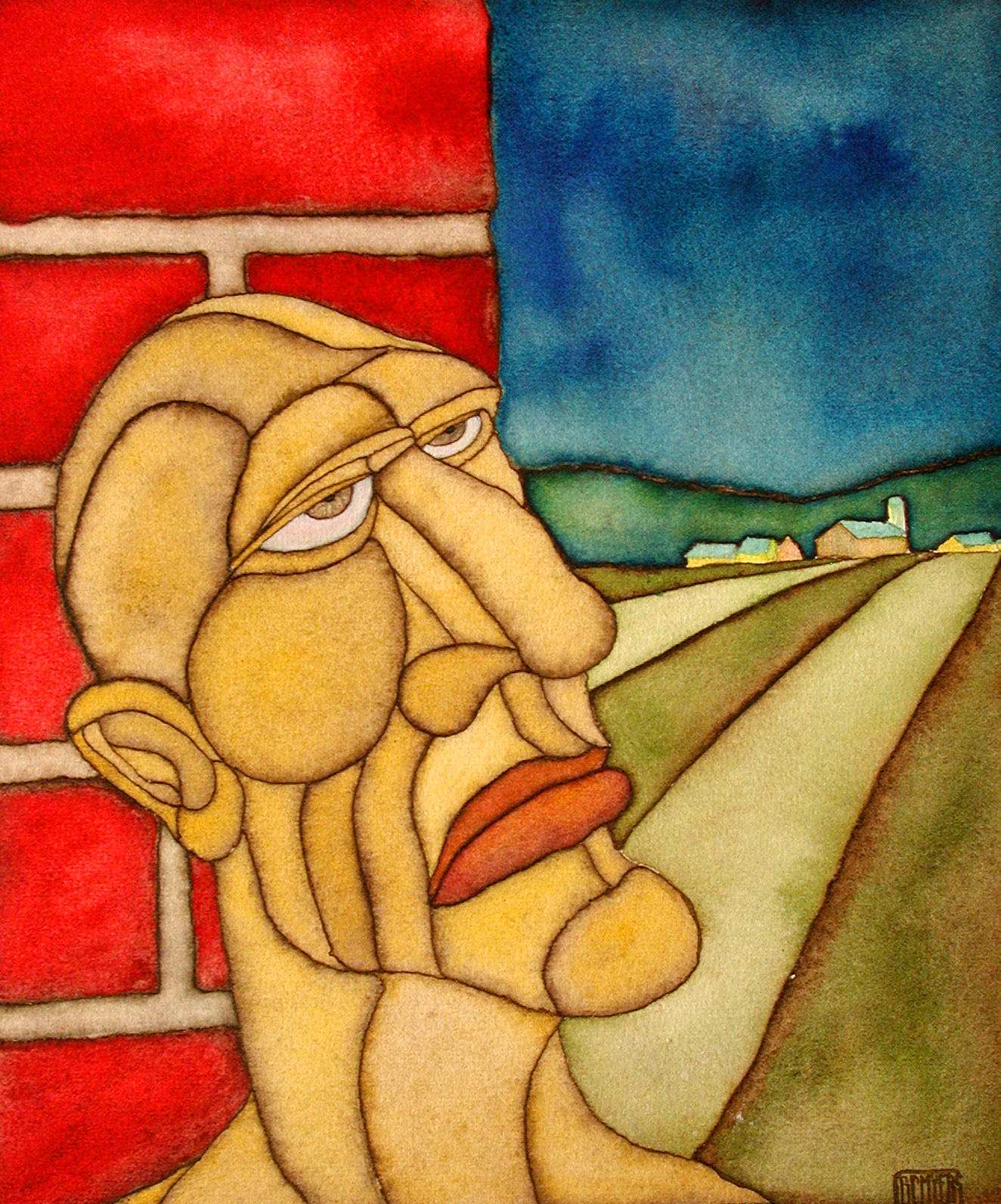
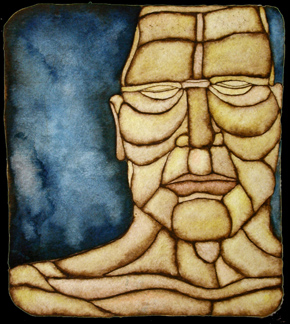
The feelings of helplessness and hopelessness that came from this were manifested in the faces I began to paint.  They mirrored the extreme pain we watched her endure and could do nothing to alleviate.  They were the only way that I could express the myriad feelings of that time and to this day fill me with emotion.

That is, in short, how this series came about and why I still show the work on my website.  My work has evolved over the years but  this work remains perhaps the closest to me.

exile14-smallexile15-small
exile16-small

Read Full Post »

Quiet Rising

It seems a little odd to sit down and write something about why you like your own work.  I know a lot of artists find it difficult and maybe even a little distasteful.  For me, it’s about trying to find that part of a painting that reaches out to people, the part that is communicating.  I am the first person to see the work so in order for the piece to be able to speak to others it must first speak to me.  It must excite me on some level.  That excitement is a very big part of my process and carries me through a lot of long days alone in my studio.  So when I write or speak about my own work it’s so that I might understand better why the painting works.

That being said, this is a painting titled Quiet Rising which I’m showing  because I like this piece on many different levels.  On an emotional level I find this piece very calm, very quiet.  There is a nice harmony in the way the colors and forms fit together, again in a way that I find very calming.  For me, that appearance of placid calm seems to be an important aspect in my own evaluation of my work.

The path in the foreground has a curve that I find very intriguing.  I can’t put my finger on the reason but it reminds me of an element from Henri Rousseau painting.  Maybe it’s the movement of the path or the quality of the blue in the sky– I can’t be sure.  A lot of the feelings I get from a piece are not quite fully realized thoughts.  More like snippets or a tiny bit of a memory that comes to you without the whole episode, leaving you unsure if there even was a real memory there to begin with.

Whatever the case, this painting works for me and is worth sharing.  It’s being shown at the West End Gallery in Corning, NY.

Read Full Post »

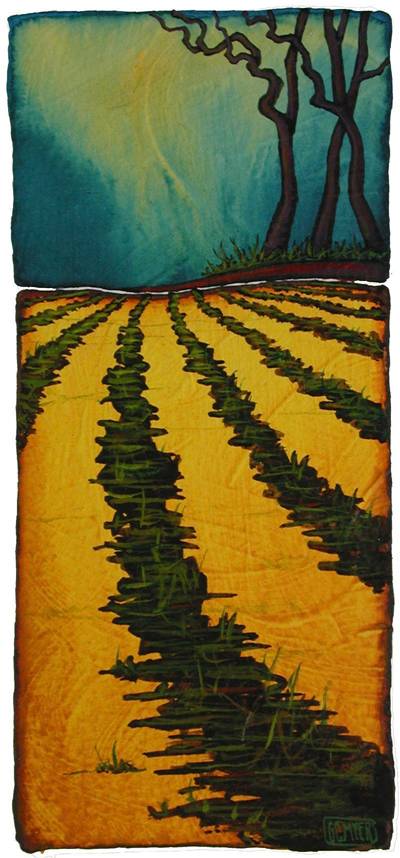
This is a piece called “Labor to Light”, a smaller piece that is at the West End Gallery in Corning.  It features one of what I call my icons, the field rows running back to the horizon.  To me, they represent the act of labor and its fruits- the work ethic which has been very important to me in this career and something I stress to kids whenever I get to talk to them.  

I remember years ago reading an interview with author John Irving (of “Garp” fame) where he talked about his work routine.  He talks quite a bit about wrestling in his writing as he was a high school and college grappler and he used a wrestling analogy to describe how he approached his writing.  He said that if he wanted to go to the highest level as a wrestler, which would be an Olympic or world  champion, he would have to train harder and longer than the men he would be competing against.  He felt that he was basically competing against every wrestler in the world.  He then turned this to writing.  

He turned his writing into a competitive effort of Olympic proportion, where he was competing with every other writer in the world for each reader that came into a bookstore.  If you were buying someone else’s book, you weren’t buying his and in his mind, he had lost.  So he began to train himself as a writer with the same effort as though he were an Olympic athlete, writing 7-8 hours per day, forcing himself to forge ahead even on days when it would be easy to just blow it off and do anything else.

When I read this it struck a chord.  I realized that in order to reach my highest level I would have to be willing to devote myself to working harder and longer than other artists, be willing to spend more time alone, away from distraction.  It would require sacrifice and hard labor.  But Irving’s example gave me a path to follow, a starting point.

I have since realized that there is a multitude of talented people out there, many with abilities far beyond mine.  But to communicate successfully with one’s art one needs to push that ability fully, in order to go beyond what your mind sees as an endpoint. I see this as my goal everyday in the studio.  Sometimes I succeed and sometimes I come up short but I’m out there competing everyday.

Thanks, John Irving.

Read Full Post »

Let me continue and finish up telling about how I came to be a painter.  I had fallen from my ladder, been injured, started painting with surprising results and became obsessed with improving as a painter. This is all in Starting Out: Part I on this blog.

So there I was painting away, assembling a mish-mosh of paper and board with smears of paint.  Some pieces really hit and some didn’t but, as in any endeavor, there was a lot to be learned from the misses.  The missteps defined strengths and weaknesses.  A time pass and I felt that the work was growing and was becoming a true expression of myself but I wasn’t thinking I was any more than an avid hobbyist at this point.

I had bought a painting or two over the years from the West End Gallery in Corning, NY.  One of the owners at that time was Tom Gardner, also a well-known painter and teacher.  Tom has a knack for conversation and I would occasionally stop in and we’d end up pulling out chairs in the middle of the spacious gallery and just shoot the breeze for a couple of hours.  It was during one such talk that Tom asked if I painted.  I hemmed and hawed a bit then confessed that I had puttered around a little.  Tom told me that I should bring some stufff in and he’d be glad to critique it but to be prepared to accept a harsh judgement if the work deserved it.  I hesitatingly agreed.

A week or so later I showed up at the gallery and Tom, seeing me, started to laugh.  I was hauling my pieces in an old blue milk crate with pieces of paper and cardboard sticking out all over the place.  It was not the organized portfolio of a serious artist or student.  Tom hunkered down and began shuffling through the pile of work and turned to me.

“I’ve got one question for you,” he said, pausing for a beat. “Where the hell have you been?”

I was shocked and thrilled.  It was a validation of the work.  He saw something original and strong in the work, saw real possibility.  My head reeled.  About this time, co-owner Linda Gardner walked in and looked over Tom’s shoulder for a few minutes.  After a moment she turned to me.

“Can you have 10 or 12 of these ready by next week for our next opening”

I can still remember the giddiness I felt from this unexpected turn of events.  A new possibility opened before me in that one moment, that one simple question.  I said yes. of course I could have the work ready.  I wanted to be confident even though I had no idea how to present the work properly.  But I knew I would learn and learn quickly because there was new horizon in front of me now, an opportunity that I knew I could not squander.  I would give it everything I had.

So, it was started.  Here is one of the first pieces I exhibited and I believe the first piece I ever sold:

Anyway, that’s how I first came to show my work publicly.  I’ll talk more about that in later posts.

Read Full Post »

« Newer Posts