
Harmony in Blue and Green— At West End Gallery
Excellence is an art won by training and habituation: we do not act rightly because we have virtue or excellence, but we rather have these because we have acted rightly; ‘these virtues are formed in man by his doing the actions‘; we are what we repeatedly do. Excellence, then, is not an act but a habit: ‘the good of man is a working of the soul in the way of excellence in a complete life… for as it is not one swallow or one fine day that makes a spring, so it is not one day or a short time that makes a man blessed and happy’.
–Will Durant, The Story of Philosophy (1926)
I recently came across the passage at the top from the esteemed historian/philosopher Will Durant. I was taken by hos words which very much aligned with one part of yesterday’s post that stated that we become what we say and do. Durant stressed the repetition required to create habit in our virtue and excellence.
Good stuff. Practical and applicable to most people. And the practice of becoming and being an artist. I’ve often felt that one of my strengths is my willingness– or perhaps it’s compulsion– to work. I would like to believe that this habit I have created shows itself in some small degree of excellence.
While reading the article that contained this passage from Durant, I noticed there was an attached note pointing out that the passage’s quoted phrase ‘these virtues are formed in man by his doing the actions were taken from the Nicomachean Ethics written by Aristotle around 350 B.C.E. I decided to investigate a bit further to see the context of Aristotle’s words. This further digging is now part of my writing habit. Not sure any excellence has come of it yet.
I was interested in what Aristotle wrote on this subject. My concise reading of the chapter containing the phrase above is that all art has a level of goodness contained within itself. This applies even if it is performed or created by those lacking goodness and virtue. The character of the work only becomes virtuous when the work is created with conscious intent by a virtuous artist of firm and unchanging character.
This made me wonder if the qualities that I sense in my work were the inherent goodness already present in it or did they reflect my character and whatever goodness I might have contributed to the work? Were my feelings I experienced from seeing the work I created actually part of the work? Or was any character and virtue the work possessed its alone?
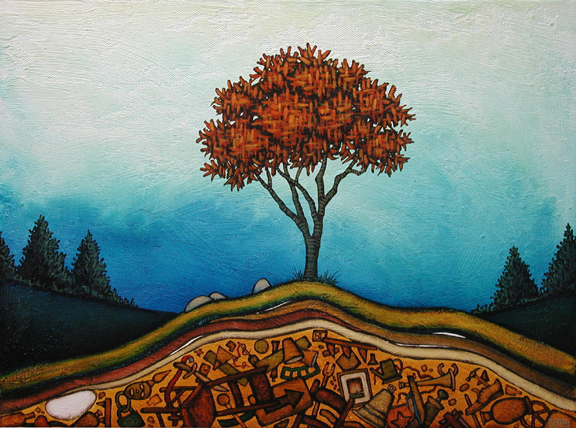
This created quite a quandary in my mind. It made me think of a conversation I had with a good friend recently where I was briefly talking about the new work created in this past year, of which the piece at the top is an example. I was describing to my friend the disappointment I felt in the general reception to this work. I said that I saw something in the work from this time that felt as though it might one day be important and definitive in the larger context of my work.
Well, if there ever is such a thing as the larger context of my work. That’s out of my hands.
But I felt that this work was created with great intent and was truly reflective of my character and beliefs. It had a passion in it that was instantly apparent to me. It deserved to be created and seen.
Of course, that is my personal opinion. That can often be too close or biased in judging one’s own work. Maybe the passion and depth I sensed didn’t come through in the inherent goodness of the work? Or perhaps that which I perceived then as goodness and virtue is not that exactly? Maybe much less?
Or maybe what I was seeing was real and present in the work but was appearing in the wrong time and place?
I don’t know and may never know. That’s something you have to accept as an artist. You never know how your work, no matter how passionate you are about it, will be received. Now or in the future. You create on your own faith and belief in what you do, over and over again, with the hope that, as Durant points out, excellence will one day be achieved through this habituation.
You just do what you do and let the chips fall where they may. Now and in the future.
As I said, maybe the work was in the right place at the wrong time. Here’s the late and ever flamboyant Dr. John with a song that hits this nail on the head. This is a performance from the Midnight Special in 1973 of his Right Place Wrong Time with the Doc in full Night Tripper regalia.
A blast from the past. Well, my past, at least. You got your own past to work from, kids.
Now get out of here before I turn surly.
 Civilization exists by geological consent, subject to change without notice.
 Redtree Times