American Art Collector Show Preview, June 2024 Issue
Mere change is not growth. Growth is the synthesis of change and continuity, and where there is no continuity there is no growth.
–C. S. Lewis
The new June issue of American Art Collectorarrived yesterday. In it there is a pretty good preview of my upcoming show, Continuum: The Red Tree at 25, at the Principle Gallery. By pretty good I mean that that the feel of the images together on the pages truly seem to reflect the visual tone of the show as a whole, which doesn’t always happen. As it says in the opening paragraph, I am seeking maximum visual impact with this show and the group of four images very much represent that aim.
It was good to see them maintain the same effect on the page as they do here in the studio. I view this as a big show for me, one that hopefully punctuates the quarter century run of solo shows at the Principle Gallery with an exclamation point.
The beauty in having this string of solo shows going back to the RedTree show of 2000 is that it demonstrates the synthesis of change and continuity that C.S. Lewis mentions in the quote at the top. I believe there has been real growth in the work over these past twenty-five years that might not have appeared without the continuity of the goal that each year’s show has provided. The goal of this year’s show is to demonstrate the fullness and growth in the work brought on by this continuity.
I think it will do just that but I am usually suspicious of my own impression of such things. I am just too close and invested to the work to be truly objective. But seeing this spread made me feel better about my gut feeling for this show.
Hopefully those who get to the Principle Gallery during its run there will see it the same way.
Continuum: The Red Treeat 25opens June 14, 2024 at the Principle Gallery in Alexandria, VA. The exhibit runs until July 3.
Comes a Time– Coming to Principle Gallery Alexandria
Tell your heart that the fear of suffering is worse than the suffering itself. And that no heart has ever suffered when it goes in search of its dreams, because every second of the search is a second’s encounter with God and with eternity.
–Paulo Coelho, The Alchemist (1988)
There’s an idyllic quality to this new painting that somewhat masks the underlying desire that I see in it. I think that a first glance would lead one to believe this was a dream achieved. In reality, it is only the representation of the dreamer’s hoped-for destination– the imagined and vaguely defined object of the dreamer’s search.
It is an elusive thing, this object of desire that drives the search. Most likely, the dreamer will get but a fleeting glimpse of it. But that momentary burst of its transcendence is ample reward for the travails endured that it took to reach that moment.
When all is said and done, the dreamer finally discovers that the importance comes not in attaining that which you seek but in simply having and maintaining the dream. The search ultimately reveals so many things that the dreamer never thought to imagine in their initial vision and brings an awareness of such things in their life in the real world.
The search clarifies and deepens.
I might represent the object of my search as an idyllic landscape but it is probably better defined a search for understanding. And maybe that is what this painting represents for me– the time of arriving at understanding.
There’s more to be said about this painting but I am going to leave it at that this morning. Let’s add a song for this week’s Sunday Morning Music that will make sense since I borrowed its title for this painting, Comes a Time. The song is a longtime favorite from Neil Young and there’s something in it that feels akin to the feel of this painting.
Comes a Time is 36″ high by 18″ wide on canvas and is included in Continuum: The Red Tree at 25, this year’s edition of my annual solo show at the Principle Gallery in Alexandria, VA. This show, which is my 25th with the Principle Gallery, opens June 14, 2024.
Held By the Moon-– Coming to Principle Gallery, June
But if you build your life on dreams it’s prudent to recall; a man with moonlight in his hands has nothing there at all.
—Miguel de Cervantes, Don Quixote de la Mancha (1605)
I wanted a quote or literary passage to open this post about the new painting above and came across the line above from Cervantes’ Don Quixote. It gave me great pause, not only for how I saw it in relating to this painting but in how it might have echoes in my own life.
I have built my life as an artist on the pursuit of dreams, in creating imaginary landscapes, in searching for impossible intangibles that I can’t define, describe, or explain. I seek that things that may not even exist.
Like Don Quixote, it sometimes appears that I might be tilting at windmills.
It makes me wonder if the wooden carved figure of Don Quixote that stands on a stone shelf above me now, given to me by my sister 50-some years ago, was an unconscious hint as to what was in store for me.
I don’t know how this makes me feel. There’s an aspect to it in which it is sad, much like the seeker who looks to hold the moonlight in their hands finding that they hold nothing at all. There are certainly days when it feels as though the years spent painting have left me with little more than that. But part of me is okay with this idea of appearing as some sort of mad knight on a misguided but chivalrous errand.
There are worst things to be in this world. Or in my imaginary world, for that matter.
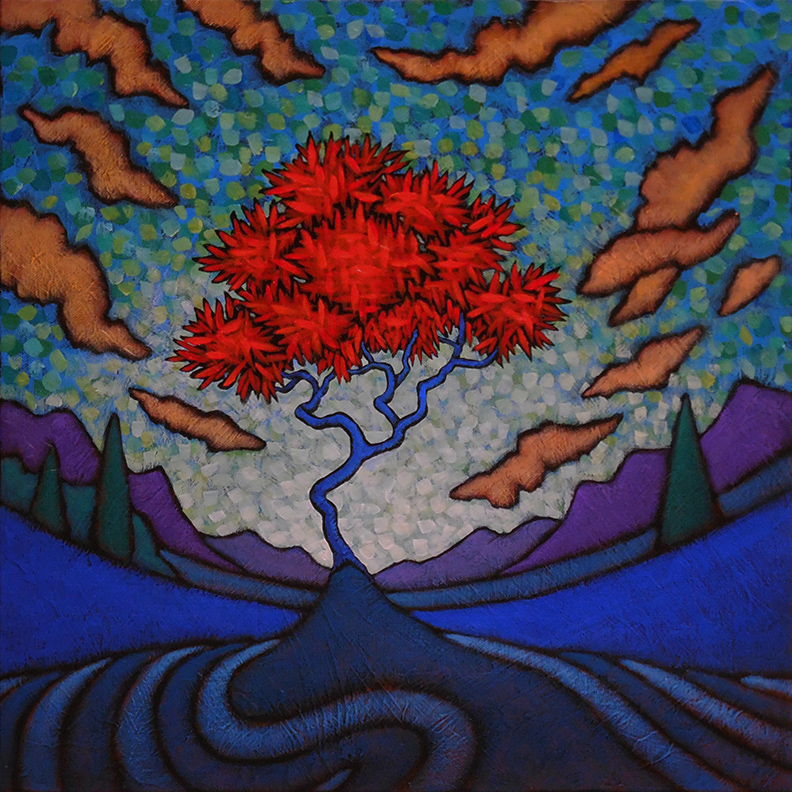
I see this painting, Held By the Moon, as being much like Don Quixote. Like him, it has a romantic and larger than life feel to it, probably from the fact that it is a large painting, 48″ high by 36″ wide. The tens of thousands of brushstrokes that make up the sky represent for me the futility of holding on to moonlight.
It is there but then again, it is not.
You cannot hold it. But it certainly can hold you.
This painting, Held By the Moon, is part of Continuum: The Red Tree at 25, which opens at the Principle Gallery in Alexandria, VA on June 14, 2024. This show marks my 25th solo show at the Principle, a streak that began with my RedTreeshow in 2000.
I somehow have been holding on to the moonlight for a quarter of a century. Or so I believe…
On the Blue Side— Included in “Continuum: The Red Tree at 25“, Opening June 14 at Principle Gallery, Alexandria, VA
I once wrote a short story called ‘The Best Blues Singer in the World,’ and it went like this: ‘The streets that Balboa walked were his own private ocean, and Balboa was drowning.’ End of story. That says it all. Nothing else to say. I’ve been rewriting that same story over and over again. All my plays are rewriting that same story.
–August Wilson
I came across quote above from playwright August Wilson recently. It struck a chord with me, especially as I am in the hectic midst of prepping work for my annual solo show next month at the Principle Gallery. Sometimes when I am surrounded by new work at this point in getting ready for any solo show, the idea that I am constantly rewriting the same story over and over in my own work seems too obvious to ignore. Even more so for a show that focuses strongly on my signature element, the Red Tree.
It used to bother me. I worried that the story I was writing wasn’t good enough or not interesting enough to hold a viewer for too long or that they would simply tire of that ubiquitous Red Tree.
But over the years, that worrying has faded a bit. Not fully, especially at this point in prepping for a show. But it has become less bothersome. I think some of this has to do with looking at the work of other artists across a variety of mediums. I found that many– maybe most– tell the same story with their work with slight variations and changes. Small additions and subtractions, changes in tone and location, speeding up and slowing down.
In a NY Times article from April of 2000, Wilson explained that this is because the artist works, like the Balboa in his story, in their own private ocean, one that is fed from tributary streams of their personal and cultural identity, their experiences, thoughts, and beliefs.
Their ocean is their story.
All they are and know. And as they say, a writer should write about what they know firsthand. Wilson put it this way in the article:
Before one can become an artist one must first be. It is this being in all its facets, its many definitions, that endows the artist with an immutable sense of himself that is necessary for the accomplishment of his task. Simply put, art is beholden to the kiln in which the artist was fired.
In short, the story my work attempts to tell is a representation of my personal ocean. I guess in my case, it is more of a landscape than an ocean. It may seem narrow at times but it tells the story I need to tell and in the only way I know how.
As I have recognized this, it feels as though the years have allowed me to hone my story, to fine tune it as though I am constantly rewriting and reediting it.
Or maybe it is more like genetic natural selection. When a piece works in a way that excites or please me now, it feels as though it is a result of the many other paintings that came before it. As though it were an ancestral descendant of those earlier pieces, taking what was best from them and enhancing those things. Maybe making them better or, at least, telling the story is a clearer and more direct way.
That’s kind of what I see in this new painting, On the Blue Side. It’s a simply composed painting, like a story I have told innumerable times before. But it takes that same storyline and embellishes it with new nuances and touches that result in it feeling like something new, all unto itself. Something that moves and surprises me.
Yet, I see the same story in it.
How could I not? It’s my story. My ocean. Or should I say, my hillside, my fields, my Red Tree?
I call this painting, 18″ by 18″ on canvas, On the Blue Side. It’s a title I took from a song, Blue Side of the Mountain, that Chris Stapleton wrote with Mike Henderson, in 2008 while both were members of the bluegrass group, The SteelDrivers. It felt like the song related to this painting in that, while I have often dwelt “on the blue side of that mountain where the sun don’t ever shine,” I now know that even though I can’t see the sun directly, I can still see the light from it above me.
And that gives me the hope to keep hanging on. To keep telling my story. The only one I know.
Here’s that song from The Steeldrivers from a 2008 performance.
Follow the Heart— Coming to Principle Gallery, June 2024
Look at every path closely and deliberately. Try it as many times as you think necessary. Then ask yourself, and yourself alone, one question… Does this path have a heart? If it does, the path is good; if it doesn’t, it is of no use.
—Carlos Castaneda, The Teachings of Don Juan (1968)
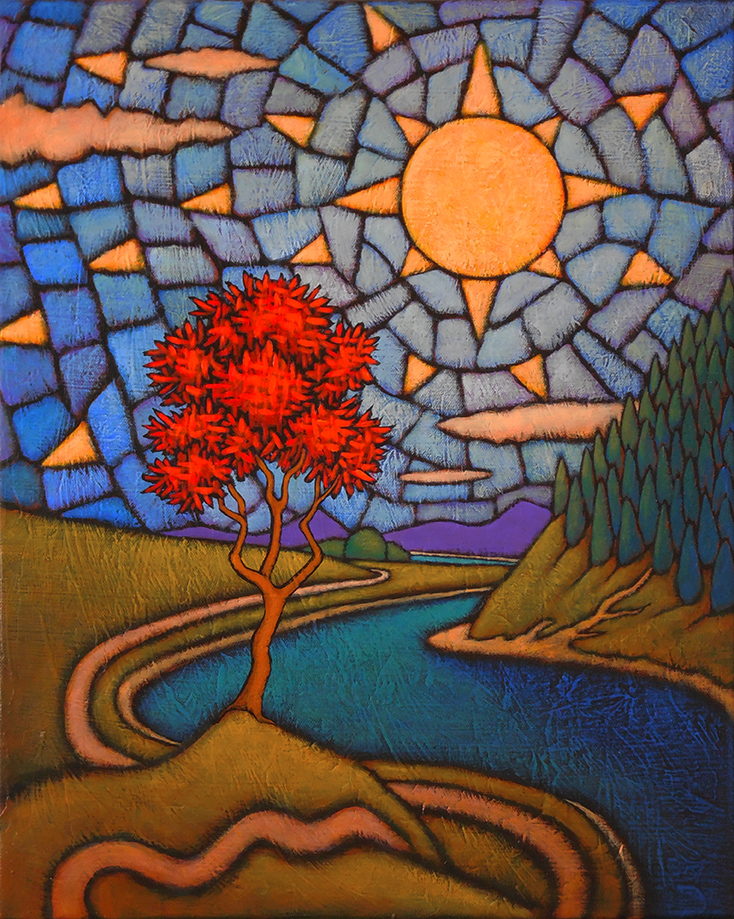
The painting above is a new painting that is 20″ high by 16″ wide on canvas. It is part of Continuum: The RedTree at 25, my 25th annual solo show at the Principle Gallery, which opens June 14.
The title is Follow the Heart which is taken from the passage above from Carlos Castaneda. I saw this piece as being about the choices that come before us through our lives, even as I was painting it which is a bit out of the norm. Whatever message a painting transmits to me usually isn’t fully evident until it is complete or nearly so.
I think that’s because, even though I am often stepping away and taking it as a whole in order to determine balance, I am usually focused on whatever smaller bit is in front of me at the moment. That goes back to a personal goal I set back when I first started painting. I always felt that if I could make every square inch of the surface have some visual interest of its own yet still harmonize with all the other square inches, then ultimately the piece would be sure to come alive.
I would like to believe that if you looked at any part of the surface of a piece you would find something visually interesting in it. That’s one of the reasons I prefer to float my canvasses and mat my works on paper with their edges exposed. Every bit, even the far edges, play a part in the painting, and I don’t like covering any part of it.
But getting back to Follow the Heart, I felt that there was a lot of motion in it, with the winding path and stream, and the little path that moves up the streambank. All seemed to indicate possibility, different paths that could be followed. The sun in the sky literally serves as guiding compass here and the clouds represent the movement of time.
The RedTree seems to ask: Which way do we go and how do we choose?
That’s where the Castaneda passage comes into play. Only you can determine the heart of any path. Others will tell you what is the right path but they can only recognize the heart of the path they know. They can’t hear the know what path holds a beating heart for you. And if you follow a path whose heart that doesn’t beat for you, it will never fully satisfy the needs and wants that only you know.
So, follow the heart.
It sounds easy but, of course, it isn’t. Others will still judge and criticize because they think their path is the one and only path. They may never hear the heartbeat of your path. And that’s okay. So long as you hear that heartbeat their opinions won’t matter much.
Here’s a song for this week’s Sunday Morning Music that pretty much sums it all up. It’s Andra Day channeling the spirit of Billie Holiday with the oft-covered blues classic, Ain’t Nobody’s Business.
Good advice for those listening for the heartbeat of a path.
Farewell, my dearest sister, fare thee well: The elements be kind to thee, and make Thy spirits all of comfort! Fare thee well.
–William Shakespeare, Antony and Cleopatra
Lousy day yesterday as I lost my longtime studio partner, Hobo. Her hyperthyroidism, high blood pressure and the sheer weight of what we figured were her 18 years of age finally took their ultimate toll. She was in rough shape and I hesitatingly made that awful final decision to take her to the vet for the last time. It was a quiet and easy end. Fitting, since she was always quiet and easy to care for. Easy to live with. Easy to love.
She had been reduced over the past few years to a frail bag of bones. At her death she was just over 6 pounds, in stark comparison to her at her peak when she was a vibrant and powerful 13 pounds. Back then, when I would call for her and she would run to me on the path through the woods, the sound of her footfalls on the trail sounded like those of a running horse.
Hobie (her real name is officially Hobo Joe From Idaho but I called her Hobie) showed up as a stray about 15 years ago. She kept her distance for the longest time. It wasn’t until she chased our housecat, Zsa Zsa, up a pine tree and on to the roof of the studio that we really engaged. Zsa Zsa allowed me to climb a ladder and retrieve her from the roof. Hobie remained, calmly watching me as she sat at the peak. I put another ladder beside the first and ran a board between the two. I told her to watch and moved my hand from the roof to the board then down the ladder rungs. Moving away, I stood at a safe distance for her as she calmly made her way to the edge of the roof then hopped on the board and down the ladder just as I had showed her.
She trotted away that day but soon showed up again. Finally, a few weeks later, I spied her peeking at me from the corner of the studio. I slapped my leg and yelled to her, “Well, come on!” She ran right up to me, demanding to be petted for several minutes.
From that moment on, she was my girl. She was soon spending her nights in the studio though she preferred to prowl the woods and lawn during the day. In the studio, she was never a problem at all, outside of shredding the edge of one of my kitchen cabinets, which I never really minded because they are pretty horrible to begin with. Plus, she took such relish in it, especially when I came into the studio first thing in the morning. But she never showed any interest in scratching a painting or a frame. Never a problem of any kind. Even in these last years when she received meds several times a day, she was easy to deal with.
For the past 12+ years she had been solely an indoor cat, after an incident when she came flying into the screen room off the back of the studio with another large cat hot on her tail. She came in that day and had never strayed outside again, outside of one incident where I inadvertently left the door open. She went out and sniffed around on the sidewalk until I walked over to her. She willingly allowed me to pick her up and her ever effusive purr started immediately as I climbed the steps to bring her in.
She knew she had good gig.
And while she may have felt fortunate after spending years outside, I was the true lucky one in having received such loyal and unconditional love from her for so long. I could go on and on about how great she was in so many ways, but I will leave it at this. The studio certainly feels empty and a little colder this morning. Hobie will be missed but I suspect she remains here in some way. And that’s a good thing. Comforting.
There are three cats in my basement now, the feral family that have been my outdoor mates for the past three years, waiting to make the transition to being studio cats. They have been in the basement for most of the winter, mainly at night and during the day in poor weather. It has been kind of an audition, knowing that Hobie was not long for this world. So far, they seem to be doing well and haven’t destroyed anything down there. They are great, loving cats and will no doubt be fine studio cats. When I call them, they come running through the woods but even though they are equal in size, they don’t make the same pounding sound that Hobie.
They will have to make the space their home in their own unique way because they never replace Hobie.
Thank you, Hobie, for all you gave me. Fare thee well, my good girl.
I never climbed any ladder: I have achieved eminence by sheer gravitation.
—George Bernard Shaw, preface to The Irrational Knot (1905)
Shaw wrote his novel, The Irrational Knot, in 1880 and wrote a preface for it in a new American edition 25 years later. It’s a comic introduction but has many interesting lines including one near the beginning in which he says that the book was written by someone other than himself as he was now, in 1905.
As Shaw explains:
At present, of course, I am not the author of The Irrational Knot. Physiologists inform us that the substance of our bodies (and consequently of our souls) is shed and renewed at such a rate that no part of us lasts longer than eight years: I am therefore not now in any atom of me the person who wrote The Irrational Knot in 1880. The last of that author perished in 1888; and two of his successors have since joined the majority.
This made me think about my upcoming solo show at the Principle Gallery in June. This year’s show is my 25th solo exhibit at the Alexandria gallery which makes me wonder if those paintings from that first show in 2000 were painted by the same person who is feverishly working on these new ones scattered around my studio.
They certainly look different in many ways. The techniques and the media employed have certainly changed and evolved. The surfaces are different with more textures and layers and even deeper colors. More elements have been added to the compositions.
Maybe there is not a single atom remaining from the previous me who painted those earlier paintings.
However, though every atom might be gone from that progenitor in 2000, the subsequent generations of myself possess the same DNA. The emotions rendered are much the same. The Red Tree remains, like some genetic physical trait that spans multiple generations in a family– always the same but slightly different in its time. And though there are more layers and elements now, the basic compositions remain simplified.
I think of this when I look at this new painting, In Eminence, from the upcoming show. It is a painting that would have looked much the same in some ways when the me of 2000 (or the great-great grandfather me if you go with Shaw’s premise that we are new beings every 8 years) might have painted it.
You would recognize the family resemblance, but it would also look very different. This piece feels to me as though it took the lessons passed down from one ancestral me to the next and incorporated them into a statement that fully describes the state of being that exists now in the Red Tree family line. It’s a piece that brings me great satisfaction in viewing it.
Let’s call it family pride. I think the me that was in 2000 would be happy with it.
But we’ll never really know, will we? That dude is long gone.
But hopefully, the me that might one day be my grandson, if my time here on this spinning rock allows that to occur, will feel the same.
I have a feeling he will feel much the same about it as his old granddad did back in the day.
Just a hunch on my part but who knows what he will really think about it?
Crazy kids…
In Eminence is 30 inches high by 15 inches wide on canvas. It is included in my solo exhibit, Continuum: The RedTree at 25, which opens June 14, 2024 at the Principle Gallery in Alexandria, VA.
To appreciate a work of art, is it okay to like what you like, and the heck with the art critics and experts? Absolutely.
–Thomas Hoving
I came across this quote from the late Thomas Hoving and thought it would be a good opportunity to show off an illustration of him done by the late David Levine, the famed illustrator/artist whose distinct caricatures adorned the New York Review of Books for many years, along with many other publications. The original drawing now hangs in a corner of my studio, obtained from the estate of Thomas Buechner who was friend to both Levine and Hoving.
Thomas Hoving wore a number of hats but was primarily a museum director. Now that sounds pretty blasé on its surface but he was a rock star among his peers, writing bestselling books and using his flamboyant showman skills to usher the Metropolitan Museum into a renaissance of sorts as its director. He was big personality in what is often a low-key position.
His words above definitely ring true as good advice to anyone who has ever felt anxious about purchasing or even sharing their opinion on a piece of art. Feel free to buy and admire work that speaks to you, regardless of what critics might say. Art is based on an emotional elicitation, and nobody can dictate how anyone should respond to any one piece of work. A critic may have a response to a work of art and write effusively about that work, perhaps even making cogent points about the validity of the work. But if I don’t feel that same emotional response, all the eloquence in the world telling me why I should like it cannot make me suddenly adore that work.
In short, we like what we like.
I’ve seen people in high powered positions, people who normally ooze confidence, suddenly turn to jelly when trying to decide whether they should buy a piece of art. Art is such a nebulous and subjective thing that many of these folks feel a bit lost and out of their depth. They are afraid of making a mistake and lose all trust in their own opinion. They forget that they should simply like what they like and trust that feeling.
So, if you see something you like sometime, don’t be shy about showing your admiration for it. Maybe that means purchasing it or maybe it’s just letting the artist know that it moves you somehow.
Both are appreciated by every artist I have ever known.
There is a lot on my plate this morning so I am reposting the above from several years back. Being an artist working in my own idiosyncratic niche, I have often run up against this distrust of one’s own response to a piece of art. We all want to judge things against other things and a piece of art that doesn’t pose an easy comparison can be vexing.
So, trust your feelings when you look at art. If you like something, don’t be afraid to admit it. It’s art– there is no absolute right or wrong.
For this week’s Sunday Morning Music let’s go with a song that speak directly to this– I Like It Like That. The problem is that there are two (actually probably more than two) songs with that title. The two here are very different but very distinct in their appeal. The first is a 1967 tune from the late Bronx-based bandleader Pete Rodriguez whose genre they put in the category of Latin Boogaloo. I never heard that term before. But it’s a great tune and one you may have heard before since it’s been in a lot of movies and has been covered many times.
The same can be said for the second song from New Orleans-based R&B singer/songwriter Chris Kenner in 1961. You might recognize one or the other immediately. Or not. Doesn’t matter–I think both are good tunes.
Call of the Blue Moon– Coming to Principle Gallery, June 2024
He who Doubts from what he sees Will neer Believe do what you Please If the Sun & Moon should Doubt They’d immediately Go out
—William Blake, Auguries of Innocence
My annual solo exhibit at the Principle Gallery opens in 6 weeks, on June 14. One of the first pieces I completed for this exhibit, my 25th such show at the Alexandria, Virginia gallery, is this larger painting, a 36″ by 36″ canvas called Call of the Blue Moon.
It’s a piece that has been catching my eye for several months here in the studio, one that always seems to calm and center me when self-doubt seems overwhelming.
It possesses a coolness and clarity that is a balm for my doubts.
I’ve been needing to look at it quite often recently.
And an air of certainty. It seems to me like a place where there is no room for doubt. It depicts a cold and barren landscape where any doubt could be lethal. Yet it has a beauty and underlying warmth that transcends its harshness.
Maybe that is its simple message, that life is often harsh and dangerous yet still offers us beauty and tenderness. And hope.
Perhaps hope is that blue moon.
It just might be but you may well see it differently. As it should be.
Here’s a song to go along with this piece, though I am not sure it fully syncs with it. It’s a song I like that I was listening to this morning as I began writing this. I came across the music of the Yoshida Brothers a few years back. They are a duo playing the traditional Japanese shamisen, a three-stringed that sort of looks like a square banjo which is played by plucking or slamming the strings with a plectrum that looks kind a scraper. The Yoshida Brothers have a very eclectic sound that mixes traditional Japanese music and sounds many other musical influences. I sometimes hear Celtic or Bluegrass influences in some of their pieces and hard rock and electronica in others. This is Overland Blues.
String theory has the potential to show that all of the wondrous happenings in the universe – from the frantic dance of subatomic quarks to the stately waltz of orbiting binary stars; from the primordial fireball of the big bang to the majestic swirl of heavenly galaxies – are reflections of one, grand physical principle, one master equation.
—Brian Greene,The Elegant Universe
[From October 2014]
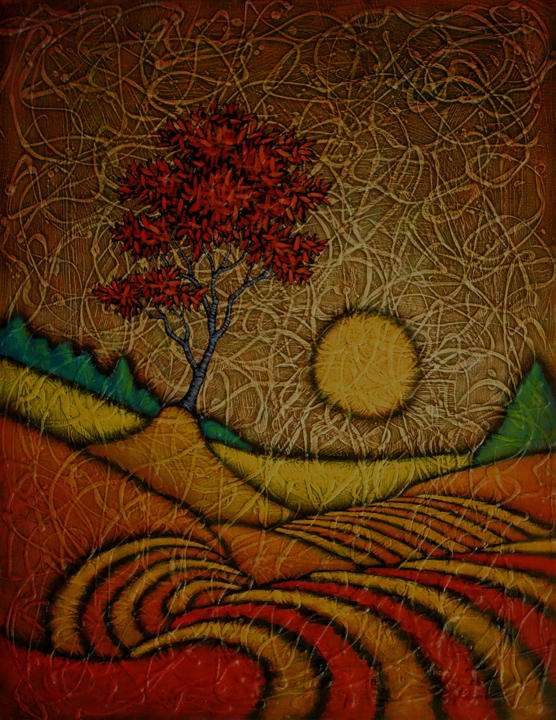
I’ve done several paintings through the years using textured surface that has bands or strings that twist and turn throughout. It’s an extreme texture, more pronounced on than my typical surfaces, and, as a result, takes center stage in these pieces. They become the driving force in the painting.
These bands that run through these paintings always spur something in me, some sense of wonder at the great unknowns of our world and universe. The painting shown here, Here There Everywhere, certainly does this for me. Looking at it, I am filled with questions about the world or worlds that lie just past our perceptions. Are there other dimensions, other pasts and futures swirling around us at any moment? And if so, are we connected in some way to this web of chaotic energy or are we merely physical beings, unwitting bystanders in the great dance of the universe?
In this painting, the Red Tree serves as the questioner, living in the moment but recognizing the forces that permeate everything and give that moment a discernible depth and meaning beyond the simple beauty it can physically observe. I know that I have had that feeling. I might be out driving and see a certain curve of a field, a bend of a tree or the filtering light from the sun and suddenly feel an intense emotional response that seems to have no basis of origin in my past, one so strong that I find myself asking why and where it came from.
Perhaps this indefinable emotional is a brush with these other worlds, these energy forces?
I certainly don’t know. Part of me wishes it to be so but part of me simply wants to savor that moment and emotion without questioning it. Something to ponder on a gray autumn morning.
Or something to ponder on a damp spring morning nearly ten years later. I was looking at this painting this morning in the studio for a few moments. It is one that made the gallery rounds and came back here years ago. I only used that sort of whirling texture in a handful of pieces around that time in 2014. They were all quite striking, as is this piece, but I never really employed that texture after those pieces.
This piece has a sort of elegant feel to me, almost regal. It certainly doesn’t feel like an orphan painting that never found a home. Maybe it’s more like exiled royalty than orphan.
But beyond its feel, it serves as a constant reminder of string theory which I roughly described in another post about another painting from around that time:
It reminded me of one of the supposed byproducts of the string theory which is a very speculative area of quantum physics. Without going into the scientific basis for the theory (which I couldn’t do very well anyway), string theory basically creates a platform where extra dimensions– it is speculated that there may actually be at least nine dimensions– could and may exist alongside the dimensions that we know and dwell within, without our knowledge of their existence. A simplified example of how this might work is the way we are surrounded by radio signals all the time without our knowledge but with the proper receptor, a radio, they become apparent. With string theory, perhaps there are also parallel dimensions around us without our knowledge, dimensions that contain others forms of energy, other forms of existence.
People have used this as theoretical basis for many things such as time travel, the existence of UFOs, and things supernatural such as ghosts and other spectral occurrences. The string theory has been a very fertile field for science fiction writers to work.
Perhaps it also provides a place where the soul, the source of energy that animates the body, ultimately dwells. Perhaps there is the energy of souls all around us in these alternative dimensions. Maybe the photons we see are also the part, a facet, of something unseen. That’s how I see the sky in this painting, as masses of disparate energies that we only see partially in the dimensions we can detect.
None of this has much to do with anything this morning. At least not here, in our meager world of limited dimensions. But it gives me something different to think about and that’s got to be worth something, right?
Here’s a lovely song whose title sort of inspired the title for the painting above. It’s the Beatles and Here, There and Everywhere.
Now, listen then leave quietly without disturbing my strings…






 Redtree Times