Feeds:
Posts
Comments

Archive for February, 2009

POD007850025The NBA recently announced that the MVP award of the NBA final will be named the Bill Russell Award.  I’m sure there are a lot of younger people out there who don’t even know who Bill Russell is or what he meant to basketball and sports in general.

Bill Russell was and is the greatest winner in basketball history.  Perhaps, in all sports history.

He led his University of San Francisco team to consecutive NCAA championships.

He captained the gold medal winning USA Olympic team in 1956.

He was the foundation of the Boston Celtics dynasty.  11 NBA championships.  Eleven in thirteen years.  Think about that.

Along with Bob Gibson, Bill Russell was my childhood idol.  When playing sock basketball with a bent wire hanger for a rim, I was always Bill Russell.  Trying to block everything.  Grabbing every rebound.  He won by doing the basics, not by scoring but by smothering the opponents with hsi defense and rebounding.

I remember sitting with my dada at the kitchen table,  listening to the radio, a green plastic box with a stick in the back that held the batteries in place.  The Celtics’ legendary announcer Johnny Most‘s voice cutting through the static, crackles and pops:

Russell blocks the shot!

What a competitor.  I remember reading James Toback‘s 1971 biography of Jim Brown where he recounted playing golf with Brown, Bill Russell and Fred “The Hammer” Williamson.  He was amazed as Brown and Russell went head to head, both legendary competitors.  Shot after shot, they matched one another, neither giving an inch.  It was a pure demonstration of the spirit of what may be the two most dominant players in sports history.  Russell’s competitive intensity was always evident on the court in his glares and the way he stalked the lane.  The fact that he regularly dominated Wilt Chamberlain, who was perhaps the most dominant offensive talent in NBA history, in their legendary head to head battles is further proof of this will to win.

But he was so much more.  He was an intellect, smart and witty.  He could and would expound on subjects outside of the basketball courtand do so with the same strength and grace he displayed on the court.  I loved listening to him as a commentator  after his career ended.  He was insightful and downright funny at times.  His gap-toothed grin and laugh were pure joy.  He was bigger  than sport.  

It’s a pity it took so long for the NBA to honor this man but at least they finally got it right.  He should be on the trophy…

Read Full Post »

The Name Game

The IncantationWhat’s your name? Who’s your daddy?

Is he rich, is he rich like me?

A couple of memorable line from the old Zombies song, The Time of the Season.  

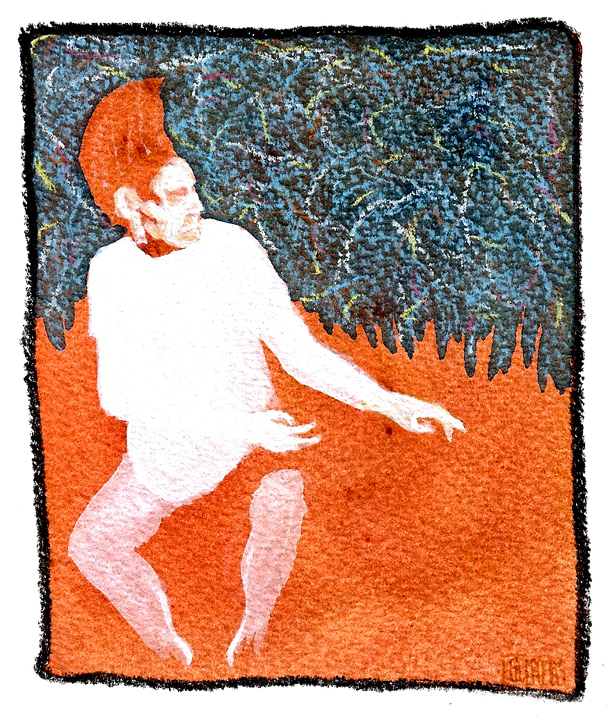
Knowing the true name of something has often been the sign of power over that person or thing. Think of a shaman performing an incantation, perhaps like the one depicted in this older piece I painted  many years ago.  I suppose that means that if one can know the truth, the real essence, of something, they can control or dominate it.

There is obviously something to the concept and  causes me to worry a bit for the open nature of our lives today  as expressed on blogs and social networks.

Maybe it’s a little paranoid, but I would rather be the incantor than the incantee.

Anyway, that’s only the premise to get to a little music.  I bet you thought it would be The Time of the Season ( which is a great song, one where the original is far superior to any subsequent covers) but actually I wanted to play a song that was sung many times over the years and remains a lot of fun to hear.  Plus it’s another great snapshot of the time with go-go dancers and everybody in jackets and ties.  Here’s Shirley Ellis and  The Name Game.


Read Full Post »

dsc_0343-smallIn a comment from yesterdays post (Out Into the Wide World) there was a comment from David Terrenoire  (his entertaining blog A Dark Planet can and should be reached from my links list) where he thought he liked the shown painting because there an implied narrative.

I think there is something to this comment  and I think it’s central to some of the attraction that my work may hold for some viewers.  I may have addressed this before so if this seems familiar, excuse me.  

Years ago, Cheri, my wife, described my paintings as blank sentences.  By that, she meant that I was giving context, some detail and a bit of direction but the actual narrative of the piece was left to be filled by the imagination of the viewer and the experiences that they brought with them.

I immediately sensed the truth of her words.  It also explained a few things.  My writing had always lacked narrative depth.  I was more concerned about creating mood and emotion with the words rather than the story construct.  As a result, most of my writing centered around describing silence, ephemeral moments and wide open spaces.  Pretty limited stuff and it left me feeling as though I were missing the mark somehow.

I wanted to create an environment where someone could see the things in my writing- silence, space and moment- but in a way where I was not filling in every detail.  The viewer would add an actual element to the painting.  The narrative of the piece might be implied but was only there if the viewer so wished.

Maybe I’m off-base here or maybe I’m blathering on in the artspeak that I so detest.  I just don’t know.

The piece above is a new painting tentatively titled  Above Canaltown.  This might be a good example of what I’m trying to say here.  For me, this very much about shapes, color and creating a certain emotional rhythm with the placement of the buildings, paths and canal.  However, I can see where there is room for narrative and I may have my own for this scene.  But if this piece is to succeed and have a life of its own, the sentence will be completed by someone other than me.

That okay with you, Dave?

Read Full Post »

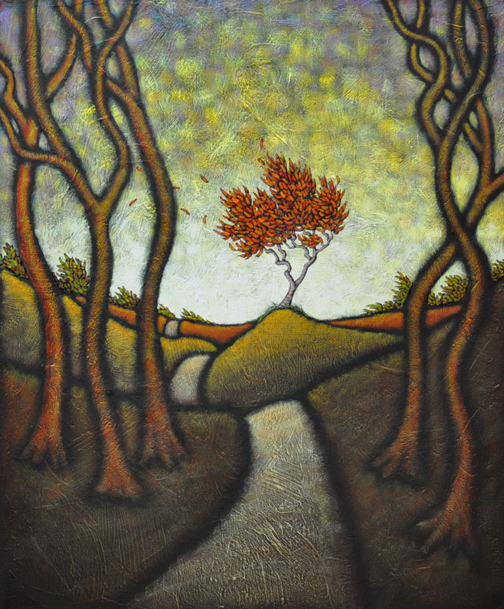
Out Into the Wide WorldThis is a new painting titled Out Into the Wide World.  It’s painted in the same manner as my Red Roof series, in a style that I call  obsessionism.

This piece uses some familiar icons that appear frequently in my work.  There is the path that winds through the scene and there is the ever present red tree, this time being wind blown.  The tree is often placed on a small mound that  lifts it above the surrounding landscape, giving it a sense of importance in this context.

In this particular painting, I see the red tree as a guide or mentor, indicating here that one must follow the path that lays before them and must get past the trees in the foreground which might obstruct the view ahead. I suppose this is really about keeping one’s focus on the bigger picture and not getting caught up in the smallness and pettiness of things which might prevent one from moving on in their path to growth.

Now, this is only an interpretation made after the fact of the actual painting.  I never intend such meaning or message beforehand and am never sure what will emerge.  Generally, when a painting succeeds visually it is fairly easy to read meaning into it.  The elements that create an effective painting for me- depth, texture, contrast, mood- are the very things that create thoughtful evaluation.  For me.

For others, it may (or may not) be just a pleasant  little picture and nothing more. And that is fine and equally correct.  That is the subjectiveness and beauty of art.

Read Full Post »

Bob GibsonIt’s that time of the year.

Catchers and pitchers are reporting to spring training.  Baseball is in the air.

Baseball has always held a special place for me.  Oh, I was no more than an average player– decent bat, lousy arm and a so-so glove– but there was pure magic in seeing the heroes of my youth and hearing the stories of the early legends of the game.

I remember my grandmother telling me of going to NY in 1921 on their honeymoon to see Babe Ruth play.  Ruth hit a double and a triple as she recalled.

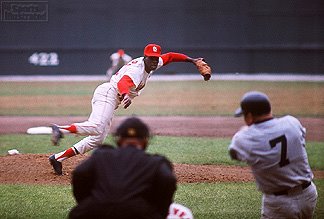
I remember sitting with my grandfather, the mythological Shank ,who used to call me  “The Rat,” and watching the  World Series in the afternoons after I had my tonsils out in 1968.  The St. Louis Cardinals were playing the Detroit Tigers and I was introduced to one of the heroes of my youth, Bob Gibson.

Gibby was it for me.  The toughest guy out there, one whose competitive fire is still legendary.   So dominating as a pitcher that baseball changed the mound height because they felt the hitters needed help since he was practically unhittable.  I read his early autobiography, From Ghetto to Glory, numerous times and that made him an even bigger hero to me.  He was eloquent and college-educated, a rarity for ballplayers of that era, and his story was compelling.  He remains a hero.

Baseball was always played at our house.  My dad was a pretty fair pitcher.  He would play catch with me and my friends and would break out his knuckleball.  It was uncatchable, having a spectacular drop that would appear to be entering your glove only to end up hitting you in the stomach.  I was never able to master the pitch but still appreciate a well thrown knuckler.

Other times, I would pitch to him and he would hit flies to my brother in the outfield.  Periodically, he would hit hard liners back at me.  They would bang off me or make me dive out of the way and he would cackle.  I would then try to drill him with the next pitch, which would make him laugh even more because he had gotten my goat.  I would calm myself and wait until he would pitch to me, waiting for the perfect pitch when I could send one back at him, making him duck or dive.

Over the years baseball has become my calendar for the passing of the year and is a comforting friend on the days when the world seems ready to implode.  I am still captive to the numbers and legends of baseball, one of those romantics who see poetry in a game based in tradition.

To that end, here is a wonderful version of Take Me Out to the Ballpark from Harpo Marx, played on I Love Lucy. It is delicate and graceful.  It’s the essence of the memory of baseball for me…

Read Full Post »

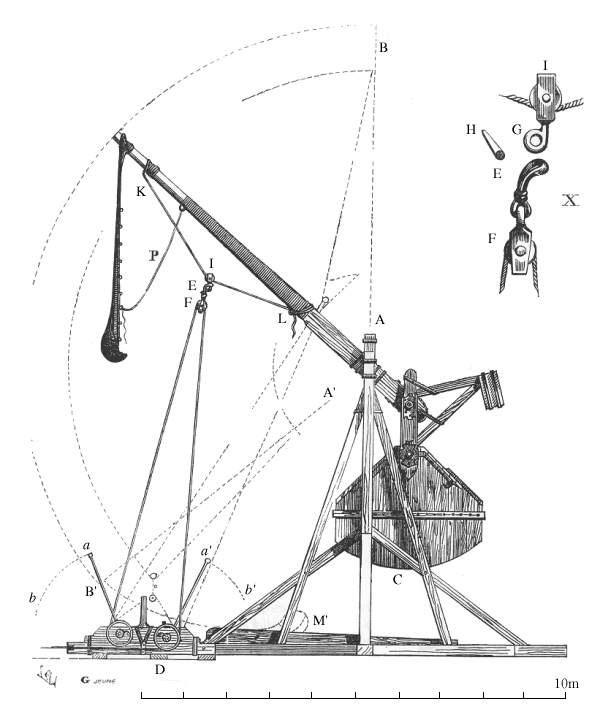
trebuchet2A number of years back, there was an episode of the quirky television show Northern Exposure, which was set in a small Alaskan town, that involved the town’s philosopher-artist-DJ, Chris, building a trebuchet, shown here on the left.  A trebuchet is  a medieval war machine, a type of advanced catapult that flings objects great distances.  In the show Chris used it to fling an old piano, the old upright flying in a perfect  slow-motion arc through a blue sky and crashing to the earth in a pile.

Every time I see this episode I am moved by an odd, primal thrill in seeing the arc of the piano’s flight and am reminded  of how this has always excited something I can’t explain in myself.

As a kid watching Fran Tarkenton and Joe Namath (New York teams on our local channels) throwing long bombs brought the same pleasure as the spirals seemed to defy time and space as they hurtled through the cold, autumn skies.  

In baseball, there is nothing more exciting to me than the right-fielder throwing out a runner at the plate or third base.  I still am thrilled by memories of throws from Dwight Evans of the Red Sox and Ichiro Suzuki of the Mariners that are delivered with arcs of such power and sheer grace.

Then there is the beauty of the towering arc of a home run.  I recently saw a replay of Josh Hamilton’s amazing performance at last year’s All-Star game.  One after another, huge shots rained out of Yankee Stadium.  Majestic is the only word that comes to mind.

Personally, I remember being at a friend’s house in high school with a group of buddies,  having blown off classes, drinking beers and just being delinquents.  We were in the back yard of this house which was in a small development.  One kid picked up a large stone and heaved it sky-ward.  It left his hand as we watched and went into the sky in a perfect arc, tumbling in a beautiful, smooth rotation.  It seemed to slow time itself and finally began to descend to earth, crashing finally through the window of the neighbor’s garden shed.

I did say we were delinquents, didn’t I?

But that moment is etched in my mind.  I have friend who was there that I occasionally see whose eyes become wide when I mention the arc of that rock.  He remembers it as one of the amazing things he’s ever experienced, a transcendent event.

Maybe there’s something sad in that but to me it attests to our reaction to the arc.  I wish I could scientifically explain how our brain recognizes and processes the beauty of the arc but I can’t.  I only know that when I see its natural curvature that I am seeing a type of rightness, that quality I often struggle to describe for the lines and curves in my work.  

If I can capture that natural grace, I will be a happy man…

Read Full Post »

OmegaI was listening to some music yesterday and, coming across some stuff from the late  Townes Van Zandt  that I hadn’t heard in a bit was reminded of a documentary that my nephew, Jeremy, passed on to me a few years back.  It’s called Heartworn Highways and is from around 1975, chronicling some of the singer-songwriters who came to be known as alt-country.  

It’s pretty gritty.  These guys are shown completely unvarnished and it is the antidote to the packaged, slickly produced  music that pervades the airwaves today.  There is the first recorded version of Mercenary Song from a very young and greasy looking Steve Earle and good versions of  L.A. Freeway  and Desperados Waiting For a Train from Guy Clark but the parts that stand out for me are those with Townes Van Zandt.

This is Waitin’ Around to Die and has an interesting intro that really sets up the tune well.  It’s a pretty powerful song.  Enjoy…

Read Full Post »

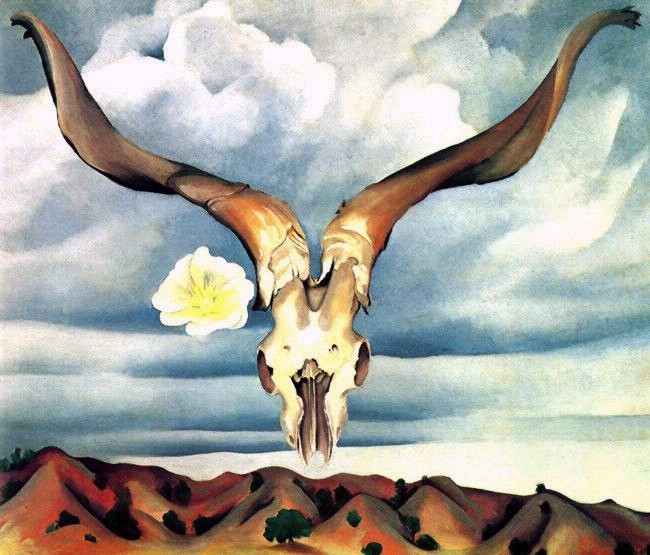
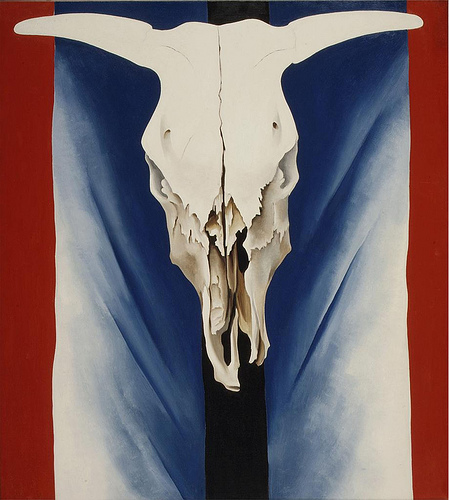
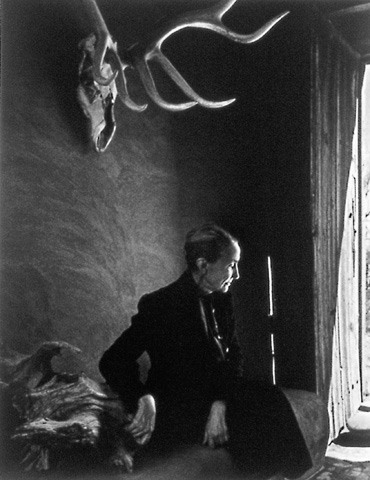
Georgia O'Keefe Ram's HeadOne of the first painters to really draw me into their work was Georgia O’Keefe.  Her colors were vibrant and crisp.  Her use of organic forms and the beauty of the curves and arcs she employed was impeccable.  Her compositions were unique and out of the box, often bisecting the picture frame in an unorthodox manner.okeefe-cow-skull

Here images were very iconographic– cow skulls, driftwood, poppies that filled the picture frame in an abstract fashion and on and on.  Her paintings were not narratives nor  were they snapshots of a particular  time.  There was an ethereal, timeless quality that makes them always feel contemporary, fresh and vital

There was also the sense of stillness and spirit that I now hope for in my own work.  Again, there is a timelessness in the work that goes beyond the moment when she created the piece.

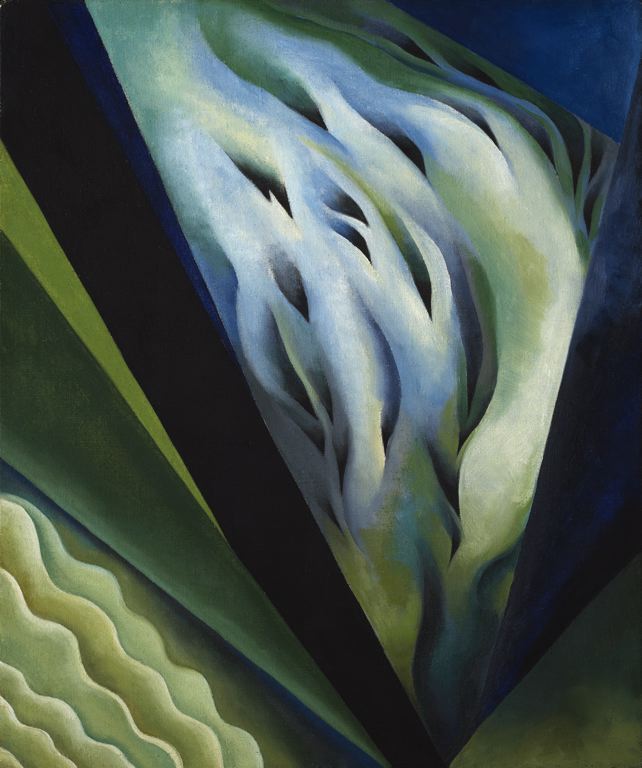
okeefe-blue-green-musicI was also drawn to the different styles of her work- her modernist cityscapes, her abstract paintings of flowing color and form and her floral.  Her hand was always obvious in the work.   Every piece in every style has a sense of being in the present. 

There are so many elements in her work that I have absorbed over the years and incorporated in my own work that I could never fully express the appreciation and gratitude I have  for her career.

As much as I have always been drawn to her work and affected by it, there is one drawback that I first discovered a number of years ago.  I had discovered her work in books and prints, never seeing them in person.  When I first saw a show of her work, while being stunned to see the imagery up close, I was less than excited by the surfaces of her paintings.  There was a great deal of flatness and they lacked the visual oomph of the printed page.  The surfaces had no excitement of their own.okeeffe-music-pink-and-blue-ii-1919

I realize this is my own subjective feeling on the work and that many great paintings have this same lack of surface excitement.  For example, I feel the same way about the work of Joan Miro even though I am  knocked out and excited by his work.  This feeling of mine does not in amy way take away from the greatness of the work.  I just realized that while I wanted to create the same type of graphic excitement of these artists, I also wanted to create something that  had a tactile, textural effect when seen up close and in person.  To that end, I think  my work always shows better in person than in print or on a computer screen.okeefe-karsh-photo

But that doesn’t really matter today.  I just want to show the icons and forms of Georgia O’Keefe and hopefully it will spark something in someone else and they will create their own forms, their own vocabulary of imagery.  

Their own world…

Read Full Post »

Bang Your Drum

Bang Your DrumThis is another piece from my early Exiles series, titled Bang Your Drum.  This is a later piece, finished in late 1996.  

Initially, I was a bit more ambivalent about this painting compared to the feeling I had for the other pieces of the Exiles series.  It exuded a different vibe.  For me, the fact that the drummer is marching signifies a move away from the pain and loss of the other Exiles pieces.  There is still solemnity but he is moving ahead to the future, away from the past.

Over the years, this piece has grown on me and I relate very strongly to the symbolism of the act of beating one’s own drum, something that is a very large part of promoting your work as an artist.  For me and most artists, it is a very difficult aspect of the job, one that is the polar opposite to the traits that led many of us to art.  Many are introverted observers of the world, passively taking in the world as it races by as they quietly watch from a distance.  To have to suddenly be the the motor to propel your work outward is an awkward step for many, myself included.  Even this blog, which is a vehicle for informing the public about my ongoing work and remains very useful to me as a therapeutic tool for organizing  my thoughts , is often a tortuous chore, one that I sometimes agonize and fret over.  Even though my work is a public display of my personal feelings, this is different.  More obvious and out in the open.

There’s always the fear that I will expose myself to be less than my work.  The fear that people will suddenly discover the myriad weaknesses in my character that may not show in my paintings, forever altering their view of it.  The fear that I will be  revealed to be, as they say, a mile wide and an inch deep.  

But here I stand with my drumstick in hand, hoping to overcome these fears and trusting that people will look beyond my obvious flaws when they view my work.  Maybe they too have the same fears and that is the commonality they see and connect with in the work.  Whatever the case, there is something in the work that makes me believe that I must fight past these fears and move it forward, out into the world.

What that is, as I’ve said before, I just don’t know.  Can’t think about it now– I’ve got a drum to pound…


Read Full Post »

60-MPH View

Above the BabbleThere are times when ideas for a piece come from seeing something once or twice and taking what you remember of it and using that in your work.

For example, a number of years ago I remember driving through the Poconos on the way to NYC.  As I drove down a hill, I glimpsed to my right a group of trees, maybe an orchard.  It was early morning and the sun was low behind them, casting long individual shadows in the damp, long grass.   The whole scene was taken in in the blink of an eye.

I call that the 60-MPH view.  Actually, it’s closer to 75 MPH but who’s really keeping track?

From this split-second glance I returned to the studio a few days later and took the elements of that scene that remained in memory and created several versions of that scene.  They were vibrant and alive.  It was as the speed of the glimpse took away interfering details and distilled the remaining elements into something stronger.

The painting above, Above the Babble, is another kind of this taking in quickly and using the elements from memory.  My sister had a small print that has hung for many years in her home.  I always would notice the print when I visited but didn’t spend much time in front of it.  One day in the studio the composition of that piece, as I remembered it, came to mind.  This was the result along with several subsequent versions over the years.  None of them really look like the print in any specific detail but for me they echo the rhythm and feel of the inspiring piece.

I try to use this viewing process  when I look at other artists’ works as well, taking in the work quickly then trying to remember what I saw.  This forces the strengths, as I see them, forward and they remain in my memory.  This allows me to find things in work that is very unlike mine that I ultimately use in my own work.  A form of synthesis, I suppose….

Read Full Post »

« Newer Posts - Older Posts »