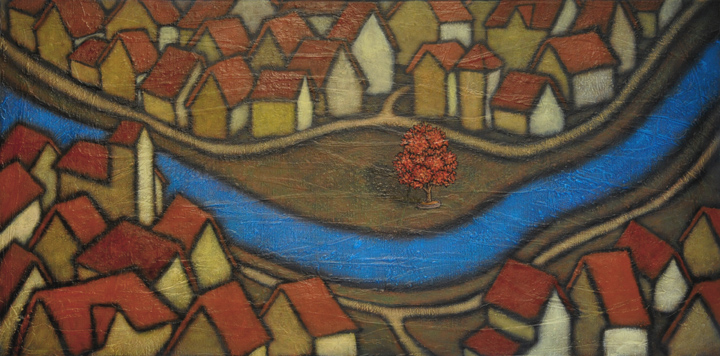
 This is a new piece I’m working on that I’m calling Just the Other Side of Blue. It’s on canvas and is 18″ high by 36″ wide. This is not the final photography so I apologize for some glare spots and a little darkness in some areas.
This is painted in my obsessionist or additive style where paint is built up rather than taken away as I do in much if not most of my work. It has an overall darker feel than most of my work, probably due to the lack of transparency as well as the black underpaint.
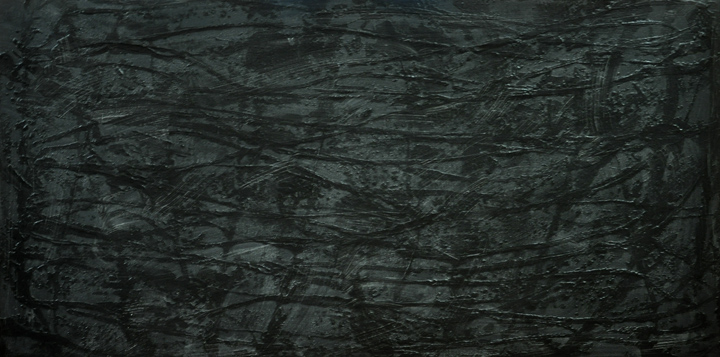 I start a piece with a blank canvas and add layers of gesso to create a distinct texture. If I were going to paint in my fluid, transparent style I would begin painting at this point but since I am planning to paint in the additive style I add a layer of black paint.
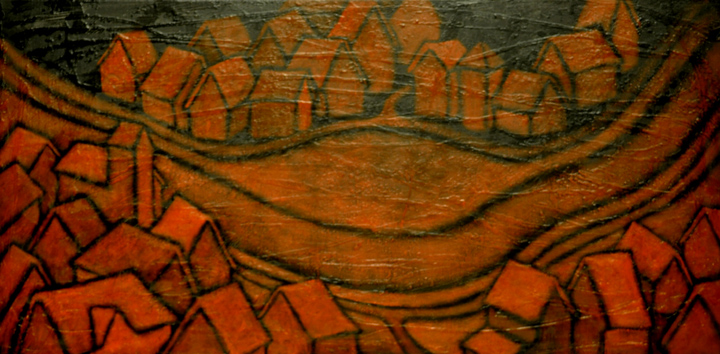 I next start blocking in with red oxide paint, a color that I choose because I like the warmth it adds underneath. I usually start in one of the bottom corners and just start building, letting my eye guide me. In this case, I started at the bottom left and reached a point where I felt there needed to be a change and began to realize that I wanted a canal or river cutting across the entire width of the painting. I wanted that slash of color separating the two sides of the town. The little piece of ground with no buildings was left and I began to think on how I would later incorporate that into the composition.
 I finish blocking in the rest of the village then start to shade the buildings, starting with shades of yellow building up to the whites. The roofs are done in reds with some left in red oxide, just deepened a bit in shade. There’s a lot of time spent stepping away from the easel and just looking, trying to see where the focus of the piece should fall and how the colors of the buildings and roofs should play off that.
 After this preliminary blocking in is done, I decide to add color to the canal. I choose a bright, vibrant blue. I don’t really care if there is any basis in reality for the color choice. I’m going with this color because of its visual impact in the piece while still maintaining a certain harmony within it. The painting begins to take on a life for me at this point and I realize that there is need for a central figure here. I’ve left a hole that needs to be addressed, namely the park-like blank piece of ground.
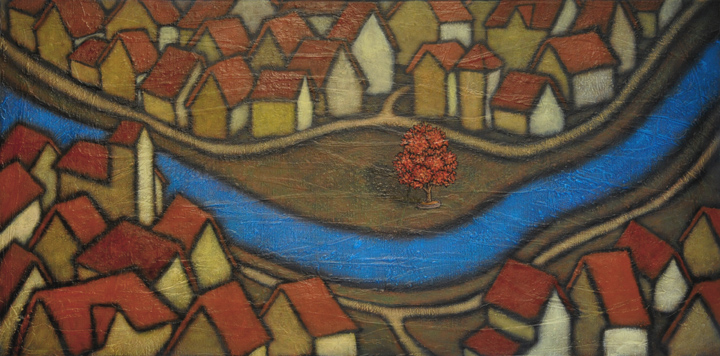 I decide to go with the Red Tree and paint it into place. But there is something else needed to balance it as it sits. I decide that it needs a shadow, to give it depth and weight, atmosphere. Like matching colors to reality, I normally don’t concern myself with naturalistic shadowing unless it adds to the impact of a composition, which I think it does in this case. For me , the entire piece is transformed with the simple addition of a shadow beneath the tree.
So, this is where it sits for the time being. I will study it more, probably add color here and there, enhance certain parts in small ways until it feels fully alive. But it feels close now and I find myself sneaking peeks at it quite often. I will post a final photo of it when I feel it has reached its endpoint.
 Redtree Times
Thanks for taking the time to document and share the insights into your process, Gary. Good stuff.
Thanks, Mark. I know I left out a lot of steps and probably could’ve included more on the thought process but I wanted to at least show some of the steps. In future posts I will do more WIP’s with a little more detail.
Sup G,
Like the Canal, I’ve thought about your lines before, how do you create the soft edges, They look dry brushed or scrubbed on with a worn brush.
Tex is the man!
Just wondering,
bh
Mr. Hart– The lines are actually just what is left of the underpainting after I paint the upper layers. Much of the paint is applied pretty much in a dry brush manner with worn brushes.
And yes, Tex is the man.