Feeds:
Posts
Comments

Archive for March, 2010

I  have many guilty pleasures, things that I enjoy but am hesitant to admit to others for various reasons.  I don’t know if the television series Breaking Bad , which starts it’s third season tonight on AMC, qualifies if only for the fact that the word pleasure doesn’t seem to fit the viewing experience.

Unsettling.  Disturbing.  These words seemed like a better fit.  And fascinating, always fascinating, despite the uneasy hellscape in which you find yourself immersed.

For those unfamiliar, Breaking Bad is the story of Walter White, a struggling high school chemistry teacher in New Mexico who discovers that he has malignant cancer and in order to provide for his family, which includes a baby and a teenage son with cerebral palsy, turns his chemistry knowledge towards the production of crystal meth.  It’s basically the story of a good person who makes the decision to compromise his beliefs for what he views as good reason and must deal with the transformations and unintended consequences of that decision.

And there are transformations.  And consequences.

I think that’s the appeal of the show.  It’s about a seemingly normal person with good intentions that we can all identify with in some way.  He could easily be someone we know, someone we nod to on the street or chat with at the supermarket.  But his initial bad decision has placed him a labyrinth where every subsequent decision sends him in veering directions that take him further and further from his intended destination.  It’s something that many people who’ve made drastically wrong choices in their lives often encounter although most will never encounter the often horrifying circumstances that accompany Walt’s oddyssey.  When you see where Walt finds himself, you look at your own life and breath a sigh of relief.

And maybe that’s the attraction.

Read Full Post »

The Arrival

Maybe it’s the coming of spring and the later daybreaks caused by our recent shift in the clocks that remind me of how the first light of each day holds so much promise and potential.  Maybe that’s why I’m calling this smaller new painting  The Arrival.  It’s a 9″ by 12″ canvas and is a continuation of my Red Roof series.

I’ve always been enticed about the promise of potential in many things and often find myself wondering why we so often fail to take full advantage of the opportunities that sometimes rise before us.  How many of us have failed to follow their desires, choosing security first?  This always comes to mind when I spend some time doing the genealogy of my family.

So often these people, unheard names from distant times and places who become my family with the turn of a page, packed up and headed for a new horizon, leaving behind the security of  home and family.  Some sought freedoms.  Some sought wealth.  Some, just an opportunity. 

I’m not sure how many of them felt they ever captured the potential of their new land’s potential but that may not be the point.  Perhaps it is in just seeing the potential and following it that matters.

And that’s kind of what I see in this small piece.  While others sleep in their secure homes, the seeker is awake and awaiting the potential of the new day.  The new opportunity’s arrival.

Read Full Post »

Today is the beginning of March Madness, the annual tournament to determine college basketball’s national champion.  The first two days are wall to wall games, 16 each day.  It’s a virtual all-you-can-eat buffet for any college hoop fan.

I’ve followed the Syracuse Orangemen since I was a kid and still get giddy at this point in the season when they play in the tournament.  It has more often than not ended in disappointment and frustration but  the several times when they’ve moved deep into the tournament have been worth the pain of the imminent defeat.

I guess that’s the beauty of the college game, the excitement of a new and changed team with new players every year.  Experiencing how they evolve and grow ( or falter and come apart) as the season progresses.  Like many things, it often comes down to establishing a rhythm and making every part move together in an intuitve way.  When these teams gel and become a cohesive unit, it’s an exciting thing to see.  When they don’t, you simply say, “Wait ’til next year…”

Hopefully, one of these cohesive units will be Syracuse.   Go, Orange.

Read Full Post »

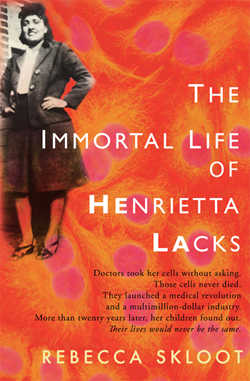
Today is  St. Patrick’s Day and I was going to write about the day and how it was my late mother’s birthday.   She would have been 78 today.  But today I’m interested in a story in the news as of late brought about by the recent publication of a book by Rebecca Skloot, The Immortal Life of Henrietta Lacks.

It tells the story of the amazing cells of Henrietta Lacks that survive to this day, almost 59 years after death.  You see, Henrietta was a poor African-American woman living in the Baltimore area in 1951.  She was 31 years old when she was diagnosed with cervical cancer and her treating physician took a sample of her cancer cells without her knowing, which was common at the time.  Later that year, Henrietta succumbed to the cancer and died.

In most cases, the life of a 31 year old poor black woman who died so long ago might only be remembered by a very small group of family and friends, and even then, only fleetingly.  But Henrietta’s name is very much alive today. 

Her name and her cells.

You see, the cells taken from other humans have been found to have  short lifespans outside the body,  usually days.  But not Henrietta’s.  Hers were unlike all others and continued to live.  And live and live and live. This was a boon for medical research.  Her cells , now called HeLa Cells, were used by Jonas Salk in developing the polio vaccine and in the years since have been part of almost all new vaccines and medical developments.  Her cells continue to grow and have become a factory of sorts as there are companies that mass produce her cells for use in medical research. 

 In fact, over 50 million metric tons of her cells have grown in those decades.  To put  that into perspective, that would be enough to fill the space of the Empire State Building– 15 times.

There’s more to the story.  Her immediate family was not aware until 1976  that her cells were stll alive and being produced for sale and were, in fact, a multi-billion dollar business.  They have never seen a penny and are ironically without health insurance and in need of  treatments that have been developed with Henrietta’s cells.

I don’t want to get into a rant over the ethics of big business and healthcare but it brings to light a question of what constitutes life and ownership of our own cells outside our body.  I don’t really know where I stand on the subject.  I would like to think that those cells are indeed a part of Henrietta Lacks and that her life continues in them.  It would be a lovely concept to think of her cells forming an immortality that extends beyond the memory of a small group of family.  That the spirit her family saw in her lives on.

Is it so?  I certainly don’t know.  It would be nice if her family could see even a token gesture from the companies that have been built on the legacy of her cells.  Then maybe her cells could live on in other ways as well.

Happy Birthday, Mom.

Read Full Post »

This is a new painting, a 16″ by 2o” canvas.  It has a darker feeling than a lot of the recent work and has a much more ominous tone.  I think a lot of that comes from the chaotic nature of the sky and the darkness that rises up from between the field rows.

What’s this painting about?  I don’t know actually.  Like most of the work I do, there’s not a lot of predetermination in the way I paint so sometimes my paintings probably reflect my mood or state of mind from the particular time frame in which a piece is painted.  I guess I was a bit more worried than usual when I was painting this.

Or maybe this piece just worried me a little.  The chicken and the egg thing.

I often wonder if a piece reflects how I’m feeling at the moment of painting or has more effect on me after it’s done.  Maybe they’re the same thing and it’s just a matter of recognition.

I don’t really know.  I just paint.

This painting is still untitled.  I’m still trying to gauge what I see and feel in it so a title is still sort of nebulous for me.  If you have any suggestions, I’d like to hear them.  I may have another contest like the one I held last year to name a painting so use this as a warm-up, okay?

Read Full Post »

I’ve been exhibiting at the West End Gallery for over 15 years now and have benefitted in many ways. It was the first place I showed and sold my first piece of work. It was the first place my work was showcased. It was the place that first gave me hope of doing what I love as a career and has served as a jumping off point to other galleries.  So many other things as well. But perhaps the greatest benefit may have been what I have gained from observing the work of the other artists there over the years.

I’ve talked here and in my own blog of how artists from the Corning area such as Mark Reep, Marty Poole and Dave Higgins,  have shaped how I work and how I see my own work. Another such artist is Treacy Ziegler who has shown her collagraphs and, more recently, her paintings at the West End for many years now.

From the moment I saw Treacy’s work many years ago, I was intrigued. I instantly recognized that she was doing with her work what I wanted and didn’t have in my work at the time. Her prints had great areas of dark and light contrast and even in the lightest sections, a sense of darkness was always present which gave every piece real weight. Her bold colors and striking contrasts gave even the simplest compositions a deeper feeling.

They were also immediately identifiable as Treacy’s work. You could see a piece from across the street and you knew whose work it was. She has a very idiosyncratic visual vocabulary and her shapes and forms react beautifully with one another in the techniques she uses in producing her work.

At the time, my own work was still very transparent and very much watercolor based. With Treacy’s work in mind I started adding layers of darkness in my own way. Simplifying form. Enhancing contrast and color. All the time searching for my own vocabulary, my own look.

I’ve always maintained that artists are often more like synthesizers than creators. They absorb multiple influences and take what they see in these influences, merging them together to create something that is completely different than the original. Sometimes not even reminiscent of the influencing work.  For me, the West End has always been a great source for ideas and concepts to absorb. It may be in a certain brushstroke or the way a painting’s composition comes together or just in being exposed to a certain artist’s body of work for a long period of time. Whatever the case, I always find something in the work there that sparks new ideas within me.

And that has been a great benefit…

Read Full Post »

HBO starts a new series tonight that I’ve been anticipating for a while now.  The Pacific is a 10-part series that follows the path of several soldiers as they fight in the Pacific theatre of World War II

It’s in the same vein as Band of Brothers, which  was set in WW II Europe, and set the standard for films of the sort with it’s fast paced action and dynamic camera work that gave one a true sense of the danger and the brutal reality of the situation.  The Pacific is produced by Steven Spielberg and Tom Hanks who also produced Band of Brothers.  They wanted to honor the soldiers who fought in the Pacific by giving their stories the same careful treatment in the telling that they did with Band of Brothers.

I doubt that anyone will be greatly disappointed. 

When I saw the image above I was instantly hit with the feeling that one gets from looking at one of the nightmare landscapes of Hieronymous Bosch which I suppose is only fitting.  I can’t fully imagine what it must have taken to persevere through the extreme hardships of the  campaigns on those islands.   It must have literally felt like hell on earth , a neverending carousel of horror and terror.  Those who survived deserve every honor they received and more.

They certainly have my respect…

Read Full Post »

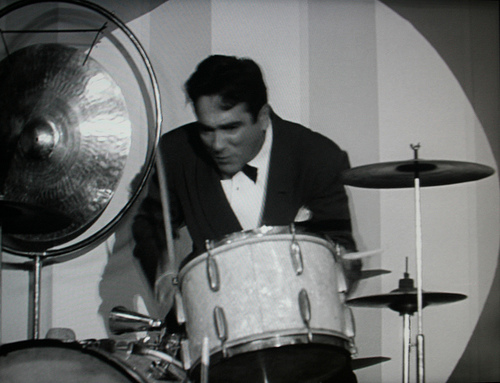
I was painting in the studio yesterday and I threw on a movie that I hadn’t seen in years, Ball of Fire starring Gary Cooper and Barbara Stanwyck.  It’s a great comedy from1941, written by Billy Wilder and featuring some of the great character actors of the time.

I only mention  this because there’s a great scene of Stanwyck performing as a nightclub singer with Gene Krupa, the legendary drummer , and his band.  They perform Drum Boogie and if you ever doubted that your parents or grandparents knew how to rock, this will put those doubts to rest.

Try to stay with it to the end.  Krupa does a part where he changes Drum Boogie to Matchbox Boogie and plays the song with wooden matches as his sticks.  There’s a lesson in there for artists about the power of contrasts.

Good stuff…

Read Full Post »

Signs of Spring

Whenever I have been outside over the last several days, my ears are filled with the sounds of spring.  Our small creek is roaring with the sound of the snow from the forest melting and running off.  The smalll birds are twittering and tweeting all through the woods and from above, the constant honk of Canadian geese moving northward.  Huge flocks with hundreds of geese soar high overhead in flying vees, one after another.  It seems as though on some days there is hardly a break in their migration.

This year, for the first time, we have seen very large groups of the beautiful white snow geese fly over.  I’m sure they must have went over in the past but somehow over the years they have eluded our sight.  It was stunning to see a recent group that flew over at a very low altitude.  It was a very large flock and their braying honks filled the air.  As they passed the sun perfectly lit their wide white wings,  giving them a glow and showing the black tips in stark contrast.

Just beautiful.

They’re a pretty amazing bird.  We’ve been fortunate a few times to have a family reside for the summer on our pond.  Although I could do without the incredible amount of crap they produce, they are great to observe.  They are exemplary parents, keenly observant of every move of their offspring and everything anywhere near their location.  They keep the young in line with scolding honks and as the summer progresses they make the pond a clasroom as they teach each gosling the proper way to take to flight from the water.  When all have learned and have made several short flights, they begin to think about joining the larger flock that gathers a mile or so away at a larger lake and soon they are gone for the year. 

Heading further south for open waters to spend their winter.

And the cycle continues and once again they are honking overhead.

Read Full Post »

There’s an old piece of film that I have often seen in snippets, usually in a montage about the earliest days of film in the late 1890’s.  It’s a short film of a dancer with swathes of fabric twirling, very modern dance-ish in style, and as she spins the fabric changes color.  It’s a pretty mesmerizing piece of fim, even more so given the infancy of the medium of the time.

Doing a little research I found that this was filmed by the French film pioneers, the Lumiere Brothers, in 1896.  Each film cell is handpainted to achieve the color effects.  The dancer in the film is Loie Fuller, an American-born pioneer of modern dance who was the toast of Paris in the 1890’s, starring often at the Folies-Bergere

I find this film quite enchanting which is pretty amazing considering how many different  moving images, how much computer generated animation and other advances in film-making I, like most people, have witnessed in this time, over 110 years in the future.  Can you imagine how mind-blowing this must have seemed to the average person of the day?

This point is well illustrated in the movie, The Magic Box, a 1951 film in which Robert Donat portrayed British inventor, William Friese-Greene, who had invented and patented the motion picture camera a year before Edison but never received any credit and died in virtual anonymity.  In the film, when he finally is able to fully demonstrate the motion picture with his invention he is alone in his lab, late at night.  He is frantic with excitement and runs out into the London streets to let the world know of his triumph.  The only person he encounters is a London police officer, played by Laurence Olivier.  The bobby suspiciously goes along with Friese-Greene thinking he has a psychotic on his hands.  He hesitantly agrees to look at Friese-Greene’s demonstration and when the film rolls and the images of the London citizens strolling in Hyde Park appear, he is frozen with amazement.  It is as though he is looking on a true miracle.  And perhaps he was– the miracle of invention.

Anyway, take a look to see a beginning point and realize how far we have come…

Read Full Post »

« Newer Posts - Older Posts »