Feeds:
Posts
Comments

Archive for September, 2010

Explorer

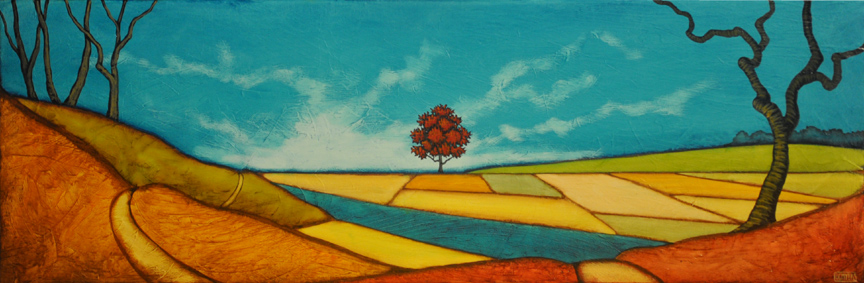
Well, off on one of my drive-fests, first to Asheville then to Alexandria then home, all within 48 hours. Just the way I like it.

This is a painting that is going to the Haen Gallery in Asheville.  Titled Explorer, it’s a 30″ by 40″ canvas that I’ve been very proud of as it sat waiting in the studio.  It is a piece that, if I had to sum up in one painting what my work has been to this point, would fit the bill nicely.  It has a real feeling of completeness, of being a fully mature and realized piece, as though it exists in only that moment without any thought or deference to the past or future.

I think that might be what I’m looking for in my work-  a self-contained world in its own present time and place, separate  from the world we know.  It’s own sense of landscape, of light and color– all familiar yet apart.  But welcoming.

I could go on wading in esoterica but I’ll spare you that. Let’s just say that it’s a piece that really hits for me. 

Anyway, time to hit the road.  If you’re in the Alexandria area tomorrow, Saturday, stop into the Principle Gallery for my gallery talk or just to say “Hi!” 

 Hope to see you there.

Read Full Post »

Bounty

This is a new painting that is going with me down to the Principle Gallery.  It’s a 10″ by 30″ canvas that  I call Bounty.  I chose the title because there is an idealized feel to the painting, not necessarily a representation of  how things are but how they might be, in a land that is rich in everything but greed.  It feels like a meditation on sharing the richness of the land with everyone. 

 Call it an egalitarian daydream.

Egalitarian.  It’s a word that has been in my mind lately.   It’s not a popular word or concept these days, oddly enough.  The word has evolved to a point where people think of it as another way of saying welfare state or that other dreaded word,socialism.  This is unfortunate because the idea of equality, a society without classes,  is such a beautiful concept and one that was one of the legs that our nation first stood on. 

 Of course, there was never such a place.  Not in post-Revolution America or France or Russia.  Aspirations, yes.  Practical application, no. 

Again, unfortunate.  But one can dream of such a place.  If it exists, I hope it feels like this…

Read Full Post »

It’s a busy day for me as I finish up a group of work before I head out on the road for a couple of days, going first to Asheville to drop off some new pieces at the Haen Gallery then on to Alexandria for a Gallery Talk at the Principle Gallery on Saturday.  I am finishing up framing  and there’s always a sense of urgency at this point.

So, here’s a little musical interlude.  It’s a song from April Smith called Terrible Things.  It first came to my attention as part of a promo for the TV show Weeds and it really caught my ear.  I came across this acoustic version that I like a lot.

It’s an interesting song.  Terrible things.  How many of us carry the weight of terrible things we’ve done behind our everyday appearance?  I know I’ve done things of which I’m not proud but I try to keep them buried and not dwell on them.  I want to be defined by the person I ultimately became, not the impetuous, naive youth I was.

Anyway, give a listen.

Read Full Post »

This is a new painting that I finished at the request of a collector in North Carolina.  It was an interesting request, one that piqued my imagination enough to accept the commission.  He wanted a very specific sized painting built on a hinged frame that would cover an unsightly circuit breaker box located in the middle of a wall in a well used room.

I found the idea that the painting would be part of a utilitarian object, something that had a real practical use,  intriguing.  But I didn’t want this purpose to outweigh the painting itself.  The painting had to be the dominant aspect of the whole, not a mere afterthought or pure decoration.

The client had specific requests that had to be addressed. First of all, it needed too be one size, which ended up being an 18″ wide by 42″ high canvas.  This size and proportion would dictate how the painting was composed.  He wanted it to be part of the Archaeology series as he had uncovered a number of old items in the ground around the old farmhouse he was renovating.  But he didn’t want to not have the below-the-surface area overwhelm the painting, desiring a smaller presence for the assorted items.  He liked my blue night skies and moons and red trees that were spindly like the pink mimosas in the yard of the old farmhouse.  The two red trees furthest away have touches of pink in them.

The part that I wrestled with the most was having a night skyline in the painting,  of which he had expressed an interest.  At first, I was hesitant as I had always seen the Archaeology pieces as being beyond the time of man, at a point when we’ve entered the realm of dinosaurs and exist only in the evidence we’ve left behind.  The idea of having evidence of man still existing rocked me at first but then I began to think that it might be interesting to see how it would play.  After all, we have certainly created a wealth of underground archaeology up to this point.  And maybe I was being a little too cynical in assuming that a time would come when we cease to walk the Earth.

After painting in the buildings, which vaguely represent the Asheville skyline especially with the far outline of the mountains behind, I was really pleased.  It gave me the feeling of two worlds, two histories, exisiting simultaneously, one above the ground and the other beneath it.  One history, the past, is already written and the other is being written in the present.  It really seemed to work,  filling out a new narrative and giving the piece a different depth.

I began to see that the painting had become one of my own paintings, beyond the desires of the collector, which was exactly what I wanted for it.  When people ask about commissions that is the point I try to get across– that I have to satisfy myself,  with the painting, have to feel that it has its own life,   before I would even consider showing it to them.  And this piece does just that.  It feels alive and vibrant to me.

Now it can move on to its new life.

Read Full Post »

Labor Day

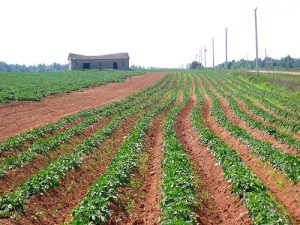
pei-potato-farmAnother Labor Day has come. Most folks have forgotten that this holiday was first celebrated back in 1894, signed in as a federal holiday as an effort to bring an air of reconciliation to the nation which had just endured the widespread and violent Pullman Strike. It is meant to honor the Labor Movement and the workers it represents.

For me, the day reminds me of the first time I worked outside of our home for someone else as a child, a memory that was recently reawakened at a wedding of an old friend near the fields where I first used my hands and back for labor. There was an old potato farmer on the road where I grew up and a friend of mine would periodically go down there and work, most of the time picking or bagging potatoes. One day he asked if I wanted to come along as the farmer was going to lay irrigation pipe that day and could use some extra help. Being eleven years old and wanting to make some extra cash and having no idea what I was getting myself into, I agreed.

It was hot and dusty work. The long pipes weren’t heavy but were awkward and each time they began to dip towards the ground as you carried them brought a gruff yell from the crusty old farmer, was not one to wear out his smile from use. He certainly did a lot of yelling and cursing at us that day.

We had just a short break to eat the sandwich each of us had brought with us and after about eight hours in the fields, I was exhausted and covered with alternating layers of sweat and gray, grimy dust. It was the first real day of work I had experienced. It had been a tough for an untested eleven year old but now I would be rewarded.

As my friend and I prepared to mount our bicycles and head tiredly home, the farmer stood before us in his dusty bib overalls, unsmiling, of course.

“Suppose you want to get paid?”

It came out of his mouth not so much like a question but more like a complaint. We silently nodded, eager in our anticipation of our sweet reward. He stuck his thick, strong farmer hand into a pocket and pulled out a handful of change. He counted out three dollars in quarters to each of us and said, “Okay?”

Again, not really a question. More of a dismissal, more like okay, we’re done here, now go.

We were just kids but we knew we had been taken advantage of that day. But we were eleven years old and afraid to death to talk back to the surly old man, to say that this was unfair. We never worked another day for him and I found out later that this was his modus operandi, working the hell out of kids then underpaying them. If they didn’t come back, so what? There were always kids looking  to make some money.

It was a small incident but it shaped how I viewed labor and the way many people are exploited. It was a clear object lesson, in microcosm, on the value of the labor movement in this country as a unifying force for those of us most susceptible to being exploited.

The labor movement is underappreciated now. Our memories are short and we lose sight of the abuse and exploitation of workers that have taken place over the ages. We take for granted many of the rights, rules and protections in the workplace, thinking they have always been in place. But they are there only because people in the labor movement stood up against this exploitation and abuse. These folks willing to stand against injustice deserve our gratitude on this day. We could use a hell of a lot more of them now.

So, as you spend your holiday in a hopefully happy and relaxing manner, remember those who made this day possible. Happy Labor Day.

Read Full Post »

In a recent post on WestEndTalk, the blog of the West End Gallery, artist Jeff Perrault wrote about how a piece of art is best seen when viewed under the proper conditions and the proper setting– framing was the point of his article.  Without the correct frame, a fine piece of work can sometimes be overlooked.

He cited a social experiment done by a Washington Post reporter, Gene Weingarten, back in 2007, one that I had missed.  In the experiment, one of the great violinists of our time, Joshua Bell, showed up on the Metro platform at L’Enfant Plaza in Washington.  He was as shown in the photo here, in a long-sleeve T-shirt and a baseball cap.  Nothing denoting his stature as a musician.  Well, maybe the $3.5 million Stradavarius he was playing was a giveaway but who among us would have noticed?  I mean, jeesh, the thing doesn’t even have a decal on it.

So there he was with his violin case on the floor in front of him, open and waiting for the money to start pouring in.  He started playing selections of Bach.  Part of the experiment involved him playing music that was extremely difficult, to show his virtuosity to the crowds.  For 45 minutes, he played  and at no point did he attract anything close to a crowd.  The busy commuters rushed by, coffees in hand and cellphones at their ears, never noticing the extraordinary talent on display for free, far less than the $100 tickets often charged for his normal shows.  Most people didn’t even glance his way, let alone stop.

It came down to context.  Many of those folks scurrying by could have and would have appreciated Bell’s music had they heard it in a setting in which they were expecting the performance.  It made me wonder about how many times I’ve passed by someting extraordinary simply because it was out of context, thus changing my perception of it. 

 I know this happens in a lot of cases.  One of my favorites spots in NYC is the lobby of one the Equitable Center’s building, the one on the Avenue of the Americas.  The three walls are filled with Thomas Hart Benton’s epic mural, America Today.  It is spectacular, a celebration of the breadth of American life filled with motion and magnificent color.  It never ceases to take my breath away.  Yet, day after day thousands and thousands of people passby outside those windows and through the lobby itself, many never giving it a look.

Context.

I want to try to look beyond context and just see things as they are but it is difficult in this busy world.  But I am going to try.

Read Full Post »

Delayed Satisfaction

This is a small painting, a 9″ by 12″ canvas, that I just finished.  If someone were to ask me how long it took to finish I would have to anwer that it took over a year.  Quite a long time for such a little piece.

Actually I finished most of it a little over a year ago and found myself kind of painted into a corner.  I like what I had painted thus far but the mound that dominated the center seemed too tall for the proportion of the whole painting and I just couldn’t see how it could be finished in a manner that would be satisfying.  So I hesitatingly put it aside.

For a year or so it has sat on a cabinet next to my painting table until this past week when I thought it had been there too long, just sitting in my line of sight whenever I turned.  It was a persistent reminder of a failed attempt and the time had come to end the nagging feeling it cast on me.  I would finish it and one way or another be done with it, satisfied or not.

So I painted in the tree and touched up the clouds a bit.  No expectation of anything.  Just get it done.

But to my surprise it worked.  The proportion seemed okay with the tree, much different than I had seen it in my head for the past year, and the painting seemed suddenly to pop.  There was a rush of satisfaction through me.  It was so much more than I had hoped, far exceeding the expectations that had diminished over the year.  I had only seen it with one result when it had a much better result hiding in plain sight.

Like many things, there are often results that can exceed our expectations if we just go ahead with our plans and finish them, not putting them aside before they reveal their true potential to us.

Read Full Post »

I Feel So Good

This album from guitar icon Richard Thompson, Rumor and Sigh, has been out for almost twenty years now and I still consider it one of my favorites.  I even like the folk-arty album cover.

I came across a video of the song I Feel So Good which was the closest thing to a popular hit from this allbum.  There are only a handful of production videos out there of Thompson so this was interesting to see.  It’s totally animated in much the same style as the cover of the album and moves well with the song, which is a gem itself.  It’s  about the elation of a man just released from prison, both joyous and dark in nature.

Take a look and a listen.

Read Full Post »

I’m busy at work, putting the final touches on several paintings that are strewn around the studio.  The final bits of color and detail don’t take a long time to put on the surface but the transformation to the painting is remarkable.  Sometimes it takes a piece that seems stagnant and lifeless to my eye, that seems to have lost direction, and suddenly imbues it with spirit, making it seem vibrant and alive before my eyes.

For me, it’s the most exciting time in the process and the one that most often baffles me, leaving me wondering how such a change occurred in just a few strokes of the brush.

This is a new piece that is an example.  As I worked on this piece, a 12″ x 24″ canvas, and let the composition come together, there were things I really liked about it.  The symetry was strong and obvious and the color was sharp and rich.  I could see where it was going but it seemed to be lacking.

I thought that perhaps adding the tree would do it but seeing the silhouette did nothing to animate the surface.  As I built up the layers of color, I still wasn’t feeling it.  Then as I put on the final touches that highlighted the edges of the foliage, there was a huge change in the painting.  Those final touches gave added depth and in this depth, the whole surface seemed to unite, coming together as one entity.  It became alive and vibrant.  

I sat at my work table with it before me and shook my head.  I’ve done this many, many times yet I am still amazed when I see this tranformation take place.  Even though it’s a small event late in the process, it is that moment that gives me the ultimate gratification in what I do.  I don’t know if my words can describe the feeling I’m trying to describe.  It seems like such a nebulous thing, like trying to describe something that you didn’t quite see and don’t really recognize to someone who didn’t see it at all.

Well, that’s what I do, I guess.

Read Full Post »

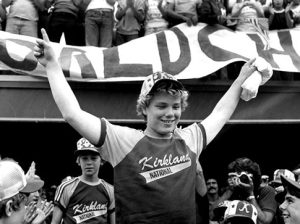
I watched a documentary last night on ESPN, Little Big Men, that tells the tale of the Little League team from Kirkland, Washington as it marched through the 1982 Little League World Series to face  and defeat the mighty Taiwanese team in the final game.  It was considered a huge upset at the time as Taiwan had thoroughly dominated the World Series for the past decade, winning 9 times out of 11 years.  The only time they didn’t win came in a loss to champion Japan one year and in 1975 when foreign teams were temporarily banned from competing.  Apparently, the Little League wasn’t quite committed to the term “world” in World Series in 1975. 

It’s a nice documentary of a group of kids accomplishing big things.  All of the team members carry great memories from their experience but the documentray is not just about the glory of the moment.  No, it’s concerned more with the aftermath and the treatment of one player, Cody Webster, by other parents.

Cody Webster was the big star of the 1982 Kirkland team.  He was a 5′ 7″, 174 pound 12 year-old who threw the baseball hard and hit it even harder.  In the final game, he baffled the Taiwan team with his fastballs and curves  and at the plate hit a tape-measure homerun that sealed their fate.  After he struck out the final Taiwanese batter, his teammates poured onto the mound and he carried his first baseman in one arm like a child.  He certainly seemed larger than life.

But he was simply a 12 year old kid who wanted to just be part of the team, not be the big star.  Even at the time, he expressed concern that his teammates weren’t getting the recognition they deserved, that there was too much focus on him. 

And there was focus on him.  Parades.  Rallies.  Television appearances.  It was pretty heady stuff for a shy 12 year old.

But the worse part came soon after.  His celebrity made him a huge target.  In the years after, as he competed in baseball, other teams wanted to beat the kid who won the World Series.  In their minds, to beat the champ made them the champ, which is all fine and good.  However, the parents of these other  teams took it to another level.  Cody Webster was swore at repeatedly and even spat on by opposing parents.  In the documentary, one of his teammates broke down in tears, recalling all the terrible taunts Cody had to endure as a kid but saying that he was glad that it was Cody, of all the team members, who had to take it because he was the only one of them who could have endured it.

And he did.  Thankfully, this is a cautionary tale that doesn’t have a tragic end.  Cody doesn’t end up dead or living in a cardboard box.  He did give up baseball several times in this teens until throwing it in for good as a college freshman.  As he said, he was a good baseball player at 12 but not at 17.  The fun had left the game with every curse hurled at him as a 12 and 13 year old until the joy that was so apparent in the team’s victory seemed like ancient history. 

But he did endure.  And as he says, it’s okay.  He coaches and instructs elite players in the Seattle area now and I’m sure he has a lot to pass on about handling the pressures put on these kids by parents with grand expectations.  Adults who take the joy out of a little boy’s game.

Read Full Post »

« Newer Posts