 I received a comment on yesterday’s post about the Victorian era stereopticon plates that mentioned the year 6513 that was in one of the photos, New Years Day in Hell, from the Les Diableries series that I was highlighting. He thought the significance of the date was in indicating a very distant date that suggested eternity. Sounded good to me.
But I began to think and was wondering if this date had to do with some prophecy, some Mayan calendar or Nostradamus thing. After all, if the Mayan calendar ends on December 21, 2012 ( when doomsayers predict an end to our time on Earth), New Years day in 2013 would be pretty hellish. At least I would think.
So I looked up dates and tried to figure some significance for 6513, thinking that the calendar used in such predictions went back that far. But I came up with nothing. Seems the Mayan calendar is in the 5200 year range. But as I was looking it up I came across the Antikythera Mechanism, which I have always found incredibly intriguing.
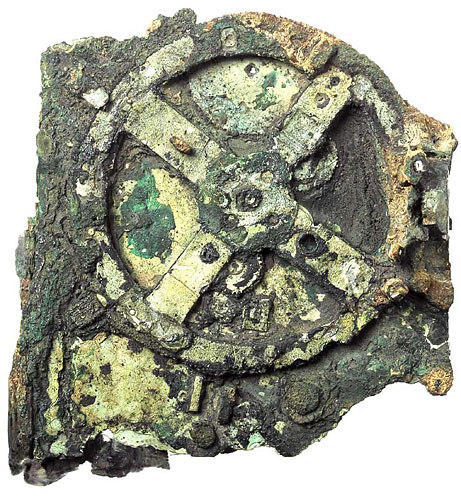
The Antikythera Mechanism, considered the first known analog computer, was found in a box in an ancient shipwreck found off the Greek island of Antikythera in 1900. The mechanism was a mystery from the beginning and remained so for decades until technology allowed the device, heavily cemented from being deeply buried in the sea for millenia, to be scanned internally and dated. It is dated back to about 150 BC and appears to be a very sophisticated device for ascertaining the location of the planets and moon and sun ( along with eclipses) at any given date. It is complex and finely machined, predating modern clockmaking by about a thousand years.
I find this amazing and just a bit more proof of how we often we are wrong when we view ourselves in this time as being so intellectually superior to times past. We may have expanded our base of knowledge and our use of technology but at the base, the brilliant minds then would be the brilliant minds now. The capacity for thought and intellectual inquiry has not grown over the eons, nor has our capacity for performing barbaric deeds diminished. In fact, this mechanism shows that we have changed far less than we would like to believe, despite our advances in science and technology. We are, at the core, the same as we’ve always been.
I don’t know if that’s comforting or sad.
I would hope that 2000 or 3000 or 4000 years would find us more evolved, less tied to our baser self, less prone to stupidity and viiolence. But it doesn’t. We are no more civilized or intelligent than the folks who conceived and built that ancient device. I guess that’s sad.
Well, now that I’ve depressed you, here’s an animation of how the mechanism is assembled…
 Redtree Times
I think you just blew my mind.
As for the barbaric stuff, that really is depressing.
I hadn’t heard of the antikythera mechanism, but it recalled recent reports that a Brit is seeking funding to build a working replica of Charles’ Babbage’s Analytical Engine.
I might kick in ten bucks for that project, just because of Ada Lovelace. She had one foot in poetry, being the daughter of Lord Byron, and one foot in programming, having come up with the first algorithm intended for mechanical processing.
Code is poetry is code, indeed! And all of these “first steps” are fascinating to see. Glad to be introduced to this one.
I’m still not convinced that “6513” was an arbitrary choice but it reminds one of other years that, at the time, seemed impossibly far in the future.
There’s Orwell’s “Nineteen Eighty-Four”, published in 1949 and read by some of us when 1984 still seemed a long way off.
Then there was Kubrick’s “2001: A Space Odyssey”, which came out in 1968 when 2001 seemed, well, a long way off.
It seems that both Orwell and Kubrick underestimated the speed at which the future arrives.
But, in 1969, Zager & Evans may have successfully hedged their bets. The year 2525 seems a long way off.
In the same vein, I celebrated my 64th birthday on Saturday.
When the Beatles celebrated the joys of the 64th year in their new 1967 release, it seemed impossibly distant and possibly unattainable. Surprise!
You say it’s your birthday?
Happy Birthday to you!
Great series of videos! I’d been holding the Zager and Evans in my backpocket for one of those days when I didn’t have much to say. It’s one of those songs that everybody knows from that time and is easy to relate to other topics.
Plus, it’s got a grabby beat.
Thanks!
And Happy Birthday!
Thanks for the greetings. It was a lovely day.