I first painted one these faces back in 1995 when they became what I call my Exile series. They were painted in very much the way I paint some of my landscapes, starting with one block of color and letting that block dictate what the next will be. I had no reference points to work from, just letting the image grow on its own and for much of the time when I was painting these I had no idea how the face would emerge. Often, they completely surprised me.
This 12″ square canvas was my first new Exile piece since that time and it took a while to reengage. The originals were painted from a very emotional personal standpoint and I am in a different emotional place now, sixteen years later. But after I haltingly began there came a point where it began to take hold and pull out its own emotion, with which I began to empathetically identify.
Call it an existential melancholy.
I see some of these figures in that way, alienated from their past and haunted by memories. They are, in a way, prisoners of their own experience, trapped in a moment long gone and never to be seen again. Not all of them, but many, fall into this category.
I’ve been wanting to restart the Exiles series for some time. To what end, I can’t say. I don’t know if I will show these anywhere but here. I don’t know if they would want to venture from the safe haven I offer them here.
Man versus machine. John Henry and his hammer versus the steam drill. Now Jeopardy.
I’ve watched with interest the first two nights of the exhibition on Jeopardy pitting the two top players in its long run, Ken Jennings and Brad Rutter against Watson, the IBM supercomputer that contains something like 15 trillion pieces of data. It’s been a pretty impressive display in these first two days for Watson as it racked up over $36,000 in winnings versus Jennings’ $4,800 and Rutter’s $10,400. In the Double Jeopardy round, Jennings and Rutter only managed 5 correct answers.
Maybe I’m rooting too much for the human mind to defeat a machine that takes a room of servers and a huge team of techs to operate but I found this whole thing pretty frustrating. It wasn’t that the machine defeated these two players in knowledge but that it seemed to have a definite mechanical advantage in ringing in first to answer. Outside of a couple of questions, which all the contestants, including Watson, missed, this was not an extremely difficult game. You could see that the two champions knew the answers but were simply defeated mechanically. It was irritating to watch and there seemed to be a bit of frustration on the two humans’ faces at the end.
When the machine missed, it missed wildly. For instance, the Final Jeopardy question was in the category U.S. Cities and asked which city had an airport named after a World War II hero and one named for a WW II battle. The answer, of course, was Chicago. Watson answered Toronto, which doesn’t even fall under the final category. With the thirty seconds given to answer, it seems there was breakdown in its comprehension.
I have some question as to how the machine is given the questions. I believe that Alex Trebek stated that the computer was digitally fed the questions simultaneously. So this was not voice recognition technology. It was, instead, just a very large computer pulling up data at a fast pace then beating its opponents to the buzzer with superior mechanical timing. Timing is vital in ringing in on Jeopardy so a tuned mechanical device would have a definite advantage against even the most adept human.
I sound like I’m a bit technophobic here. I do appreciate the advances of technology and am constantly amazed at how quickly our world changes with each new breakthrough. It’s mind-boggling how different our world is today when compared to even a mere thirty years back due to the changes in technology. And I’m sure that there are applications where Watson’s power and speed will greatly benefit us as a species in the future. But for now I find this whole thing a bit frustrating and secretly wish for a John Henry moment where Brad Rutter pulls out a sledge hammer and takes it to this irritating machine.
Here’s my favorite version of that great folk song, John Henry, sung by Johnny Cash:
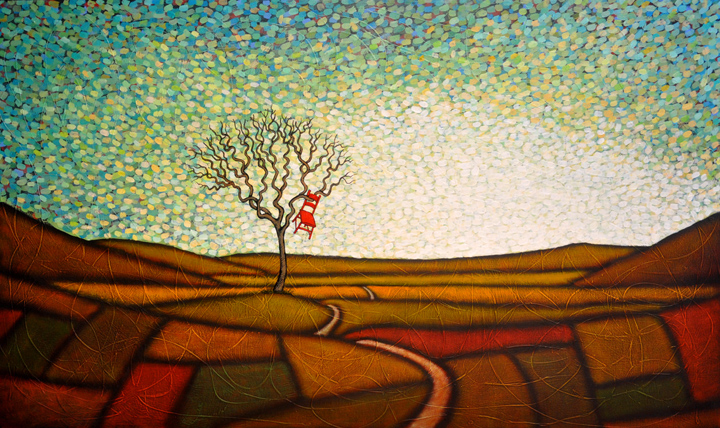
I call this painting Like Sugar In Water. It is a continuation of the group of paintings that I have been working on over the past few months and is by far the largest of the series at 36″ by 60″. The larger scale gives the piece a real sense of space and depth that I think carries the work.
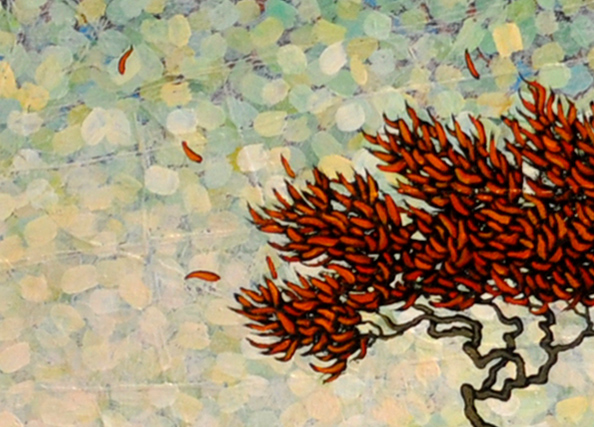
This painting evolved in a much different way than I originally thought it might. As I started, I first saw this as being a piece about movement and saw a large tree bowing in the gusting wind with leaves being released out into the large space created by the sky, which had its own sense of motion in the brushwork. But as the sky came into being it changed and I found myself sensing a much different feel for this piece. It became quieter and the sky didn’t feel frantic but rather had a sense of light breaking into particles and quietly dissolving into a multitude of colors. Because of this change, the central figure in the painting, the tree, changed for me. It had to have a calmness but it had to have a different function than my typical red tree. Here I saw it as a connection between the landscape and the sky, like a conduit of energy from the earth upward. It would have to be less dominate than my typical red tree.
At this point I set this piece aside so that I could fully consider it. I really felt that the landscape and the sky were strong and could stand on their own but I wanted to make sure in my own mind. So I went to work on other work and kept an eye on this piece, continually looking at it and pondering what lay in store for it. Finally, after a couple of weeks, I decided it was time to let this painting complete its metamorphosis. I had come to see the tree as being bare of leaves with the branches stretching up into the sky, almost dissolving into the particles of the sky. This feeling of dissolving is carried through in this piece by the landscape as well. I see it in the road that runs through the structured geometric pattern of the field of the foreground, moving up through the spreading branches of the tree and into the breaking sky.
I see the red chair here, not as I often do as a symbol of memory or of the dead, but as a symbol of the temporary nature of our existence here, living as we do between the solidness of the earth beneath our feet and the particulate nature of the heavens above our heads. This is reflected in the title as well. Perhaps the universe is like a large body of water and we are but a bit of sugar.
I don’t know about that. But I do that I think that there is a lot to be found in this piece and I find myself pondering over it quite often, taking in whatever message there is in it.
I talked the other day about painting in series and that brought ot mind a few themes that I have painted over the years that were part of a loose series, not necessarily painted near each other in time but connected through subject and composition. One such series were a group of paintings done over a number of years that contained a single sail boat riding out the waves. They were simple compositions, with basic elements that emphasized the motion of the craft yet maintained an almost abstract quality.
The piece shown here, Glory Run, is one of my favorites from that series and has that abstraction with the round sun and the crescent sail playing off one another. The rounded arcs of the waves and the oblong clouds add more geometry to the composition and make it a piece that I can look at without even realizing the subject. On the other hand, I can sometimes look at this piece and focus solely on the shape of the craft and the sailor at its stern.
Near this same time I also did this piece, Lone Running, working off the same basic theme. This might be that same sailor. I’m not really sure. This piece, to me, plays even more off the way the shapes interact, giving it a very abstract feel. The crescent sail comes rhythmically off the curve of the wave and creates a nice symetry with the sun. This painting really works for me in this manner.
Now, as I write about how I see these and what I think makes them work, I have to point out that none of those thoughts about symetry, abstraction or interaction of the elements come to mind when I’m painting. Oh, they may be there, hidden in the thoughts of simply obtaining a sense of rightness in the piece, which is first and foremost. They probably do have a say in the back of my mind. But as I approach the table or easel, they are secondary to the idea of conveying emotion. After a painting is done it’s then easy to see how these qualities have played a part in bringing out the emotion I was seeking.
I haven’t painted a boat piece in a few years, haven’t had whatever urge it was that created these pieces. But I always stop over these pieces and gaze at them for a while. There’s something there for me that goes beyond breaking down the elements and composition. Maybe I should soon continue the series…
I spent most of my time in the studio yesterday watching the situation in Egypt, watching Mubarak’s regime finally fall before the will of organized, unarmed protest. Even with the ever present cynicism concerning what the next step for that nation will be, I have to admit I was moved by the Egyptian people and their steadfast unity through these last few weeks. I was certain that Mubarak’s address Thursday evening would result in violent confrontations, his words goading the protesters into a frenzy that would be enough for him to send in his police squads or the military. But, to their credit, the pro-democracy protesters did not take the bait and instead came out in larger, louder numbers yesterday, all united by a theme of peaceful power.
At that point, it must have become obvious to the regime that these people were not simply going away. They had endured. They had withstood attacks from the regime’s goon squads, losing nearly 300 lives in the process, and had not retreated (oddly enough, there have been no reports of counter-protests since those obviously staged by the regime a week or so back). They had ignored veiled threats from the vice-president that they must go home. They held fast.
A report said that after Mubarak’s address on Thursday, the Army turned on him and that marked the beginning of the end for his regime.
Again, I have no idea what the next step for these folks will be. I don’t know if this is absolutely the best thing for them, that their lives will be appreciably better in the years to come. Whether they will continue down this road to a pure democracy or if they will fall prey to radical ideologues vying for control, I don’t think anyone knows for sure. That’s one of the qualities of freedom– uncertainty. But they at least have a chance now and to see them have their voices heard and to feel that their will is stronger than the usurped power of the corrupt ex-regime is a wonder to behold. It is a moment to cherish, a moment to inspire other oppressed peoples. There are few sweet moments like this in most people’s lives and though it is not my moment, I revel in it. Good for you, Egypt.
Power to the people.
In the coverage I heard an Egyptian reciting this phrase so here’s a little tune with that message to hum along to this morning:
The new work I’ve been showing over the past few monthes has maintained a similarity in the color and in the way they are painted. I often switch back and forth between the two distinct styles I maintain in my work- the reductive style which is very fluid and transparent and is about adding paint then taking it away, as though carving the image from the paint, and the additive which is about building layers of paint upon layers of paint to form the image- but when I get in a certain groove where I feel one style is clicking in sync with my mind I will stay in that style for a while, creating a series of paintings that have unmistakable similarities.
I’ve talked about this here before, explaining that one of the benefits of staying in a series is that it reduces the number of conscious decisions, allowing me to focus not on decisions of color selection or composition but rather on qualityand depth of color and brushstrokes. It also allows me to almost paint without conscious thought, allowing other parts of the mind to enter the equation, which creates a subtlety and nuance that makes each piece distinctive.
Taking away these decisions simply makes the flow of the painting smoother, like a piece of music in the hands of a musician after monthes of rehearsal. I’ve often thought of my paintings as rehearsals in a way, each often a fine tuning from the last. Actually, I think performance is the better term. Each is complete within itself, each stroke being done with the intent of that piece alone, like a note being played for the beauty of its tone at that moment, not as a rehearsal for a later performance.
I am usually pretty excited by the work I do when I am am painting in series. If not, I wouldn’t be able to stay in the groove long and wwould move on. Maintaining my own excitement is pretty important for my work, and I think for most artists. I don’t know where I heard it but the saying goes that a bored artist makes boring work. I have certainly found that to be true. Though there are always exceptions to the rule, if a piece moves or excites me in some way it generally will do the same for others. If I am not moved by a piece then I know it should not leave the studio. Simple as that.
I call this new piece Regal Bearing. It’s 30″ square and is a continuation of the style and color of much of my recent work.
I find myself viewing this not as a landscape but as a piece of portraiture. There’s a seense of orderliness and formality in the composition that brings this sense of a head and shoulders pose to mind. When I look at this I see the red tree as the head atop the neck formed by the mound which is emerging from shoulders formed by the fields. I see this as a portrait of a monarch from the 19th century dressed in grand military regalia, the field comprised of alternating rows creating a sense of a sash or epaulets. It’s this visualization that forms the title.
There is often a personification of the red tree in my work but this is perhaps as overt an example as I have done. I’m sure there are other ways of seeing this painting but for me I only see that image of a ruler who has the bearing that puts forth the belief that it is both his right and his responsibility to lord over a people and a land. Here, the landscape that extends beyond the tree is its realm.
I don’t see this as a glorification of a system based on monarchies. I am certainly no fan of ruling classes. Rather, I think it is about the belief in oneself and the certainty of ones own place in the world that I see in this piece. It is something that I see in some folks who are far from being royalty. Call it what you will, confidence or pride or something else.
Whatever the case, I see strength and resolve in this painting that appeals to me…
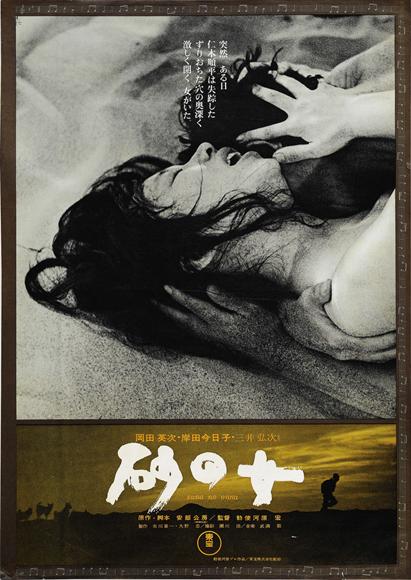
There’s a film starting in a few moments on TCM that really intrigued me, one I’d never heard of before. It’s a Japanese film from 1964 whose title translates to Woman in the Dunes. When I read the description I had to go back and read it several times to make sure I was understanding it fully. It said “A Japanese entomologist is trapped with widow in a sand pit.”
That was it.
My mid began to twirl into imaginations of what this story could be. It didn’t sound like any story I had heard before and that is pretty rare in a world where most narratives are simply variations on well worn tales. It turns out that the story is of a man who is collecting bugs for research stumbles upon village situated among the seaside dunes. Asking if there is a place to stay in the poor village, the locals tell him he can stay in a house that is located at the bottom of one of the large sand pits which apparently are used to produce sand for the concrete industry. The house is inhabited by a widow.
He descends into the pit and the next day discovers that the rope ladder leading down into the pit has been removed and that he is trapped. The widow it seems is a prisoner whose purpose is to constantly shovel the sand into baskets. She shovels to produce sand for the villagers and to keep her ramshackle home, and herself, from being buried. There’s an element of Sisyphus here.
The story becomes an existential tale of the entomologist struggling to escape then becoming accepting of his situation and living with the widow for many years, even after he realizes he could easily escape.
It sounds like such an absurd premise, especially to face at 6:30 in the morning, that I must take a look…
I wasn’t going to show this. Part of being an artist is in creating and maintaining a certain facade, playing up the more favorable facets of one’s personal prism. To show something that might be perceived as contrary to this nurtured persona is always a risk, at least in an intellectual sense. People don’t always want to know anything beyond the single dimension they might know and to offer more than that imperils their regard for even that single dimension.
For instance, several years back I did a series of dark figures that I called the Outlaw series. Whem they were hung at my annual show, the gallery asked for a separate statement to explain these figures out of the fear that my collectors would think that this was the new direction that my work had headed, instead of it merely being another view of those same emotions that had created the more calm and placid work that they recognized and were drawn to. I did, in fact, have several folks ask if this was the new direction and some even asked me to promise that it was not. I tried to explain that this was not new but merely a different part of the same person. Another facet on the prism.
I’m not sure they were convinced.
It was painted yesterday in about ten minutes, without much thought or care. It’s about 16″ by 20″ and painted with one large brush. Over the years I have periodically dashed off these characters, calling them my angry pictures. I am not necessarily angry when I paint these figures. Perhaps frustrated or anxious. I don’t really know.
I have had these guys in me since I was child and periodically they emerge. I don’t know if they serve a purpose or what part of myself, if any, they represent. I always feel a bit of release after they are on the surface and perhaps that is the purpose. They usually go into a sort of file and aren’t often seen after that. Occasionally, I will pull them out and be slightly baffled by them and very seldom do I show them to anyone.
But I felt that I would show a bit more of the prism today. They don’t change the visble light coming from the other facets. It comes from the same source but out in a different manner.
 I first painted one these faces back in 1995 when they became what I call my Exile series. They were painted in very much the way I paint some of my landscapes, starting with one block of color and letting that block dictate what the next will be. I had no reference points to work from, just letting the image grow on its own and for much of the time when I was painting these I had no idea how the face would emerge. Often, they completely surprised me.




 Redtree Times