Feeds:
Posts
Comments

Archive for February, 2011

If any artist has stuck more closely to variations on a single theme than Chuck Close, I am not aware of him.  Close has had a long and illustrious career painting portraits based on the grid system often associated with photographic  pixels, taking the contents of each grid placed over a photo and transferring and expanding it in size to a corresponding grid on his canvas, to put it in simplistic terms.  Beginning early on, Close created  huge canvasses where he would capture every single detail and blemish in his subjects’ faces in an extreme photorealist manner.  These have tremendous impact when seen in person, from the massive scale as well as the ultra-clarity provided in the detail.

  But over the years he went beyond the photorealist aspect and created variations.  Instead of replicating each pixel with absolute precision, Close would use the grid to create almost abstract mosaic tiles that captured some of the color and form of the referenced grid but had their own form as well.  The self portrait shown above is such an example. He also used his thumbprints to create portraits in this manner, taking fingerpainting to new heights.  Fanny/Fingerpainting 1985, shown here, is an example.  Hard to believe that this very realistic image is built from thumbprints.

As an artist, I am most intrigued by Close’s dedication to his process and his ability to discover variation within it.  Ultimately, subject matter is not the important part of his body of work.  It is his unique process that makes his work special.  That’s something that you hope young artists realize, that it is more vital to adapt a way of painting, a process,  that meshes with the workings of your own mind than finding interesting subject matter.

There’s a lot more to say about Chuck Close than I’m saying at the moment.  For instance, how he has adapted his process to his physical limitations that resulted from a spinal blood clot in the late 80’s.  That’s a story in itself.  There’s a wealth of info on the web about the artist for those who seek more detail.

Here’s a neat promo for a show from 2009 of Close’s printwork held at the San Jose Museum of Art.
Read Full Post »

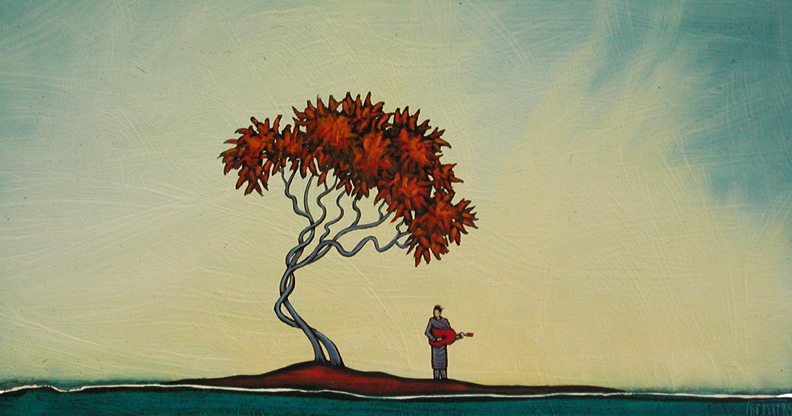
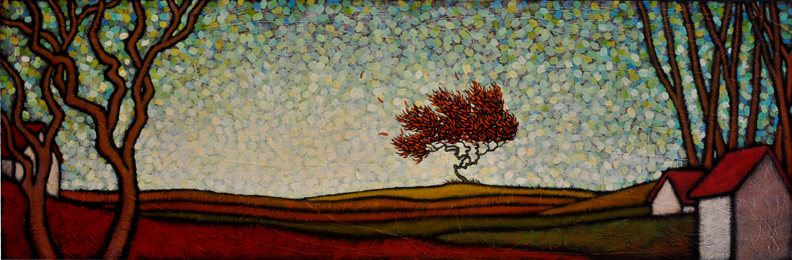
This is a painting that I started in December and on which I finally put the finishing touches just a week or so ago.  It’s a large piece, a 20″ tall by 60″ wide canvas, that really accentuates the panoramic aspect, one that I enjoy working in.  I really was at a standstill on this piece at one point, really savoring the composition and the sky but not knowing how to bring it to completion that fit with where it was at that point.

But it came.

I’ve really been enjoying this sort of groove I’ve fallen in over tha last month or so, feeling the tedium of painting the skies growing, with the thousands of small strokes slowly building to a sort of crescendo.  There’s been a common thread of color running through this work, including a very large 36″ by 60″ painting that I am working on now.  The sky is comprised of dozens of different shades of blue and green and yellow all over deeper violets and reds that peek through  in tiny almost unseen glimpses.  To me, these pieces are really about the light of the sky pulling out the dark colors of the ground below, creating a tension between the light and dark that gives the piece the emotion it emits. 

For me, this emotion goes back and forth between joyous, almost triumphantly defiant, and a bit sad, as though the leaves are moments slipping away, opportunites lost.  Perhaps it is both.  Whatever the case, I find myself liking this piece a lot, looking at it quite often as it sits over the fireplace in the studio.  Now to find a title…

Read Full Post »

I have a book that I often find myself flipping through in the studio.  It’s  Gardens of Revelation: Environments by Visioionary Artists from author John Beardsley.  It is an overview of various atist gardens around the world, documenting the creative and idiosyncratic outdoor worlds made by average folks who have a drive to leave some sort of mark on the world.  It’s a wonderful book that shows how strong this need to create these environments can manifest itself, often becoming the driving force in the lives of those who undertake them.

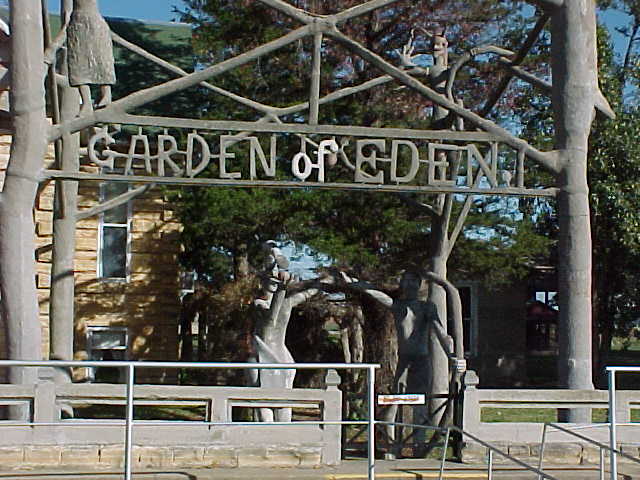
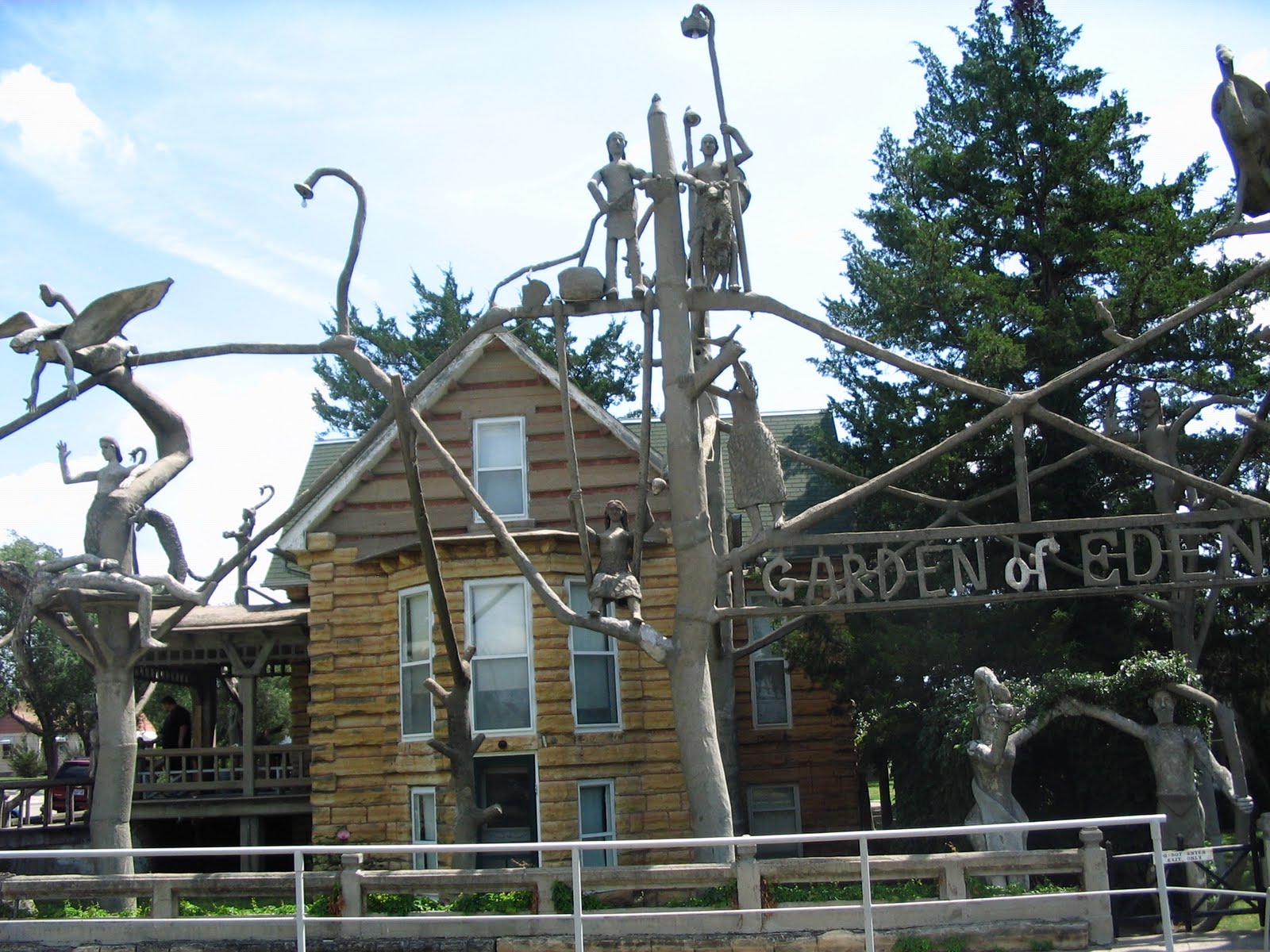
One of my favorites is the Garden of Eden, located in the booming metropolis of Lucas, Kansas, population 460.  Built there by Civil War veteran Samuel Perry Dinsmoor, it started as a home built for Dinsmoor’s family.  In the timber-bare plains of Kansas, Dinsmoor painstakingly built a cabin  from limestone slabs carved to look like logs.  After completing the house, he soon set to building his vision formed from Biblical tales,  mixed in with his unique view of the world at the time, as he saw them.  Built over steel and chicken wire, each element is made with handformed concrete, sealed well to keep it from deteriorating in the unrelenting weather of the plains.  It soon spread to cover most of the 1/2 acre lot and became a well known Kansas roadside attraction. 

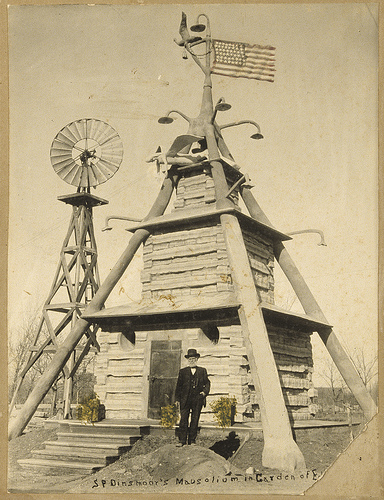
Dinsmoor was quite a character and saw his creation as a way to support his family long after he was gone.  He married his second wife when he was eighty years old.  She was 20 and they had two children before his death in 1932 at the age of 89.  Wanting to still be a presence, he proceeded to build a final structure on the lot– a mausoleum constructed from the same limetone logs as he had incorporated in his home.  In a final attempt to provide for his family after his death , he built a tomb that allowed paying visitors to view his embalmed body through a viewing panel.  You can still take a look at the leathery and somewhat mildewed creator of this Earthly Garden of Eden today.

I’m glad that Dinsmoor’s garden still prospers today.  The sculpture seems to be in great shape, seeming as vibrant as they must have nearly 100 years ago. Someday I must wander across the plains to Lucas and give it a gander and pay my respects to its builder.

Read Full Post »

Blow Away the Blues

Well, we’re into February and just about every corner of this country has been pounded lately with some form of winter wrath.  But the sun is shining brightly here this morning and with the white blanket of snow combines to make everything glow.  Gorgeous!

I’m working on a very large painting but am not ready to write about it at the moment.  But I am eager to get at it so I’m going to play a little pick-me-up music.  It’s a version of the classic Guitar Boogie from the super talented Australian guitarist Tommy Emmanuel.  This will warm you up even if February is leaving you in shivers.

Enjoy!

Read Full Post »

I’m kind of wired from watching the conflict in Egypt on the tube in real time as though it were some sort of twisted sporting event,  the momentum of each side surging back and forth under a rainstorm of rocks and Molotov cocktails.  The term I heard several times yesterday was medieval and it certainly brings to mind the stories of the siege battles of that era.  Fire falling from rooftops on to the crowd below.  Men with whips racing through the throngs on horses and camel, flailing away as they rode.  Sheets of steel used as shields behind which the advancing forces marched forward.  Men carrying machetes and clubs.  I’m still waiting for someone to drag out a catapult or trebuchet.

Crazy stuff.  I need some sort of relief from the tension of merely watching this horror show.

How about this painting of  H.R. Pufnstuf from my friend  and great painter Dave Higgins?  It’s a tiny piece, about 3″ square, of the title character from the old Saturday morning kids show.  From Sid and Marty Krofft, it ran for a couple of years back around 1970 and featured life-sized puppet-like characters in a storyline about a young boy who is lost and trapped on this enchanted island where everything is alive.  For instance, the houses talk.  The island is ruled by its mayor H.R. Pufnstuf who protects the young boy from the evil Witchiepoo and her minions who constantly try to steal the boy’s companion talking flute.

Actually, it was pretty awful and I remember thinking that as a kid even as I kept watching .  But the awfulness has transformed into a certain  kitschiness over the years and it has achieved a sort of iconic quality.  It’s still pretty hard to watch (you can see episodes on hulu.com) but it has a catchy theme song that uses Paul Simon’s 59th Street Bridge Song (Feelin’ Groovy) as its melody.

This little painting is part of the West End Gallery’s Little Gems show which I’ve written about here before and opens tomorrow night.  I took a walk through the show late last week and when I saw this piece, it stopped me dead in my tracks.  It was such a lovely little piece, mixing the pop quality of Pufnstuf with Dave’s ability to paint beautiful landscapes with the feel of the early Luminist school.  He’s known for this juxtaposition, most notably for his Pimp in the Woods series, shown here.

Long story short, I bought this little gem.  It makes me smile and that’s so much better than what I’ve been seeing on the news.

Read Full Post »

Is It Time?

Watching Egyptian President Mubarak last night address his nation and the world brought the quote I used the other day in this blog from Wendell Phillips more clearly into focus.  He was defiant as a pharoah who believed his authority was the word of God and gave no hint of leaving office until every last card he had was played.  His taste for power was still strong.  It’s as though he has no sense of the reality of the situation and, as several analysts have pointed out, he has lived for 30 years in a world surrounded by sycophants who never point out shortcomings.  The idea that his absolute power is being challenged is a concept that hasn’t yet cracked his nut.

It’s been interesting watching this evolve over the last two weeks, to see how it has grown in scope to include a representative swath of the Egyptian people.  It is no longer a protest of students or the political opposition.  It is shopkeepers and cab drivers.  Lawyers and clerks.  Young and old.  The poor and not so poor.   It is Egypt.

I have been impressed by the bravery to come forward and maintain this protest against such an imbedded regime.  Also impressive is the love of their country that is expressed in their restraint as a mob.  They are steadfast yet don’t seem willing to destroy the country they are not fighting to take back.  There’s something noble in that.  I’m hoping Mubarak has that same type of respect for his land and his citizens and doesn’t try to destroy Egypt in his fight to stay in control.

I heard an interesting analogy from Congressman Gary Ackerman of NY yesterday.  He said Mubarak is like a neighbor you’ve lived next to for 30 years.  He keeps an eye on your house when you’re not around.  He’s always there to lend a hand.   He lets you park in front of his house and shovels your walk when the snow has fallen.  He’s a great neighbor.

  But he beats his kids.

And, no matter how great a neighbor, your allegiance has got to come down on the side of the kids.

It will be interesting to see how this plays out.  Revolutions, as a rule, don’t go backwards and the genie is out of the bottle now.  Let’s hope the will of the people is honored and a peaceful and quick transition is soon underway.

UPDATE: 8:00 AM.  Well, perhaps I hoped for a peaceful transition too soon.  The TV is now showing clashes between the crowd and pro-Mubarak forces, many on horseback.  It looks pretty ugly.  Obviously Mubarak loves his power more than the people of Egypt.

Read Full Post »

Comforter

I’ve been dabbling on this painting for the past month or so, working on it for a while then setting it aside.  Taking some time before jumping ahead, lettting time give me a better view of where I was going here.  It’s a fairly large canvas at 30″ by 30″ and features the Red Chair that is the central figure of a number of my paintings.  I consider the chair an icon-like object that has meaning (or personification) for many people beyond its obvious nature as a mere chair.  For instance, for me it often signifies memory but others see it as a seat for past family members or as a place to sit and pause on their own journey in life.  It’s a subjective meaning and there is no right or wrong here.

As significant as the chair is here, the tree equally shares the role as the central figure in this piece.  I decided to make this tree a bit of an anomaly for my work– not a red tree.  The greens are not deep or opaque in color and allow the red oxide underpainting to shine through, giving it a reddish tint and creating depth in the foliage.  The tree forms a very bold figure in the middle distance, one that relates in some way to the Red Chair in the foreground.

How does it relate?  What is this piece saying? I’m still working on this myself.  It sometimes takes me longer to translate a piece than it does for someone who first sees it for a few moments in a gallery.  I can say that this piece has a very comforting feel for me.  Their is a warmth in the colors and the composition seems to  cradle the eye as it progresses into the picture along the rolling path.  The sky has a brightness and the darkness at its edges is not overly foreboding.  While there is a contemplative feel to the chair, it is not anxious but, rather, tranquil.  As I said, comforting.

I am still taking this painting in and this reading will evolve over time.  But for now, I’m happy to have it in sight to feel its calming effect.

Read Full Post »

« Newer Posts